Speculative Materialism and International Relations

eagle transformation mask

Eagle transforming into Sisuitl mask (by Richard Hunt)

‘[You humans] are not as free as you think you are; your cleverness and pride bind you to the truth. Don’t you see what you are doing to us and yourselves?’ ~’The Animal’s Lawsuit Against Humanity’, 10th Century Iraqi Fable.

Over the course of the past year I have discovered and immersed myself in a relatively new philosophical school called variously ‘Speculative Materialism’, ‘Speculative Realism’, and ‘Object-Oriented Philosophy.’ While not an overtly political form of philosophy, being much more in the realm of metaphysics and the like, it nonetheless has political implications, as all schools of thoughts do when you look hard enough whether they mean to or not. Since international relations theory is a part of what is covered on this blog, I would like to make a brief case for how Speculative Materialism could impact the study of that subject in the future.

I will confess that I am somewhat new to this school of thought and have not yet read all of the works I mean to someday. I have, however, read the text that probably started it all: Quentin Meillasoux’s ‘After Finitude’ as well as Steven Shaviro’s ‘The Universe of Things’ and the essay collection by multiple authors of ‘The Non-Human Turn.’ This is not a field of my expertise by any means and I have more reading to do, with ‘The Fragility of Things’ at the top of the list. So as of yet I cannot speak with the confidence I could on say historical or geopolitical manners. That aside, having delved into this field on the side in the past year has me with a few observations.

First, what is speculative materialism? To put it in the simplest terms it is the simultaneous rejection of platonic idealism and postmodernism relativism. It should be obvious to regular readers of this blog that I already do both (and indeed, have for most of my adult life), but this is a framework for viewing material issues (as material issues are what matters) in a way that divorces them from simply being objects under human observation and interaction to independent (but non-idealized) objects in their own right. Rather than embrace Platonic desires of therefore setting these objects up as pristine and independent, speculative materialism focuses as much on the interrelations between said objects as just as important a part of their existence as themselves. But the key here is to de-anthropocentrize the relationship factor. A rock with a stream or a fox in the stream standing on the rock all create relationships in real physical space that have nothing to do with ideals or even feelings about them, and thus the relevance of human consciousnesses as a central force is called into question, or at least its uniqueness is. In a materialist world view (i.e. the only world view that is not entirely based on faith) the consciousness is affected by the objects if at all, but not so much vice-versa. Being trapped between the utopian idealism of the left or the golden age worshiping revanchism of the right has no place in this view, and the fatuousness of consciousness-worshiping postmodern identity politics has even less. What has long been a period of affluence based ideology for middle class people to feel educated and make a pretense at being impartial observers has been dated for a long time, but postmodernists still thought themselves as fashionable and forward thinking. They never were, but now there is a new kid on the block as a philosophical school to finally show the sportscar driving midlife crisis having ageing group of people that no, they are no longer even  young nor particular culturally relevant…so maybe its time they stop hovering outside of college campuses trying to pick up prospects. If I may quote once again from ‘The Animal’s Lawsuit Against Humanity’: ‘If this is how you humans glorify yourselves , then your ignorance speaks against you. And as for what you have argued-why, it is vanity, hot air, lies and fabrications!’

That is a very stripped down version of speculative materialism, but it will do for now. What I want to mention is how much ammunition this gives the anti-idealists among us to recognize the coming crisis of world affairs is going to be in large part ecological and thus the political affairs that will arise from such ecological issues will be decidedly material.  It also helps explain in more philosophical terms the issues I have with economic globalization. While no one would deny it brings benefits, I view it as an experiment running long past its usefulness as state actors are still the most powerful actors on the world stage and must make laws and policies to reflect the differences of where they are in space and time. Therefore, global economic projects (unless they become about ensuring the installation of more sustainable energy sources or joint national parks) more often impede the policies needed to be enacted by societies. Much necessary divisions of strategies to tackle issues (Florida and Iceland will experience global warming very differently, after all) reflect that the relationships we have with the material world are not equal but based in the physical and political geography of where we spend most of our time. This in turn dovetails into geopolitics which recognizes that the use of space is the key determining factor in diplomacy, conflict, and alliance building–and sometimes even capacity for development.

The relationships we have with the non-human world around us matters as much as that with the human. But this is not some absolutist hippie creed, anything but. We are a predatory species, and like other predatory species we do what we must to survive. But in this ruthless and inevitable struggle we can at least acknowledge the context of us as reactors as much (if not more so) than actors. Much as we view the rest of nature. And this will not be some simple exercise in hubris reduction, but a way to mold our political and social strategies to give the best return for less effort. Something about it all makes me suspect speculative materialism might just be a good corollary for defense realism as a foreign policy theory. Our species base material needs are the real driving both of domestic and international affairs, and attempts to pretend otherwise often lead to error if not outright ruin.

Since the trickster is the theme of this blog it might perhaps be best to sum up my feelings with a quote from Dan Flores’ excellent book study of the coyote ‘Coyote Nation’ which shows why I find the myths of polytheism so much more enlightening to how the world really is than that of monotheism. After all it is under aninism and shamanism that the inter-contentedness of humanity as part of the animal world is constantly reinforced:

‘But what, no moral code in these stories? No promise of eternal life, no salvation from death? Coyote stories offer up none of these things…It ought to be said that Coyote stories are not really for visionary dreamers who expect to change the world. Coyotism is a philosophy for the realists among us, those who can do a Cormac McCarthy-like appraisal of human motives but find a kind of chagrined humor in the act, who think of the human story as cyclical…Coyotism tells us that while we may long have misunderstood the motives of our behavior, we’ve also known how human nature expresses itself. And who better to illustrate that than self-centered, gluttonous, carnal Coyote?’
 

The World’s Biggest Feint

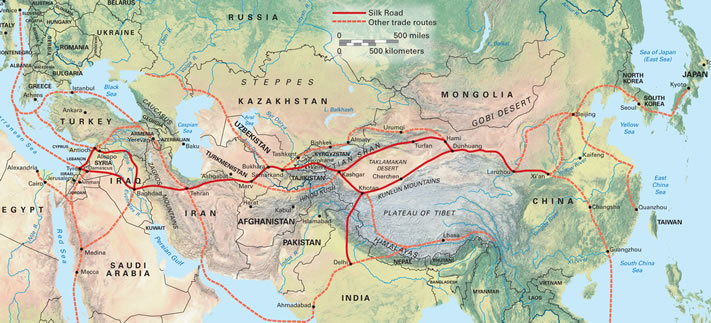
SilkRoadMap

‘All warfare is based on deception…Offer the enemy bait to lure him.’

~Sunzi

So you have probably heard of the recent ruling in the South China Sea. Considering the internalization of maritime and other disputes that Beijing enjoys deploying as nation-affirming red meat for the people, I would certainly not want to say this issue will be solved anytime soon. However, I would like to posit one even more interesting interpretation-that whether or not domestic pressures force a dangerous showdown in the Southwestern Pacific or not, this ecologically destructive race of island building and extending maritime claims  was originally and possibly still is nothing but a geopolitical feint of truly massive scope.

Think about it. China is a nation with an ancient history of grand strategy. Many of the best strategists in history come from there and nearly two centuries of a national dark age has knocked the former complacency of several thousand years of relative cultural success out of stasis. Surely, considering these factors, a rapidly rising world power is not yet on track to risk everything in a mad-dash naval rivalry with the United States and its allies? After all, the example of the last country to do that is China’s favorite punching bag: Japan. Only once, in the early Ming Dynasty, did it seriously see itself as a naval power rather than a land power with naval interests on the side.

While it is worth considering that shore based anti-ship missiles might have restored the advantage to the defender in naval war for the first time since before cannons on ships, we simply do not know how effectively they will actually be yet. So while retaining the caveat that China might have pushed its maritime claims into its domestic sphere so far that it might be forced to be foolishly belligerent, let me advance the potential for a wiser and probably more likely scenario.

The Chinese government wants US forces on the ready in the Pacific. Combined with America’s hubristic and unnecessary proclivity to deploy many forces to the Middle East, this leaves less for Washington to have immediately ready to act in the Indian Ocean. More importantly, the US, having abandoned Central Asia to Russia (and rightly so, as it was an unnecessary extension for a naval power) can now no longer pursue more military and political influence in said region.

During the War of Spanish Succession, the Duke of Marlborough on multiple occasions fought against the most powerful army of his day by launching multiple feints, forcing the foe to weaken critical spots in their line by redeploying forces elsewhere to meet his well broadcast attacks. This inactive backwater of the front or battlefield would then become the main focus of his attacks, overwhelming the overburdened position of the enemy. If one views what is often called as ‘The Eurasian Chessboard’ in a similar way one sees an opening for China in the west, which leads to a potential opening south.

Even if the Beijing-Islamabad axis never gets any stronger, and India remains strong enough to contain the Indian Ocean, there is plenty to be gained from inland Eurasia. And not a damn thing the U.S.-whose regional role is now to be isolated and bogged down in Afghanistan and nothing else-can do about it. In fact, Beijing benefits from Washington keeping the Taliban busy while it pursues its own objectives elsewhere in the neighborhood.

In order to shore up this economic and resource expansion on the continent, it is necessary for Beijing to keep good relations with Moscow. Russia holds this new arrangement together, keeping the northern flank intact and providing the cooperation needed to work well with local elites in the region. But Russia, with its insecurities about the Siberian frontier, remains cautious. The historically inclined inside the PRC are probably salivating at the potential for analogies for when the Han Dynasty divided the Xiongnu Empire and turned some of them into perpetual warrior proxies on their behalf.

Therefore, one suspects as Chinese interests grow in Central and possibly South Asia that tacit yet unofficial backing of Russian bellicosity in the Caucasus and Eastern Europe will in fact increase. They would never admit it openly of course, but to drive the wedge further between Russia and western Europe and the US is to keep Russia from contesting losing some relative influence in Central Asia to China. Not to mention that if very successful, this policy could also reduce the long-running de facto military hardware export dealing between Moscow and Delhi, which would further strengthen China’s position towards its giant southern rival.

Assuming this comes to pass, I actually see it as a potential positive in world affairs. A confirmed sea power and a confirmed land power with minimal ability to directly interfere in each other’s interior business and with only a few places where proxy conflict could break out. A type of Cold War lite with the appeals to ideology mercifully slim. Of course, in order to keep Moscow and Brussels sufficiently separate even in this best-case scenario major upsets will occur.

And of course it requires two very important and totally not guaranteed variables: Sober realism in both Beijing and Washington.


A Future of Nagorno-Falklandbakhs

falklands pic

This past month marked two very interesting events the bilateral relations of four different countries. Fighting once again broke out in the disputed Nagorno-Karabakh region between Armenia and Azerbaijan, and the UK made a very strong statement about their ability to obliterate an Argentine attack on the Falklands in a short amount of time should another conflict ever occur.

Much has been made of Russian foreign policy in regards to exploiting frozen conflicts in order to retain a post-Soviet periphery, be it in Georgia, Ukraine, Moldova, or Tajikistan. But this is hardly a behavior unique to Russia. It is only the scale and multiplicity of Russian interests that mark it out as most noteworthy. But frozen conflicts play a large role in the foreign policies of many smaller nations. In fact, a single seemingly minor dispute can be an all-consuming issue in a smaller nation’s outlook on international affairs. Sometimes, these disputes are useful rallying cries for fragile nations, but they can also be quagmires which reasonable policymakers know are useless but are forced to continue on with thanks to domestic pressures. It can also be both of these things at once.

When Argentina invaded the Falklands and South Georgia Island in 1982 it was after the failure of decades of diplomacy. The risk was high but Britain was obviously in steep decline compared to its great power days and would have a massive logistical problem to overcome to re-take the islands, located near the Antarctic Circle. Even with this accomplished, they would still be in range of South American based fighter attack and far away from the nearest British base on Ascension Island. Considering the internal instability and economic fragility of the Argentine junta, this was seen as a risk worth taking to rally the people to their cause.

But while the Argentine air force performed well, crippling several British ships in succession, their navy chickened after the General Belgrano was sunk by a submarine and their mostly conscript army rapidly folded once the professional British forces landed and began to make their way across the wind-swept islands. Britain seemed to reverse its former historical record by performing impressively on land and awkwardly at sea, but considering the timidity of the Argentinian Navy this ended up working out.

In the end the total count of killed and wounded on both sides would slightly outnumber the population of the islands in that era.

The dispute, which technically began in the 18th century between Spain and Britain, is still ongoing, with the UN currently contemplating that the islands are in Argentine waters. Having turned the conflict into a post-WWII rallying cray, Britain is unlikely to voluntarily hand over the territory without some kind of joint-administration agreement, if at all.

The Nagorno-Karabakh War is another hold over, of a more recent but more deadly nature. It was a region where both Armenians and Azeris lived in Soviet times, though rising nationalism throughout the Caucasus in the latter-Soviet era was present. Before even the unraveling of the USSR it was apparent that Armenia and Azerbaijan were fast moving into independence and conflict with each other over the demarcation of their borders. It became ethnic and both sides committed mass deportations against the ethnic populations of the other. This eventually spiraled into full blown conventional conflict with newly unemployed Russian officers and tank units even selling their services to both sides as mercenaries.

The Armenians, despite the initial odds, wiped the floor with the Azeris. And yet, much like in the Falklands, a dispute was not actually ended by a strong showing on one side. It became politically toxic for the losing side to give up the ghost, so they simply did not. Perhaps in the hope, not unreasonable, that if one is patient but dedicated one can get with negotiation what they failed to retain by fighting.

But the main point here is that these are not isolates. If anything, I would expect to see more of these big military and diplomatic blow ups over remote and disputed territories. It can be both a legitimate way of asserting sovereignty and a useful distraction at home. From the present military build up in the South China Sea between China, the Philippines, the USA, and Japan over various disputed and sometimes even artificial islands to various tiny islands between Greece and Turkey to the potentially rekindled fires of Nagorno-Karabakh and the Falklands, the future of conventional warfare could very well be tied up with these kind of disputes. Average civilians in the core regions of countries are probably under little threat, but those on the frontier and in the armed forces might just have to be aware that these kinds of frozen conflicts are highways to the danger zone.

For a real life example of *Danger Zone* check out these low level Argentinian bombing raids on British ships in 1982:

https://www.youtube.com/watch?v=5FuyCcZtMgo


The Washington Treaty of 1871 and Sovereignty Today

kearsarge vs alabama

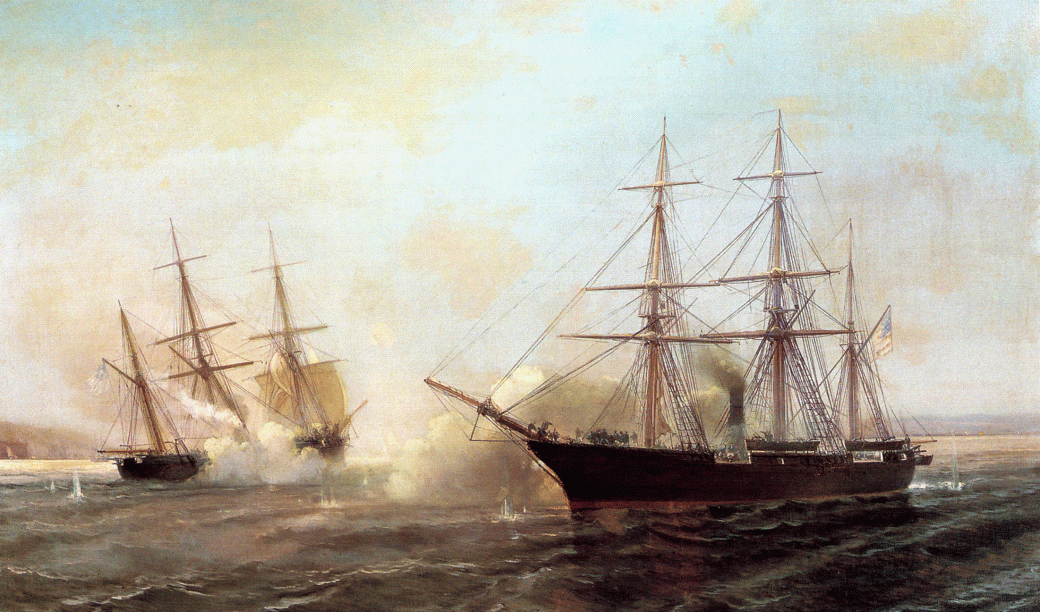
USS Kearsarge sinks CSS Alabama off the coast of Cherbourg, France in 1864

There is the temptation among American Civil War buffs to view that conflict as a purely American affair. Brother fought brother and everyone was American, etc. But this assumption is just as wrong as if you to assume that the Syrian or Congolese Civil Wars have little outside involvement.

From the beginning, the governments of Britain and France pulled heavily for the Confederacy. They saw the emerging industrial and commercial might of the United States as a grave threat to their Atlantic supremacy and the order they had barely established after the Crimean War with Russia. With the US distracted by what would become the bloodiest conflict in all of its history, France seized the opportunity to install a puppet regime in Mexico. After the Trent Affair in 1861 (when British ships were boarded and Confederate agents on them arrested in international waters) Britain upped the ante, sending threatening noises of war and violating neutrality by building blockade runners stocked with weapons shipments which would slip into Gulf ports such as Mobile Bay and New Orleans. This in turn would shape the Union naval strategy for the rest of the war, with David Farragut’s famous battles being the actions to close those ports.

Despite Gladstone’s and Queen Victoria’s southern sympathies, once the Emancipation Proclamation was declared after the Union victory at Antietam in 1862, general British public opinion turned against the south. But the rich business of economically and logistically aiding the Confederacy continued among the entrepreneurs of the Liverpool dockyards. Confederate agents remained extremely active in Canada, and even planned (though did not execute) a biological warfare attack by infecting New York City army hospitals with Yellow Fever.

In light of this dangerous situation, only one power expressed open support for the Union cause. The navy of the Russian Empire sent squadrons of warships to dock in both east and west coast ports of the United States should Britain or France get any ideas about attacking the strung out Union blockade. Sealed orders on board the Russian flagship contained instructions that should any outside power attack the United States during the war against secession, the Russian fleet was to sail and engage said power’s naval forces. Tsar Alexander II was not about to let Anglo-French meddling deprive him of potential allies all around the world.

After Gettysburg and Vicksburg the attractiveness of supporting the Confederate cause abroad dried up. And yet those British built commerce raiders with their British cannons continued to wreak havoc on the US whaling and trading ships. The CSS Alabama-the most effective commerce raider in all of history to this day-was a particular sensation in the press. It was finally sunk, as pictured above, by the sloop of war USS Kearsarge after an intensive hunt throughout Europe.

But the end of the war in 1865 did not bring an end to the international repercussions of that conflict. Secretary of War Edwin Stanton was ready for another war against Britain on the charges of the immense damage its ships and weapons had done-even if in Confederate hands. He considered the war to have been effectively over more than a year before it finished-and its prolongation a direct result of British interference. Britain, therefore, should pay the costs of the Union for late 1864 and 1865.

Meanwhile, in the now occupied south, US forces under General Sheridan began their own weapon smuggling operation to the forces of Benito Juarez who were fighting the French backed Hapsburg pretender in charge of the occupation of Mexico. The tide had already turned in Mexico’s favor, but the new weapons surely sped things up. Rather than overtly violating neutrality, US forces tended to simply leave weapons stockpiles at certain places on the border and then disappear, expecting that in the night Mexican agents would come, cross the border, and take them without anyone ‘knowing’ otherwise. Two could play at the cloaked interference game.

The French were eventually driven from Mexico. But the economic reparations demanded by the United States on Britain remained, poisoning relations between the two countries, who had remained steady rivals since 1775, with little to no respite even further.

But then came the Franco-Prussian War, the rise of an immensely powerful German state, a major economic and industrial boom in Russia, and several naval arms races between Britain and France. Britain could no longer blithely sit on the top of the world, uncaring as to its relations with other major powers. As the furthest away power, the US represented the safest option to begin a re-orientation of British policy. With the Americans agreeing to drop their more outlandish claims and also paying reparations for events like the Trent Affair, Britain agreed to pay damages and acknowledge guilt related to the neutrality violations of British built commerce raiders. Since then, the two countries have enjoyed quite amicable relations by and large, with the notable exception of a major breakdown in the 20s and early 30s in the aftermath of the failure of Wilsonian idealism.

So, what does the Washington Treaty of 1871 have to do with us today? Well, functionally, quite little. But I would like to float the idea that in the case of the Syrian Civil War the issues of outside backing of internal rebel movements is once again a major issue in great power diplomacy. Russia plays a much more direct role supporting the government, but remains committed to stopping its allies from being overwhelmed by foreign-supported forces. Meanwhile, in the United States and other countries, a backlash is growing in the general public to a policy which is increasingly clear should never interfered in the first place, and failing that, is backing the wrong side. Like the Union, the Syrian government is a flawed but multicultural organization, like the Confederacy the rebellion in Syria belongs overwhelmingly to a much narrower demographic. While the rebellion in Syria is much more justifiable than the southern rebellion was, it has come with time to be if anything even more scary and destabilizing for its region. Meanwhile, the US now plays the role of 19th Century Britain, its people increasingly coming to look with horror over who they are backing while the policy elites blithely continue on an expensive course of confirmed failure. Motivated as much by personal sympathies as strategic concerns, if not more so, as the recently declassified Hillary Clinton emails strongly imply.

In our extremely globalized world, upholding national sovereignty, particularly of small and weak states, seems almost an antiquated idea. But perhaps it is time to realize that quite often it can serve big power interests. I am not so naive to believe that strong countries will not interfere with the internal politics of smaller ones. There are in fact many instances where this serves vital strategic interests. But I do think it is time to make it something people think upon as a dangerous action one should only pursue in extremity-and this means there should be repercussions. Russia is doing to the Ukraine what America, Turkey, and Saudi Arabia do to Syria. It doesn’t like the government so it plays brinksmanship with rebel forces as its allies. Rwanda has decades of experience with similar actions in the Congo. These turn into frozen conflicts that simply drag out suffering on the ground, as per Secretary of War Stanton’s presumption of British actions in the 1860s.

My favorite aspect of Cold War history to study when it comes to diplomacy is the Non-Aligned League. I do wonder if there could be such a small-state-in-hotspot alliance in the future. A league of nations who might share little in the way of domestic structure or big power friends but remain committed to domestic sovereignty against outside interference. The fact remains that nations like Syria and Ukraine could make quite good cases for reparations from other nations for neutrality violations in internal conflicts. Even though the great powers could never be forced to pay, the mere PR of such a move might grant small states a bit of a reprieve in today’s world as journalists picked up on the story. It would certainly make them more sympathetic.

Plus, rather than pay it itself the United States could always split the difference between Saudi Arabia and the Clinton Foundation to get the money for its reparations to Syria.

Anyway, have a musical number. Maybe one day they will write one that replaces Georgia with Donetsk or Raqqa.

Foreign Policy in the Present Election Cycle

Domestic Politics? In *this* blog? It’s more likely than you think.

Of course, I really mean to discuss how American domestic politics impacts foreign policy. So it still fits the theme.

You would think that in a highly competitive primary season with both parties selecting from pools of candidates that there would be more interesting discussions on foreign policy in the United States. While it was true that Rand Paul was the torch bearer of sanity in foreign policy (if little else) earlier on, he has already become history. Donald Trump, who is grotesque and hilarious in equal measures, has at least forced a reckoning on Dubya’s legacy long delayed by the GOP-even if he has no coherent ideas of his own.

The candidates both party establishments clearly want to win are, unsurprisingly, the two most hawkish of hawks. Hillary Clinton and Marco Rubio are basically indistinguishable from each other on big picture foreign affairs. American Exceptionalism, delusions of grandeur, and a blind faith in military solutions when regarding small weaker nations ruled in ways contrary to American values. They both have track records of opinions which would meet the approval of Cheney and Kristol alike.

The Democratic primary is just as much wild card vs reckoning. No one actually knows what Bernie Sanders holds as views on foreign policy, if any are coherent at all. But then a very interesting thing happened…Tulsi Gabbard resigned her post as DNC Vice Chair to endorse him.

I am definitely not yet sold on the Sanders bandwagon, nor do I think endorsements matter as much as people think they do, but I cannot contain my joy at the following two things:
1. I remain convinced that Gabbard is going places. I have mentioned her previously on this blog as one of the rare realists left in congress. We have had decades of endless and naively conducted war with little grand strategic perspective. With a Sanders nomination unlikely she took a long term calculation to back him specifically because of foreign policy issues and to build her future reputation as the foreign policy realist (who is not Rand Paul). Its her career trajectory that most fascinates me rather than his. And if he does win, she will no doubt get an interesting cabinet post.
2. I am so thankful after decades of evidence that the Clintons are basically Dick Cheney Lite that someone is making a major point of finally calling them out for it. The media never had the spine to do this. It still doesn’t. They look at the quantity of titles on her resume without looking to see the quality and results of what they describe.
There is something beautifully Roveian (in the best ways) about destroying a foe’s strength. Going after Clinton on foreign policy is like a factual and justifiable version of swift boating, you sink the opposition’s main selling point-and this time you actually do it by telling the verifiable truth. Obviously Gabbard can do this, and Sanders cannot as he has no actually articulated foreign policy views or coherent record.
Maybe, just maybe, we can have a real discussion about foreign policy in this election season…for once. After all, this is hardly an issue that primarily affects Americans. One could say in fact it primarily affects people who are not Americans. That is why non-Americans tend to know more about American foreign policy than Americans do, by and large.
Plus, while you might think a trickster themed blog does revel in the chaos-or shadenfreude- caused by Trumps’ run, I would counter that Trump is just a shuckster insider who knows how to play the system created by decades of toxic (primarily conservative) social divide and rule politics. A quite typical figure actually in the mold of William Jennings Bryan, Vladimir Putin, or Marine le Pen. Whereas the first Hindu in congress (potentially, hopefully?) running with in some capacity a Jewish candidate against a bombardment of media hostility and entrenched interests is a much more interesting upset to the system. Trump after all hardly threatens any media oligarch tax brackets and thus no doubt they could come to accommodate him.
Even if the Sanders ticket goes down in defeat, as is probable, its run will have shaken things up-specifically in the realm least expected of it, that of foreign policy.
Keep your eyes on Gabbard. She is going places.


Interstate Anarchy and the Befuddled Monotheist

Gallen-Kallela_The_defence_of_the_Sampo

When the subject of International Relations is taught in universities, it often opens up with a discussion of the concept of ‘anarchy’. In this specific subject’s domain, anarchy neither denotes the political philosophy nor one of the rightly less-talked about Batman villains, but rather the classic definition of realm without governance. This may seem a strange topic for a subject/major which is ostensibly about state to state interaction, but what it effectively means is that there is no over-arching governing structure above that of states.

Protestations that this is not the case because of the UN or ‘values and norms’ should always be met with derision. After all, big states don’t have to do anything the UN tells them too, little ones often do depending on their relations with bigger powers.

Despite being an important introductory concept, I tend to find it is one that many people, not just entry-level students, struggle with. In earlier posts I have mentioned how common place but also delusional the Anglo-American view of a progressive international realm moving in a linear direction is, but I have yet to articulate why this is often the case. I can put it simply, believing in one ultimate power is akin to committing intellectual and suicide for the person seeking to understand strategy.

Even before the world was integrated and largely aware of, well, the rest of everyone outside of a particular region’s existence, where a single dominant power form of unipolarity could often rise a la Rome at its height or the Chinese Han or Tang Dynasties, such arrangements were not assumed to be perpetual perfections of humanity. Rather, the security they provided was a fragile construct worth defending…until it wasn’t anymore because the consensus upholding it had broken down. The Han were aware of the Qin before them, the Tang would be aware of the Han, and so on. Confucianism, often a boring conservative philosophy on so many issues, rightly predicted that no order, no matter how perfect, could last forever or be immune to change. The Byzantine Empire certainly recalled its glory days by never giving up the title of Romans even if they had long since left Rome itself behind.

Such unipolar arrangements are rare. Since 1991 we have seen arguably the only one to ever span the entire planet. It will not last forever. It once was taken for granted that it would by the complacent chattering classes of liberalism and conservatism alike, but now enough reality has set in that we face something just as bad-denial giving way to impotent rage and divisive fury. Where did America go wrong? Who is to blame?

Well, America is to blame. Just as the Cold War gave it the spending priorities and mobilization to build a space program and first class infrastructure, so too did unipolarity give it lazy navel-gazing narcissism. This is a process that happens to all powers (sorry, exceptionalists) but can either be delayed or accelerated by a variety of factors. One of them is buying into your own mythology. When your advertising brand becomes your very existential core of existence believed by the governing class itself, you have a problem.

The United States, like Britain before it and other spectacularly insecure powers, viewed itself as apart of history. A moral titan reshaping the world with the righteous energy of Christian values and liberal politics. But as is usual in politics, righteousness is really a code word for ‘strategically toxic and anti-intellectual while still being just as coercive as any other order.’ Herein lies the problem: cultures who believe (either actually or symbolically) in one absolute higher power suffer from massive handicaps to much of the population when it comes to getting the inter-state system and the ever-present anarchy that is an inevitable part of it.

The United States may be the most powerful state which has ever existed in all of human history. For all we know it might continue to be so for decades or even a century if one is being generous. It still does not rule the world. Nor could it. It merely can get away with more for less. That is what power really is in the end, the ability to shift the world’s various circumstances in one way rather than another through intention. It is why it is an invaluable, if incalculable, resource. An invisible resource created only by very real material ones.

And it matters because there is no authority. There is no God here. This is international relations- a realm of little highly specific gods whose fickle natures and epic, tragic feuds are the stuff of legend. As fortune weaves out fate their various importance in the hierarchy rise and fall accordingly. They uphold no values but that which geography and history gave to them, much like representative deities of specific regions, lifestyles, and careers. Or like packs of social and competitive animals. Much like the illusion of order is given by the United Nations, Mount Olympus is an imposing location of projected celestial unity which under closer scrutiny gives way to the back-halls of scheming and backstabbing. Comedy and tragedy abound in equal and intertwined measure.

And yet we treat the act of wishing this away for supernatural or philosophical paternalism as one of principle and heroism. It is anything but. It is in fact cowardice. The fear of the unknown, the fear of not being the good guy. But what we need is exactly people who are willing and able to see themselves as the villains in someone else’s story, and still be willing to carry one regardless. Maybe even revel in it a bit.

This is not a world of universal morality or high ideals. It never could be. It is a state of anarchy, and it is also a state of philosophical and circumstantial polytheism. This means that as far as an intellectual understanding goes, some cultures are better equipped than others to understand the fundamental principles of IR in both theory and practice. Obviously, many great strategists exist in all literate cultures, so its not a supressive effect. We do have Cardinal Richelieu after all. But in the Muslim and especially Christian worlds, those strategists were thinking against the currents of their time and often regarded as highly scandalous, whereas in non-monotheistic cultures such strategists were a utilitarian novelty. This is less an issue about strategists themselves than one of non-strategists learning about or from them. I do not find it a pure accident that the only sane person on foreign policy issues in the US congress right now is a Hindu.

In a world where the public (and often times even more the private) educational system emphasizes the inherited baggage of monotheism and its secular surrogates it risks creating a population of people with absolute opinions and no practical way to achieve them. As it is, most internet political culture in countries like America and those of Western Europe has become one where the greatest posturer is regarded as the default winner, rather than people who actually accomplish things. Specifically on foreign policy it creates a right wing addicted to war and a left wing addicted to war-like things which are not claimed to be wars but rather ‘interventions.’ This is because paying homage to some nonexistent order is regarded as more important than the more morally ambiguous and complicating of simply living the life of a hypersocial and tribal animal. ‘We have to do something’, they say, ‘it is our responsibility to uphold this order.’ They ignore that in domestic politics the state serves as the final arbiter, and their moralism can be translated into legalese and upheld. It is not so in the international realm.

I often make jokes at the expense of conservatives overfond of America/Rome analogies. The two societies are really nothing alike and its mostly a way for BHB’s to pretend to be educated about the past. But if you are going to make one, here it is: It is telling that the Roman Empire adopted Christianity most likely in an attempt to shore up a declining state by having a uniform religion. What actually happened though was that the need for uniform views itself led to internal strife unlike that ever seen in the pagan days, with theologians at each others throats and various factions only happy enough to jump right in, eventually expanding their disputes to competing foreign peoples. It was a conversion whose only real strategic effect was a massive amount of irony. Monotheism cannot even make itself true in a unipolar order. In fact, one could make the case that unipolarity increases the need for a more ‘polytheistic’ approach to strategic thought, as to acknowledge a state of nature beyond human ideals and aspirations is to be on guard against complacency.

And yes, I know about Niebuhr. And yes, I am unimpressed. Because you are still just kicking the can down the road ineffectually if your argument is ‘humanity is just so rotten we can’t see the glorious unity of order and can’t take part in it until we die.’ Because there is nothing rotten about any of this. It is just how it is. People may call my views cynical, but the fact is I accept humanity as it is and don’t pretend it can or even should be something else, here or postmortem. It is what it is, get used to it. There is nothing ‘wrong’ with a multi-polar world, and there is everything right with one when it comes to debate, discussion, and diversity of ideas. But, the unipolar world only works when it acknowledges itself as a freak occurrence or a product of circumstance, not as a harbinger of world order and morality (also somehow conflated with economics by 20th century powers to ridiculous degrees). The more unipolar the world, the greater the necessity for a more diversified understanding of values and politics. It is worth remembering that at the end of the Finnish epic ‘The Kalevala’, Vainamoinen is being banished from the world by the arrival of magical baby (the Christian religion), yet he swears one day his people will need him and he will return.

After all, the trickster, the theme element of this blog, could not exist in a world of black and white and universal order. It would be an irrelevant concept. And yet the people who stand the test of time as thinkers were often those who stood against their own era’s received wisdom. But look around you in both folk legend and real life and you will see tricksters everywhere. Probably having a pretty good time too. And if not, making some over serious person have a bad time, which is just as good. There is a reason the myths and legends from cultures with many gods are always more fun to read anyway, it speaks to our actual multi-faceted experience in the real world.


Ibn Khaldun vs Washington DC


ibn khaldun

Ibn Khaldun (1332-1406) was a historian and social science theorist from Tunis most famous for writing the Muqaddimah, a work of historical theory which sought to explain the cyclic nature of politics, its benefits and drawbacks, and how best to ride these changes for certain fields like medicine and scientific exploration to keep growing even while the regimes they required to support themselves kept inevitably declining and/or collapsing. He traveled widely, found employment in many places, and even directly discussed Emir Timur’s role in history with Timur himself during the siege of Damascus. There are few examples of primary source research so direct and enviable as that.

He was a bit of Gray and a bit of Marx and a bit of Smith and a bit of Diamond and even a bit of the contemporary IR theories of both neoclassical realism and world systems theory long before any of those things existed. He pioneered materialism in historical research and advocated political policies ahead of their time for his context. His work is widely available and translated in many languages so I need not go over it in detail. It merely needs to be stated that he is probably the single most important social theorist in my life. No one individual has ever, to me, made more sense of history and politics on the macro scale. I read and cited him extensively while I was working on my doctoral thesis.

For the sake of this post we need now only deal with one of his thesis, perhaps his most famous. That all regimes and governments become corrupted with incompetence, nepotism, and laziness with time. The longer they are around, the worse it becomes. They lose all their ‘asibyyah’ (group-feeling) while forces opposed to them will unite and therefore gain asibiyyah. In Khaldun’s world these were nomadic and tribal people, be it Bedouin, Turks, or Mongols. They had the practical skills and solidarity enough to eventually capitalize on the rotten empires, come in, and take over. For a few generations the new ruling class would re-invigorate society combining the best of the outsider’s abilities with the resources and learning of the establishment. Then, they too would begin to be subsumed into the conventions, rote thinking, and petty factionalism of the society to which they had integrated into to rule. Then the cycle would begin again.

Demographic changes over centuries ending in the industrial revolution abolished the power of nomadic societies but kept the privateering naval oriented ones going strong in this way, though states that survived industrialization became too strong to fall to outsiders so easily unless said outsiders were more powerful established states themselves or were internal mass revolutions. This in no way invalidates Khaldun’s thesis to be a relic of the medieval past, however. I would argue it merely shifted who the outsiders were. One could bring in Marx here and say it was the working classes who could play this role now. Mao would say it was the rural peasants. Marxism, however, at its core remains an often Hegelian and almost always eurocentric philosophy (particularly when discussing history-just look at the farce of Hobsbawm being taken as a great insightful thinker for a more modern example) in both theory and historical assumption. Perhaps Marx’s theories would have been better off at the bat had he been able to  engage with figures like Khaldun. As it is, the promise in Marxist theory has yet to be fully realized and work there still has to be done by those so inclined. Still, the fact remains that the ‘lower orders’ of society might very well be the invigorating invaders we need to topple the status quo.

Or just as easily, perhaps not. Perhaps the people who have the luxury to not have direct regional attachments will be such a force, or perhaps disaffected and disillusioned former establishment operators will be it. Or an alliance of some or all of the above. Perhaps an anti-populist reaction against purist movements will one day grow and demand to seize the power from the complacent classes which in America have certainly built around them webs of true believers and ideologues capable of nothing but posturing their supposed purity in front on each other like Calvinists and Wahhabis at a theological convention.

Edward Gibbon once theorized that Christianity itself was the root cause of the decline of Rome (at least in the west). While I am far too much a materialist to agree entirely, I would say a values system that prioritizes feelings over action and moral posturing over civic duty is surely no positive introduction to society. We have seen waves of this moral absolutism and internal purge-culture throughout societies since that time, and now in the form of faith based economic models and appeals to identity politics of all stripes it still rides a high horse through the land, motivating politicians obsessed with election cycles to harness this ignorant mass in order to ensure little gets done while their positions (and book deals) are secure. It is a government by the elect, for the true believers. Thus, it is really no government at all.

One of the many disturbing things I have learned since I moved to DC is that the more insider to DC culture one is and the more educated they are, the more likely they are to adopt rote thinking on major issues since they have lost the ability to see any issue as anything but a well-oiled cog in the machine which is exposed to a very small array of mandatory socially acceptable opinions. Most of these people are liberals and centrists and feel that merely by being more intelligent or well read than a Trump supporter or a Tea Party fanatic means they are in fact extremely enlightened and virtuous guardians of rationality. It would be much the same as an uncoordinatated dweebus such as myself who has no aptitude for sports claiming to be a better basketball player than Stephen Hawking. I mean, yes, it is technically true, but it effectively says nothing of substance or offers an interesting comparison.
 
It must be apparent to an outsider that this limited multiple choice test of right-on opinions as the baseline of public discussion is increasingly the problem rather than the solution, the defensive entrenched class circles the wagons even further. They admonish us to be ‘centrist’, ‘sensible’ and ‘not to rock the boat.’ Of course, they never say that to the far right, useful idiots and all, but now they have let the asp into the bed and cannot control it. But we should still trust them to be ‘sensible’ anyway.
 
Leaving aside for now the quite obvious counter-point of pointing out what a thin substance-free gruel ‘centrism’ and ‘sensibility’really is by merely asking them questions like ‘what is a sensible centrist in Saudi Arabia?’ ‘What is a sensible centrist in Iran?’ ‘What is a sensible centrist in North Korea?’ And ‘What was a sensible centrist in the Axis Powers of World War II or during the times of the Inquisition?’ ‘What was a sensible centrist in the vote to invade Iraq?’ We should move on to another point-why are you all so short cited? The obvious answer is addiction to fashion and the need to posture rather than to act. Needless to say, these are all symptoms of a regime in decline which-technology adjusted-Ibn Khaldun would have recognized in a heartbeat.

It is the shame of the legislative branch of the United States that so many people can be part of such a powerful institution with access to so many resources-including intellectual ones, I became an official card carrying ‘Reader’ at the Library of Congress just last week-is so short term and factionally driven. Much like the nonprofit sector which grows around the establishment and feeds off of its divisions, petty media-driven battles are considered good politics in America rather than the act of actual governing or planning beyond an electoral cycle. Otherwise thoughtful people tow the line on ideological package deals when cherry picking would be more admirable and honest of a course to take.

Just take one sad, sorry, drawn out example is that of the US response to the Syrian Civil War, to look at how much nonsense such a dysfunctional regime can produce. In a zealous quest to overthrow a government of the country where Khaldun once met Timur the establishment found itself arming effectively Al Qaeda affiliated rebel groups and even ‘moderate’ rebels who have no room for sectarian and ethnic minorities in their new order. This toxic combination helped lead to the rise of Daesh, which now is every (sane) person’s enemy. And yet, an accommodation with the (relatively secular and multicultural) regime is still avoided because the Washington Consensus from congress to its mindless town criers and prophets by the names of Dowd, Friedman, Kristol, and Will somehow believes the fundamental values of not rocking the boat of the establishment is worth upholding. Indeed, even extolling in moral terms.

To say that the building forces of accumulated history which may as well be the ghost of Ibn Khladun himself will one day lay down the vengeance on this order is to be as polite as humanely possible. And not just the United States. I feel like we are living in a collection of powerful societies unwittingly and even proudly reenacting the death throws of Late Imperial Russia.

But even within this sad state of affairs, one heroic figure has emerged from the most unlikely place-inside of congress. Outside of shunted aside realist academic thinkers and a kooky quixotic Rand Paul presidential campaign, no one has come from the inside to really challenge the ossified orthodoxy on foreign policy-until Congresswoman Tulsi Gabbard that is.

From challenging the internal incompetence of the Democratic Party (currently seeming to be throwing away all its collective advantages and surrendering all power locally simply to hold on to the presidency-a bad long term strategy if ever there was one) to the inability of people to state that radical Islam itself is a problem, to the neocon establishment that lurks in both parties, she takes them all on. Here is someone who made it to the inside but retained the more sober and less fashion-prone perspective of the outsider. If Americans do not make a concerted effort to support people like her in government they may as well give up on retaining opinions or participation with the government as it is in any shape or form. People like her are our last best hope in the system as it presently is.

The question is, where do we find our own new outsider-based regime? This is ‘The outsiders guide to geopolitics’ as a blog after all, but I am still trying to figure this out. We need more tricksters. We need an Age of Tricksters. And not just hovering outside poking fun-though that is always necessary-but inside. We have to figure out how to remake governments with those immune to its faddish complacent tendencies directly in power. Inevitably, over time, they will integrate and the process will has to be repeated of course, just as Khaldun said. But only fools think history progresses along a linear path to a predetermined end point after all.
That is the challenge to ponder for the future.


Two Reluctant Cheers for Authority

hadrian

In today’s discourse you will almost never come across someone self-identifying as ‘authoritarian.’ In fact, the word seems merely to exist as a straw man for half baked and childish libertarian ‘political tests’ which are superficial and designed to make literally everyone on the planet think they are secretly libertarian. Of course, my own test based on the same axis is much better as it captures the essence of everyone and everything in all times and places which ever once had a political opinion of any kind.

But maybe the term authoritarian requires at least a partial resurrection. Coming off of the heels of a century of unprecedented state-directed terror this may seem odd, but that was also then, and this is now. As John Gray so accurately points out in The New Statesman, it is the stateless parts of the world which are the problems now more than the overly-governed.

This is not to say we need an overreaction which apologizes for the excesses of the NSA or admires the more terrifyingly over-regimented societies on the planet. As Gray reminds us, this is not a question of good and evil and freedom versus slavery. All political stances are in fact the decision of who to regulate and who not to, rather than some simplistic quest for freedom for beautiful caged birds who write poetry standing at odds against regimented hordes of riding crop wielding jackbooted thugs. A regime which is free to one kind of person can be unfree to another and vice-versa. So if merely to call for a recognition that the state is still the best form of self-organization we have, and that we should not be so quick to topple those of others lest we threaten backlashes which can make our own less free is to be authoritarian, by all means, let us be ‘authoritarian.’

Personally, I fear the political backlash to terrorism more than the acts themselves. They are far more likely, proportionally, to affect me directly. But it also means we have to be serious about what kinds of freedoms we want and don’t want. And we also have to acknowledge that most likely we will not be the ones to decide. What is relevant right now is that authoritarianism may very well make a come back, and that doesn’t have to be *all* bad. And no, I don’t even think terrorism will be the main reason it comes back, but rather ecological catastrophe. Whatever terrorism brings us now in debates on state power is merely the prelude to a greater debate on responding to a rapidly changing planet.

And this is where authoritarianism might be selectively helpful. We have already seen how some kinds of regimes in sectarian-divided countries keep minorities safer than they would be otherwise by being undemocratic. We also know that authoritarian states have a pretty good record at crisis response. Particularly on environmental issues. The world’s largest polluter and most rapidly developing country, China, is also the one going through a crash course in large scale sustainable energy which puts its rivals and some developed countries to shame in ambition and hopefully effect. But let us go further.

When Jared Diamond’s book ‘Collapse’ came out in 2005 I was a sophomore history major in college and a fan of all things Diamond (in many ways I still am-this post was originally going to be ‘Hooray for Determinism’ after all before recent events changed its nature when I got around to it-though I might still write such a thing)  and also a libertarian. Having that simple (and oh so American) world view, I found myself invigorated by the challenge he presented. The two large scale examples he presented of a state successfully responding to ecological crisis were both very authoritarian states. One, the Dominican Republic, a blatantly racist and fascistic government under Raphael Trujillo, and the other, the mega-centralizing hyper-bureaucratic Tokugawa Shogunate. These were the states which he lauded for foresight. Two opposite poles of me were in a delicious conflict over what position to take on this issue.

Well, in about three years I made a full recovery from libertarianism and I knew the answer. Though to be fair, the materialist always lurking inside me probably made this inevitable. Libertarianism is, at its core, a type of Taliban-style liberalism of just taking one non-material ideology and ramping up it to 11 with philosophical purity as its key point. With this discarded, I could acknowledge that Trujillo may have been one of the biggest dicks to ever live, but a broken clock and all that. One doesn’t have to endorse a Shogunate as an ideal type of government to acknowledge there are many things that particular one did right, from public health administration to education and infrastructure. And of course, a national forestry system with an eye on conservation-in the 17th Century no less!

Weak states and loose confederacies are better at doing many things than stronger more centralized states. And I will always defend federal style systems as ideal for learning about the divergences in policy execution in the laboratories of regions and adapting accordingly. But crisis response is not one of them. Terrorism is only the tip of the iceberg. It is the less media sexy but slow burning fuse of ecological collapse which will drive state reaction in the long term. And we might just find certain types of authority useful.

After all, many of the greatest periods of multicultural cohesion have been under monarchies and pre-victorian empires. Many on the far right betray their true colors when they imply that a society which can accommodate many kinds of people is a threat to the social cohesion of democracy. Maybe they are right in some instances, but the Roman Republic appeals much less to me than the Roman Empire does. I would give up the vote before I would give my access to material goods of diverse origin and interaction with people of greater backgrounds. I doubt there will ever be such a dramatic either/or choice and I am largely playing devil’s advocate here, but should such a turn come, I will chose multicultural authority over monolithic democracy. History makes a better case for it in terms of overall case studies. Sure, one can always say most people are political idiots in any context, as it is I have already railed against the naive cosmopolitanism of liberalism on this very blog. But as a lesser of evils, wouldn’t you rather have a variety of idiots than the same kind repeated over and over again? Awash in a sea of vatniks or their American or whatever equivalent is a future far too boring and horrible for any type of interesting person to even fathom.

Previously, I waxed poetic about my love of the Heavy Gear setting for looking an a non-utopian science fiction of international relations. One thing I always really liked about the setting is that the Southern Republic was the best representation of a complicated authoritarian order. It was a zero tolerance regime for criticizing the government, but in exchange it was a patron of the arts and a subsidizer of the common citizen. It also allowed social libertinism unseen in other competing states of the setting. This reminds me of the Tang Dynasty, the early Mongol Empire, High Rome or any other period of effective cultural flowering. Of course, being able to the criticize the government is a right I would loathe to lose, but let us be honest-for most people food, sex, and housing matters most. If one can’t have it all one can get their priorities in a proper hierarchy. Principles be damned in the face of impoverishment or even in compromising the epicure.

As I stated at the start, this isn’t a post glorifying state power. It is a post building upon Gray’s call for a mature discussion of what freedom and authority really are without devolving into enlightenment baggage of good and evil and free and unfree. The world moves fast and change is constant. State collapse increases the negatives of this and as our biodiversity collapsed and our rapacious need for resources grows unchecked, its time to move beyond lame establishment narratives of NGOS and hippie activists saving the planet through fundraising and talk about what might be necessary for states to do.

And not to do.

P.S.: I love the Shadowrun games and find them (and the original rpg setting) a pretty brutal look at what a technological yet stateless society would look like. It aint pretty, even with all the cool magic and creatures. Its a setting which is clearly influencing one of my present creative projects in fact so it is on my mind. So, I leave you with the most recent (and best) entry in the series very good soundtrack. It gets much better in the second half by the way.

https://www.youtube.com/watch?v=2OqqbesJ-Ks


A helpful reminder of history

Its nice to see establishment publications running articles on this topic-the very cause of this blog. Nial Ferguson is a historian I can have a complicated relationship with, but I love his writing and his deep perspective. He, and also Graham Allison who wrote this article, have a true understanding behind why Kissinger was so unique in American foreign policy and in so being so much more effective than any other Secretary of State in history. It is why this blog holds Kissinger up as one of the archetype trickster-trolls (in the best sense) of foreign policy.

Americans, are by and large, shockingly ignorant of history and philosophy. The fetishization of the short-term practical has made a nation of boring technocrats in policy circles whose knowledge base could fit in a watercolor set. This comes from a preference for immediate fads over deep temporal understanding. This is also a problem in contemporary European philosophy as well, at least since the 80s.

Well, I guess I know what book I am getting for Christmas. It is interesting of all the biographies I have read I have never done a Kissinger one.

I know my posts have been short lately compared to before, but I have a pretty cool idea for something upcoming which will be one of my longer and weirder posts. I have really come to like taking various IR theories to fictional settings and so far have done it twice for science fiction settings here and here. I was thinking it was time to give fantasy a turn. And no, it will not be Game of Thrones or Lord of the Rings. Much less expected than that. There are two different ones I wish to do actually, so we will see what comes first, but stay tuned.

The Postcolonial Complexities of the Heavy Gear Universe

heavy gear blog

After ranting previously about the horrors of ‘Awareness Movies‘ I then presented, with the example of DS9, how popular entertainment and science fiction allegory is much more effective at dealing with the subject of International Relations and politics than all the pearl clutching of Meryl Streep, Robert Redford, and NPR reviewed movies combined. It is a theme I would like to explore further.

I know that previously I suggested that the next time I would delve into great fictional settings which overlapped with international relations I mentioned Battletech would be the next post on this topic. That is not to be so. Battletech is a setting which I have loved since I was a kid, and it is a great example of the theory of offensive realism and balance of power in action. However, it, like the previously covered universe of Star Trek Deep Space 9, is a great-power focused setting. Having done that last time, I feel that something else is in order. After all, most nations today on Earth are not great powers, and it is intra-state conflicts such as civil wars which are the most typical forms of strife in our present era. Additionally, many nations around today are the products of colonialism and are still dealing with the aftermath of that. Many are divided into hostile factions because of this, even if the factions share hatred of common foes from the past.

Now let me introduce you to the world of Heavy Gear, one in which all of the above descriptors of conflict in our world strongly apply. Heavy Gear, a product of Dream Pod 9, began as a tactical tabletop board game in the 90s. It reached its peak fame with two games released at the tail end of the mech based land simulator craze in the late 90s. Heavy Gear I and II were games which I found by far the most fun (if challenging) to play as a kid in this genre, and the second one in particular became my favorite land combat simulator of all time. It still is. Though getting it to run on any computer system from any time period after Gary Condit’s congressional career is notoriously difficult. In fact, I was only recently reminded of its existence full-force after a long time of neglect due to finding out about the upcoming Heavy Gear Assault, which reminded me of my love for this often under-the-radar series.

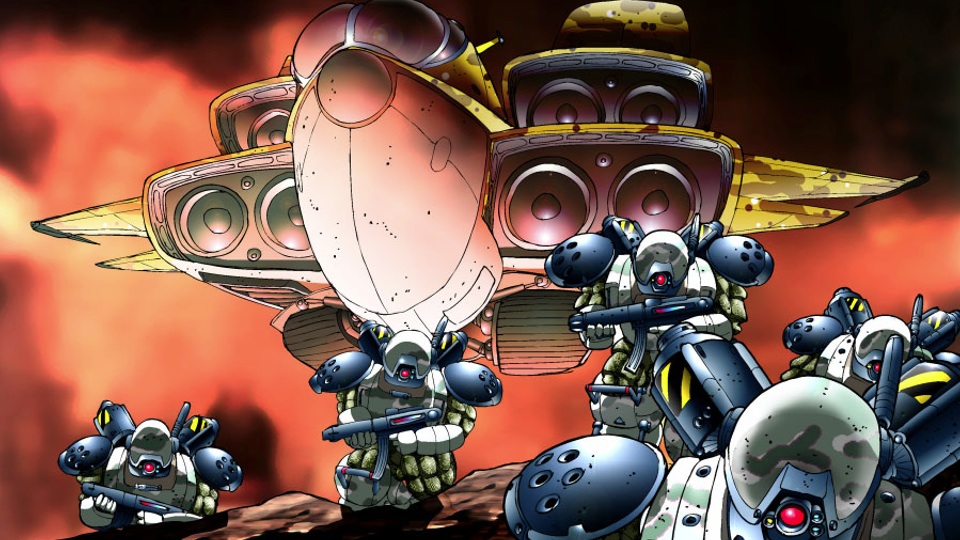
In addition to the fluid and unique control scheme, the setting offered a lot of new stuff to a then-over-saturated genre. Gears were small (about three humans high on average), using maneuverability and tactics along with the flexibility of going prone, crouching, and launching mortars from their backs to bombard enemies from ambush. They had a kind of ‘stealth-mode’ in the form of passive sensors (vs active ones) and in the second game you could customize camouflage patterns-though this had no real effect on the game, it was still a cool touch. Gears effectively functioned as elite warriors and special forces, but were by no means the sole core of military forces. Many large tanks in a stand-up fight were more powerful than gears, and hover vehicles, APCs, infantry, and even floating hover-battleships all worked together in combined-arms fashion. Given that Gears had the most interesting missions and versatility (not to mention skates for moving over flat land fast), that was what you played as in the games. And it was a blast. It also made sense. Sure, anthropoid combat vehicles make little sense in an era of heavy firepower with those high target profiles, but the gear felt much more feasible if less awe-inspiring than the conventional mechs of other series’ when it came to imagining future warfare.

But what really interests us right now is the setting. Heavy Gear does not traipse across the galaxy chronicling the rise and fall of massive star empires. Its setting, in fact, is a single planet. Terra Nova, once the jewel in the crown of Earth’s expansionist empire, now a world divided into two hostile geopolitical alliance networks made up of multiple nations. With its focus on a single world, the Heavy Gear setting allows geography to matter once more. Strange anomalies in magnetism enable massive floating battleships and carriers to act as navies on a world where most water is underground. Most of the population is clustered near the more temperate poles of this warm planet while the equator is a desert band with few people but much in the way of resources. It is this that forms the rough border (and primary disputed territory) of the Northern and Southern leagues (more on this later).

Once Earth’s empire went into decline, its outlying colonies were abandoned. Cut off from support of the mother world, Terra Nova had to effectively start from scratch. The chaos of sudden and rapid decolonization coupled with that the planet was largely just exploited for resources under Earth meant that it did not have the requisite stability or infrastructure to thrive in the short term. Needless to say, this is a familiar story for many parts of our own world in the mid-20th century. Eventually, after much strife, coalitions were built around the poles. In the North, a common religion and political ethos facilitated an almost-equitable confederation, The Confederated Northern City-States. In the south, the rise of one particularly successful and powerful state, The Southern Republic, gave rise to a more autocratic system of alliances, where said republic dominates the other nations as vassals and proxies through the Allied Southern Territories alliance network. The setting, being well developed however, does not make the north the good guys and the south the bad guys. The more one looks, the more complicated the situation becomes. The North may be a more political success, but it is heavily influenced by a somewhat militarist and very morally strident religion and society priorities some fields much higher than others to its cultural detriment. The South is less unified, but its dominant state is a culturally dynamic place where people have many (non-political) freedoms that those in the north lack. Just as in most conflict zones today, it is impossible to declare a ‘good’ and ‘bad’ faction as an absolute, and rather your feelings as an outsider will be guided by your personal preferences. Certainly, neither side could be easily glorified. Even if my personal loyalties are always going to reside with the faction which deploys the excellent Black Mamba gear.

SnakeEyeBM

Especially the sweet Snake Eyes Mamba variant!

Between these powers, many smaller nations still continue to eke out a dangerous and fragile existence. Some, like the officially neutral autonomous arms manufacturer, Peace River, successfully exploit these niches to make lots of money off of perpetual frontier warfare between the northern and southern leagues, others find themselves courted or fought over by the larger powers.

From South Asian partition to the more recent splitting of Sudan and South Sudan, to the division of Korea, we in the real world are very familiar with such narratives. In many more cases we are also familiar with officially unitary states which are anything but in practice, much like the Democratic Republic of Congo. Largely, on matters dealing with space in the future, it seems there is little focus on planets having multiple hostile political entities-but on Terra Nova this is a reality. I see no reason, in a hypothetical future of human expansion off-planet, that this would not be the case. It is certainly in line with human history. Division and unity come in cycles, not linear narratives with clear ending points.

But what is most interesting about Terra Nova is that multiple conflicts over the Badlands have not dampened the general sense of Terra Novan solidarity when it comes to the old colonial master of Earth. When a resurgent Earth attempted to reconquer its old abandoned colonies centuries after it gave them up, it used its superior wealth and technology to take a few of them. But Terra Nova was a different story.

The defiant planet unified against the invaders. And using the Gears they had invented (originally for mining) as re-purposed war machines, they defeated the ‘Earthers’ and drove them from the world, leaving only a small cut off remnant behind, which quite fittingly is named Port Arthur.

Though with the withdrawal of the common threat came the resumption of traditional north-south hostilities, a special task force was set up of hand-picked warriors from all sides who would work for a unit that rose above planetary politics and safeguard the world from further revanchist operations directed from Earth. Indeed, being a member of this unit and leading a squad on a special off world mission to sabotage an interstellar mass driver ( I think) weapon being operated by Earth forces is the main story of the game Heavy Gear 2 and its very cool intro shows this pretty well:

This is the element of this fictional setting which I think has the potential to be the most interesting when pondering our real world future. In an era of rising multipolarity and where we can quite clearly see neocolonialist policies from some countries such as France in West Africa or Russia towards some of its neighbors, to name just a few, will we ever see collective bloc alliances among normal local foes on other  as a reaction to bigger more global ones? This will depend of course on the behavior of more powerful countries towards less powerful ones, but it is interesting to think about. The widely divergent Non-Aligned League of the Cold War, though not much of a real actor, is an interesting example of an attempt from the past.

Anyway, have some badass soundtrack music while I ever so reluctantly go back to studying the real world:

https://www.youtube.com/watch?v=_GB5WLWvrsE

Pictures used are from Dream Pod 9.