For much of the ‘Third World’ the Cold War was the Good Old Days


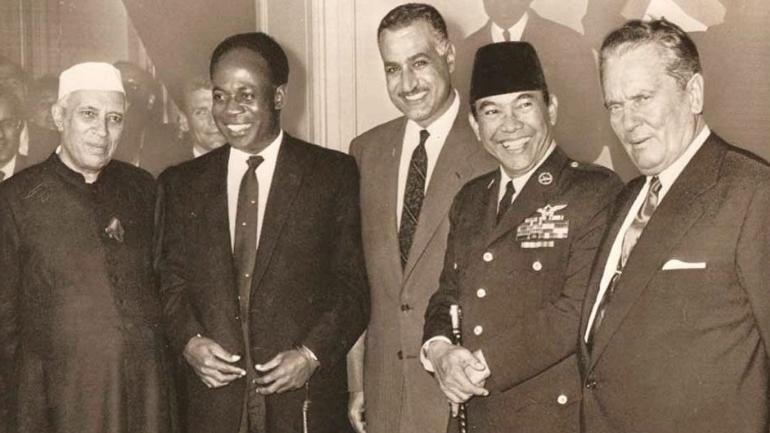
Nonaligned Meeting

When looking at the potential for future multi-polarity in world affairs it becomes important to consider what kind of multi-polarity is preferable and what is not. Surely, no one but the most diseased wiki-youtube edgelords of the alt right and neoreactionary movements pine for the days before World War II, where the entire planet was either exploited by rapacious colonial powers or had to live in fear from the periodic eruptions of late-comer powers with a world war or two in tow. But between the endless devastation of the first half of the Twentieth Century and the increasingly schizoid overreach of the dying post-9/11 neoliberal consensus, and the foul upswing in religious and ethnic identitarian non state actors it has unintentionally spawned, lies a far more instructive period of history to what our near future could learn from.

The Cold War, like any era, was a time filled with horrors of its own. It should never be the point of the serious historian or strategist to grow sentimental, idealistic, or above all become afflicted with that disease of critical thinking…nostalgia. But some time periods are simply more constructive for examples of this issue than others. Then, as now, the world lived under the threat of nuclear weapon armed powers. Now, perhaps as then, such enforced great power stability could give smaller and more independent countries the room to grow both diplomatically and developmentally. If they are up to the task anyway.

There were epic disasters in that time period, of course. The Khmer Rouge, the multiple attempts by outside powers to subjugate and divide Vietnam, the rule of Idi Amin in Uganda, Apartheid South Africa, Pakistan’s attempt to retain Bangladesh, the Soviet intervention in Afghanistan, and many more. But none of that outshines the vast achievements in human economic development made across the planet in this time-achievements that would slow or even reverse with the end of the Cold War and the triumph of neoliberalism. This is because the end of the Cold War also led to a diminishing in the power of small states diplomacy for the omnipresent dictatorship of a globalized market. We see the results of this now.

In countries like America and Britain we sigh at the decadent boomers who think with hard work and gumption you can get a college degree for the price of a used car and view hoarded wealth as a sacred entitlement. We rightly condemn that generation’s war on the postwar consensus of their actually hard working forefathers for the sake of tax breaks while gutting civil society and the planet itself with no regard for future generations This effect, however, is still restricted to the victory addled Anglosphere more than the rest of the world. While North America and the North Atlantic lived off the accumulated fat of times past, and even made some gains with it, other places actually did have to build from nothing. Many succeeded.

In much of the rest of the world the destruction of the final colonial powers (Japan, Britain, France) as well as the large scale stability of the situation between the United States and the USSR and the removal of the perennial German threat saw a massive wave of development guided by various modernist visions of a future for newly independent states. Perhaps more importantly, the ability to extract aid, technical advisers, and good deals from the major powers was increased by the fact that they were in a constant state of rivalry. Egypt under Nasser was particularly adept at using diplomacy to aid development and to grow living standards, but others would soon follow suit.

When the paranoia of the immediate post-Stalin Soviet Union and post-McCarthy United States started to peter away, more and more of the astute started to realize that this too was simply more of a great power competition than any ideological battle. In addition to the loosely affiliated nations of the so-called Non-Aligned League, it became more and more possible with time to seek a more fluid status in the international realm by rejecting the thinking of binaries. France, despite its pro-western tilt, made concerted efforts to reach out and develop connections with Eastern Bloc nations, while communist Yugoslavia maintained both NATO and the Warsaw Pact at equal distance-which in turn helped it extract better aid and trade deals from both as well as boost its international position with other independent states. Technological developments too were spread not just from the defense budgets of the competing powers (a la space exploration) but also in a desire to show off what they could do and how they could be of use to the Third World. Nowhere was this more apparent than the Green Revolution in agriculture whose spread was assisted by experts being encouraged to come to other nations. While both Washington and Moscow often tried to compete with technologies and aid in a way framed as a competition between capitalism and communism, the truth was they were using their technological advantages to buy influence and allies. And this was often a net boon for many newly independent countries. This was not a company hiring a few locals as it extracts raw materials for profit. This was genuine developmental assistance.

With the end of the Cold War, this favorable conjunction for national development would also end. While new opportunities would open up to a select few who had reached a level of development strong enough to take advantage of the changes that came in the late 80s and through the 90s (mostly, and perhaps tellingly, in already partially developed post Soviet countries such as Kazakhstan and Estonia), the majority of the Third World effectively lost its bargaining power. Even leaving aside that the collapse of living standards in much of the former USSR was the largest peacetime loss of human development in recorded history, the consequences for the Third World would often be quite dire as well.

Much aid dried up almost immediately. The US lacked a need to compete with anyone. Meanwhile, the type of economic exchange between the North Atlantic plus Japan and the rest of the world moved towards a more unchecked and predatory phase. Many developmental and technological advisers were replaced by voluntourists and vulture capitalists. While trade increased, development often slowed or stopped at the same time more and more resources were extracted. While the most extreme forms of poverty has continued to reduce since 1991, the majority of the people who experience that boon are in China, a country far less tied to neoliberalism than most others. Many other successes come from nations who had already set up a path to success before ’91. Meanwhile, the countries targeted for regime change such as Libya and Syria have seen an utter collapse of living standards in systems that once two were somewhat independent and working towards developmental success. To further this, the very pioneers of the present economic order are now facing rising poverty rates, especially in rural and post-industrial areas.

In a world were all gains are temporary but can at least be made somewhat long term in the right circumstances, it behooves us to think about what opportunities could be returning to developing countries as the Chinese economy reaches out to challenge America’s. For all the various dangerous multi-polarity can bring, there could be a bounty of opportunities for the independent nations of the world…ready to open a bidding war of experts and assistance between the great powers.

Its either that or give in to nostalgia as the only refuge.

https://www.youtube.com/watch?v=jZ8USuDX_jE


Despite all the Agent Orange, the Jungle Grows Back

Fighting wildfires

The DPRK-USA summit in Vietnam is about to start. Given the generations that have passed since a frozen armistice was put in place and the decidedly erratic character of the American president I will withhold from speculating on how effective such talks will be. I do support having them, however. Everyone should. There is not a person on this Earth that would benefit, long term, from renewed hostilities on the Korean peninsula. Even the usually gleeful for conflict types in policy and business would suffer when China, now a nuclear armed nation came to the DPRK’s defense. Though we do not presently look like we are are staring down the barrel of such a confrontation, leaving the festering sore of nonexistent relations between Pyongyang and much of the rest of the world is of little benefit to anyone.

My concern here is that Pyongyang has an astute eye on Venezuela, and rightfully so. Saddam Hussein had no up to date weapons of mass destruction but for domestic reasons could not come out and say it. His lack of them hardly prevented the war that came his way. Qaddafi then saw an opportunity for his nation to be lifted from U.S. sanctions and in return give Bush a (minor) victory by renouncing such weapons. This failed to save him from an attack launched by the Obama administration under heavy pressure from Britain and France. This taught the world, and especially Syria, that it wasn’t worth giving up your WMD’s. In fact, it might be just what you need to make more powerful foes think twice. Everyone knows Israel, which once was subjected to endless conventional attack, has not been so attacked since it (unofficially) became a nuclear power. Everyone knows that North Korea’s bargaining position has been stronger since it became one. The intercontinental ballistic missile is the ultimate sovereignty guarantor.

Meanwhile, while this noteworthy and laudable attempt to normalize relations with North Korea goes forward, the US is attempting at the very same time to topple the government of Venezuela. This is extremely counter productive and will put Pyongyang on edge. Considering that all factions in Venezuela are unpopular, and that so far most of the army seems to be sticking with Caracas, it flirts with the risk of conflict or disruption that could set off another wave of migrants and conflict. Even if it does not, outside of private corporate interests who seek the Venezuelan economy opened to them, the average American stands no chance at benefiting from any major US-backed operation there…but will no doubt pick up the tab for it as always. Indeed, Maduro’s popularity is extremely low but not lower than Macron’s (who arguably treats opposition protesters worse), and opposition to US military intervention in that country is significantly higher than even the percentage of the people who want Maduro gone. If they want him gone, they will do it their way.

So far of candidates running for high office, only Tulsi Gabbard has raised a voice of opposition to our destabilizing actions in Venezuela, particularly at this sensitive time. The odds are high that if reaching a deal is more difficult than expected this would be the reason why.

This is just one issue among many that one could point to in order to make the counter-point to a growing Beltway-Lanyard narrative about America’s supposed withdrawal from the world. Robert Kagan, a well respected prognosticator despite a very long record of supporting failed policies, uses the phrase ‘the jungle grows back.’ We often see this narrative used increasingly by democrats and ‘never Trump’ conservatives to critique Trump from the neoconservative right. They are setting up a false binary where we must choose between pure isolationism and endless brushfire-war militarism. This is obviously false because there is quite simply no way the worlds largest economy could return to anything resembling prewar ‘isolationism’, much less give up its numerous diplomatic ties.

There is this assumption that undoing World War Two, the crucible of American world domination, lurks as a potential in every part of the world. But the Second World War was not normal, it was bizarre. Most of human history does not have quite so large conflicts in all out total war for global hegemony where the triumph of one side was so clearly preferable than to the other. The circumstances that made the prewar era do not exist any longer. And most tellingly, it would hardly be the United States to which much of the world would look to for deliverance at this point in time. This is because rather than intelligently shoring up its position once its last remaining true rival, the Soviet Union, fell in 1991, the United States has gone on not to uphold the stability to the post Cold War world but to endlessly undermine it. In so doing it has not only undermined its own position through over-expansion, but also made itself the most feared and least trusted nation on planet Earth. Trump’s bumbling obviously doesn’t help, but this problem dates back on some level to the over-expansion of NATO in the Clinton administration and especially from the unhinged Bush Jr. presidency. If the rest of the world doing its thing is the jungle, then we are Agent Orange. And the overreach of so much of our consensus foreign policy has made a lot of those jungle dwellers nostalgic for the days without chemically induced mutation.

In my time at the State Department I often found that the foreign service officers who had served in countries that struck an independent course of self sufficiency were often the ones more content with their ‘hardship’ (not fully developed nation) postings. Prewar Syria and Belarus were commonly lauded places to be. There is, perhaps, a reason why foreign service officers are restricted to two years per post abroad. You don’t want them getting any funny ideas about countries pursuing independent paths of development.

This needs to be kept in mind when doing big diplomatic negotiations like the one currently in Vietnam. A country that we dumped endless amounts of chemicals on, then left, and allowed the jungle to grow back. Now Vietnam is doing better than ever before in modern history *and* has positively warm relations with the United States. Diplomacy, its cheap and effective and our war to preserve the artificial construction of South Vietnam was for nothing. But in addition to hard power backing up diplomacy it also needs the soft power of knowing you are reliable and trustworthy.

Many in North Korea may be looking at Venezuela and wondering how many concessions it is worth giving the United States. It didn’t have to be this way, and it sure doesn’t in the future. There is a professional and political class in desperate need of replacing.

‘The Hell of Good Intentions’, A Review

hell of good intentions

Stephen Walt was one of the most influential contemporary international relations theorists to me when I first entered the field of IR as a Master’s student over a decade ago. Of the currently active crop of IR thinkers he remains my favorite, so it should be no surprise that the coming of his newest book, ‘The Hell of Good Intentions: America’s Foreign Policy Elite and the Decline of U.S. Primacy’ was an instant acquisition for my massive nonfiction library. Though Walt and I have diverged on some issues in the past few years, our overall diagnoses of both what ails the US foreign policy mainstream as well as what to do about it remains extremely similar.

I am not going to go over the details of the book as many of its themes have been covered on this blog multiple times already. From the incestuous navel gazing of the Court Eunuchs of the Beltway ghoul class to the virtues of America’s fortuitous geography in its rise and options towards grand strategy, to the virtues of offshore balancing to those lucky enough to be able to practice it, all can be found here in various posts. If you know many of my bugbears you can guess what are Walt’s, and vice-versa.

What I will do, however, is review how good a case Walt makes for covering this topic as a single book meant for a large audience. Unsurprisingly, this book is meant for a similar audience as the very one it rightly criticizes. This means Walt takes a very different tactic than I do. Whereas I tend to go after people outside-of-the Beltway and show how the fables of liberal hegemony are directly counter to someone’s interests, Walt wants to convince those who are a bit more integrated into these elite circles. This is not a criticism of mine, as its important to be firing on all cylinders here. I am merely acknowledging that if he is the Martin Luther King Jr of foreign policy realism than I am more the Huey Newton-to use a somewhat tortured and tongue in cheek analogy. I try to convince people who are non-centrist independents, the few sane paleocons, and leftists and he goes more for the liberals and centrists.

Keeping this in mind, Walt does an excellent job. Not only does he wage a thorough and quite multi-topical demolition of both the record of our very own Late Ming court eunuch equivalents whose lanyards are the modern version of the old quill said eunuchs once used to hold in their piss (analogy once again mine), but also the long term effects of these luxury wars we have found ourselves in. For someone who is sometimes (unjustly) criticized in academic circles for ignoring domestic factors and how they shape foreign policy, it is worth pointing out that, so far, this book seems to have little in the way of big newspaper reviews. Quite possibly because it also criticizes the general neoconservative/liberal bias of major legacy papers such as the Washington Post and the New York Times’ op-ed section. Had this book come out in the twilight of the cursed Bush II presidency I have no doubt it would have been given more media attention, but in a world where both parties now identify openly with unthinking hawkishness-from Trump embracing Pompeo and Bolton to the Democrats rallying around the flag of the national security state and even bizarrely ex-Bush Junior officials-there is little mainstream attention paid to this work so far despite the fact that Walt is a distinguished and well known scholar in the field.

Fascinating that. I’m sure its just a coincidence.

Needless to say, this is *the* work to get your foreign policy orthodoxy questioning people to engage with series realist critiques of both the present system and what to do about it. The book even helpfully closes out a useful list of talking points and arguments that could be deployed to make the case for a more restrained offshore balancing strategy. Worth keeping around to push the needle especially as a reckoning with the establishment must be only one or two more of their failures away.

My only real critiques of the text as follows:

While Walt does mention how the Lanyard Ghoul (once again, my phraseology) class has an intrinsic reason to back mindlessly hawkish policies due to them making money and status off of such policies, he only barely mentions the privatization and for profit militarization of much of the DoD in the past few decades. This is not something that could be easily reversed without major structural reform not only of The Pentagon, but also our entire political-economic system as it presently stands. This, along with environmental issues, are some of the reasons being a realist actually made me evolve more structurally left wing positions over time. Also, when living in DC, as I currently do, one sees how this recession-proof city really functions as more and more ‘Beltway Bandits’ move in with the attached monstrous apartment complexes clearly designed for pod people in tow. In DC the policy is made, and DC itself is increasingly economically reliant on what Eisenhower once called ‘the military-industrial complex’….except that now said complex has a profit motive above all, and thus far less reasons to uphold the national interest first. This entails not only many jobs that rely directly on the perpetuation of bad policies to exist, but also an army of lobbyists to see that their voices are disproportionately heard in government.

My second criticism is just a minor oversight but one worth mentioning. Walt rightly bemoans the lack of foreign policy focused elected leadership in office currently. While I agree with the argument overall, and also with his complaint that the cause suffers when certain people from a family with the last name of ‘Paul’ do much of the public speaking on its behalf, he is missing one very persistent and vocal figure in congress: Congresswoman Tulsi Gabbard of Hawaii. The entire reason she has managed to restore realist and restraint positions to the discourse is because she is charismatic and is a rare figure focused on foreign affairs. Personally, I would love to see Walt support her mission in congress as congruent to his own.


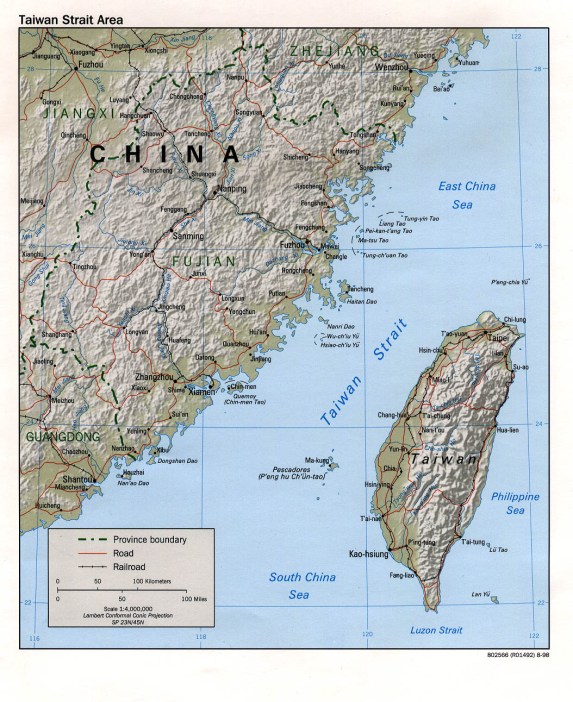
Will Taiwan Fight?

taiwan_strait_98

It is the nightmare scenario of policy planners in Beijing and Washington alike. It is the hypothetical that keeps many an IR scholar pondering the many ramifications and dangers. It is a war over Taiwan.

To the fellow traveler interested in world history, Taiwan’s ambiguous status on the world stage is hardly a new thing. The island was one of main progenitor points of Polynesian culture and eventually would attract a Dutch trading fort due to its simultaneous remoteness to dense population but also close proximity to China proper. The Dutch would in turn be evicted by Ming Dynasty loyalists fleeing the collapse of their government and the birth of the new Manchurian Qing Dynasty. Once the pirate base for Ming loyalists was subdued the Qing recognized the need to incorporate this nearby landmass firmly into their state.

After the First Sino-Japanese War of 1894-5 the island’s ownership was transferred to Japan and Taiwan soon became the new Japanese Empire’s first major overseas possession (that wasn’t under the assumption of one day becoming a home island). The Japanese met significant resistance from the native population (though not the Chinese already there) and would eventually go on to incorporate indigenous scouts into their Pacific forces once this initial colonial conflict was over. There is even a metal song about these units.

Taiwan was restored to China-then the Republic of China-after Japan’s total defeat in World War II. Shortly afterwards, the civil war in China would drive the Republic’s government and forces (with the state treasury in tow) to the island as their position rapidly collapsed in China Proper. Late Ming history repeating itself. Here the Kuomintang forces under Chiang Kai-shek would survive, unlike their Ming forebears, due to the protection of the American navy and the weak post-war status of naval forces now held by the People’s Republic on the mainland.

Not giving up its official title to be the legitimate government of China, the Republican forces on Taiwan would in fact hold China’s seat in the UN until the United States and Beijing came together during the Nixon administration to work out defensive arrangements against a perceived common Soviet threat. Much like democratic peace theory today or the US-France ‘Quasi War’ during the aftermath of both countries revolutions, international communist solidarity turned out to be hollow words easily undone by the brute realities of great power competition. The price for the US to gain this new inroad with Beijing was, of course, to put the PRC in the drivers seat as the internationally recognized government of China. Washington also had to agree that Taiwan was a part of China-but it retained its influence over the island and reiterated that it would defend the island from a reunion with the mainland that would be conducted with force.

So it remains up through today. In the meanwhile, there have been significant if minority calls in Taiwan to cease being the Republic of China and simply become Taiwan, a fully independent nation. Its historical experience has certainly put it on a more divergent path than the simple warlord renegade provinces of modern Chinese history before World War II. Of course, everyone knows that a blatant declaration of independence might well trigger a full blown military response from the mainland.

This all sounds quite convoluted, and as history and political baggage it certainly is. Will Taiwan come back into the fold through force? Diplomacy? Will even the PRC one day unexpectedly collapse leading to Chiang’s long delayed dream of reunification from Tapei a strange new reality? Will Taiwan become a fully sovereign and recognized state?

But one way it is not complicated is in what will happen to Taiwan’s future if that nightmare scenario of a military invasion to forcibly reunify the island breaks out. Despite what you may assume about such a complex issue, the entire fate of the island and of great power conflict will rest solely on one factor: Do the people of Taiwan resist the PRC or do they not?

It seems simple and perhaps reductive to break down the fate of this issue in a confrontation to this one factor, but I will list reasons why I believe this to be true:

-Neither China nor the United States wants to fight each other directly, especially as neither country knows the effectiveness of its naval strategy against the other. China has bet a lot on diesel submarines and shore based anti-ship missiles, the US on carrier battle groups, nuclear submarines, and air power. The Taiwan Straits could be the death zone of an invading fleet coming across American technological power projection, or it could be a perfect shooting gallery for mainland missiles restoring coastal defenses to their pre-gunpowder days of sabotaging troublesome fleets. Either power, or both of them, could be fatally weakened with global consequences in such a confrontation.

-The morale of the Chinese forces would be higher than that of the American forces, considering the historical ties to the island that one shares and the other do not. For Americans to be willing to take the casualties necessary to either defend or (more likely) re-take Taiwan the country would have to be united in the cause. The country could *only* be united in such a cause if the people of Taiwan were seen to be oppressed and victims of an unwanted annexation like that of Iraq invading Kuwait in 1990.

-Therefore the decision falls into Taipei’s ball court rather than Washington or Beijing. Taipei and the common people of Taiwan in general. The island is riddled with underground defenses and weapons caches to fight and delay any invasion until a bailout from America can occur. Much of its terrain is extremely mountainous. It also has a large amount of jungle. Taiwan could indeed put up quite the fight-if it were willing to. Conventionally it might be plastered (unless the PRC really screws up the initial operations) but a popular war waged by the army and militia and common civilian resistance could flounder an invasion. More importantly, such resistance is the single factor that could bring in open ended American commitment for a fight until the issue is settled with a fully independent Taiwan. (Or, if American was being extra clever, a unified China that had to legalize the KMT throughout the entirety of the mainland and open the system up to competitive elections).

And this is the question, is Taiwan willing to do this? Literally everything in a conflict over the island boils down to this single factor. Honestly, I have no idea. I don’t think most people in Taiwan even really know with certainty. But I do know that this is the factor on which US-China rivalry will hinge on in any confrontation. Without something that at least looks like a genuine people’s war, America might roll over and acquiesce as easily as a compliant Taiwan would. After all, it barely effects the core of American Pacific strength and provides a rallying cry to get more nations on Washington’s bandwagon. But if the Taiwanese are clearly fighting as allies expecting a delivery then this flies out the window. If Taiwan were to fight all sides would have to see it through for the sake of their preexisting commitments and the very legitimacy of their governments.

So to get the heart of the mater, will Taiwan fight or not?


O’Bagy and Boots: Spirit Totems of the Beltway Ghoul Class

You may not remember (or have ever heard of) Elizabeth O’Bagy. Basically, she was a fraudulent expert hired by the (neoconservative) Institute for the Study of War to serve as a Syria expert. Her expertise was largely in advocating for the ‘moderate rebels’, whose work she did on their behalf she failed to disclose, and in lying to people that she had a doctorate. See below:

In a denouement that will surprise exactly no one, she had the right opinions of cheerleading endless regime change policies to qualify for a failing upwards promotion to join the staff of Senator John McCain (of course) as a legislative assistant.

What this small potatoes lanyard has in microcosm is in fact emblematic of a greater problem with the Beltway. I have mentioned before how ideologues get signal boosted and actual scholars get sidelined, but its worth mentioning exactly why this is and what purpose such a system serves.

Amber A’Lee Frost, who as far as I know has no foreign policy experience, accurately diagnosed the problem with so many regional ‘experts’ in mainstream foreign policy commentary. To paraphrase from memory, ‘the point of regional experts is-90% of the time-to advocate for more U.S. intervention in their region of focus.’ As someone who has lived and worked in DC for a few years now, I can confirm the truth of this statement. Objective reporting and actual regional expertise for cost/benefit calculation is sidelined for new ways to make a case for various forms of intervention and increased defense spending and to dupe the middle class rubes who seek such high minded sounding justification. This is the name of the game.

While these types are common beyond belief, a certain few always rise to what passes for media influence from time to time. William Kristol, the hilariously named Power and Slaughter Axis (Samantha Power and Anne Marie Slaughter), and on the list goes. But none has quite taken the O’Bagy status of our times quite like Max Boot.

Boot’s career is far more ‘impressive’ than any of these, if we take impressive to mean consistently and often hilariously wrong. He is one of the rare military historians who has achieved fame, and the method of acquiring that fame is the one which is most detrimental to history: parroting the popular political mythologies of the ruling class of his time. Despite the fact that a thorough study of global history, and yes, military history, reveals a total lack of teleology in human affairs save for the triumph of power and cleverness over weakness and rote-thinking, Boot has churned out one book after another turning advocating for an understanding of American history that supports the largely disastrous post-Cold War trends of foreign policy-as well as increasing those failed policies in both scope and intensity. I suppose at this rate he should be loved by accelerationists who wish to see a collapse of American world power, since the acceptance of everything he wants would fatally cripple the long term sustainability of American power.

But rather than go on about his career I really wish to lament that these are the people called in for ‘expert analysis’ on much of the media. All that gives the public is self-affirmation of the policy wonk bubble-a bubble that has been clearly failing since 2003 if not before. See for yourself Max Boot in action:

And also here:

What I find fascinating about both of these clips is that Boot is up against opposition that is hardly unsurpassable. Tucker Carlson is often laughable rube on many issues that are not related to his welcome recent turn on foreign policy. Stephen Cohen is a real scholar but is certainly the most uniformly pro-Russian voice you could possibly find on American television anywhere. Yet despite being able to take any number of ins, Boot always gets flustered that other people simply don’t believe in an ‘American Exceptionalism’ where great power politics is cloaked in the language of morality and norms. On the very format of cable news where his audience is most likely going to be sympathetic he cannot even hold his own.

When the propaganda machine promotes the unworthy every time they make a terrible policy prediction that just so happens to flatter the already existing biases of a class of people it will inevitably lead to their own PR not being able to hold its own in the public arena.

Perhaps, in this way, O’Bagy and Boot are indeed performing a public service of sorts.

Douglas MacArthur’s Ghost and the Bolton Democrats


Trumpkim.jpg

Image via the BBC

Today was a big day in diplomacy over there in Singapore. Trump met Kim and their advisers met each other. America has apparently committed to ending joint military exercises with South Korea (for now) and North Korea has started demolishing its weapons testing sites, though only a few so far.

The almost nonexistent relationship between the US and the DPRK is an artifact of the Cold War. One that became obsolete from an ideological point of view in 1992 but has lingered on anyway. This is, of course, because it (much like the Cold War itself in my opinion) was not primarily ideological but rather a contest of rival power poles and alliance networks. In reality, North Korea has remained an issue because it fears the United States and encirclement from their allies but also fears that this unenviable and de facto blockaded position on the world stage would force it to become so subordinate to their giant ally China that their sovereignty might also be indirectly compromised from that direction.  If you wondered why a government is so clamped down and beholden in all factors to security concerns this is why. China wants a compliant vassal state protecting its only land border with a US rival, South Korea and the US want to keep affirming their alliance, and Japan wants to stop being used as a testing ground for North Korean weapons demonstrations. North Korea, for all its oddness, really just wants to survive and avoid any kind of regime change operation, be it conducted from their south or, perhaps more indirectly, from their north. When it comes to security actions and goals abroad, Pyongyang is one of the most rational actors around today.

So why is there so much moaning that we are even talking to them directly now?

I have no interest in predicting whether these current talks will be successful or not. Trump is far too mercurial and there will be many established interests in many different countries who will not want these talks to produce good results. I *hope* they start a running dialogue that succeeds in their purposes, but I am not going to yet come out and say they will. They should, however, be given the chance. To increase the chance of them working, much of foreign policy in both major parties in the United States should be figuring out how to bring this about.

But here rises the ghost of Korean War General Douglas MacArthur.

MacArthur began his role in the Korean War with a massive amphibious flanking victory at Inchon, changing the fortunes of the war which up to that point had been largely one North Korean victory after another. His famous hubris led him to build off this victory by driving ever onward without regrouping or securing his position and in frank disregard (which he would convince an initially reluctant Truman to follow with) for China’s determination of keep America off its border. What resulted, in the Yalu Campaign, was one of the US armies’ biggest defeats, perhaps second only in scale to the loss of the Philippines in 1942-something MacArthur also played a role in. The war went from imminent US victory to grinding stalemate, with MacArthur having to be replaced by the more cautious and adaptive General Ridgeway. There would be a ceasefire in 1953, but in technical terms the conflict never would end.

MacArthur returned stateside to play the victim of Washington, the scapegoat of the President. Never mind he himself had advocated for expanding the war into China and the use of tactical nuclear weapons to facilitate this grandiose and mad counter-offensive. Never mind that he had inverted his WWII career by starting out winning and ending up losing. He blamed others and became an icon of the far right which was just then beginning to descend into the howling madness of McCarthyism.

If he were around today he would sound like John Bolton…or your average establishment Democrat. After all, the historic meeting in Singapore had barely made the press when notorious King of Corruption and Popularity, Senator Bob Menendez, said it was a ‘victory for North Korea’ that we had somehow blundered into to our loss. Meanwhile, the old guard of the Democrats (as well as the sociopathic hawk and daily birthday cake quaffing Tom Cotton and his types) have been constantly pushing America’s famously vain and media-obsessed President to take a more hawkish line on North Korea.

Do keep in mind these are the same people who constantly refer to him as a madman and unhinged. Yet they want more war like policies from him as they vote for more and more defense spending increases. Amazing.

These Bolton Democrats are in effect trying to push Trump to his right on foreign policy as well as position them as the ‘true patriots’ who ‘aren’t afraid of foreign countries’ and can say ‘see we told you so’ if something goes wrong. The problem is that policy issues of this size really shouldn’t be partisan footballs. There is no ideological clique driving this policy, such as there was in Iraq, but rather probably just two leaders both seeking a win to legitimize their standing. This seemingly petty reason should not turn us away from the many opportunities that improving relations between DC and Pyongyang could represent. And it should not blind us to the fact that America holds most of the cards in this bilateral relationship, from sanctions to diplomatic relations in the region, and therefore can afford to give a little here and there. North Korea will have little to give up at the opening stages, so I don’t really view it as a failure to diplomacy to scrap the exercises early on.

Furthermore, in a grand strategy perspective, taking bold moves towards ending rivalry with the DPRK might provide proper benefits to American Grand Strategy in the future. The US is far stronger at sea than on land in Asia, and a Korean peninsula working towards reunification peacefully would almost certainly be a de facto neutral nation, allaying both Chinese and American concerns there. The task would be Herculean enough that they would most likely want to stay out of more great power rivalry, giving the Chinese some breathing room on their border and the US the ability to avoid being sucked into a repeat of 1950-3’s land war. Any conflict that might break out would be at sea, where the much more strategically vital Indonesia waits. This would most likely be to American advantage should it happen.

In the inevitable barrage of Norms Nerd commentary which is to follow, who will wring their hands and clutch their pearls about ‘normalizing a regime’, I can say only this: The Kim family and the ruling party have run North Korea for significantly over half a century. Get over it. You will find when you come to accept reality as it is and not as you wish it to be, that it can be much easier to get things done in the field of diplomacy than otherwise.

Bolton and the Blobocracy

Boltonized

It is so thick, yet you can still count the hairs individually.

I have to regard the first two generations of the Mongol Empire as the best run superpower in history. From diplomacy and espionage to warfare, an incredibly small band of people could grow through assimilation of other steppe tribes while also conquering much more numerous sedentary people. In the chapter on leadership in Timothy May’s ‘Mongol Art of War’ this is summarized succinctly:

‘Whereas in the rest of the medieval world military genius, or even competence, was rare, among the Mongols it was expected from every commander. Much of this resulted from how the Mongols selected their commanders and trained them in the performance of their duties. Unlike many of their contemporaries, the Mongols did not base the ability to command on lineage, although this might support one’s claim to authority. Instead, throughout his ascent to power, Chinggis Khan demonstrated an extraordinary gift for spotting talent in men, whether they were of noble birth or commoners. Merit was the key to acquiring a position of leadership in the Mongol military hierarchy , and battlefield promotions were not uncommon.’

One could also apply this summary to the Mongol use of diplomats, technicians, and the like as well. Such a system enabled one of the most rapid and successful expansions of force projection in history. Such a system, also, is the exact opposite of what the United States is currently wielding to shore up its rapidly deteriorating position as unipolar superpower. As Ibn Khaldun’s theories of history accurately predict, when a previously successful power becomes complacent it loses its bonds of solidarity and loyalty and drifts into the path of corruption for the sake of defensive and hoarding elites. The ending of social mobility in the governing elite is one of the key aspects of this decline. The lanyards of today are like the court eunuchs of many terminal Chinese dynasties of the past, albeit with a far less painful mark of their status to dangle from their person. Obama himself while president called this class ‘The Blob’, a monolithic force which, in our society, constantly advocates for interventionist war as the primary method of solving what are often minor and regional diplomatic disputes, or rivalries left over from the past which no longer have relevance to the average person. At the time this was remarked upon, that very blob proved its reality by launching numerous attempts at rebuttals, some of which are mentioned and linked to here. This is the Blobocracy, an alliance of misguided idealists, blindfolded patriots, ultra-credulous West Wing fans, foreign nations with the cash to buy lobbyists, and rapacious profit motivated defense contractors (only the last two of these factions is truly achieving its objectives).

How does this get us to the newly onboarding national security adviser John Bolton? Well, because in many ways Bolton is the ultimate creature of the establishment-even though many of them serve as his greatest detractors. He is decried by war hawks as a war hawk, but really, much like the craven Republican establishment of Paul Ryan in relation to Trump, what they really dislike is the brazen overtness and tone deafness of their own polices stated publicly by an uncouth village idiot type figure. And yet the village idiot is still spawned from the context of the village that helped to mold them.

John Bolton, who I once mentioned before in the early days of this blog-if in passing, began his illustrious career in foreign affairs by joining the National Guard to duck draft service in Vietnam. I can’t fault him for that, who would want to play Burgoyne and Cornwallis to Vo Nguyen Giap’s George Washington especially when the outcome seemed negative for the US? But it is in light of his later-life commitments to sending other young men to die in ill conceived and strategically disastrous conflicts that casts a retrospective shadow of hypocrisy on this once logical decision. Bolton proceeded to behave like many of the eager beavers DC is still host to today, rising up the partisan ranks by attaching himself to a school of thought with inside the Beltway cred. This was the neoconservative movement, a truly Guy de Lusignan-esque medley of ex-Trotskyites, defense hawks fearful of the end of the Cold War, and Lawrence of Arabia LARPers committed to the naive teleology of enlightenment progress in geopolitics and determined to do to the Middle East what had already been done to Japan and Western Europe and eager to rush out into the desert to end up with mass graves. The problem, of course, is that Japan and Western Europe had already been industrialized nation states before their reconstruction after World War II. The fact that the very nation that had failed to adequately reconstruct and reintegrate the former Confederate States of the American Civil War had really lucked out on occupations in 1945 allowed a delusional belief to fester, despite the fact that the next up to develop states were largely places that did it on their own terms. But loyalty to cause rather than ability decided (and still decides) the upper echelons of promotion in DC. It was this constant falling upwards, a common feature in the professional classes of policy wonkery, that Bolton rose to higher and higher positions.

Bolton, to his credit, did not actually believe much of the pablum about democracy promotion and ‘the end of history.’ But what he did believe, and still does believe, is the merit of constant applications of offensive force-which was the true core of underlying those other beliefs. This is an overtly realist blog and hardly one to dispute the utility of power projection, but power projection is always dangerous when it comes to military action and usually should be a last resort after much planning for contingencies. Allies, certainly, should not be alienated and wars unnecessary for the vital national interest (that should be apparent to an average citizen to be worth their support or participation) should not be pursued. The effect of Bolton’s policy positions is actually identical to, say, Bill Kristol, Dick Cheney, or Hillary Clinton, but simply with more unilateralism and less caution. The underlying effect of them, however, remains largely the same. Infamously establishment Thought Loser Shadi Hamid even recently pined that he *wished* Bolton was a neocon, largely for purely semantic and utterly virtue signalling reasons. The problem with much of this is that the cause does not matter. Looking, post-World War II at major American military interventions serving even its own narrow interest, one cannot help but see the failures far outweigh the success and even the utterly ambiguous results. The Korean War was a success measured by its original stated goals but became a disaster when hubris expanded those goals into a new war. Vietnam was an unmitigated disaster. So was Lebanon and Somalia if on a much smaller scale-and then you have everything post 9/11. This leaves the First Persian Gulf War and Kosovo as the only real wins, with the first leading to a repeat of the over-extension in hubris of Korea ( in subsequent rather than the same conflict) and the second’s benefiting any member of NATO or even the world in general extremely in doubt. American group think has a planning problem. Even if you made a case for all of these conflicts, it would be hard to say they had been planned and executed well by the Blob. And Bolton is very much the greatest cheerleader of continuing these blundering policies. Perhaps even expanding them.

Bolton maintains, to this day, that Iraq was a success. He supported the Libyan intervention and the (thankfully failed) attempt to regime change Syria. He constantly advocates for war upon Iran and North Korea. We can, of course, hope that his appointment is a canny move by Trump to create a fearsome persona making his upcoming negotiations with foreign foes easier, but such moves require a strategic thinker like Theodore Roosevelt or Richard Nixon-something that Trump so far has shown he is not. But one thing that cannot be stated is that Bolton is some crazy outlier, coming into a sensible system ready to play wrecking crew. He is in fact merely the strongest fundamentalist proponent of that very system. If the Bipartisan Consensus is a Southern Baptist convention advocating for young earth creationism on the Middle East than Bolton is merely the Westborough Baptist Church picketing across the street cutting straight to the fire and brimstone. He is exceptionally dangerous, but he is hardly an abnormality to the Blobocracy.

Confederation in Anarchy: The International Relations of Redwall

Well, I promised a lighter post more like my earlier entries, did I not? So let’s talk about  80s/90s children’s book series Redwall.

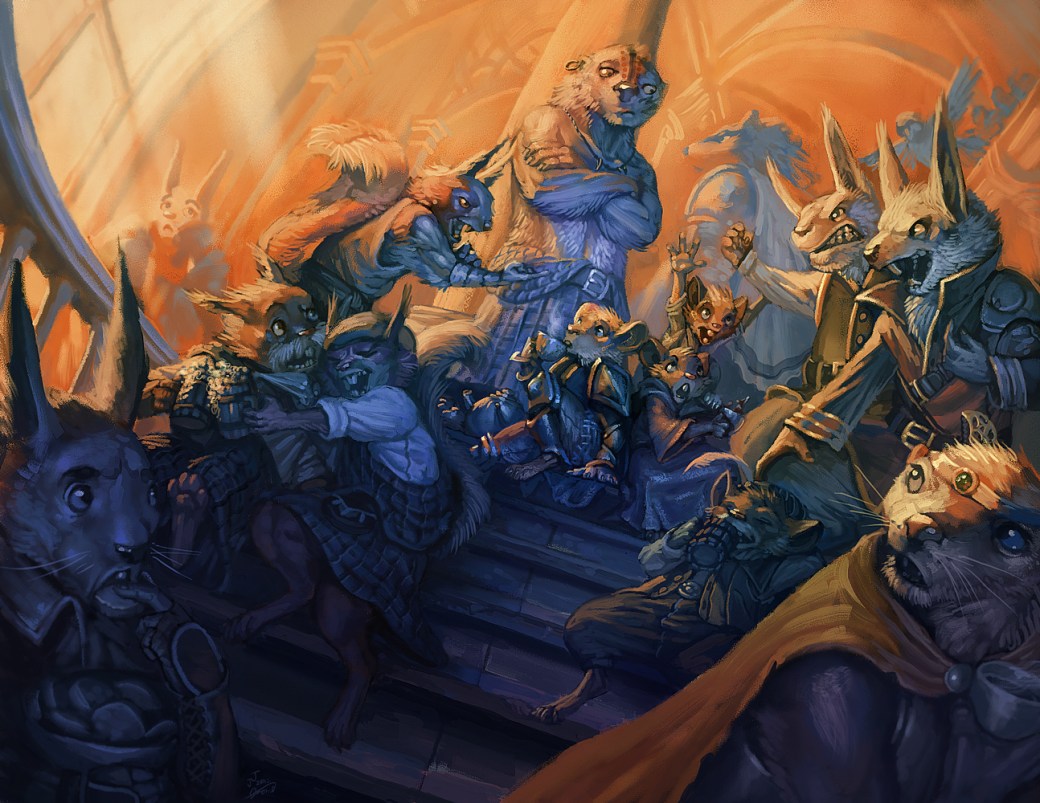
redwall-party

Redwall Fanart by the extremely talented chichapie, who also did many of the illustrations for the great possibly somewhat Redwall-inspired game ‘Armello’)

Redwall came into my life around third age 7 and remained (tied with Phillip Pullman’s ‘His Dark Materials’) the top tier reading material for me until I found Lovecraft at age 15. Even after its demotion I still kept up with the series until I went to college, making Taggerung the last entry I ever read. Still, as part of the inoculation in my childhood making me immune to the culture homogenizing adverb abusing virus that was ‘Harry Potter’it will always remain a part of my life. The best entry in the series, ‘Mossflower’, I even re-read only a few years ago to see if I still got the same kick out of it. I did.

Seemingly unrelated, in recent months I have also gotten into the Chapo Trap House podcast. Because being the opposition to all mess makers who got us where we are now requires not tone policing and pedantry but a crass sense of humor and disdain for the pundit class that positively drips. Clearly, fellow travelers to Geotrickster. Anyway, episode 82 was an interview with an American volunteer fighting with the YPG in Rojava in Syria, who corrected some inaccuracies in his more well known coverage in a Rolling Stone article. Most notably, he mentioned how what often is internationally defined as anarchism is really a functioning pseudo-state in Rojava, with portraits of its imprisoned founder everywhere and a fair amount of group discipline along with the egalitarianism.

You know what that reminds me of? Redwall Abbey. But since I talk about Syria and Iraq enough on this blog, while that may have been the spark that led to this post initially, it is not the real world comparison I am going to end up using. But first, a series primer.

Redwall, the name of the first (published, not chronological) book in series and also the name of the Abbey where most of the stories take place in, was the creation of the now deceased Brian Jacques. They consist of stories of woodland creatures, the majority of which are endemic to his native Britain. The woodlands (mice, moles, hares, badgers, otters, squirrels, etc), who try to live lives of peace and equality in a chaotic and unstable low fantasy world which seems to be around the technology level of the early Dark Ages. Their frequent enemies, roving bands of vermin (rats, stoats, foxes, weasels, etc), are also sentient and bipedal but their lives are governed by near constant conflict and territorial pissing matches. Some vermin command from daunting fortresses while others rove as nomadic bands, looking for loot or a fixed place of their own to take (usually Redwall).

Martin the Warrior, an escaped slave who liberated an entire pirate plantation and crushed the slavers drifted from far away into Mossflower Country after the tragic death of his love and his many friends in their war for freedom. To make a long series of stories short, he ended up falling with a guerrilla resistance who fought some local tyrants in the region, and after gaining allies and a new meteorite forged sword helped the locals drive out the occupiers and claim their former stronghold. Most books after this event take place in Redwall Abbey, the woodlander’s own structure built atop the site of their former enemies castle. After Martin’s death, he would go down as the patron protector and symbol of the egalitarian and consensus driven society he helped make possible by defeating the militaristic occupation of the Wildcats and their henchmen. Redwall and the surrounding woods filled with other woodlander factions seems like a type of anarchist expression. But it is not the political theory of anarchy with which they most traffic with, but rather the International Relations (IR) definition of a world with no overall governing structure, which we also call anarchy, with each political unit an autonomous entity onto itself. Besides, the closer one looks at Redwall Abbey, the more apparent it becomes that this is indeed, a cohesive political entity with the territorial demarcations, division of labor, and iconography of a state.

Despite being called an ‘Abbey’, there is no apparent religion in this crew but their own civic model of local forest and farming communally acting as a guiding virtue. An abbot or abbess really comes across as a chief mediator or town mayor who can be from almost any animal type, with the various species representing different functions such as engineering for the moles, scouting for the squirrels, farming for the mice, etc. There is no ethnic hierarchy, despite the seemingly strict workplace divisions on ‘ethnicity’, and all share resources equally and are liable, if adults, to serve as militia in times of defense. Redwall has local alliances with otters and shrews, some of whom also live within the abbey, and when it needs to it, it can project its militias offensively or an behalf of its allies on expedition. Many critics, my teenage self included, tend to see the good/bad species split as a kind of creepy fantastic racism, but I actually now view the animals as different personality and professional types. When you realize Redwall and many (but not all) of the warlord villain groups seem to not really have any type of stable or absolute species hierarchy, it becomes obvious that this not really a racial divide we are seeing here but rather a professional and cultural one.

Importantly, perhaps critically for this society to exist, it is not alone. Neither next door nor too far away is the highly militarized society of Salamandastron, a hollow extinct volcano lorded over by hereditary badger lords served by a highly trained caste of warrior hares. Redwall and Salamandastron, who Martin once brought together before the building of the Abbey itself, stand together as allies, one a power, the other a resource based enterprise. You could say Redwall is Canada to Salamandastron’s America, but perhaps more critically in the same continent, that they are strongly allied tribes who are domestically autonomous in a politically uncertain and dangerous world, but utterly unified towards any exterior threat. In this way, the real way to explain the IR of the Redwall series with a real life example is to look at the native confederacies of the Great Lakes regions. The Haudenosaunee (Iroquois), the Wyandot (Huron), and the Anishinaabeg (Three Fires) confederacies were groupings of tribes who came together for mutual defense. The first two formed as common Iroquoian fronts against surrounding Algonquian peoples, the Three Fires, in turn, coalesced more westerly Algonquians due to the expanding power of the Iroquois after they became the hegemonic power in the eastern North American interior in the late 17th Century following their defeat of the Huron.

For the sake of simplicity, let us focus on the Iroquois. Also, they were the subject of my capstone thesis paper for my undergraduate degree in history. Briefly, the Iroquois were an alliance of squabbling tribes in upstate New York who were brought together by the teaching of Hiawatha, himself inspired by the prophet Denangawida, who traveled the 5 tribes, eventually with many allies, winning over an alliance of the Mohawk, Seneca, Onandaga, Cayuga, and Oneida. Each tribe had an assigned task, such as the Mohawk being the guardians of the eastern door, or the Onandaga being the keepers of the council hire, or seat of governance. The tribes were basically governed as semi-autonomous pseudo-matriarchies by the elders in times of peace, but the league appointed temporary military leaders and diplomats in times of negotiation and peace. With their strong bedrock of support at home and their fighting skills, they grew, and outlasted several conflicts with Algonquian and various European enemies until different tribes of the alliance split over who to support in the American Revolution and the system collapsed. But for centuries, the league stood, navigating the tempestuous waters of Native and European politics alike on a continent upended into chaos by mass spreading of Eurasian disease and economic reorientation.

One wonders if in the ancient history of the Redwall world something happened to introduce mass depopulation and migration. Given the plethora of ruins found in the stories, the many roving and rapacious bands, and the somewhat stagnant technology level of a book series taking place over many, many generations, one cannot help but wonder from what prehistory the scribes of Redwall Abbey’s ancestors descend from. ‘Martin the Warrior’, chronologically second, implies all or most woodlanders were either enslaved or quite primitive to how they would be later. The recovery is clearly taking place though, as in later books it seems that Redwall and Salamandastron also have much stronger advantages against vermin than before when they were very clearly the underdogs. With the epic and bloody battle (for all sides) that closed out ‘Salamandastron’ (the book) as the first big unified fight with the two in one place, it seems that since then the allies have forged a better world for their, dare I say, socialist vision? Like the Iroquois, this is a confederation of pseudostates into a state-like alliance. A necessary coming together in the face of constant anarchic adversity, invasion, and danger whose longevity turns the alliance into a de facto national entity of its own with time. Ironically, the policies that make these societies sucessfull and brotherly are the very same ones that make them such a tempting target for the many vermin hordes, who seek their riches and security of place. Perhaps it is for the best then after all, without the common vermin threat someone more cynical than the target kid audience might assume that these two lights of the woodlands would then, like the Iroquois and Huron, or the late term tribes of the Iroquois themselves, inevitably turn on each other.

In times of great upheaval and rapaciousness we should remember the woodlanders of Redwall, who could carve out their own little place in the sun despite all the uncertainty around them with group solidarity and geographic awareness.

International Flexibility Theory: A Proposal

Academia, government, the corporate world. They all like to have neat little theories with neat little acronyms averaging out to around three letters. Sometimes these are helpful classifications and sometimes not. Often, they seek to bring order to a chaotic world by creating an archetype for specialization.

When it comes to international affairs, we certainly have our own list of such categories. As with the other fields, some are actually useful and simplify things, and others fail in this regard. Not enough, however, accurately reflect the level of division and divergence which really are some of the biggest features of the international landscape.

I would like to introduce what I think (and hope) is an original contribution to the field: International Flexibility Theory-henceforth for simplicity’s sake to be referred to as ‘IFT’. IFT is not to be considered as an entire comprehensive theory of international relations, nor is it necessarily attached to any previously established school of thought. It is, rather, a kind of strategic observation which could be added to a variety of topics. Its very nature, however, probably jives with some topics and backgrounds better than others.

The key point of IFT is a very simple one: (1.) The ability of a state to rapidly change for pragmatic purposes, and thus re-mold its core values, the better the international performance of that state. Building off of that idea, we can follow up with (2.) the more flexibility a country has in its internal structure, the more flexibility it will have in its foreign relations. To put the negative side of it simply, if the core value of a state is survival, be it of the governing class (regime) or of the geographic entity, the sweet seductions of retrenchment or ideological uniformity are a false siren song luring the ship of state to be dashed upon the rocks. This means that the governing class cannot be allowed to grow complacent, be it with their own civic ideology or that of one being internationally faddish. (3.) Since the contexts of different states, (historical, geographic, political, etc) are obviously dissimilar, the lack of uniformity and divergence as different states compete against each other by following different paths is actually internationally useful for the political scientist, as it means that observation of this creation of new models may contribute new ideas of governance or diplomacy to those who otherwise would not experience them. Since the context of each countries’ or alliance network’s existence cannot be replicated, it goes without saying that any new ideas which one might want to adopt must be re-tooled to a new context-but to accept that there is no universal political model still opens the door for more creativity for the theorist and practitioner alike as well as the innovator learning from the experiences of others.

None of these points may seem particularly insightful or new, and in fact they are not on their own. But in an era of the contested breakdown of the grand alliance of global capitalism, liberalism, and humanism-after they themselves outlived international socialism, and both had replaced Victorian colonialism and made significant inroads at the expense of divine right monarchies, it seems important to remind scholars and policy makers alike of the deficiencies of a universalist approach to international political theory.

It has become common place enough to seem trite to cite the utter failure of ‘The End of History’ type theories. The fact is, outside of triangulating centrists and the New York Time’s op-ed page, no one really believes in these things anymore. But among certain influential chattering classes, some scaled down (and often militarized) version of this neoliberal fantasy is still validated. Furthermore, once we acknowledge that it is precisely this order (or its remnants) which has held strategists back from really engaging in civic flexibility (as stipulated in IFT) it becomes relevant to observe that whatever one makes of the recent upswing in nativism (I am, personally, not a fan) it holds the advantage of being more beholden to local circumstances, and more willing to diverge rather than being a movement with global pretentions. The common insult ‘globalist’ used by people of today’s right actually speaks a grain of truth, if sloppily applied.

To build off of that example, the liberal order itself came to defeat the socialist alternative not based off of ideological or economic superiority, but rather, according to IFT, because it was more flexible to adaptation than its primary competition. The political and economic systems of what was called the Free World were actually extremely divergent from one other, their common interest largely being either geopolitical opposition to the expansion of the USSR’s power or local opposition to the spread of communism in the near abroad. It really was an alliance of convenience, and only when things were clearly swinging in the direction of the United States did it start to become a proper ideological and international project. Compared to the explicitly international objectives of the socialist bloc, this gave a flexibility advantage to the goals of the alliance. Meanwhile, in the socialist bloc, the attempt to hold it together (under Moscow’s thumb) as a cohesive and more uniform alliance exacerbated the Sino-Soviet Split and the alienation of Yugoslavia. Yugoslavia itself, most famous today for its messy breakup (I would add as an aside, inevitable since 1919 and hardly reflective of Tito’s government or even the Cold War) then went its own unorthodox way and succeeded, despite its many handicaps and being one of the most devastated states of World War 2, to make impressive gains in development and diplomacy. Cuba also, more isolated by geography than anything else, entered a path that kept its model sustainable long after the end of the Cold War.

Going back to even further, the vast material supremacy of the Allies over the Axis was in part due to their more sprawling societies. Sure, someone like myself can say that the root of this is in geopolitical security, but geopolitical security can still make a state stable enough to handle dynamic pressures others cannot. The highly centralized ethnocentrism of the Axis, coupled with a single minded desire to upend the power of competitive states, made a brought coalition against them inevitable, not to mention fascism’s predilection for romantic ideals and smug sense of superiority for certain ethnic groups could be argued to have negatively affected strategic decision making from Barbarossa to Pearl Harbor. Such appeals to nativism and supremacy themselves become a rigid doctrine where people are too proud to admit error or a fate to be surpassed by another state. Pride and self-flattery are always the enemies of IFT. So too is triumphalism, as it exacerbates the dismissal of change and learning from the experience of others.

This is not a new idea. More of an experimental approach I want to throw out there and see where it goes as it evolves. In the future I would like to do a vigorous historical study covering many more eras and locations and see if a general trend emerges as theorized here. From what I know of history, I can already think of countless examples where the flexible power or group of powers had an innate advantage specifically because they were more open to change than their competition, and more willing to accept divergence from whatever their idea of the ‘norm’ was. From the Franco-Ottoman Alliance in the 17th Century to the Meiji Restoration of the 19th, it is societies willing and able to question their own status quos who have held the adaptable advantage over those who do not when competing in the anarchic inter-state system.

Reclaim Military History!

timurid-dueling-period-peice

Expect the unexpected. Prepare for collateral damage. Prioritize outcome over ideals. Fear the costs of war and so avoid it whenever possible, but when it is not avoidable prosecute it with the utter ruthlessness of one who knows victory wipes away all prior qualms. These are lessons that seem obvious to anyone with at least a passing engagement in military history. What is increasingly obvious to me, however, is that these are still things found baffling by most of the populations of nations in North America and Western Europe. By failing to take into account of the most important aspects of history, large segments of the populations who can afford such ignorance are often baffled by sudden and shocking current events. When they are told of a plan that fits with their preconceived ideological notions they assume this plan will work. When told of one they disagree with they assume it will never work. People who know the fragility of military plans in history might not be so easily taken in.

So why, if understanding military history has such obvious contemporary value, is it one of the more lost and relegated arts under the humanities umbrella? Why are we now living in a world where vast swathes of the population who fancy themselves ‘informed’ largely get blindsided by events, clutch their pearls, and scream what the year currently is in response?

Well, it’s the same reason when I was an undergrad so many people I was sharing a History major with did topics like ‘Peasant Festivals and Identity.’ It is also, interestingly enough, from the same origin as the present plague of right wing identity politics. More on that last example later, but needless to say, it comes from the hyper-individualistic and romantically affirming hegemonic influence of postmodernism in academia. In the post-Vietnam era studying war became something akin to being a slack-jawed neanderthal, studying ways to ignore it in favor of supposedly lost approaches to human behavior that prioritize emotional response and ‘identity’ took its place. Because of that, I would argue, political science and critical thinking lost a valuable asset in the tools it had to analyze the world around us.

It may not surprise anyone who reads this blog that Victor Davis Hansen and I basically come from nearly opposite perspectives on everything political. He is a hard core neoconservative who often interprets history along a Fukuyama-Hegelianesque path of societies fighting ‘for freedom’ against those who fail to imbibe the Freedumb Fries and also persists in one of my biggest pet peeves, the assumption that there is something inherently special about the ‘western’ world that can be seen throughout history. He often presents us with stuff written for low-information suburban dads who also read Tom Clancy novels style of military history, despite his obvious talents as a nonfiction writer. But one of his books I did really like, ‘The Father of Us All’, in which he argues that military history is engaging, informative, and under siege. It is by far his strongest work and one I enjoyed despite the inevitability of quibbles given the author. He talks at length of the class divide in appreciating military history, with working class students trending much more strongly in favor of it in class to their more economically sheltered peers. It resonated with those who had struggled in life and realized the lack of individual choices in real life and who fate sweeps us along via events much bigger than ourselves. He wrote also about history professors who looked down their noses at people with a war specialty as if they were some kind of ghoulish cabal of necrophiles just flicking through the pages of the past for a rush.

Granted, that is how I got into it myself in a manner of speaking. When I first became interested in history it was to experience a whole new wonderful world of weaponry, armor, and battles that could not be found in the present day world. What can I say? I always liked action and horror movies. I wasn’t silly enough to think it was fun or glorious, far from it, it only confirmed my desire to never experience war directly. But interesting? You bet! I was also in my early teens, so this was in some sense the inevitable bridge to get me into nonfiction events. But even then it taught me valuable lessons like that things never go according to plan, a lot of strange borders make sense if you know the history behind them, geography and ecology are the ultimate determining factor in human affairs, and just how potent human hubris can be. None of these are lessons your average news junkie reblogger of today seems to have learned, but they are all lessons they need. As it was, I ended up diversifying my interests into cultural and diplomatic history just as much as military in adulthood, and my core interest in the militaries of present and past has not stopped me from being a constant agitator against unnecessary conflict, the neoconservative foreign policy status quo, and making a world better fit for a reduction in defense spending to focus on environmental and infrastructure issues as priority whenever possible.

Most tellingly, this kind of military history education could be used to allay some of the pearl clutching over the ongoing fall of Aleppo. Taking two seconds to think before commencing in pearl clutching would make people realize several things:

  1. An orgy of violence is most often better than a long drawn out perpetual stalemate and siege.
  2. In an era of urbanization war is more likely to come down to city sieges. That is more likely to affect civilians. It is an outcome of demographic and technological shifts and not a constant and intentional policy by everyone with explosives who uses them.
  3. Targeting civilians can indeed meet strategic ends. If it does so and shortens the conflict in the process (think Sherman’s March here) it is actually justifiable on ethical grounds.

I could probably list more, but that does for now. I also like to remind fans of hashtag slacktivism that ‘never again’ was always a silly slogan. ‘We’ did nothing in Rwanda, a huge scandal to humanitarian warriors of the 90s and probably a big reason ‘we’ took such a hawkish line on Kosovo later. The problem is that in Rwanda, remarkable leadership, which began on the battlefield by local actors, caused the persecuted side to recapture the country, defeat their enemies, and set an an infinitely superior and more stable government in its place. In Kosovo, where intervention was touted as a success and a way forward (before the various calamities of the 21rst century would rightly tarnish its image) we have a mafia run pseudostate which gave to its Serb minority as bad as once was given by them, and which furnishes no insignificant amount of recruits to jihadist groups in the Middle East. So…the ‘we must do something’ mantra *must* be questioned given the uneven results it gives. Ironically, this is a position most likely to caution against military action-and one it seems only adhered to by those who have some knowledge of the military past. After all, the most effective intervention against a horror show regime in modern history was almost certainly Vietnam deposing the Khmer Rouge, but since it is not a liberal democracy initiating the action it gets ignored. It was also an operation launched with clear geostrategic objectives in mind on the part of Hanoi. Often times, to see a conflict you need to question the dominant narrative. That becomes easier to do when you study the long-forgotten conflicts of history, where one’s present temporal location makes them less partisan. You start to seek not who is right and wrong, but why some won and others lost. Those are lesson that apply to all times and all fights. They are lesson which are easy to overlook when one is only a partisan of the present. ‘(It’s the [current year]!!!!!’ comes from this lack of depth in perspective.

I also want to mention that other side to the hippy horror show descended from the postmodern hegemony: the neofacist right. The natural people who would attach themselves to identity politics were of course the perpetually (supposedly) victimized white identity types. It is often these types of people who fantasize about a world of strong virtuous men and their manly deeds. No homo. Often, you see these kinds of people latch on to superficial elements of military history in addition to their bad Roman Empire analogies. With these type of people now clearly in the cultural ascendant, we must not let the utility of military history be claimed by those incapable of using it intelligently. Plus, in most nearly equal fights far right governments overall tend to have pretty terrible military records. There is a difference between knowing how to draw an analogy from many periods of history of many different cultures and how context-centering that can be, and some goon who can cite multiple youtube videos and Cracked articles. Don’t cede this ground to such unworthies.

A new group of young people entering the worlds of civic service with a strong and global understanding of military history, coupled with other forms of history and political science, would be a fearsome and potentially wondrous thing to behold. In an age of complacent breakdown leading to a time of fear and retrenchment it is now, more than ever, that we must reclaim military history!

And on that note, a fair goodnight with a song to perturb the pacifist: