Kawashima Yoshiko: The Twentieth Century Female Trickster

SCM-Legend-Kawashima-Yoshiko-Anita-Mui

Above you is the image of Hong Kong actress Anita Mui. She is dressed in an archaic and masculine style because she is playing the role of Kawashima Yoshiko A.K.A. Jin Binhui, bith name Aisin Gioro Xianyu, a member of the extended family of the royal Qing Dynasty of China and a notorious spy and part time public figure in service of the Empire Japan in the 1930s. A movie, roughly but never completely inaccurately (as long as you are willing to forgive a few obviously fabricated scenes, everyone speaking Cantonese, and a couple kung fu movie style fistfights), based upon what we either know or suspect about her life. In the above image the actress captures a brazen attitude which defies typical East Asian gender and social norms. You can find the movie on youtube in fact.The fact that this role was based on a real person just makes her excellent portrayal all the more interesting.

Assuming that most of my audience are native English speakers (as stats imply) you most likely came across a portrayal of her in ‘The Last Emperor’ as the opium smoking pilot who bore a blood vendetta against Han Chinese for the disposal of her ethnicity and family from the ruling position of Chinese politics. This version shows effectively how she is viewed in China since the war, an unhinged traitor and a die hard collaborator. It was precisely what her trial for treason after the war sought to establish, and what she was executed for shortly before the fall of the Kuomintang in the Chinese Civil War. Never mind the fact that Chiang Kai Shek happily employed high ranking members of the occupying Japanese army in his command after 1945-an honest enemy perhaps is easier to stomach than a more amorphous one.

I recently finished the book ‘Manchu Princess, Japanese Spy’ by Phyllis Birnbaum. This post will not be about the book itself, though I did love it and gave it 5 stars on goodreads for thorough research and having equal parts of sympathy and criticism. Dealing with a fascinating character with a record of biographical self-distortion is no easy task. But it got me thinking that Ms. Kawashima would be good segue into the topic of a female trickster figure. Female tricksters are rare in mythology. Lewis Hyde and others have postulated on why this is. Often the conclusion is that the frequency and debilitating nature of pregnancy made such personality types less common in women in the pre-modern world.  They do exist, if rarely, in some tales. The Anasazi and the Navajo have a few female coyote tales, for instance. Almost always, these tales stand out for showcasing the female trickster as simply someone trying to get by in a cruel world-playing off people to get the best deal. This is really not so different from the male trickster in the end. Perhaps more importantly, tricksters of all genders are famous for their ability to walk a divided line, for males to take on female roles and vice-versa. As a subversive figure, tricksters never do what is conventional or safe.

That sums up Kawashima’s life. Her once royal family was devoid of power after the 1911 revolution and fell on hard times. Japanese spies operated throughout the country and set up links with them. To seal the bond she was given to a Japanese agent-one Kawashima Naniwa, to raise in Japan. Spending much of her formative years in Japan, the former princess would become a product of both worlds and also, in a way, of neither. Exposed to Japanese racism and an increasing sense of international chauvanism (not to mention possible abuse from her stepfather), she would return as an young adult to China. There, her accent and mannerisms would also mark her as an alien, not to mention the still virulent anti-Manchurian racism in Chinese society. After an abortive marriage into the Inner Mongolian royal family (or what passed for it) she became a bit of a drifter.

But this culturally liminal status would hardly be the most important factor in her life. In her final years in Japan she had crossed an even bigger barrier. She had decided to become a man. After a botched suicide attempt after a failed love affair she had shaved her head, began dressing as a man, and drunkenly cavorted in the streets using rough lower-class masculine language all while declaring herself to be male. She had decided that the world being what it was to women, that it would be better to make her way forward as a man.

After a few failed starts in Shanghai she ended up falling in with Japanese intelligence. She played some role in setting up the Shanghai incident and abducted the recalcitrant wife of Pu Yi, who was then preparing to be re-established as emperor in the Qing lineage of the then newly born Manchukuo, a puppet state under Japanese rule. Kawashima would claim that she stashed the Empress in the trunk of her Ford V-8 while roaring past the Chinese guards on her way to the docks in a daring night time chase.

kawashima_yoshiko1

After this, she was redeployed to her ostensible homeland. Crowned by the Japanese press as a ‘Joan of Arc of Manchuria’ she would be given a military commission and an anti-partisan cavalry militia to command around the same time the Kwantung army added Jehol to Manchurian territory. Upon viewing her ex-bandit unit for the first time she commented on how ugly they were and proceeded to drive out to attend a party with them in tow to make the guests uncomfortable.Though she did not fight in any conventional battles, she was supposedly wounded in a skirmish. Coupled with her bullet wound from her previous suicide attempt, this would lead her eventually towards drug dependency.

All this time she received Japanese military titles, Manchu noble titles, and sacks of cash from various well connected lovers and acquaintances. She claimed to perform feats of derring-do behind enemy lines which are not verifiable. No longer a secret agent she became a celebrity instead. She tore around Changchun’s streets in her giant car, hosted wild parties, and recorded her own album of Mongolian folk songs (which, to my immense sadness, I cannot find recordings of).

But as full scale war was launched across China proper the facade of Japanese-Manchurian collaboration broke down and the rampant exploitation of the people to serve the Kwantung Army became harder to ignore. Having fought for and achieved a place where mobs of Han nationalists could not threaten her place in society, she now found that her allies had become her enemies in their place.

Kawashima was no idiot nor a fawning collaborator. Since an early age she had been exposed to Japanese elitism. But as a lone individual who clearly wasn’t going to have a future in China she joined an enterprise she thought might at least benefit her. After all, one strange misfit amongst giant events can only do so much besides look out for herself. But as the situation got worse and her funding dried up she spoke out. According to her Japanese secretary: ‘She wasn’t a bad person, she liked causing a fuss […] She had bad feelings for Japan. She made fools of the Japanese authorities when she had nothing better to do.’

Using her radio program to mock military authorities, and quickly developing a trail of dangerous espionage linked ex lovers who were plotting her assassination, Kawashima took off and left Manchukuo for first Japan, and then Tianjin. There she kept a low profile running a restaurant into the ground and attending film screenings in full military uniform while loudly mocking the films in question. Her immense spy network and her increasing irrelevance protected her from Japanese agents, and she continued to criticize the powers that be. With the outbreak of the Pacific War she felt defeat was imminent and tried without success to open peace talks between Manchukuo and Chiang Kai Shek, who she increasingly came to see as the best hope for China.

The collapse of Japan in 1945 meant that many of her acquaintances urged her to flee there. She did not, spitefully awaiting her fate in Beijing. Having received no sympathy from either world she could not expect her life to be spared by either side. Perhaps she simply thought she had done rather well and led an interesting life despite the many odds against her.

She would still dispute her execution and imprisonment, as a Japanese raised Manchu she probably had a good case. But she had never been officially a Japanese citizen so she was executed anyway.

Those who are poorly integrated to convention are often crushed underfoot by our society. Sometimes they rise higher than expected because the situation is chaotic they can worm their way into places other people would dare to tread. Though working with Japanese militarists is not something which should either be forgotten or forgiven, her tale is one worth remembering. We do not get to choose the sides of struggles we are offered or even the state of our societies. Fate determines where we go more than our own efforts, the claims of fashionable contemporary western self-help dogma aside. But this hardly means we have to give up ourselves or blindly obey the trends of our times.

No matter how ugly the circumstances, carving a niche for oneself in eras like the Second World War is something few could do. The challenges for a woman must have been many times greater than that of man. As such an effective renegade, Kawashima deserves to be remembered as a proper real life trickster. Morally neutral and ambiguous to the end, full of boasting behavior and unverifiable exploits, she probably ended up seeing the world much more clearly through her opium haze than many of the unadventurous proper people of her time ever could have. In doing what she did she overturned the expectations of everyone. One cannot guess her motivations, but one can suspect that in the face of tragedy she realized she could not take life so seriously and decided to squeeze it for what it was worth. Just like those rare female trickster archetypes that exist from time to time. It was either that or keep one’s head down and behave.

As she said herself in one of her final letters from prison:

‘I had planned to distance myself from all attachments but I could not do it. Attachments are power and at the same time they are death. Only when you are dead do attachments fall away. While you alive they amount to nothing except to outstanding people, crazy people, and fools.’

She probably ticked all of those boxes.

The Provincialism of Cosmopolitanism

ATNewYorkerG-752040

Living in the information age we are accustomed to increasing rates of urbanization all over the world, especially in the developed world. This is as much of a inevitability bending towards changing material circumstances as anything else. Hardly a conscious policy, today’s rates of a general increase in city-dwellers is simply a process which we react to rather than intentionally shape.

And yet among many it has become a mark of pride. A feeling of being ahead of the times. Above all, a feeling of being *enlightened.* But is it really so?

Cosmopolitanism certainly does exist, for what it is worth. Great cities mean more cultural co-mingling where one can meet others from different language, class, and ethnic backgrounds. Certainly this broadens horizons. Indeed, despite my love of nature and need to escape into it more than most people, I myself am more comfortable living in such settings than practically any other. But what needs to be confronted is this idea that simply living in such a place imbues one with innate knowledge about the world.

Anyone who has traveled in the backwoods, or even the more milquetoast of suburbs (most of them) knows the normal form of provincialism: suspicious of outsiders, addicted to routine, stultifying in its conservative nature, unable to comprehend a different cultural background. None of this is good by any means. But the question is if the big hip cities of the world really are much different? On the surface they overcome these initial hangups, but the core cultural effects remain the same. The desire to conform to a status of good bien-pensants is just as strong-if not stronger-due to the need to establish bonds of regional loyalty which are not lineage-based.

In the cosmopolitan identity a good citizen is at one with all potential people they may come across-unless of course said person is from a rural area or different political persuasion. Now, I am the last person who will ever criticize someone for not wanting to associate with people of certain either boring or outright horrifying political views, but I am honest about this up front. And the key word for me here is *boring*, a term which very much applies to the Enlightened Cosmopolitan.

Many of these people either grew up in the city of their residence or one like it, many more are suburban transplants from Milquetoastia flyover country. Both are as ignorant of wild or rural lands as a small town hick is of the city. The second type is far more militant and far more evangelical on the whole as they are trying to stake a place in their adopted community and overcome the embarrassment of their origin. Commonly we refer to these as ‘hipsters’, though now that they are growing up it might be more correct to come up with a new term for them. What this effect leads to is the assumption that pretty bland (usually center-left liberalism, sometimes libertarianism or social democracy) is radical and enlightened rather than just a stylistic expansion pack to mainstream developed world politics.

The problem of course is that any world view that becomes too insider loses its ability to confront challenges over time. And any group convinced of its own success and status is at the point of heading to its own downfall. If there is any lesson in history it must be this.

In larger cities this cosmopolitan monoculture fits the bill of something so self-assured it has stopped trying to have a future. It is pretty much just one giant blob of self-referencing echo chamber ignorance which over time makes all large cities in developed countries have pretty much the same socio-economic arrangement. But since living in such a place is the pinnacle ideal of the educated in society this merger is extra dangerous-for now there is nothing better to strive to at all. Michael Bloomberg is the best it is going to get. And of course, this view is inherently right, just look at the people who have it! They are just so fashionable!

It is of course an entirely faith based system. One only enabled by large quantities of cheap food, global transportation networks, and of course geopolitical security arrangements. And yet the common belief among its fundamentalist wing is that through the power of their Enlightened Awareness these city dwelling bourgeois have brought it about through their own effort of merely living there and thinking the right things. For a people who love to flatter themselves as critical and logical, it is a remarkably Calvinistic world view to have.

Fad diets, thinking ethical consumerism has an impact on the world, watching Bill Maher, going to restaurants with exposed brick walls and glass mason jars holding ingredients, thinking The New Yorker is funny or that Thomas Friedman or Maureen Dowd are insightful. It is kind of a Californification of the world-an admission that America or any other comparatively successful nation has no actual political or social choice left but a rather boring and superficial liberal-postmodernist hybridization with nothing but empty rhetoric to sustain it. And this attitude is a fundamentalist religion in many big cities, especially among the elite.

Now you would be perfectly right to ask, ‘very well and good, but what on Earth does this have to do with foreign policy and the general topics of this blog?’ Well, aside from the above mentioned naivete about where security and prosperity actually come from (and the implication that those privileged enough to be able to espouse pacifist politics are those who benefit the most from a strong military), I have to return to the central point of complacency.

As this quite conservative-if stylistically progressive-world view increases it’s grip on cities and urbanization continues at rapid speeds the city risks becoming as provincial as the small rural town. It’s more well-traveled citizens often largely just go from one cosmopolitan city to another rather than out in the country of either city or anywhere else. These cities are where, for obvious logistical reasons, the major institutions of learning, policy making, and observation are located. But all those institutions are made up of people.  People who are numerically likely to be slaves to fashionable thinking in any given moment. History shows us that the punchlines of tomorrow are often the era specific tropes of today. Embedding themselves within the sterile context of Cosmopolitan Provincialism it is easy to see why the options and strategies policy makers pursue seem so bland and basic: Either they are doing exactly what is expected of them by their immediate constituents, or they themselves have lost the ability to take an outsider’s perspective. Either way, the contemporary obsession with nation’s branding themselves over having long term strategy seems a direct result of the growing influence of this educated-yet-ignorant clientele.

The city could still be a force of self-challenging and creativity, but only if it got over itself as a political culture and re-learned to accept having many different overlapping but distinct intellectual cultures. We need to acknowledge is that we should value diversity of thought just as much as diversity of origin in order to really strike out against complacency-but one suspects that might be a step too far for a class of people whose entire sense of self-worth is tied to the validation they felt getting good grades in high school and following the right and proper Op-ed columns.

For a great parody of the Cosmopolitan Provincial check out Edgy White-Liberal.

Also have a song:

Nomads are Tricksters Too!

Especially certain groups of Inner Eurasian nomads. Real disruptive agents of chaos, innovation, and also bad tidings. How do I know? This book told me. How can I recommend this book? Because I wrote it.

Sorry there have been no updates in a little while. I have a great idea for the next one I just need to have the right amount of time and be in the right mood to write it up. It will be coming soon though.

The Strategic Tricksterism of Herman Kahn

‘Better to operate with detachment, then; better to have a way but infuse it with a little humor; best to have no way at all but instead the wit constantly to make one’s way anew from the materials at hand.’

~Lewis Hyde, ‘Trickster Makes This World: Mischief, Myth, and Art’

‘I am against fashionable thinking.’

~Herman Kahn

herman kahn

As someone who is deeply interested in the think tank world (and eventually perhaps finding employment there) I have long been fascinated by Herman Kahn. This is a field which attracts already-made celebrities, bur rarely creates them first. But with Kahn, it did. Or to put it closer to the truth, he was one of the rare disruptive personalities to make a name for himself there.

I recently finished Sharon Ghamari-Tabrizi’s excellent part-biography part-Cold War think tank survey ‘The Worlds of Herman Kahn: The Intuitive Science of Thermonuclear War’ and was immediately struck by the kindred spirit painted so adeptly on her pages. I had known about Kahn before of course, but only related to his book ‘On Thermonuclear War’ and the effect it had on the popular consciousness at the time of its publication in 1961 (most obviously as the declared inspiration for the Dr. Strangelove character in the film of the same name). Seeing a personal portrait of the comical, self-deprecating man who fired off jokes about mothers learning to love their two headed babies twice as much in the event of a nuclear war, all while giving presentations to the media, the Air Force, and peace activists alike really helped flesh out Kahn’s larger than life persona better than even his controversial and potentially horrifying book on strategy.

Kahn was an early prodigy who breezed into Air Force logistics and support during World War II before devoting himself to wargaming, systems analysis, and work at the RAND Corporation. Within the organization he made a name for himself as an affable eccentric who loved to argue and play the contrarian. In some of the most establishment settings imaginable he upset norms and provided outsider insight.

All this was just prelude though. ‘On Thermonuclear War’ was coming, and popular culture was about to take note. Kahn wrote a book which somehow managed to offend everyone. Nuclear War was removed from a pedestal of ‘the final option’ to something real and almost mundane. Like a battlefield everyone lost but some lost much more than others, meaning of course that there were still winners and losers. Intercontinental exchanges of ICBMs became part numbers game and part tactical risk. It was doable, it was a real possibility, and there would still be a world left when it was all over.

Everyone lost it. The right threw a conniption because Kahn simply viewed the U.S. and the U.S.S.R. as nation-state rivals and gave no significant credence to any ideological element of the Cold War in his strategies (he had remarked in his personal life that he hated right wingers and refused to even eat dinner with them). The left by and large had a meltdown, seeing  the doomsday scenario treated in such a detached and occasionally flippant manner as the ultimate in diseased military-industrial complex thinking. The defense establishment itself worried about bad PR but had a more sedate reaction, even if Kahn personally rubbed them the wrong way with his jokes and gross inserts (he had once blurted out to officers that the military command were unthinking brutes about grand strategy and only capable of having ‘wargasms’-a term he coined and which would appear intermittently in nerd culture-most importantly to child-me in the late 90s action/strategy hybrid game ‘Wargasm.‘)

But Kahn wasn’t some mad technocrat simply crunching the numbers of people’s lives like the human resources department from hell. He was someone who saw quite simply that if at least two nations on Earth were willing to build and stockpile massive amounts of nuclear weapons than there was the obvious chance they might be used. This did not mean the world would immediately come to an end or that strategy had become obsolete. In fact, the idea that nuclear weapons could only lead to an immediate end of all things meant that they were less likely to be taken seriously as a threat both at home and abroad. Kahn took nuclear warfare seriously and many, if not most, of the establishment did not. So to get their attention he talked about a very real possibility of nuclear war in a manner deemed ‘unprofessional’. Crude jokes making light of the most dire subject matter ironically got people to take the unthinkable seriously, and thus start thinking about it. It was reported that once translations had been made, the Soviet leadership was all over the book just as much as the Pentagon was.

Since there never was a massive nuclear exchange, we may never know how good Kahn’s strategies were. But this is far less relevant compared to the discussion he started. He became target number one of the peace and anti-nuclear movements, who he was willing to meet in person. They often left discussions with him in a glow, feeling the man was both affable and respectable. No one, save one particularly vindictive book reviewer, viewed him as a threat. In the end some peace movements would even embrace his arguments, seeing them as the stark truth of the necessity of their cause laid bare in a neutral tone.

On the other side, many of his own employers were not exactly enthused with the kind of attention they were now getting. Feeling stifled by RAND after the release of his book, Kahn would go on to found The Hudson Institute, which seems to have somewhat different overall priorities today but at the time was his own personal project with some friends. It is the hallmark of the trickster, as they go along they travel constantly and upset the status quo, turning enemies into friends and friends into enemies but always leaving the world changed.

Could another international relations trickster exist (aside from this blog of course) and have such an impact from within the insider world of strategic analysis? Of course. But would they be able to get as far into the popular mind before being given the boot? One doubts it as things are now. The influx of raw talent from outside the calcified circles of the elite in past eras was caused by the mass mobilization of World War II. The perpetual defense mechanisms in place since have had no such upheavals however, and the reinforcement of tropes in thinking seems extremely strong.

But these things do tend to come in cycles. One day the tropes will fail, the complacency will shake, and outsider advice will need to be sought again. Nothing can stay the same forever.

The question is will I, this blog, and it’s mission of reinvigorating strategy from without, live to see it? And if so, where? As Kahn himself said about professional tones and overly serious working culture:

‘One does not do research in a cathedral. Awe is fine for those who come to worship or admire, but for those who come to analyze, to change, to tamper, to criticize…sometimes a colorful approach is to be preferred.’

Anyway, using the phrase ‘systems analysis’ seriously makes me think immediately of vaporwave, so have some on the house:

On the Execrable and Vapid Trend of ‘Awareness Movies’

Awareness movies. They used to plague movie trailer watching in theaters during the second term of the Bush administration like swarms of locusts. Hollywood wanted to prove to people that it too read The New Yorker, Slate, and The New Republic, and make a profit off of news network angst all while showing how informed it was. A string of mediocrities issued forth with massive budgets which were the total inverse of their eventual profit margins. After years of garnering glowing coverage on NPR and in the news magazine b-list article sections before hemorrhaging money, BloodDiamondSyrianaLionLambStopLossExtraordinaryRenditionConstantGardenerFifthEstate seemed to have finally died. The life support was disconnected when the brain-death at the core of this Awareness Movie trend could no longer be denied.

I added the quotes to the post title for emphasis, but as far as I now I am the first person to use this term. ‘Awareness Movie’. Oh, you haven’t heard of it? Well don’t worry, most people have no idea because no one actually watched any of these movies-except for Blood Diamond I guess. Because I have always been drawn to international affairs I have not been so fortunate. I have seen some of them, and I have seen all of their trailers while waiting for much better movies to start playing. I can tell you that ‘The Constant Gardener’ is one of the absolute worst movies I have ever seen in my life, and the Stop Loss is basically what happens when Lifetime goes above PG-13, but I am not going to go into summaries of each, but rather do something more efficient, give a summary of the entire non-genre. Or more accurately, its motivations. Why? Because this seemingly dead genre, much like Jason Vorhees, is back once again.

Well, maybe it got a bit of a gritty reboot this time. Except of course that it is effectively like watching a multiplayer Starcraft tournament in South Korea seeing as the audience knows that isn’t real drone footage they are looking at. A movie of a fake drone control room. Why, its almost as thrilling as Pentagon Janitor After Hours!

It may seem mean and unfair to say such things about a movie I haven’t even seen, which does in fact tackle serious issues or ethical and moral dilemmas such as drone strikes, but this is an Awareness Movie-and if you have seen one you have already seen them all.

The Awareness Movie wants to make an issue only news wonks and policy nerds talk about sexy for the masses. You know, to ‘raise awareness’ much like Kony 2012 purported to do. None of them have ever succeeded of course, but this is the intention. If they *do* succeed they get to be lauded for being oh-so important is the hope. There is already a problem with this premise however, even at this embryonic stage. No one who wants bad-ass action or sexy drama or anything people watch movies for is going to go for the second rate edutainment version when they could have the real deal. Why? Because nothing is so awkward as watching ‘The Atlantic’s Op-Eds as Directed by Michael Bay.’ Oblivious to this problem, however, producers march right ahead. Maybe they can make their own demographic after all. That’s what Tom Clancy did with literary neoconservative erotica, right?

Except that these movies inevitably are going for a liberal-centrist or left-liberal audience. So more drama and less explosions. Fine. Except for the problem that anyone smart enough to care about the topics of this movie is going to know this movie will be a simplified and ham-handed attempt to deal with issues they already know about.

So the Awareness Movie is unique because it appeals to exactly no one. It is too boring to be appealing for thrill seekers or film snobs, too unoriginal to appeal to people who want something different, and too stupid to appeal to anyone who cares about the topics it is ostensibly about-no matter how important those topics may actually be. Not all of the star power and contrived seriousness in the world can overcome such flaws. Just try and watch this trailer where things which should be interesting happen and try to feel excited. All the ingredients are there, action, intrigue, personal conflict….but it doesn’t matter. The whole damn thing is so contrived you can see through it just like overly CG’d special effects in lieu of real ones. Also notice that there are basically no comments on the thing starting from a year the trailer was released. Same here. Forgotten, irrelevant. These movies are now only good if someone decides to reboot Mystery Science Theater 3000 to give them the treatment.

There is a reason these things always bomb. And who knows, maybe ‘Good Kill’ will buck the trend, but do not hold your breath. The film the media commentators are all talking about now will probably be forgotten and smoldering as wreckage in just a few months if history is any guide.

‘But,’ you ask, ‘are you saying that IR-the very subject of this blog-is like Lovecraft and nigh unfilmable?’

Absolutely not! But it surely never will be filmable in watchable format as long as we allow this heinous reign of Awareness Movies to dominate its production!

But I can go beyond that. As someone who writes both fiction and non-fiction, and reads both as well, let me explain the importance of combing them in the right way. If you want to talk about something pertinent to the present, don’t simply talk about the present! The hypothetical future and the analogous past is a much more effective way to state a case without dramatizing the news into a redundant package no one likes. There are no genres better than science fiction and horror for exploring the dilemmas of our present world. Both directly and indirectly, this is how people with creativity (i.e. not the writers of Awareness Movies) tell stories which can be subversive or thought provoking. Just like in books, everyone knows ‘1984’ and ‘Brave New World’ but no one gives two craps about ‘The O’Reilly Factor For Kids despite being a much more era-topical publication while still being editorial.

The art of storytelling is to make something not only good on its own merits as a story but also to make sure it is unique enough to go beyond one simple flash in the pan era and touch others as well. And if it is *too* specific to the present it will seem redundant and pointless in that single era it can have relevance in.

So in the near future I will make an effort to see Mad Max: Fury Road, because it looks fun and who knows? It might be smart in an unexpected way. I will not, however, be making any effort to see ‘Good Kill.’

Well, maybe some time in the far future with a healthy dose of booze and two cobbled together space station robots for company.

mst3kHulu

The Strangely Overlooked Continent

When I was in kindergarten I discovered my first non-train, non-car, and non-construction vehicle based obsession in baby’s first geography lesson. There was a shape on the globe that seemed so much cooler than all the others. Part half-melted ice cream cone, part Octabrain side view. That was the place I wanted to know about and to go to one day. One day I did indeed go there, but the initial childish passion soon faded and I became like the rest…forgetful.

South_America_-_Blue_Marble_orthographic

Feel free to poll anybody you know in the humanities with a regional or even global focus. Ask them what regions they study. Odds are, if they aren’t indigenous culture anthropologists, that none of them focus on South America unless they happen to be from there.

With less media-attention-grabbing gang wars than Central America and creeping towards almost a century without large scale conventional warfare, Post-Cold War South America seems a decidedly unsexy place to invest ones history or international relations major. I personally have never met anyone who specializes in either its past or contemporary political situation though I have met many people from the land mass itself.

This is not me complaining about having no compadres with which to share my secret passion. My focus is on East and Central Asia as well as North America with secondary frequent guest stars Europe, East Africa, and the Middle East. Though its most probable I know more about South American history and politics than your average non-South American person, it is hardly my specialty. And while I have a particular fascination with Chilean history, food, and geography (I mean come on, both topographically and on the map it has the coolest country-shape of any of them) this has yet to extend to the rest of the nations there, in the present day anyway.

But this is, I contend, a problem. Particularly for international relations. Why? Because not only is it criminally negligent to have one continent effectively written out of potential case studies, but also even more importantly because geopolitically speaking, it is an example of truly impressive kind of success.

‘South America?’ You exclaim, ‘there is so much poverty there! Cold War dictators! Most of the countries are under U.S. de facto dominion! etc. etc.’ This cannot be denied, but what also cannot be denied is those borders…those long term and extremely stable borders. Those borders whose two largest current disputes can be summed up by the phrases ‘Bolivians sometimes migrate as tourists to northern Chile and plant flags on the beach’ and ‘Argentina is mad because some islands which are closer to them than Britain are ruled by Britain despite the fact that Argentina never even ruled the place.’

Of course there are other disputes which are not as famous. And of course these borders hardly drew themselves nicely. After independence the large realm liberated by Simon Bolivar split into many countries. A functionally speaking totally separate war of liberation was waged further south, and of course like all nations in the Americas the borders were drawn in the blood of the native people who lived there. Including by far the longest settler-native war in history, a back and forth struggle between Spanish Chile and then independent Chile (and sometimes Argentina) against the Mapuche people who were extremely effective at holding the government at bay for centuries.

Then in the 19th Century the new states often struggled against each other to define their borders. The War of the Triple Alliance was a particularly devastating conflict when quite possibly the most incompetently over-ambitious state  ruler in the history of the planet decided to play Napoleon against all of his neighbors at once to resolve a low level border dispute. It did not end well. Chile had much better luck taking on the combined forces of Peru and Bolivia in an utterly fascinating conflict if you are into ironclad warfare , though at the expense of losing extensive territorial claims in Patagonia to Argentina. When it comes to the War of the Pacific may I heavily recommend this book.

But who didn’t have border problems in the 19th century? Settler societies were exploding everywhere. Europe’s ascendancy from second rate subcontinent to maritime hegemon was well confirmed. The world was changing faster than it had in a very long time. New resources were being mined and harvested on previously undreamed scales all while men with gurning smiles and bombastic mustaches nodded their approval in a manner which allowed their monocles to stay in place. And for now anyway, South America largely settled its border issues in that century, unlike basically every other populated continent ever.

The most noticeable smear on the 20th Century was of course the Chaco War. A tragedy if you were there, and a tragicomedy if you were not due to the fact that Bolivia’s claims on Paraguay (which, spoiler alert, failed spectacularly), were based on a hypothesis that the disputed wasteland held a bounty of oil. This still has yet to be proven or exploited however, but even if that does pan out those soldiers and politicians of the nations who fought in the 1930s surely won’t see any of it.

But compare even this nasty conflict with those of Europe, the Middle East, South Asia, and East Asia in the Twentieth Century. Less wealthy regions tend to be quite prone to state on state violence since World War II ended. One could counter with Central Asia as another example if one was willing to overlook it being (partly forcibly) incorporated into the USSR but its a bad case for that precise reason. The United States exerted dominance in South America of course, but indirectly and not unlike Britain had in the much more bloody 19th Century.

To someone like me who is focused on geography as a primary mover rather than simple backdrop, many answers could be found in the layout of the countries. Most of them are in difficult mountainous or sparse terrain making many borders natural administrative divisions from Spanish rule or simply sensible. Frontiers are often sparsely settled minimizing land disputes. The big daddy, Brazil, has many of its landward borders in places barely, if at all, governed centrally.

Taking another view, one could point that all of the countries save Brazil share the same language, and that the one outlier language is closely related. They also mostly had the same colonial power or similar powers. Economically speaking, these are very class stratified societies as well who might share common security interests in regime survival with each other which they would not want to test with the dangerous posturing of conventional armies.

No matter what, South America is an interesting and incredibly stable place, something we are often told is only the state of being for affluent ones (funny that, historically speaking, Europe is probably the most warlike landmass on Earth on average but hey don’t tell that to any liberals, neo or otherwise). Many of its countries are getting more prosperous, and it certainly has many large insurgent movements, but its overall geopolitical stability puts any other continent save North America (obviously as one country for an entire continent and one continent without any countries in the cases of Australia and Antarctica are not in the running) to shame. Even Africa, whose often arbitrary colonial borders never seem to really move on the map, contains numerous proxies and factions which de facto control places all outside of official sanction.

There are a ton of theories and debates to have about this continent. But rather than have them here right now I simply post the question:

Why, outside of Latin America, is no one having these discussions? What if there is something to be learned from South America?

I leave you with some native-inspired Columbian metal.

 And also fun facts about a strange canine from South America who eats fruit and has urine which smells like cannabis. Naturally one of the coolest animals ever.

So Sometimes I Make Pictures…

..and so when I heard that this was a thing, and then after a bit of searching myself was able to confirm it, well, I just knew I had to illustrate a campaign ad for such a hypothetical run for the presidency. Sure, you can tell by looking at the ‘About’ section of this blog that it is anti-neocon, but you know what? In a time where both parties seem to be running neoconservative candidates while disavowing that they are in fact doing so…well, even I can appreciate the blunt honesty of John Bolton-diametrical opposed though we may be. After all, if he can shift the debate towards national security issues (for once) it means the opposition might get more say as well on those very issues rather than just being shunted aside as usual.


BoltonKaelin2016


P.S. I put Kato Kaelin on the ticket in a craven attempt to appeal to all those people my age who are currently flooding social media with clickbait 90s nostalgia, but I am sure you could run basically anyone famous for that specific era to do the same.


Or right, and every good campaign needs a song of course. I figure either ‘Eye of the Tiger or this:


How to Write a Generic International Relations Article

You may have never written an academic IR article, and if you are very lucky you may have never read one. Don’t worry about that though, no one else does either. But in case you ever decide that this is some kind of cred you need in your life…well, I have some tips for you. Its not say that all tropes are bad or they don’t exist for a reason, but let’s examine the tropes to get you on your way in the most speedy manner possible.

1. Your Article Title: Should it be Followed by a Subtitle Question?

Yes. In fact, if your title deviates from the above format I just used you clearly aren’t a real scholar. See, a real scholar always makes the point they are arguing obvious by the question they ask, yet still asks it as a question in a transparent attempt to posture from a type of faux-humility. That way, your question makes it look like you care about debate, but also cuts to the chase by showing you have already made up your mind. Some more examples I will make up on the fly which are more topic relevant:

The Straits of Doom: Taiwan U.S. Ally or Liability?

The Ties That Bind: Sino-Russian Relations, Towards Partnership or Rivalry?

Xerxes at the Gates: Does the European Union Undermine its Own Influence in Greece?

Not My Mother’s County: Immigrant Radicalization, a Reaction to Cable News Sensationalism?

With enough experience regarding IR journals you will soon be able to summarize all of these articles simply by reading the titles. Basically the answer is either ‘yes’ or ‘whatever the option that less people are assuming to be true at the date of publication.’ Sure, you could be honest and just drop the question mark-thus stating your point clearly and without unnecessary and condescending obfuscation, but why do that when you can be a real scholar?

2.  Let us take our original title and build on it, so your article is called ‘Your Article Title: Should it be Followed by a Subtitle Question?’ Begin the article with a statement about how you are about to change everyone’s assumptions, you genius you. Do this by assuming that your audience of two adjunct professors at Ball State University have only ever heard of Professor Derpheim’s mainstream (lamestream, amirite?) point that actually, having question ended subtitles is just bizarre and unnerving. State that he is wrong because questions lead to thinking, and thinking is what real scholars encourage. They teach, they do not dictate. But you wish to encourage original thinking, you are a professor after all. That is a title you clearly take much more seriously than Derpheim.

3. Having established your argument, use case studies. But don’t pick them from anywhere outside of your primary research background. You have to be on ground where you can trumpet being an expert to shut down criticism, and you can’t do that if you go outside your personal geographic or theoretical practices now can you? No matter how global the topic, if you leave people alone they might do the same to you. Only criticize scholars far above your pay grade that everyone else criticizes too, then you have herd immunity. Professor Derpheim is raking in too much dough from book sales these days to care about your little resume-padder article. He won’t retaliate, and if he does your position gets elevated anyway.

4. Conclude with a non-conclusion. We can be argumentative but not disagreeable here. What if one day you escape from teaching Waltz 101 to bored undergrads at Chucklefuk County Community College and get invited to join the prestigious ranks of Spotsdale Suburban University, where Professor Derpheim teaches? What if he is on your hiring board? What if his office is next to yours? You are an academic, not an actual writer. You can only fight your battles using asymmetric passive-aggressive tactics. But surely you couldn’t do it all day, at such close proximity?

No, the risk is too great. You must hedge. No matter how bold your opening statement, or the eloquence of your point that question subtitles are indeed necessary for journal titles, you still need an escape clause. Therefore, declare your research not to have turned the argument on its head entirely, but rather ‘problematized’ it. Never mind that ‘problematize’, or any conjugation thereof, is not even a word…you have done your part to dress up your argument with decorum, and thus are a real scholar.

Congratulations on your article! Oh, and if anyone criticizes you for not actually talking about IR in your long dense diatribe about article titles, just tell them you are a post-structuralist. This will drive the people who aren’t away from asking more, and those who are will nod approvingly at your genius.

Now for some serious and non-facetious writing advice. Nujabes. Nujabes makes great background music for writing.

A Strategy of Restraint: The Inevitable Future with No Current Backers

posen restraint

Taking a grand view of American history, one conclusion seems inescapable: Americans are by and large apathetic or even downright hostile to caring about foreign affairs. The Second World War and the resultant uncertainties of its Cold War aftermath were enough to generate some amount of popular if superficial involvement by the public-at-large due to the massive stakes. However, with the end of the large scary oppositional power bloc that was The Big Bad Commies, the innate nativism was in danger of creeping back. But how then to justify the continued presence of numerous military installations around the world?

The answer was that America, as *the* global power, now had a positive rather than negative role to play with when it came to grand strategy. No longer having to deny the freedom of action of other powers, it could now globally take the offensive. A perpetual offensive of world-building rather than mere postwar selective nation-building. Naturally, sensing opportunity and the chance to act unfettered abroad the business community and the media followed suit, singing the praises of this messianic new cause. Intellectuals backed them up with glorious predictions of humanitarian causes and mutual integration through shared economic and political values.

Well, despite a promising and perhaps necessary coalition against Iraq in the 1991 war, and a relatively easy (if dubious in value) Kosovo operation in 1999 (let us ignore the Somalia debacle and the complete apathy regarding Rwanda here out of charity) this didn’t exactly happen except in a few specific cases. There is no need here to go over events everyone knows, but needless to say the marriage of liberal ideologues and right wing hawks which is the neoconservative movement capitalized on the events of 9/11 to push for even further and more radical world changing efforts. After all, what could be more shaking to this triumphalist narrative of eternal progress than the idea that a small group of retrogrades could suddenly call its effectiveness into question? The crusade had found its righteous causus belli to rally the masses.

But from the beginning the strategic limitations imposed by this thinking was apparent. Iran offered to assist the United States against the mutual foes of the Taliban, and they were brusquely refused. A chance to engage and fix a toxic relationship was thrown out, partly because it hurt pride, and partly-one imagines-because it hurt the narrative. Only now, after fighting against effectively the same people in conflict after conflict, has the U.S. begun to ponder the usefulness of engaging with Iran.

The completely unilateral and totally unnecessary Iraq War followed soon after. Needless to say, less than 200,000 troops and some set up elections did not magically transform a fragile society into a marketplace of reasonable property owners discussing the archaic nature of sectarian division in their salons and drafting rooms. The ridiculous idea of ‘De-Baathification’ (firing the entire armed forces, effectively) was founded on the hubris that what America had to offer alone could overcome history with the power of ideas. Instead, it led to a further inflammation of radical insurgency, and eventually the asymmetrical warfare and even large scale city battles such as Fallujah.

Ever since then its been a downhill collapse of U.S. popular self-confidence and willingness to engage in such operations. And yet, the policy establishment is undeterred by flagging popular support. William Kristol, the buxom bimbo equivalent who takes center stage in the neocon cheerleader formation, now blames tepid U.S. withdrawal from Iraq for the rise of Daesh-completely ignoring the first vital step in their creation was the very interventionist and regime-change supporting policies he championed. Even if you are for action against Daesh (and this blog most certainly is) we should not forget where they came from and that it is America’s mess and that America should clean up after itself. And yet, despite seeing the radicalization of the rebels and the dangers faced by minorities, these types still champion intervention in the Syrian Civil War.

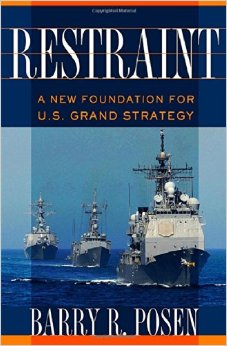
Into this world came the necessary backlash. Mearsheimer was the first big name to be raising the specter of necon/liberal hijacking of the American strategic establishment, and others have followed in his place. I myself went from a history undergraduate to a IR postgraduate because I wanted in on the backlash myself. One of the most recent is Barry Posen, whose ‘Restraint: A New Foundation for U.S. Grand Strategy‘ I have just finished reading.

I am not going to go through his arguments point by point so much as to point out what I see as the gist of them. Posen sees, like Mearsheimer, the United States as by far the most capable power in world history. But even this realization does not mean it is an infinite and eternally expanding world-changer. It still has limits, particularly if it wants to spend money on anything aside from defense. And these limits mean it can choose between a shaky, unstable but all-pervasive hegemony or a stable, easier, possibly less dangerous limited posture on how it sits on the throne. No one calls it this yet (that I know of) but for sake of description we could refer to this alternative method as ‘Hadrian’s Seawall.’

Posen is particularly focused on the lackluster role of America’s main allies, who are happy to save money by getting a free ride on the United States’ largess. This is hardly a new observation, but it is a valid one. Countries that face legitimate threats would have to raise defense spending with a U.S. scale-back. More ambiguous ones might decide a new ally is in order. The question is, to retain dominance how many of these allies does America need? Clearly not Georgia-even Bush wouldn’t intervene there- and now its disgraced former president Mikhail Saakashvilli wanders Brooklyn as yet another out of state trust fund hipster. No, really.

What struck me most about Posen’s work is that many of the signs of this scale-back already seem apparent on many fronts. The Obama administration has begun the much vaunted ‘pivot to Asia’ in strategic priorities, and despite nebulous expansions of black ops in Central Africa and Yemen there are noises from policy makers that the Middle East is to be reduced in priority, and the oceans-especially of the Pacific and Indian-will be focuses of the future. But there is at least as much backlash to these necessary structural readjustments.

This is where I found flaws with Posen’s work. Overall, I liked the book and think its necessary reading. What he neglected to do however is to examine *why* people oppose the necessity of his ideas at least being injected into public debate. He gives too much credit to his opponents in assuming that they care about strategy, their country, or even are thinking rationally. Maybe I shouldn’t be hard on him, after all, deconstructing the motivations behind bad strategy is my niche (maybe in the future, I hope) so perhaps he left me a gift. But one of the curses of mainline realism is that it assumes policy makers are rational actors or that domestic concerns don’t influence their strategy as a dominant concern.

In this case I think both of those factors are at play. Many in the business community benefit from U.S. influence expansion even if their own country does not. Think what America got from the Iraq War-now compare it to what Haliburton got. There is still loot to be gained from regime change, even if soldiers are no longer allowed to ransack homes. Once upon a time raids were launched by poor countries against rich ones, nowadays that paradigm could be said to have been reversed in many case studies. There are resources which the removal of a strong (if nasty) state opens up. Even state breakdown and chaos creates non-state actors which can be influenced through bribery. Hell, even some benign NGOs would be bereft of donations without new trendy conflict zones opening up, though obviously they do not hope for these invasions in the same way some private entities do. Such non state actors wield great influence over lawmakers, and so push for more hawkish policies. In D.C. connections are everything-and who is better connected than a lobbyist?

But even this, I think, could be reigned in as it requires cooperation from people who do not benefit so much from this arrangement. Even the media’s most milquetoast commentators are wising up to this. Alone, it could not mold policy in such an overt way. No-there is another ingredient missing: True Belief.

Faith is a hell of a drug. And the truth is, given the (relative) transparency of the American system you could not get average people to go along with securing diverse resources for increasingly international companies unless many of them truly believed that they were doing good. Indeed, that it was necessary and if we don’t do so we will have to fight them over here…or something.

Officially, legally, and constitutionally America is not a Christian nation-and certainly not a specifically protestant one. But culturally that is still the dominant attitude in society. A strident missionary creed is held by leftists and rightists alike, the religious and the secular, but through it all is this idea that ‘Our values are righteous, the world is black and white, and we are the ones to win it for the light.’ Needless to say this trope treats all fights as worthy, moral, and on a higher level than base strategic interest. It is a view so ingrained very few are immune to its apparent charms. This had always been a part of the American character, and the era of isolationism merely meant it was often directed elsewhere, but it was fully unleashed in the 90’s onto the foreign policy world.

But that hypnotic gaze which has attracted so many is that of the gorgon. It is outside the scope of this blog to debate whatever merits this view has (or doesn’t) on domestic or philosophical points alone, but on foreign policy it is nothing but a stumbling block at best and a deadly poison at worst. Many policy makers behave in ways which eschews long term thinking for short term applause lines. Pessimism (a vital ingredient in strategic thinking-perhaps a separate post later on that topic) is eschewed for saying the right things about ‘American Exceptionalism‘ or the blind faith in democracy and free markets to fundamentally reshape the world. Of course, the world doesn’t move in a clean linear path. Alliances, revolutions, social and economic trends, all of it creates reactions and counter-reactions. A despotic country becomes a democracy and a democracy can become frail or unstable-necessitating a despotism replace it. Powers rise and fall. History has shown every example of someone claiming that ‘now everything political will be different!’ to be a charlatan or unhinged. There are indeed things to be learned from history, and one of them is the fallacy of declaring it over. It usually comes down to famous last words before the tragic overreach. America is no more capable of being the missionary who attempts to recreate the world to reflect their values than Britain, China, or Rome were in the past-and the last two of those were so successful in the long term because they actually made no attempt to impose universal order outside of their cores anyway. It is merely the ultimate of superpowers-an extremely impressive achievement but one whose effects are still tied up in the greater world’s histories, rivalries, and passions. No matter how powerful, a country younger than many of the rivalries it seeks to police is not going to have any insightful or positive impact in remote conflicts outside core interests. Yet many remain convinced that this is necessary if even just for the self-esteem of the state itself. It is often an emotional and irrational commitment.

In addition to finishing Posen’s book another thing happened today in the realm of politics by the way:

Hillary Clinton

Which could very well mean that as necessary as a discussion on U.S. strategy incorporating the ideas of ‘Restraint’ could be, we are likely to see a race where all the major contenders are, to varying degrees, in the neoconservative camp. Right now, the signs do not look great for an open or refreshing debate on geostrategy in either political party.

There’s One Thing I Haven’t Heard Yet About the U.S.-Iran Deal….

US-Iran deal

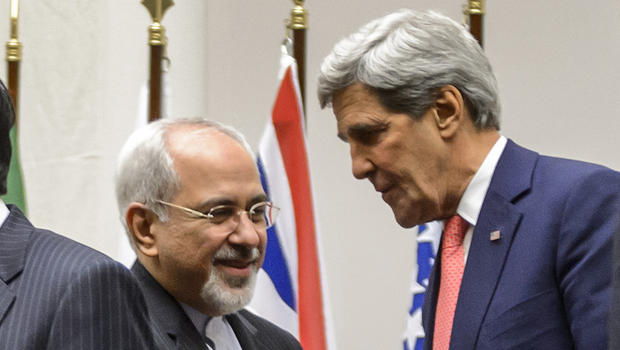
You can hear the discussions and the debates already: ‘A Major Middle-Eastern Re-Alignment’, ‘The Dawn of a New Era’, ‘From Foes to Friends?’ and on the litany of predictable headlines goes. And it is true, no matter what the future holds this was a big moment in the relations between two countries who have oscillated from low-intensity Cold War to outright hostility and back and back again numerous times since 1979. But now both sides realize the commonalities of interest outweigh the still substantial disagreements and there will at least be an attempt to deal with it. Whether or not it will be successful only time will tell. But hopefully it will be. Both nations share an enemy in combating Sunni extremism, which has much more global appeal and violent credit to its name than any corresponding Shi’a movement. In fact, last month U.S. airstrikes supported Iranian backed Shi’a militia offensives against Daesh (ISIS) in Iraq. Nothing like an even scarier foe to bring to former enemies together.

The question will be if this rapprochement is temporary or long term. Iran also wants more diplomatic options, an end to sanctions, and greater levels of flexibility than to be forced into becoming a junior partner with Russia. The U.S. on the other hand no longer has the will to bluster about constant large scale conventional intervention and also needs more options in the region-particularly if it is going to downplay its presence in order to focus on the far more important (to Washington) Asia-Pacific and possibly even European spheres of interest. It may also be desirable to remind the Saudis and Israelis who is boss in the relationship with Washington, but good luck getting anyone to acknowledge that in any official capacity. Both sides have a lot to gain and even more to lose. Nothing is settled yet but the gamble just might be worth it. After all, look at Yemen. A Saudi led coalition as well as (allegedly by some but unproven so far) an uninvited Israeli guest are stepping up bombing runs on Iranian-aligned Houthi rebels who are making gains at the expense of the government. Now this is a wild card for both parties as it introduces independent action from their allies separate of their own negotiations. It is so convoluted that it actually has captured a fair amount of media attention relating to the talks-as it should.

But one thing I am so far not seeing mentioned, except in passing, concerns less about new-found chumminess in Iraq against a common foe or even the dangers of the situation in Yemen, but rather the still ongoing and far more deadly than either of those examples Syrian Civil War.

When the war began there was no question as to whose side Iran would stand on. Syria under the Assad family was a die-hard Iranian ally, all the more important for really being the only one. Naturally, this meant that the United States and its allies jumped on the rebels bandwagon (this was of course those dark and far off days of 2011). Syria also of course had close ties to Russia (The Tartus Naval Base in Syria being Russia’s only external military installation not in a part of the former U.S.S.R.) and a quite obvious minefield of ethnic and sectarian divides. All of this made direct intervention a la Libya not an option. But short of invasion or no-fly zone, the U.S. and Iran went to work on a proxy conflict as the once sealed Syrian state splintered apart.

The problem of course was that so did Saudi Arabia. In fact, nations like Saudi Arabia and Qatar were much more gung-ho about such an intervention than even the U.S. seemed to be (neoconservative fantasies of then Secretary of State Hillary Clinton aside). The extreme form of Islam often championed by elements within these states, coupled with the fact that the Assad regime had long since made alliances against the majority Sunni population of their nation with many of the various other minorities basically guaranteed a particularly nasty division of society. Something that the Iraq War should have given the U.S. foreign policy establishment much more pause when contemplating entering the fray.

Once it became apparent that the Syrian government would not fall quickly-or perhaps at all-radicalization within the rebel movement was pretty much a guarantee. Gradually, the Islamist elements became a larger and larger part of the Syrian opposition, to the point where any hopes of a moderate-only victory became about as likely as a Green Party candidate winning the American presidency.

I remember watching the early stages of the Syria conflict unfold as a doctoral student familiar with Syria’s general demographic makeup. My first thought was ‘if the government doesn’t crumble in a month or two this is going to be nasty on all fronts-how I hope the U.S. doesn’t interfere!’ But so it happened. How much of an effect this had on the war is debatable, but once the war was guaranteed to be long it very much served U.S. interests to hope the regime-yes the Assad one-would be the faction which emerged triumphant. Rebel victory increasingly looked like a scenario where the price of getting rid of one family and their nepotistic gang would demand a terrible price for ethnic and sectarian minorities alike, not to mention the empowerment of religious fanatics who respected no borders. And yet, the American foreign policy establishment still hedged its bets with the rebels who at best could deliver only the most questionable gains in the form of Iran having to spend money and arms on aid to Damascus.

Perhaps the United States realizes its errors on this issue. Perhaps not. But this brings us back to the recent Iran-US talks. Iran and Russia are the only state level external actors that pull weight with the Syrian regime. It would be wise-if the U.S. wishes to take back its Syrian mistakes-to be using those secret talks in order to negotiate something on Syria, namely to agree to stop any indirect support for the rebels in order for something else.

Considering the way things can go in such negotiations, it would hardly surprise me if that ‘something else’ was acknowledging Iranian influence in Syria and maybe even assisting them against Daesh there (where they are even more entrenched in than in Iraq) in exchange for Iran agreeing to make its Shi’a militias in Iraq loyal to the Iraqi government at least once the current conflict is over. Or it could be for Iran to have its proxies hold off from hostility with the Kurds. This is of course speculation, but its the kind of deal I would strike. If it is not that, one suspects Syria still comes up, and that the U.S. could very well be looking for a face-saving way to distance itself from that country or for further collaboration between all parties opposed to Daesh-something Iran could very likely provide.

Simply because this is the one issue being sidelined by the media covering the US-Iran talks makes it by far the most interesting one to me. If indeed this is being actively discussed the ramifications of it could be as big as any nuclear program or shift in alliance networks.

Anyway, have a pretty jumpin’ propaganda song.


Edit: 4/13 to clarify that the claims of Israeli involvement in Yemen are so far unsubstantiated.