Politics is Not a Safe Space: Neoliberalism and the Electoral Race to the Bottom


Poverty Rates in Appalachia, 2007–2011

Outside of self-imposed social media bubbles, history is not progressive like technology. While the march of technology changes how societies evolve in ways that no two eras are ever really the same, the cycle of the rise and fall of governments, regions, and classes continues with a somewhat random yet patterned process not dissimilar to biological evolution-itself not a progressive process in any demonstrable way. When I first reached adulthood and began to study history at the college level this was a harsh lesson to learn. In America and other countries like it we are fed a steady diet of individualism and liberal idealism from an early age. We want to believe, as the Puritans once did before they consumed themselves and burned out as a culture, that  we are at the forefront of a new era. We want to think history can be guided in such a way as to be manageable for everyone. This ignores that politics would not exist if convergent interests greatly outnumbered divergent interests. Most importantly, it ignores Ibn Khaldun‘s most prescient observation: that complacency breeds decline, that the losers of history often deserve to lose, and that the winners of today are the losers of tomorrow. It is the very act of winning that can be the most dangerous thing of all.

The Democratic Party at the national level became this complacent ruling elite, even while they kept losing house seats and state governorships. They had a bland faith in demographics and this restricted their campaigning only to certain swing state’s suburban enclaves. This strategy cost them an election they probably should have won. Women were assumed to be a safe bet, but white women ended up favoring Trump. Minorities were expected to just show up out of a sense of obligation and duty to a party that does not overtly hate them, Bill’s mass incarceration and drug wars and Hill’s ‘superpredators’ aside. The threat of Trump was supposed to keep the Obama coalition together. But the Obama coalition was first forged in a democratic primary against the Clintonian status quo. Even eight years later, it could not so easily flip to supporting that. Clinton did worse with all minority groups than Obama did, Trump did better than Romney with them. This is a massive failure on behalf of the Democratic Party.

The seeds of this failure were sown by Clinton. Not Hillary, but Bill. When Ronald Reagan became the first partially neoliberal president and Thatcher rose to power in the UK the mantra to their deregulation and free trade deals was ‘There Is No Alternative’ (TINA). The defeated left of center parties took heed and decided two could play this game. This led to Tony Blair and Bill Clinton. Clinton would soon outstrip Reagan in his zeal to adopt the newest faddish ideas of governance of the post-Cold War era. The new Democratic Party was a party of globalized cities, and while big coastal regions thrived due to a complex combination of factors not necessarily related to these policies (Chinese growth, the arrival of the internet, etc) the rural areas of the country were written off as irrelevant to the future. Abandoned, left to rot, and with the government slashing domestic budgets for infrastructure and welfare, places like Appalachia withered on the vine. They were sacrificed on the altar of neoliberalism by a two party system in thrall to it. And nowhere was the betrayal bigger than Bill Clinton’s policy record. If you need proof, look at electoral maps from 92 and 96 then compare to 2000. So many states that backed Clinton against the Reagan-Bush consensus went to Bush Junior once Bill’s terms were up. Meanwhile, people took ‘thinkers’ such as Francis Fukuyama and Thomas Friedman seriously despite the blatantly historically ignorant Kantianism they peddled about the end of history. History, however, has a nasty habit of never ending. This ideology was remarkably self-congratulating to the ruling class and their middle class henchmen in large cities, most of whom were liberals. It told them that the values they had been raised with were fundamentally correct, and that by living those values they were making a positive difference in the world, and that by merely thinking the right thoughts and using the right language they could make the world a better place. It may only now be becoming apparent to most of those people that this was delusion, but I have to say, I always saw this as delusion. So did others, but those others were shouted down consistently as being ‘unreasonable’ or ‘not serious’ or ‘not with the times.’

Had Dubya not had the good fortune to be president during the most massive terrorist attack in American history he likely would have been a single term president. He was able to use security issues to further ramp up the neoliberal drive which was now securitized. When asked during the surge of patriotism after 9/11 what the average American should do, the Bush administration responded with ‘go shopping.’ Civic responsibility was sought by the people only to be met with more market fundamentalism. The vagaries of a supposedly logical global market was not only now in charge of domestic policy-it ran foreign policy as well. Here the strains and cracks in the edifice really began to show. The blithe predictions for Iraq bore bitter and contradictory fruit. The war itself became so toxic it cost Hillary Clinton the democratic nomination, rightfully, and the Republicans the general election, also rightfully.

Obama ended the most odious influence of the evangelicals on domestic policy and reigned in (though did not significantly reduce) the neoliberal/neoconservative drive on foreign affairs, but while he did not accelerate the objectives of neoliberalism at home, he did absolutely nothing to stop them. He failed to undo enough of the odious Bush legacy but ironically was able to scale back many worst excesses of Clinton era policies such as Don’t Ask Don’t Tell, The Defense of Marriage Act, the fever pitch of the War on Drugs, and the massive deregulation of speculating financiers. Even the affordable care act, which I admit I have directly benefited from, was really a gift to insurance companies and further entrenched the for profit civics model this country has adopted since the 80s.

Appalachia, non-farming rural enclaves of the midwest and south, and significant chunks of remote regions continued to suffer and be neglected. Rather than appeal to these people who obviously have nothing to gain from Republican theories of governance, the Democrats wrote them off as irrelevant and cast blame on them for supporting many of the policies the democratic party itself once espoused. Obama won by getting people in Florida and Ohio to recognize the horror of Bushism, but all the while the Democratic Party did nothing to substantively address many of those concerns. And yet it expected, if not demanded, people vote for them anyway. Worse still was their liberal minions outside of the party who assumed that what was good for New York City (where both campaigns and most mainline media were headquartered, it should be noted) was good for the country. They also assumed that the neoliberal consensus and the bland liberal language it used for legitimacy was not the problem-just who managed this consensus was. For a decade I have tried to convince people this was not so, and I and many people far more famous than I failed utterly in the face of this delusional alternate reality by the 21st Century bourgeoisie. We warned, correctly, that if a smart alternative to this hegemony was not presented than a dumb reactionary one would be. Trump is a new Obama, electorally speaking. He built a coalition of those dissatisfied and in so doing showed the fragility and unpopularity of the status quo.

Is this to discount the role racism and possibly sexism plays in these regions? No. And it is precisely those factors that made it important to control the backlash against the bipartisan financial interests in America. Having failed to take heed from the more observant people on the left and even the occasional clever paleocon, the liberals and centrists sowed the seeds of their own destruction. The best they could hope for was meliorist Clintonite ‘triangulation’, and this became increasingly unappealing to everyone. As it is, identity politics has clearly failed. The world is not a safe space, and a bunch of liberal theorists ignoring actual material and structural issues, writing off class or in fact actively being classist (especially towards people who do not live in cities) is an ideology for the complacent and lazy and nothing more. This is further shown by the fact that these people only get fired up about the presidency and never really bother with midterms. It is a testament to the intellectual bankruptcy and irrelevancy of 21st century liberalism that people sharing JK Rowling quotes and suggesting *all* opposition to them must be rooted in prejudice of some personal identity is assumed to be ‘woke’ and that the solution to this is some sort of vague ‘awareness’ and moralistic posturing. The fact is, liberals are not intellectually superior to conservatives and they never really were. I may find them personally somewhat more palatable largely due to social issues, but I see both of them as deeply complacent ideologies that avoid critical thinking in favor of sounding righteous and upholding some form of doctrinal status quo. People arguing for political discourse on college campuses to be made as safe as their parents suburban mcmansion are not people talking about real issues that impact people in real physical space. People who do not have the privilege of being perpetually outraged by the casting of movies or a dumb joke because they struggle to survive are not won over by this middle class fatuousness. Navel-gazing is for those who prioritize their personal feelings and the liberal concept of individualism and virtue signaling becomes a form of self-branding regarded as superior to civic responsibility. Worst of all, and as I once warned, this tip to identity politics was inevitably going to picked up by the other side, the side who deals in overt race baiting. This has been my fear ever since I first learned of politics via identity back in college. Liberals cannot castigate rural whites for being identity voters when they so clearly opened that door of political acceptability for them. Like imitates like, and under neoliberalism they both spiral down together in a race for the basest form to turn out the largest amount of famously ignorant undecided voters. It is, after all, the logic of free market capitalism that one’s civic duty exists for purposes of self-fulfillment. This is an ideological point no other successful society has ever engaged in, probably because it is blatantly untrue.

What is most insufferable is the liberal pretense to great wisdom merely by *not* being conservative. It is a low standard, and when you set such low standards it drags both sides down. Much in the same way that Clintonism made the Democratic Party abandon the working class and its union core for faddish ideology and therefore lost much of its traditional support. The SensibleSerious consensus creates a large swath of disaffected voters with nothing to lose. Both parties, working together, made this happen. Both parties, in their own way, will suffer for it. So will the country at-large, who had much less say the implementation of these policies.

And that brings us to the centrists, a group of people who I have previously made my feelings of intense disdain quite clear. Since Bill Clinton, the liberals have basically meshed with the center with the partial exception of immediately after 9/11. But the center is a place of laziness which always represents the current status quo-and these days that status quo is an ecological and regional destroying neoliberalism. Now, back in Bill’s day this was a new thing worth giving a shot, but no longer. It is dead. Even if you support it, you must acknowledge that. Brexit and Greece were merely the precursors. Want electoral proof? In all the post-Bill presidential elections the candidate who was a less doctrinaire neoliberal won over the one who was more. Or to be more specific, centrists always lose in the 21st Century. Gore, Kerry, McCain, Romney, Clinton (II): all the more traditionally centrist candidates. Centrism isn’t just intellectually sloppy, its a recipe for losing as well. No one likes centrists, and given their record in this century, no one should. In primaries this was especially obvious. Hillary Clinton’s perpetual running on the presidency and career as a milquetoast senator striking unsustainable bargains with a loathed two party system smacks of Henry Clay, a historical figure no one admires any more nor wishes to emulate. The democratic party itself reminds me of the Whigs-an unstable coalition that devours opposition movements with actual ideas in order to present a bland front against the party that holds the initiative.

There is a final key to Trump’s victory people might talk about later but haven’t so far that I have seen: endorsements hurt and castigation helps, *especially* from the media. The late night comedians which were so entertaining and good at poking holes in the paranoid post-9/11 consensus did not keep their credit as those who speak truth to power, but rather became establishment cheerleaders. They sacrificed their vital role as the opposition for one of a deeply partisan cheerleader. As these various talk show hosts and actors lined up to condescendingly urge people to vote for the democrats they unintentionally aided the narrative that the media was all for Clinton, that the ruling classes controlled everything to get the result they wanted. It is B.S. of course, plenty of the ruling class supports Trump and he has no trouble attracting upper income voters. But the comedian/actor axis made it an obnoxious reality that people in affluent cities wanted something, and considering their previous track record on what they want and how those policies effect other parts of the country. If one wanted to, say, ‘Make Comedy Great Again’ it should go after the entire system, not just one half of its Janus-face.

America does not deserve Trump as a whole, but liberals and conservatives do, and neoliberals especially. They made him by creating the conditions for his rise. If history is a guide however I do not expect them to learn this lesson as they never have before. Instead, they will lash out at everyone they can to avoid taking personal responsibility. They will fail to recognize that it was their candidate’s record, not her gender (though it likely played a subsidiary role), that was the primary reason for her loss. They will probably blame minorities for not showing up to vote, rather than themselves for not giving much of a reason for said minorities to vote as they had before. The smug condescension of Manhattan and Los Angeles returns to its traditional role as reflexive defense mechanism. People like me who saw the dangers lurking in this neoliberal system will be the ones they will blame for their own failures. I cannot count the amount of times that I personally got talked down to on issues involving minorities by people who are entirely white, affluent,  and straight. I am none of those things. I fear what might happen in a Trump presidency as much if not more than these people-but this did not happen in a vacuum and it was the liberals who were at least half of the enablers.

But this potential for at least intellectual and grassroots organizational upheaval will be surrendered and sacrificed to the right alone if major changes are not made to the dark and desperate future of having Henry Clay liberals be the primary opposition. Ironically it is the America-First candidate who has destroyed the myths of American Exceptionalism once and for all by making our right wing so blatantly European. That honesty could at least free up all sides to be more intellectually rigorous, not just one. But that requires looking beyond the consensus of the SensibleSerious™.

FOREIGN POLICY:

American elections are important to everyone, so it was worth talking about on this blog. But this is a primarily foreign policy blog and so we should now deal specifically with foreign policy issues. This is no mean task given the many contradictory statements Trump has made.

The most important and concerning thing is the cavalier attitude Trump has regarding Asia-Pacific relations. The most important countries in the world for U.S. interests are in that region and the second and third largest economies also dwell there. Hyper-nationalism and territorial disputes are legion. And no matter what the British say, the U.S.-Japan Security Agreement is the world’s most important and stable alliance. It comes closer to the bedrock of global stability than any other bilateral relationship. It is also unique in modern history for bringing together two countries which are so globally powerful for so long. Trump has been openly dismissive of this alliance, asking why the Japanese do not pay for themselves, when in fact they have been quite good at doing so. In fact, Japan payed most of the expenses of the first Persian Gulf War.

The status of this alliance is the most concerning foreign policy issue of a Trump presidency. Coupled with a trade-tariff war with China it could be a recipe for disaster. One fear I can at least tone down, however, is that of Japan acquiring a stronger and more autonomous defense. This has been in the workings for almost a decade. A great power can only be governed like a banana republic for so long. For obvious historical reasons Japan may prove more reticent to acquire a nuclear deterrent, but I do not believe it would be inherently destabilizing if it did so. Still, the alliance should be maintained.

In China, Xi Jinping is a far more intelligent leader than either Clinton or Trump, but especially Trump. It remains to be seen what opportunities this might open up to to the PRC, if any.

Europe represents opportunity in equal parts to danger. A vast over-estimation of Russia’s conventional capabilities due to a few flashy brushfire victories over smaller armies in remote theaters often guides American grand strategy, but Russia probably could be contained so long as Germany, France, and Poland stick together. Especially so if the UK stays with them, but that is less certain as we see how Brexit shapes up. The most likely reason Putin wants Trump is not some childish liberal conspiracy theory of Manchurian candidacy but rather because he expects he can run circles around him at the negotiating table. It is ever so slightly possible that some kind of mutual bargain could be struck between the two Bros-in-Chief.

The one decided potential benefit here is that Trump will probably be better than Clinton in the Middle East and possibly Africa as well. Gone will be the tone of the preaching humanitarian racist that has bungled US policy towards Africa for decades and driven important countries into the arms of the Chinese. The expansion of AFRICOM might get a more critical eye-though that remains a big maybe. Most importantly, the odds we will attack the government of Syria have gone from somewhere around say 70% under Clinton to about nil now. This is the only true demonstrable gain I can see from this election in either foreign or domestic policy for the average person-but it is (potentially) a gain. One of the few issues that Trump was consistently right on was the need to go after ISIS alone and not fight 3 sided conflicts where our intervention is not needed. Considering how utterly disastrous, deadly, and expensive 21st Century regime change policies from Iraq to Libya have been, with unintended consequences of causing surges in terrorist attacks (which in turn fuel the far right) this could be a truly concrete benefit not only for foreign policy people like me of the realist persuasion but in breaking up the neocon establishment in DC proper.

So us geostrategists have to be even more wary than usual in the near future. Uncertainty is high. But there is hope for some new ideas and a re-orientation of a neoliberal hegemony quite long in the tooth to keep representing U.S. (and others) strategic interests. That vague hope does not, however, allay my fears for various minority communities in this new era. But as there was a big backlash to Bushism on social issues that ended up winning the argument far more effectively than Democratic meliorism would have, so too that fight should never be given up. Let this be the shock to renew it with vigor rather than simply wait for the mythical liberal fairy tale of ‘inevitable progress’ to happen. Those of us against the rising global tide of reactionary identity politics can have a bright future indeed if they reject neoliberalism, complacent cosmopolitanism, ‘woke’ classisism, and the other faith based homilies that got them in this mess in the first place.

Completely Off Topic Revelation

I am sorry for this. I do try to keep the blog on topic, even if sometimes I stretch it, but I just realized something that was simply too good not to post for posterity. It is a theory about annoying television commercials.

Here is the theory: 10-15 years ago a bunch of not-so talented art kids became film majors because they were really into Wes Anderson/Zach Braff/MPDG/faux art house twaddle with yellow box-segmented posters, and imagined in the future promised to them by their special-snowflakitude would enable this to happen. However, the economy tanked and QuirkyTwee was rightly acknowledged by anyone with taste to be insufferable hackery.

So what did all these rejected artists do? They made commercials.

And that is where the all the annoying commercials with ukuleles and whistling come from. Also the background music for annoying clickbait viral videos about people with man-buns trying new foods in front of a camera.

See, historical context does matter for understanding things that happen in the present!

So Far, Only North America is a World-Island

north_a_satellite_orth_nasa

I always had two historical loves which won out over all the others. Sure, there isn’t a time and place I can’t not find interesting or even devote significant amount of time to reading up on, but my true loves that beat all the others are Eurasian nomads and Native American studies. So it has been since my teens, and remains so to this day. Just today I realized a concept I learned in the study of one might make more sense applied to the other.

When I made the transition into International Relations I became aware of geopolitics. There was a lot to disagree with as well as agree with and parsing through the gems from the coal became one of the purposes of this very blog. Even the founding article of the field, Mackinder’s ‘The Geographic Pivot of History’, is so full of holes a knowledgeable person can leap through with space to spare. But this first halting step did create new and interesting discussions in policy circles back in its original context of rampant Russophobia in Britain and the Anglo-Japanese Alliance and Russo-Japanese War which was occurring at the time of its publication. Though that war would show that the Romanov Dynasty had feet made of clay and that Germany was Britain’s true rival, the core thesis had one very stark and obvious insight: that Eurasia was rich in population and resources and the closest thing we have to a super-continent right now. Thus if one power could dominate it, it would truly be unstoppable and quite possibly unassailable. If anything, Soviet defense in depth and being able to shuffle resources back and forth from frontiers with Germany and Japan in response to changing circumstances lent the theory some real world credit in the Second World War. It certainly interested Cold War strategists in the NATO world.

Nowadays, it has spawned a quite bizarre, almost theosophist-mystic form of geopolitics in Russia. Alexander Dugin, a kind of Blavatsky-Evola-Rasputin hybrid creature, waxes poetically about Russia’s need to directly annex a variety of countries and regions and apply them to some kind of fascistic definition of Eurasian solidarity that would have made the tolerant and flexible Mongols he claims to idolize sneer in contempt. But that is a different subject from this post. Brzezinski’s book ‘The Grand Chessboard’ shows the American take on the subject is still here as well. The point is, whether for good or ill, World-Island Theory (the term for Eurasia’s central role in geopolitics) is still strong. And while I hold the central observation of Eurasia’s massive importance to be largely correct, I dispute that it has yet to achieve its potential. North America, on the other hand, already has.

comanche_osage_fight

In a great irony of prehistory, the horse, which first evolved in North America, would end up going extinct there while the Eurasian migrated branches of the species would survive, thrive, and go on to play such an important role in human history. The Americas, by and large, are severely lacking in indigenous domesticated animals which can be put to human use. Jared Diamond’s ‘Guns Germs and Steel’ and Charles Mann’s book ‘1491’ goes further into detail into the science behind this observation, as do many other works. The point is, lack of such beasts hampered both mobility and disease resistance, as this is mostly acquired through close contact by living with domestic animals. As it was, when horses returned they quickly went wild, almost as coming home. The Plains tribes rose to a massive gain of power projection and living standards practically overnight in the late 17th and early 18th Centuries due in no small part to these creatures. All this despite already have suffered through waves of depopulating plagues. By that point it was too late to undo the effect of thousands of years of their absence, but the rise of the Comanche Empire, which would humiliate the frontiers of New Spain and then Mexico for over a century despite a calamitous demographic situation for the Native population speaks volumes.

Imagine, if you will, a world where horses never died out in the Americas before being reintroduced by the Spanish.The percentage of the land taken up by the Great Plains is far larger, proportionally, than the great Eurasian Steppe, where the nomadic people there did so much to spread trade and technology from one end of the land mass to the other. One suspects it would be a realm of large empires and thriving trade cities connecting the eastern forest and river peoples to groups far further afield than they otherwise would have direct contact with, such as the Tlingit, Haida, and other Pacific Northwest peoples who had probably the highest living standards of the pre-industrial world and (possibly) a few tenuous trade links to Asia. The greater effort of technology and commerce travelling north-south as opposed to east-west (due to more shifting climate zones) could be overridden by the massive interconnectedness of the Great Plains under nomadic empires. As it was, even with the tragic and utterly unnecessary genocide and driving to the periphery of the Native peoples of North America, a small collection of fractious colonies on the eastern seaboards of both the US and Canada would find a rapid expansion followed by an intense interconnections of resources and peoples-first through rail and then through interstate highways. Now, cheap domestic flight seals the deal.

As with all things geopolitics, this is not permanent. It is the interplay of social sciences with the physicality of geoscience and geography that really make the discipline when it is being thorough. One dominant state in the center of the landmass with cordial relations with its two neighbors is not a permanent situation…but it is so far the most ideal conjunction of forces for the wielding of great power politics on a global scale than has ever so far existed. Control of the North American world-island means the security to build bases and dominate trade routes around the entire planet. The British had no defense beyond their navy in a multi-polar Europe, the Mongols were a small minority who ruled with a relatively light hand, and the Spanish came into such a glut of wealth they suffered hyperinflation and became prey for other countries’ pirates. So far, out of this group, only the United States has equaled if not surpassed the Mongolian geopolitical achievement.

Good North American strategists see that it is the ocean that is both the highway and the fortification protecting this remarkably secure and wealthy apparatus from Arctic to Panama Canal, bad ones overextend themselves dangerously into Eurasia and Africa. For North America (specifically the United States as the core of this order) to re-learn the strategy it has lost through smug complacency since the fall of the USSR, some kind of American Maritime Focused Hadrian figure is necessary. Right now there is no such thing in the running for leadership…though Congresswoman Tulsi Gabbard points to a distinct possibility for the future.

It seems such a waste for such a conjunction of positive forces to be squandered on nation building outside of core maritime connections. Not to mention the human cost of many of these ill-fought out interventions. Perhaps in the future I can write a post about what allies are actually critical to the American edifice. North American geopolitical thinkers also need not fear about Eurasian unification, it is much larger, much more divided (both geographically and culturally) and could only be unified under circumstances that do not presently nor could foreseeably exist in the near future. Eurasia, in the end, is actually a super-continent build for balance-of-power politics, not so much hegemony. After all, when various Chinese dynasties were the leading scientific and technological forces of the world, they still could not meaningfully exert this dominance too far afield. So long as powerful maritime states exist outside of Eurasia, they cannot make such an attempt in the future. The large populations of South Asia and East Asia are not coming together anytime soon, and even a demographically challenged Russia is still playing the game. And even a Eurasia-dominating empire would no longer necessarily be able to overtake a stable North America that retains its decisive role in South America. The cumulative sea-surrounded landmass of the Americas, no longer as hampered by climactic variation and choke-points as it once was, could verily be the real super-continent for strategist of the future to ponder on.

None of this is to say that North America will never split apart. The Washington DC hegemony splintering or becoming a Byzantine rump state is always a possibility, causing the political geography of North America itself to create its own states in the Northeast, Appalachia, Southeast, Plains, Rockies, and northern and southern West Coasts-to say nothing of Quebec, Mayan populated parts of Mexico, and all the many other possible conjunctions. States are like people, they have various and finite lifespans. And like the super-continent cycle itself, division and unification of landmasses under specific rule comes and goes from one to the other. This should make it all the more important that strategists in Washington, Ottawa, and Mexico City make the most of what they have now and not through it away on an altar of faddish economic and political theories which exist to self-congratulate the ruling class. The present order of world affairs is not a product of such forces, but rather of smart strategy applied to fortuitous geography. A world-island, if you can keep it.

Aleppo is the new Kony2012, or Against ‘Awareness’

machiavelli-offended

You have seen the tragic photographs from Syria, though if you primarily get your news from television you probably only see the ones from rebel held areas. This gives you feelings, as it should if you are not a sociopath. It does not give you context, and it does not give you knowledge to make meaningful determinations on the conflict on its own right.

In 2012 I was an academic working towards a doctorate in International Relations. Most people are apathetic on foreign affairs, which is fine, so long as they do not vote based on this apathy. Usually, they did not. Then suddenly we were bombarded with desperate cries of ‘Kony! He has a child army! We have to do something!’ These cries, and the breifly famous documentary (partly made by evangelicals, it should be noted) contained blatant context-free arguments and even built up a threat that was long out of date into some kind of fashionable cause. This is the difference between ‘Awareness’, as it is commonly called, or perhaps being ‘woke’, and actual knowledge. Knowledge requires research, going deep, understanding structural issues and context. Knowledge is hard but rewarding, Awareness is easy and shallow.
Anyway, yesterday Gary Johnson made a legitimate ass out of himself by not knowing what Aleppo was. No dispute there. A serious knowledge fail. One I will not defend nor should even really be defended. But it has become a major rallying point by SensibleSerious™ types to defend the validity of their increasingly death spiral-ing two party system. You know, the political system that perpetuates massive levels of divisive ignorance in the first place. This, I find, to be as much as exercise in ignorance as Johnson’s lack of current event understanding.
 
Gaffes like these act as an excuse for those who fancy themselves informed but often are in fact anything but to crow on about something they themselves know practically nothing about save ‘bad things happen there and golly gosh we should do something so I can feel better’. It is an attempt to paper over the cracks in the facade they have built about being informed. Because it is not knowledge that these people prize but rather the *pretense of knowledge*. The much vaunted value of ‘awareness’ is merely a means of paying lip service to a concept without doing the actual work to understand it. But outside of name-dropping their knowledge base this is no better than Gary Johnson on anything requiring facts, context, or more than a superficial understanding. Effectively, it is the collection of a vocabulary for the sake of appearances in snarky tweets or cocktail parties, not the acquisition of knowledge. It is the acquisition of pretense of knowledge alone and nothing more.
And in this regard, Johnson is actually superior to many of his critics. He did not duck or dodge around the issue, he flat out acknowledged he had no idea and asked about it. For a politician in America that is actually commendable. Meanwhile, in order to explain it to him the news media which supposedly prizes itself on global affairs knowledge, made itself look like even a bigger ass than Johnson in attempting to explain what Aleppo actually was.
 
I have followed the Syrian Civil War since its inception. I am informed of the various actors and alliances. I have knowledge, not ‘awareness’ and analysis and research, not just feelings. The major party candidates may be ‘aware’ about Syria but both have actively terrible plans they would execute regarding it.And let me state this bluntly to Bill Maher watching New York Times op-ed reading bien-pensants: I can criticize Johnson’s ignorance…but you can’t. Your superficial awareness isn’t part of the solution, its part of the problem.  It might even be better if you stopped being ‘aware’ and stuck only to topics you were willing to actually engage with beyond talking points. To engage with no knowledge is worse than not engaging at all. Look at how congress voted in the run up to the Iraq War on the promises of faulty intelligence. For many, not engaging at all may in fact be the best case scenario. For all of us, in fact.
Perhaps what our society needs is less of this awareness, not more.

Speculative Materialism and International Relations

eagle transformation mask

Eagle transforming into Sisuitl mask (by Richard Hunt)

‘[You humans] are not as free as you think you are; your cleverness and pride bind you to the truth. Don’t you see what you are doing to us and yourselves?’ ~’The Animal’s Lawsuit Against Humanity’, 10th Century Iraqi Fable.

Over the course of the past year I have discovered and immersed myself in a relatively new philosophical school called variously ‘Speculative Materialism’, ‘Speculative Realism’, and ‘Object-Oriented Philosophy.’ While not an overtly political form of philosophy, being much more in the realm of metaphysics and the like, it nonetheless has political implications, as all schools of thoughts do when you look hard enough whether they mean to or not. Since international relations theory is a part of what is covered on this blog, I would like to make a brief case for how Speculative Materialism could impact the study of that subject in the future.

I will confess that I am somewhat new to this school of thought and have not yet read all of the works I mean to someday. I have, however, read the text that probably started it all: Quentin Meillasoux’s ‘After Finitude’ as well as Steven Shaviro’s ‘The Universe of Things’ and the essay collection by multiple authors of ‘The Non-Human Turn.’ This is not a field of my expertise by any means and I have more reading to do, with ‘The Fragility of Things’ at the top of the list. So as of yet I cannot speak with the confidence I could on say historical or geopolitical manners. That aside, having delved into this field on the side in the past year has me with a few observations.

First, what is speculative materialism? To put it in the simplest terms it is the simultaneous rejection of platonic idealism and postmodernism relativism. It should be obvious to regular readers of this blog that I already do both (and indeed, have for most of my adult life), but this is a framework for viewing material issues (as material issues are what matters) in a way that divorces them from simply being objects under human observation and interaction to independent (but non-idealized) objects in their own right. Rather than embrace Platonic desires of therefore setting these objects up as pristine and independent, speculative materialism focuses as much on the interrelations between said objects as just as important a part of their existence as themselves. But the key here is to de-anthropocentrize the relationship factor. A rock with a stream or a fox in the stream standing on the rock all create relationships in real physical space that have nothing to do with ideals or even feelings about them, and thus the relevance of human consciousnesses as a central force is called into question, or at least its uniqueness is. In a materialist world view (i.e. the only world view that is not entirely based on faith) the consciousness is affected by the objects if at all, but not so much vice-versa. Being trapped between the utopian idealism of the left or the golden age worshiping revanchism of the right has no place in this view, and the fatuousness of consciousness-worshiping postmodern identity politics has even less. What has long been a period of affluence based ideology for middle class people to feel educated and make a pretense at being impartial observers has been dated for a long time, but postmodernists still thought themselves as fashionable and forward thinking. They never were, but now there is a new kid on the block as a philosophical school to finally show the sportscar driving midlife crisis having ageing group of people that no, they are no longer even  young nor particular culturally relevant…so maybe its time they stop hovering outside of college campuses trying to pick up prospects. If I may quote once again from ‘The Animal’s Lawsuit Against Humanity’: ‘If this is how you humans glorify yourselves , then your ignorance speaks against you. And as for what you have argued-why, it is vanity, hot air, lies and fabrications!’

That is a very stripped down version of speculative materialism, but it will do for now. What I want to mention is how much ammunition this gives the anti-idealists among us to recognize the coming crisis of world affairs is going to be in large part ecological and thus the political affairs that will arise from such ecological issues will be decidedly material.  It also helps explain in more philosophical terms the issues I have with economic globalization. While no one would deny it brings benefits, I view it as an experiment running long past its usefulness as state actors are still the most powerful actors on the world stage and must make laws and policies to reflect the differences of where they are in space and time. Therefore, global economic projects (unless they become about ensuring the installation of more sustainable energy sources or joint national parks) more often impede the policies needed to be enacted by societies. Much necessary divisions of strategies to tackle issues (Florida and Iceland will experience global warming very differently, after all) reflect that the relationships we have with the material world are not equal but based in the physical and political geography of where we spend most of our time. This in turn dovetails into geopolitics which recognizes that the use of space is the key determining factor in diplomacy, conflict, and alliance building–and sometimes even capacity for development.

The relationships we have with the non-human world around us matters as much as that with the human. But this is not some absolutist hippie creed, anything but. We are a predatory species, and like other predatory species we do what we must to survive. But in this ruthless and inevitable struggle we can at least acknowledge the context of us as reactors as much (if not more so) than actors. Much as we view the rest of nature. And this will not be some simple exercise in hubris reduction, but a way to mold our political and social strategies to give the best return for less effort. Something about it all makes me suspect speculative materialism might just be a good corollary for defense realism as a foreign policy theory. Our species base material needs are the real driving both of domestic and international affairs, and attempts to pretend otherwise often lead to error if not outright ruin.

Since the trickster is the theme of this blog it might perhaps be best to sum up my feelings with a quote from Dan Flores’ excellent book study of the coyote ‘Coyote Nation’ which shows why I find the myths of polytheism so much more enlightening to how the world really is than that of monotheism. After all it is under aninism and shamanism that the inter-contentedness of humanity as part of the animal world is constantly reinforced:

‘But what, no moral code in these stories? No promise of eternal life, no salvation from death? Coyote stories offer up none of these things…It ought to be said that Coyote stories are not really for visionary dreamers who expect to change the world. Coyotism is a philosophy for the realists among us, those who can do a Cormac McCarthy-like appraisal of human motives but find a kind of chagrined humor in the act, who think of the human story as cyclical…Coyotism tells us that while we may long have misunderstood the motives of our behavior, we’ve also known how human nature expresses itself. And who better to illustrate that than self-centered, gluttonous, carnal Coyote?’


The World’s Biggest Feint

SilkRoadMap

‘All warfare is based on deception…Offer the enemy bait to lure him.’

~Sunzi

So you have probably heard of the recent ruling in the South China Sea. Considering the internalization of maritime and other disputes that Beijing enjoys deploying as nation-affirming red meat for the people, I would certainly not want to say this issue will be solved anytime soon. However, I would like to posit one even more interesting interpretation-that whether or not domestic pressures force a dangerous showdown in the Southwestern Pacific or not, this ecologically destructive race of island building and extending maritime claims  was originally and possibly still is nothing but a geopolitical feint of truly massive scope.

Think about it. China is a nation with an ancient history of grand strategy. Many of the best strategists in history come from there and nearly two centuries of a national dark age has knocked the former complacency of several thousand years of relative cultural success out of stasis. Surely, considering these factors, a rapidly rising world power is not yet on track to risk everything in a mad-dash naval rivalry with the United States and its allies? After all, the example of the last country to do that is China’s favorite punching bag: Japan. Only once, in the early Ming Dynasty, did it seriously see itself as a naval power rather than a land power with naval interests on the side.

While it is worth considering that shore based anti-ship missiles might have restored the advantage to the defender in naval war for the first time since before cannons on ships, we simply do not know how effectively they will actually be yet. So while retaining the caveat that China might have pushed its maritime claims into its domestic sphere so far that it might be forced to be foolishly belligerent, let me advance the potential for a wiser and probably more likely scenario.

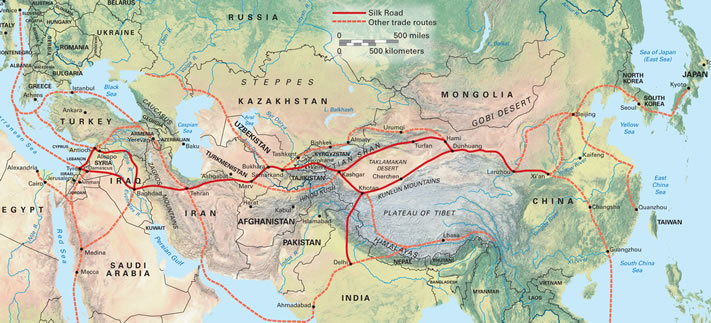
The Chinese government wants US forces on the ready in the Pacific. Combined with America’s hubristic and unnecessary proclivity to deploy many forces to the Middle East, this leaves less for Washington to have immediately ready to act in the Indian Ocean. More importantly, the US, having abandoned Central Asia to Russia (and rightly so, as it was an unnecessary extension for a naval power) can now no longer pursue more military and political influence in said region.

During the War of Spanish Succession, the Duke of Marlborough on multiple occasions fought against the most powerful army of his day by launching multiple feints, forcing the foe to weaken critical spots in their line by redeploying forces elsewhere to meet his well broadcast attacks. This inactive backwater of the front or battlefield would then become the main focus of his attacks, overwhelming the overburdened position of the enemy. If one views what is often called as ‘The Eurasian Chessboard’ in a similar way one sees an opening for China in the west, which leads to a potential opening south.

Even if the Beijing-Islamabad axis never gets any stronger, and India remains strong enough to contain the Indian Ocean, there is plenty to be gained from inland Eurasia. And not a damn thing the U.S.-whose regional role is now to be isolated and bogged down in Afghanistan and nothing else-can do about it. In fact, Beijing benefits from Washington keeping the Taliban busy while it pursues its own objectives elsewhere in the neighborhood.

In order to shore up this economic and resource expansion on the continent, it is necessary for Beijing to keep good relations with Moscow. Russia holds this new arrangement together, keeping the northern flank intact and providing the cooperation needed to work well with local elites in the region. But Russia, with its insecurities about the Siberian frontier, remains cautious. The historically inclined inside the PRC are probably salivating at the potential for analogies for when the Han Dynasty divided the Xiongnu Empire and turned some of them into perpetual warrior proxies on their behalf.

Therefore, one suspects as Chinese interests grow in Central and possibly South Asia that tacit yet unofficial backing of Russian bellicosity in the Caucasus and Eastern Europe will in fact increase. They would never admit it openly of course, but to drive the wedge further between Russia and western Europe and the US is to keep Russia from contesting losing some relative influence in Central Asia to China. Not to mention that if very successful, this policy could also reduce the long-running de facto military hardware export dealing between Moscow and Delhi, which would further strengthen China’s position towards its giant southern rival.

Assuming this comes to pass, I actually see it as a potential positive in world affairs. A confirmed sea power and a confirmed land power with minimal ability to directly interfere in each other’s interior business and with only a few places where proxy conflict could break out. A type of Cold War lite with the appeals to ideology mercifully slim. Of course, in order to keep Moscow and Brussels sufficiently separate even in this best-case scenario major upsets will occur.

And of course it requires two very important and totally not guaranteed variables: Sober realism in both Beijing and Washington.


Pray for Bourgie White Girls

Last summer, I wrote a piece about The Basic History Bro, or BHB. A type of faux-history buff ‘political scientist’ (i.e someone who reads Cracked and has opinions) male who is really just a bombastic tool who propagates received wisdom and generic middle class American chauvinism, dumbing down any conversation every time. There is however, a female equivalent to this creature, and now is the time to turn our attention to that.

Before recently, I noticed these kinds of people, but never bothered giving them my bother due like I did the BHB’s due to the fact that I am fortunate not to come across them in real life so much. The internet, however, is where they thrive. And in the wake of several subsequent terrorist attacks, where they…’shine’.

The Bourgie White Girl, or BWG, loves to pretend that she is ‘aware’. In fact, one of her favorite words is ‘awareness’, which needless to say has basically become a punchline about her type of thinking by anyone who isn’t her. ‘Awareness’ of course means posting about top news stories with snippy little tag lines such as ‘Get Educated’ and ‘Inform Yourself’ but devoid of any analysis that shows their own opinion is either educated or informed. Above all, it is an opportunistic online form of being a vulture, exhorting you to ‘pray’ for victims of tragic events, be they nations of groups of people. Leaving aside the obvious point that praying is nothing, this is not a call to discourse, to greater understanding of issues, or to advocating anything to politicians or even really to their friends. No, it is just a call to have feelings about something and then share publicly that you do so in a meaningless and context free way in order to both bulwark your status of being *aware* as well as empathetic. Of course, such shallowness is neither.

The motivation for this is the same with the unwanted and uninteresting opinions of the BHB in that it is to pontificate without the effort to justify itself, though there is one key difference. The BHB wishes to create an inside/outside group dynamic to separate who to invite to the kegger and who to insult using insecure presumptions on their sexuality. The BWG, on the other hand, wants to install a more individualistic pecking order. One where she is looked up to as separate and above the pack. ‘Look at me!’ the duckface profile picture run through a French/Belgian/Turkish flag filter says, ‘Am I not educated? Am I not empathetic? Am I not informed?’

This however is really the only major difference between such people and their male equivalents. For the reaction when challenged is the same. Become uncomfortable, retreat into received wisdom, and rather than question your sexuality, imply sexism and or some other form of oppression. Because it is oppressive to disagree with rote-learned received wisdom, apparently-just as a BHB will assume such disagreements make you gay, so too must any disagreements with a BWG make you sexist, if male, or an insufficiently educated feminist, if female. The irony of course being that most feminist theories are not too into neoliberalism, which the BWG is buried up to her neck in.

This question then dovetails into what they actually mean when BWGs talk about education. I can only speak from personal sample size, which may be unreliable, but there does seem to be a correlation between small liberal arts colleges with nice campuses in rural or rustic locations and the BWG. Usually ones with large endowments and some name recognition but no actual academic reputation and especially not Ivy League status. Being a product of both brass tacks public university education as well as a fancy-pants one, I suspect that, much like the suburbs, these kinds of universities are really the worst of both worlds. A unique combination of entitlement in attitude and generic education. That is at least the impression which its alumni so often give.

Naturally, coming from a lifetime of rote-learning and uncritical mainline mythology indoctrination, the BWG believes she is educated and informed to the hilt but shows no actual evidence for this position. Much like the her male equivalent, it is entitlement alone that keeps her afloat.

I once ruminated on the political ramifications of the BHB, deciding it was a natural fit for rising populist right wing movements such as Putin’s vatniks or Trump’s, well…vatniks.  Turns out I was right. So what, if anything, is the BWG politically? Well, to their credit, they always hate Trumpistas. To their not-so-much-credit, they pretty much unflinchingly and unquestionably fall into the Clinton camp. After all, what does the name Clinton signify better than prestige for progressive causes while also doing everything possible to screw poor people? Well, she is a bourgie for a reason. You can starve to death in the gutter, but as long as its about the amount of money you have, rather than your race or sexuality thats A-OK! So this actually makes sense from the BWG point of view. Hillary Clinton is even better than Bill because she has all this plus the woman factor.This support, unlike the BHB’s for Trump is actually fairly logical. There is, however, one glaring problem.

Remember how this post began? It started with the ‘prayers for xyz who suffer from terrorism’ thing. Here is the problem: US recalcitrance to work with-rather than against-the Syrian government is holding up the destruction of ISIS. This prevents us from coordinating with Syria in the same way we do with the government of Iraq. So people who are even more hawkish than Obama represent the precisely opposite kind of response needed to actually reduce the amount of terrorist attacks. If there is one thing people who have actually been paying attention to know, its that regime change policies do not work and must not continue-they are the ultimate enablers of international terrorist movements. Politically opposing such policies is actually doing something, unlike for instance, prayer. Supporting someone who wants to continue these policies…well, this is why all they have is prayer isn’t it?

So, if on this issue and no other, Please Pray for the Bourgie White Girls.


Adrift with the Tweeders?

We may have just witnessed the largest geopolitical earthquake (outside of Syria) since the invasion of Iraq. Some international relations focused thoughts are in order.

Lots-of-men-in-red-trousers-landscape

In my last post I argued against Brexit, but without really making a pro-EU case. It was a choice of the lesser of evils in many ways, two factions of the ruling class arguing about how best to propagate themselves. Most people will end up screwed in or out of the EU. But all politics is in some sense lesser evils, and this is inevitable. There are some countries that might be better out of the EU, Britain, I do not think, is one of them. After all, I have long believed the EU is more prone to ignorance and crisis than the United States, and wrote an entire previous article on how the complacent assumptions of cosmopolitanism would be its doom. After all, the smug tweed jacket red trouser wearing Little Englanders (who we in St Andrews disparaged as ‘Tweeders’) were always going to support whatever gets daddy a bigger dealership.

Postmodern identity politics began this rampant assertion of identity uber alles, and like all postmodern ideas, they were poison to the left that spawned them, leading to acute and even terminal cases of Tumblritis and anti-intellectualism. But even more importantly, all postmodern ideas eventually migrate to where their true Heideggerian home inevitably belongs-on the right. Where they manage, somehow, to become even worse. The pathology of victimhood, standing out due to accidents of birth and parentage, and other factors, merge perfectly with the conservative idealization of the past and the dominant ethnic group. The language of persecution gives people who are targets of comedians and writers the platform of martyrdom for…well…being in power and getting the criticism one gets for that.

And as that process unfolds, its the identity-obsessed right which holds all the cards in today’s developed world, as it dovetails perfectly with nationalism. A Brexit could lead to a vote on a Frexit. Not one likely to succeed, but even a vote in France could really bring out a new future for European nationalism beyond what is now inevitable. Even if not, the EU will work to save itself by reversing many of its current policies, becoming an awkward hybrid of preexisting unsustainable neoliberal sensible-serious-centrism with various populist movements. It is always amusing how migrants get the blame for the very obvious economic policies of the higher ups. Such tendencies could either save the union or break it up further depending on the strength of backlash. History is not a progressive story. It comes and goes, periods of integration conflict and merge with periods of division. It is clear we are entering such a more divided period now. In some ways it was the inevitable result of just how many gains the United States made from World War II onwards. Fueling world globalization was also destined to fuel backlash eventually. There has never been a narrative of history which goes only one way, save technology, and even that level of success is still dependent on a variety of factors in the humanities that wax and wane.

Not to mention the suddenly interesting issues that might come up with British military bases on Cyprus, the Falklands, and above all Gibraltar. Also overlooked is how Russia, once the backer of leftist European groups to sow dissension in western alliances, is now the tacit backer of rightist movements. Putin admires and is admired in turn by all kinds of figures from Trump, Le Pen, to Farage. The geopolitical ramifications, even without the economic issues, are large.

My personal concern, I will admit, is about the future of Scotland. A country which was my home far longer than England was, and was my home for almost as long in my adult life as America has been. As someone who once reluctantly backed the Union cause in the Scottish referendum, changing circumstances, as they always should, require one to change with them. I now support Scottish independence. For if we are to enter a world of resurgent nationalism, we can at least foster the right kind of nationalism.

Scotland has the right kind of nationalism, as far as these things go. The Scottish referendum was open to all citizens who lived in Scotland and closed to Scots abroad or in other parts of the UK. This is because Scotland has a geographic rather than strictly ethnic sense of solidarity. As a Edinburgh taxi driver once told a friend of mine, ‘Being born in Scotland doesn’t make you Scottish, dying in Scotland makes you Scottish.’ It was meant in jest, but shows some aspect of the attitude. Most UKIPers are the people you would expect, whereas the SNP has people from all over the ethnic and socio-economic spectrum. Considering also that Scotland has made a proportionally stronger push to tackle issues of environmental sustainability than the rest of the UK, it further bolsters a growing idea of mine-that the constructive form of nationalism of the future will be environmental and geographic.

Granted, this will not be most forms of nationalism, which will remain atavistic and self-destructive as usual. But if one country gets it off the ground a new example that could attract different coalitions could come into being.

Countries I thought were wise to stay out of the EU for specific reasons of the challenges they face are Greenland, Iceland, and Norway. Perhaps they should consider forming a league of their own based around arctic and sub-arctic issues in order to be better at dealing with resource and biodiversity crisis not likely to be we will understood by eurocrats. If such a thing occurred, Scotland could always break out of the UK and join such a group using Shetland and Orkney as its ins. Perhaps even carve a niche by joining both it and the EU and act as the vital bridge nation between them. It is speculative to be sure, but in crisis there is usually opportunity for those of strategic vision.

But it would be my personal hope that increasing division and nationalism, should it come to pass, could at least have a strain focused on the future rather than an idealized past. A future of being environmental stewards custom tailoring policy to biome, land, and sea. One thing is for sure, with ecological catastrophe already upon us, some civic dedication to keeping where we live livable is an inevitability. I can only hope that Scotland or some other country has the chance one day to pioneer such a turn.


Brexit to Nowhere

battle of the thames

From the ridiculous if amusing ‘Battle of the Thames‘ to the tragic and horrifying political assassination of a Labour MP by a fascist causing both campaigns to temporarily suspend themselves, it is apparent that emotions runs high in the upcoming vote for Britain staying or leaving the EU. Obviously, the geopolitical ramifications are potentially quite large.

Interestingly, there could be both a left wing and a right wing case made for leaving. Though considering the reality of domestic British politics the left could probably deliver far less than the right when it comes to this, even if their case on the inherently opaque and corporate backed EU probably more accurately identifies the organization’s problems than the Little Englanders on the right. The EU has many problems for sure, this blog has previously talked about some of them. However, as things currently stand, I am here to make the case that for the cohesiveness of the United Kingdom as a state, it is best at this juncture of time to vote ‘Remain’.

Granted, if the dissolution of the UK is more your style you might take this as a reason to make an accelorationist vote for ‘Leave’, as we shall see.

It boils down to trading one form of compromised sovereignty for another.

Britain is no longer a major world power, but a secondary one located in close proximity to other secondary ones. To offset this factor if freed from the EU Britain must compromise by becoming an even more attractive economic partner to other non-EU states. Naturally this means pulling a Boris Johnson (who once, it should be noted, almost ran over me while riding his bike up Holloway Road) by trying to turn London into a kind of Singapore-West but without the intelligence of discipline of that state. All the current factors affecting the housing and renting prices in London would be accelerated as London was made more and more a city built for Russian oligarchs and Chinese capital flight. The rich get richer and ironically for UKIP, it will be at the hands of foreign interests at least partially. Granted, the Conservative Party and UKIP will take credit for the short term economic boom that will ensue, but the long term trends will be to exacerbate already disturbing and unsustainable paths already being taken. Once the city becomes addicted to getting a nice chunk of its budget from these sources, it will further attempt to appease such investors in order to attract more.

And that is just the city of London. More interesting might be outside of said city.

For reasons listed above and others, leaving the EU will already exaggerate what I have come to call ‘The London Effect’, which is noticing how the UK is so dominated by its capitol city, which no close or even moderately distant secondary center of urban power can compete with, that it resembles a massively overgrown city-state in all but name. Perhaps this is something that comes from living in a variety of locations in the UK starting with London and eventually ending with my favorite city of Edinburgh which I liked much more, but it is a very real structural phenomenon built into the state.

Without being part of a zone containing the various competing mega-cities of Paris, Berlin, and what-have-you, the dominance of London over British affairs (and budgeting) will only increase. Combined with the likely loosening of various regulations on average workers this will exacerbate forces pulling away from state centralization. In other words, expect another Scottish independence referendum if the UK leaves the EU, and expect it to win the second time. And once that starts, who knows what next for a supposedly United Kingdom? Especially if, as would be extremely likely, Scotland then immediately applies for EU membership. How long could Wales agree to be even more proportionally dominated by the English? What would this bode for Northern Ireland?

We don’t know the answers for sure, but at this moment in time if one wanted to keep the UK together one should want to keep it inside the EU, at least for now.

Perhaps in the future we can talk about an alternative to the EU and NATO I came up with called ‘The Northern Alliance’, which would exist to protect the interests of states with arctic and sub-arctic climate change challenges and who do not wish to be divided and dominated by Russia, but that is a different enough topic that it can be saved for a future post.

Learning to Die in the Anthropocene, a review

Roy Scranton wrote this large pamphlet/small book to address what he saw as the act of a civilization not yet coping with its own ending. Not to say human extinction, but that it now seems most likely that, barring a technological miracle, the delicate economic and geopolitical forces underpinning the present lifestyle and assumptions of the developed world-as well as the environmental factors of the entire world at large-are coming to an end. And most people are in denial about it.

To quote from early on:

‘Yet the reality of global climate change is going to keep intruding on our collective fantasies of perpetual growth, constant innovation, and endless energy, just as the reality of individual mortality shocks our casual faith in permanence.

The greatest challenge of the anthropocene isn’t how the Department of Defense should plan for resource wars, whether we should put up sea walls to protect Manhattan, or when we should abandon Miami. It won’t be addressed by buying a Prius, turning off the air conditioning, or signing a treaty. The greatest challenge we face is a philosophical one: understanding that this civilization is already dead. The sooner we confront our situation and realize that there is nothing we can do to save ourselves, the sooner we can get down to the difficult task of adapting, with mortal humanity, to our new reality.’

Since I am of the materialism or GTFO school I disagree on prioritizing the philosophical question over that of the sea walls and the potential for conflict. That being said, this is a very valid question to grapple with.

Personally, though I feel like a downgrade of living standards and a rise of conflict are now inevitable due to environmental factors already under way, it would be unwise to underestimate technological innovation for future energy. Though one must be aware that vested financial interests in various old school companies will do everything they can to sabotage such a move through lobbying, and so don’t bet on public funding in any country that allows such political activity.

I found the prose and call to contemplate in this book extremely evocative and probably worth most people’s time. Though if you are already pretty versed in this and/or the growing new (finally, a good new school of philosophy!) of Speculative Realism-also called Speculative Materialism or Object Oriented Philosophy- you will hardly learn anything new. But this issue, of us as a species learning to deal with the consequences of forces we have unleashed-forces now as intrinsically a part of nature as non-man made plants and animals, is one which is desperately needed in an idealistic age overrun by anthropocentric and often non-material ideologies such as liberalism, constructivism, religious fundamentalism, and postmodernism.

The fault I find in this interesting text is its call for a new humanism. Personally, I find humanism itself to bear much of the brunt of our recent delusions and faith in ourselves and ability to consciously dominate nature. But I feel that my thoughts on the much vaunted factor of consciousness are long enough and touching upon issues out of scope with the topic of this post to talk about here. Needless to say, a future post on the topic could very well be in the making. What matters now is humanity dealing with a faceless enemy of its own making which is not human. The ultimate Frankenstein fear story where instead of a cobbled together re-animated corpse we must now recon, like with the early Godzilla movies, with something truly massive and awakened by us.

I will close with another quote I quite liked from near the end. ‘…Global Warming offers no apprehensible foe. That hasn’t stopped people from trying to find one. The Flood Wall Street protesters say the enemy is American corporations. Tanzania’s Jakaya Kikwete and Nauru’s Baron Waqa say the problem is the United States and Great Britain. Shell Oil and the Environmental Defense Fund seem to think it’s intractable UN bureaucracy that is holding us up. Barack Obama has implied its China. Tea Party Republicans would blame Obama, I’m sure, if they actually admitted that global warming is happening and caused by human activity. Meanwhile, NPR listening liberals want to believe that Tea Party republicans are responsible, so they can frame the problem as one amenable to solution by moral education and enlightened consumerism, as if it were all a matter of convincing people to eat more kale and drive electric cars…The enemy isn’t out there somewhere-the enemy is ourselves. Not as individuals, but as a collective. A system. A hive.’