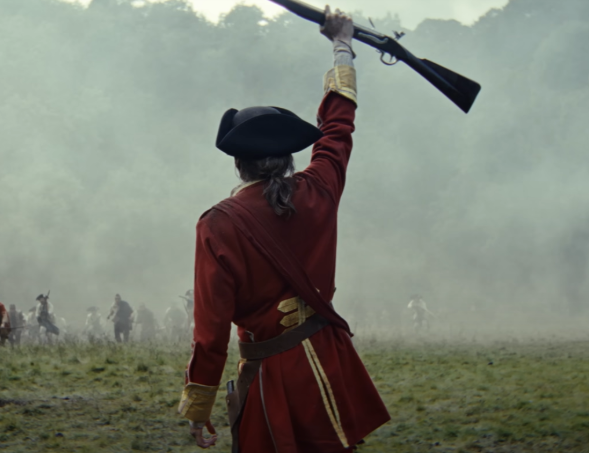
As the person who first termed the concept of Washingtonian Realism it seems only fair that I give my take on the recently dropped Young Washington film. It was not originally my intention to see it as the particular saga of Fort Necessity-Monongahela opening to the French and Indian War is well trod ground. Also, the company that produced the film is mostly known for feel good family flicks and Christian cinema. But I eventually figured if I keep banging on about the Farewell Address there is a non-zero chance I will be asked about this movie on a podcast or something so here are my impressions stripped down to simple separated points while still fresh in my mind.
For a small studio the film is very well acted, both in the less famous and more famous members of the cast.
The directing is not necessarily anything to write home about in either good or bad directions, but it certainly has its moments.
There is some creative license given to certain things, such as Washington’s half brother’s time of death and the relationship between George and his mother (which was more difficult than the simple tough love shown in this movie). Additionally, the French army operating that far from their North American core areas in Quebec would not be dressed in full field uniforms like depicted in the film, with only high ranking officers going for the whites and blues. Most would in fact have a mix of pioneer and native garb.
Nevertheless, I feel the movie did well to capture how Virginia was the one colony that replicated elements of the British class system which ran through its social interactions.
The British pomposity towards colonials is exaggerated for dramatic effect here, but was a real thing.
The depiction of General Braddock (portrayed by Andy Serkis no less) has been critiqued as over the top, but I enjoyed it. Its long become an American tradition to depict Braddock as a kind of cartoon martinet and I would almost be disappointed if this was not so. Even in death he is mocked by having the site of his greatest and most fatal defeat named after him, which then became the first town in American history to elect an ogre to be its mayor.
Despite some obvious liberties, I did generally enjoy the depiction of most events until the Battle of the Monongahela. Even leaving aside my previous point about the French uniforms, the way this battle was depicted stuck in my craw. It would be more accurate to see it as a Native-French victory rather than a French victory with Native help. The majority of fighters there were Ottawa, Ojibwe, and Abenaki, and some other allied tribes more recently displaced like the Lenape. The being said, once the film embraced a little ridiculousness and had George popping foes with perfect John Woo style pistol shots I was partially won back over.
You can tell these shots were not anywhere near the actual Allegheny region if you have ever been there. It was filmed in Ireland and it is very very obvious throughout the movie that this is so.
Movies in this era really shouldn’t shy away from blood and sanitized depictions of battle though. Stylistically it did what it could but the minimal gore rule really harmed the immersion. I know its going for a family audience but come on, its still a war movie at its core.
This movie did Thomas Gage dirty. No genius by any measure, but I never recall him behaving quite this badly in anything I ever read before. That being said, the final exchange between him and Washington over how divergent the world views of those born on opposite sides of the Atlantic had become, while obviously meant to the audience to wink and nod at, were a welcome bookend on the film opening with Washington’s surveyor experience and how it shaped him. Therefore, the film does in fact pass the test of fitting in the Washingtonian Realism camp, as the importance of situationally grounded geographic regionalism outlook (and how it informed Washington’s later concept of geopolitics) is upheld against what today we might call an imperial-globalist worldview.
There is some post credits speech thing about getting the message of the movie out. I’m not about all that so I left once it started.
While I probably would rank this movie last in the new 2026 films I have seen thus far this year, thats more a testament to there being some very strong offerings around than Young Washington being bad. It isn’t bad, it isn’t great, its perfectly watchable once.
Anyway, they will inevitably make a Revolutionary War sequel with a bigger budget and I can see that being good. But they better leave the one about his Presidency to me because there are few people I would trust to get that one right.
Also, is it just me or was Jeffrey Jones meant to play an older George Washington? I know he was Jefferson in the Washington mini-series from the 80s but come on, he’s got the face.
Anyway, if you want a great depiction of the Battle of Monongahela in musical form, and from the other side, the band Nechochwen has you covered:
 The Trickster's Guide to Geopolitics