Yung Bae Washington: A Very Brief Review

As the person who first termed the concept of Washingtonian Realism it seems only fair that I give my take on the recently dropped Young Washington film. It was not originally my intention to see it as the particular saga of Fort Necessity-Monongahela opening to the French and Indian War is well trod ground. Also, the company that produced the film is mostly known for feel good family flicks and Christian cinema. But I eventually figured if I keep banging on about the Farewell Address there is a non-zero chance I will be asked about this movie on a podcast or something so here are my impressions stripped down to simple separated points while still fresh in my mind.

For a small studio the film is very well acted, both in the less famous and more famous members of the cast.

The directing is not necessarily anything to write home about in either good or bad directions, but it certainly has its moments.

There is some creative license given to certain things, such as Washington’s half brother’s time of death and the relationship between George and his mother (which was more difficult than the simple tough love shown in this movie). Additionally, the French army operating that far from their North American core areas in Quebec would not be dressed in full field uniforms like depicted in the film, with only high ranking officers going for the whites and blues. Most would in fact have a mix of pioneer and native garb.

Nevertheless, I feel the movie did well to capture how Virginia was the one colony that replicated elements of the British class system which ran through its social interactions.

The British pomposity towards colonials is exaggerated for dramatic effect here, but was a real thing.

The depiction of General Braddock (portrayed by Andy Serkis no less) has been critiqued as over the top, but I enjoyed it. Its long become an American tradition to depict Braddock as a kind of cartoon martinet and I would almost be disappointed if this was not so. Even in death he is mocked by having the site of his greatest and most fatal defeat named after him, which then became the first town in American history to elect an ogre to be its mayor.

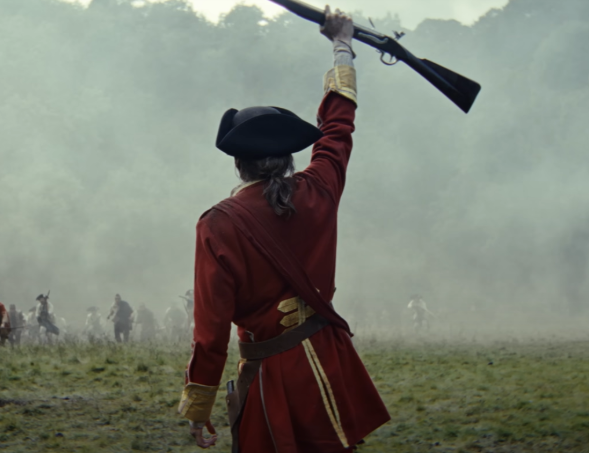
Despite some obvious liberties, I did generally enjoy the depiction of most events until the Battle of the Monongahela. Even leaving aside my previous point about the French uniforms, the way this battle was depicted stuck in my craw. It would be more accurate to see it as a Native-French victory rather than a French victory with Native help. The majority of fighters there were Ottawa, Ojibwe, and Abenaki, and some other allied tribes more recently displaced like the Lenape. The being said, once the film embraced a little ridiculousness and had George popping foes with perfect John Woo style pistol shots I was partially won back over.

You can tell these shots were not anywhere near the actual Allegheny region if you have ever been there. It was filmed in Ireland and it is very very obvious throughout the movie that this is so.

Movies in this era really shouldn’t shy away from blood and sanitized depictions of battle though. Stylistically it did what it could but the minimal gore rule really harmed the immersion. I know its going for a family audience but come on, its still a war movie at its core.

This movie did Thomas Gage dirty. No genius by any measure, but I never recall him behaving quite this badly in anything I ever read before. That being said, the final exchange between him and Washington over how divergent the world views of those born on opposite sides of the Atlantic had become, while obviously meant to the audience to wink and nod at, were a welcome bookend on the film opening with Washington’s surveyor experience and how it shaped him. Therefore, the film does in fact pass the test of fitting in the Washingtonian Realism camp, as the importance of situationally grounded geographic regionalism outlook (and how it informed Washington’s later concept of geopolitics) is upheld against what today we might call an imperial-globalist worldview.

There is some post credits speech thing about getting the message of the movie out. I’m not about all that so I left once it started.

While I probably would rank this movie last in the new 2026 films I have seen thus far this year, thats more a testament to there being some very strong offerings around than Young Washington being bad. It isn’t bad, it isn’t great, its perfectly watchable once.

Anyway, they will inevitably make a Revolutionary War sequel with a bigger budget and I can see that being good. But they better leave the one about his Presidency to me because there are few people I would trust to get that one right.

Also, is it just me or was Jeffrey Jones meant to play an older George Washington? I know he was Jefferson in the Washington mini-series from the 80s but come on, he’s got the face.

Anyway, if you want a great depiction of the Battle of Monongahela in musical form, and from the other side, the band Nechochwen has you covered:

The Black Longhouse

“You’re feeling the oppression of Christian hegemony in conflict with native animism,” he said. “Self-righteous, puritanical men seized this land. You’re also feeling the eyes of the vultures evaluating the sweet texture of your skin. The eyes of many animals. Animals endure.’

~Laird Barron, ‘Worse Angels’

What follows is a symbolic manifesto of sorts. Take from it what you will.

In a world built on bones there is an entire hemisphere that is especially shattered by abrupt displacement. On the northern continent of that hemisphere is the seat of a degenerating world-empire. Within that empire are a people unmoored from the reality of the ancient land beneath their feet even as it dies because of them. They cling to the ideologies of a failing state despite these very beliefs having brought them to this point. The universal idealism of a simple moralistic world and one set of values to make sense of it has not just failed them-it has made everything worse for everyone. The ubiquity of their communications networks brings what was once left at the pulpit of the puritan into an unceasing daily bombardment of affirmation for collapsing monoculture.

But there was a time that lasted far longer before the coming of Christ and Cotton Mather when these lands had no such grifters. Tribes existed and fought each other as humans always do, but had no concepts of messianic religion, ‘biological’ race, or the glorification of victimhood. These many diverse peoples were wiped out by an unprecedented hemisphere-encompassing apocalypse where smallpox and plague took the majority as a prelude. Then came shattered bands of survivors still alive in a time where the recently dead outnumbered the living by multitudes and were forced to respond to an alien invasion of technologically advanced extremists. They went down in a hell of a fight that took centuries and their descendants are still live today, despite the odds.

In their place came a civilization that broke all contact with this past and rushed to fill the vacuum with their own inheritance…but not all these things were a sensible fit for the new locale. Despite the cultural disconnect of most of its inhabitants, its earthy chaotic gods sleep much closer to the surface than the long-buried and fully domesticated pantheons across the sea. This is not a land of mellow meadows and shires, but of earthquakes, blizzards, tornadoes, and towering thunderstorms. This is a land that scorns weakness.

The newcomers could breed to the point where they were immune to native syncretism-avoiding the natural fate of conquerors. This further cut off the northern reaches of the hemisphere even beyond that of the rest. We live in their world now. But now, in the early 21rst Century, we see their world view cracking under the strain of its own hubris and excess. The opportunity to build something new is opening before our eyes. Something that fits this place better. Something that can at least bridge some of the gap between the incongruous ideological imposition of today and the natural state of a beautiful and terrible land.

There are those of all backgrounds and persuasions who find no tribe amongst the degenerating postmoderns of our time. They find the amplification of faddish superficial issues a distraction, the busybodies of the commentariat and consumer as the front for a past-prime ruling class in crisis. Witch hunts are everywhere as the fearful and ostensibly secular descendants of those original puritan settlers and conquistadores blame heretics for their own inadequacies.

Those who reject this status quo may find themselves walking in the woods as they travel apart from the trends. Let us say in the northeast or Great Lakes region-though it could be anywhere. The new growth forest of the woodlands hacked down and re-grown is filled with underbrush and small trees. Ticks lurk everywhere as un-predated deer strip the biodiversity as they spread like locusts.

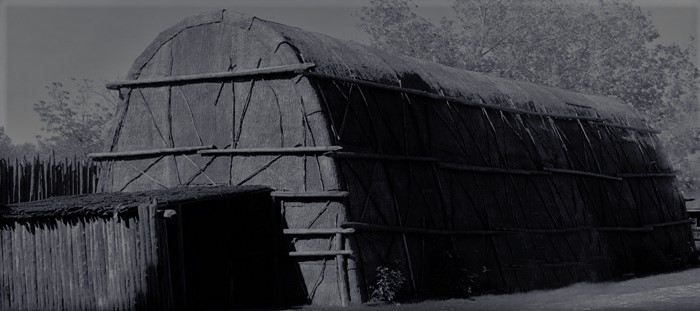
Eventually these travelers make their way to a place deep in the woods. Giant ancient trees tower above in the old growth grove. Here, the underbrush is lighter. Flowers bloom again. Sharp unseen eyes raise their hackles as they know the deer tread lightly in this place for fear of predation. At the center is a longhouse. Those redoubtable large bark clad structures that could house many people and supplies. But this longhouse is different. It is jet black and angled as only a modern construct could be. It draws from the forgotten past but is no slave to it. It would seem incongruous to those who came across it accidentally, but not to our band our travelers.

On the inside they find the interior lit only by the fire pits. The shadows cast about imply a structure far larger than seems from the outside. There wait for them masked figures-wooden shamanic grotesques with distorted and leering features. Beneath this they wear well-tailored suits. They tell the travelers that to accept the uncertainties of a new future is to draw strength from a different past. The pipe is passed around as the masked ones speak of a land people belong to, and not a land belonging to people.

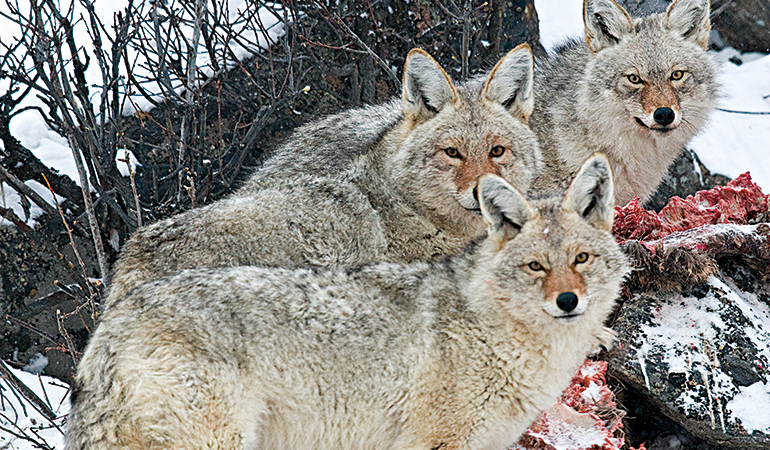
‘Mankind sought the death of Coyote, an animal once confined to the plains and Rockies. His attempts to kill it made it breed and migrate outwards. A century after this campaign began it has unintentionally spread the animal over the entire continent. Here, in the east, it has bred with Canadian wolves up north before moving south. It has thus grown in size and pack mentality.

‘The coyotes were misfits, but they came together to survive and perhaps for revenge. Now, they thrive while we decline. Be like this beast. Adapt to the new by breaking old bonds of safety. Your mouth must be red with venison for the flowers to bloom again and the ticks to recede. Face your fears directly and make them your allies against your foes. Come together at decisive points in time and scatter when countered. Always help to sabotage the complacently powerful and their defenders.’

These travelers realize their personal differences do not need to be ironed out-the diversity strengthens them. Here they can debate the most taboo subjects openly, shrouded from view of the puritans by the walls of the Black Longhouse. They have something more important now: common enemies. The missionary, the financier, the complacent monoculture that upholds them all.

As the travelers dance around the fire they revel in being both distinct and as-one. They know that their odds are low but that such difficulties only increase the glory of the fight. The future they want is yet un-defined but by taking the first step away from a failed consensus the mere possibility to building something new has been created. All of them now carry the Black Longhouse inside them.

The travelers walk out of the old growth region, through the moat of the striplings, and back into the roar of modernity. But rather than be sad as before, they see now that within this degenerating world is an abundance of new opportunities. Every decaying town is a chance to rebuild not in some nostalgic way for what it once was, but a new way to that leans forward and draws from a different and much neglected past. Many peoples, gods, and cultures united against a common old order and its increasingly hysterical defenders. What were the covenant chains of past entities on this land before colonization but the agreement that difference and divergence was fine, and could all serve a struggle against a common enemy? Such was the thought of people who lived in older longhouses. Already, one can hear the sounds of this new synthesis of forgotten old and dynamic new if one listens.

Somewhere inside a tacky suburban home at night, a clergyman (either of faith or of human resources and professional management) spots something outside the window. He peers through the glass to see the leering face of a coyote with wolf-like dimensions. The lights go dark and he screams, fumbling to bring them back on. But against one who sees in the darkness as if it was its own form of light…

In a time of monsters be the biggest baddest monster of all. And bring your friends. This ancient land demands no less of you.

In Praise of Indigenous People’s Day

battle-of-old-sitka

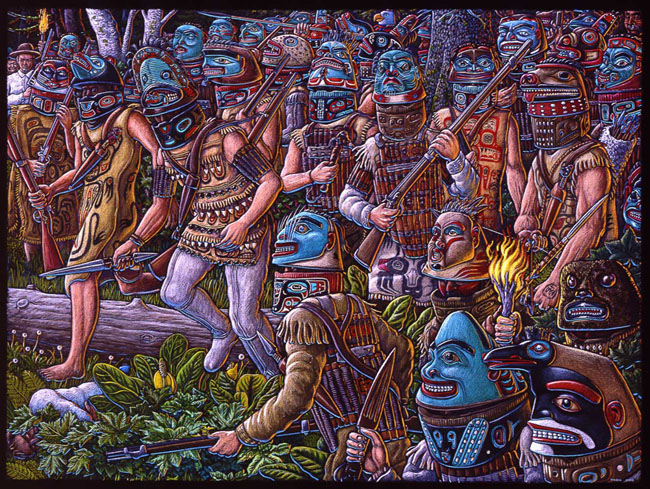
‘The Battle of Old Sitka’ by Roy Troll

If you have been following this blog for a while, you probably know I have nothing but disdain for so much of the fashionable woke causes of today. We are bombarded on a daily bases by performative virtue signalling largely sold as snake oil by grifters to the guilt-ridden white bourgeoisie and those over-eager to have passionate opinions without doing the necessary work to justify such strongly held views. No doubt today you are seeing many of those very people loudly proclaiming their inheritance to replacing Columbus Day with Indigenous People’s Day. Be not afraid though, broken clocks are right twice a day after all.

From the undeniable fact that the largest mass human die-off in recorded human history was due to Eurasian pathogens made short work of much of the Native American population, to the subsequent enslavement, murder, and conquest of these then-weakened communities (I maintain that direct European conquest would likely not have happened in that era save for certain coastal and island areas were it not for the full-fledged apocalypse of smallpox and company creating a literal post-apocalypse-but that is a big enough topic to be the subject of another post), the reasons for replacing a Holiday celebrated in the United States, a (future) country Columbus never set foot it, are obvious. Even leaving aside that Columbus was a grifter, fanatic, and died convinced he had found the edge of Southeast Asia despite everyone else realizing it was clearly something else which was a direct result of him believing the world was much smaller than it actually was-a fringe view even in his time- there are plenty of reasons to neither give up a holiday nor continue it in its present form.

The mass destruction of indigenous culture goes beyond the human toll. It robbed the world of art, thought, philosophy, biodiversity, and language. While I am hardly one to use ‘imperialism’ as a catch-all phrase of bad things, the specific form of Spanish and English colonialism towards the New World resulted in positively ISIS-levels of cultural vandalism where the pathologies of the present rob the future generations of Earth from its material heritage. If the conquest in hindsight seems inevitable, the mass destruction, Palmyra style, of religions and cultures surely was not as it was fueled purely by ideology. Conquistadores cared little for converts, but the people that came after them did. And from Torquemada’s ideological children to Cotton Mather’s bastards, a varied mosaic of thought was swept away for the barren and monolithic desert of Christian fanaticism. A legacy that very much infects almost everything today in contemporary North America.

But Indigenous People’s Day is not mainly a marking of the past but first and foremost a statement of the future. The Natives are still here. Despite everything many still keep their cultures as intact as reasonably possible.  They aren’t going anywhere. And of equal importance, it is about time that we who dwell in North America recognize how much they contributed to us. Half of the vegetables commonly used in cooking today in the world have a New World origin. Most spices come from Mesoamerica originally. Languages used as codes to baffle the Axis Powers and vital contributions especially welcome in our benighted postmodern age towards contemporary art still pour out from Native artists who are both cutting edge and traditional alike. Even our urban legends and modern myths increasingly adopt the fantastic creatures who were spoken of in these lands long before the Europeans came.

We might also do well by recognizing what they have still to give. There are ways of thought that would be a welcome break from the endless Alt-Protestant shrieking that almost all sides of our culture have degenerated into. No one is more suspicious of that famously ambiguous and mealy-mouthed phrase ‘decolonization’ than me, but we sure as hell could use some decolonization in our politics and philosophy on this front when it comes to anthropocentrism, economic priorities, and the dominant sects whose theology holds sway over much of the populace. So much of the intellectual legacy of Northern Europe is a stain on the thoughtful, including even in strategic culture. There are histories whose very concept of strategy remains to be explored as political theory. More on this later at some point, I promise.

Anyway, if you would like to explore something contemporary and native I recommend starting with Nechochwen: