The War Comes Home: A Book Review of ‘The Management of Savagery’

jihadjohnmccain

In the aftermath of the First World War there was a famous example of ‘the war coming home’ in the German Freikorps, which largely fought as anti-Bolshevik forces in the power vacuum of Eastern Europe before returning home and disproportionately joining far right movements that would be eventually subsumed under the Nazi Party. The famous and impressive Czech Legion which found itself stranded and forced to cross the length of civil war Russia to escape the other end in coastal Siberia experienced a similar phenomenon. Perhaps most analogous to modern day audiences, and the one with by far the most soldiers deployed abroad was the Japanese Army in Eastern Siberia. They were those who played the largest role in the Siberian Intervention and arguably did the most to secure the deliverance of the Czech Legion.

Japanese troops were kept fighting a low level guerrilla war of occupation in Siberia past the end of the rest of the intervening powers in that war. Although their presence succeeded in extracting oil and gas concessions in the region before departure, it was a failure in its main (if unstated) goal of making Primorye partially detached from the nascent USSR and open to business with Japan (see ‘Japan’s Siberia Intervention‘). A long and expensive intervention soured the public and domestic pressures brought the troops home. Some troops would terrify the home country with the influences they had picked up from the reds. Many others of those troops, specifically the officers, would go on to influence the growing cadre of right wing radicals in the army, a faction that would one day go rogue in the seizure of Manchuria and then go on to usurp the government, setting the Japanese Empire on an inexorable path towards self-immolation in World War II.

Max Blumenthal’s new book: ‘The Management of Savagery: How America’s National Security State Fueled the Rise of Al Qaeda, ISIS, and Donald Trump’ is far more contemporary, but is charting a very similar process to these events that happened almost a century ago. But this time there is only one seemingly unstoppable world power and a host of non-state actors.

I was fortunate enough to attend the book launch where I purchased my own copy and had it signed by the author. You may recognize his name, along with his colleague Ben Norton, as the co-hosts of the podcast ‘Moderate Rebels’, which is my personal favorite podcast which I have referenced a few times before. At that event, Blumenthal referred to the book (whose release had to be delayed and relocated due to complaints from a combination of Beltway lanyards and Syrian rebel backers) as ‘the most dangerous book in Washington.’ Its not hard to see why this could be so.

The book charts the rise of American-backed Jihadism, a process that really swung into full action with the Soviet War in Afghanistan and the golden opportunity for the CIA to inflict revenge for Vietnam on the arch-foe. Though most people in DC know of this story and the reverberations of it (Steve Coll’s quite good book Ghost Wars is a common staple around Washington) there seems to be a collective cultural and political denial that this still happens. Not only that, but that this process, only really briefly interrupted by the immediate post 9/11 rush to combat the Taliban (itself a partial creation of these policies, if unintentionally) also has domestic blowback similar to the kind once experienced by multiple nations in the interwar era.

9/11 was used by many of the more hawkish elements of the American defense establishment, as well as a crisis hungry media (I was overjoyed to see I am not the only person who remembers that the top news panic story of summer of 2001 was the false claim of a rise of shark attacks world wide-its referenced directly in the book) to roll out an ambitious neoconservative plan of reckless expansionism. This parade of wars, botched operations, and flagging public support soon after Iraq turned sour in turn led to the rise of various media grifters seeking to make a buck (or a public profile) off of the War on Terror. Both Islamists often recruiting from the west to fight in regime change wars coming home to commit terrorist attacks (The Manchester Bombing for instance) as well as radicalized far right racist terror of a more indigenous persuasion not only fed off of the blasted detritus of American policy failures abroad but also each other directly in the domestic field.

The events are recent and many of them I have written about here before. But Blumenthal weaves a convincing narrative about just how interconnected all of this is, and how the neoliberal/neoconservative center is the ultimate enabler of the extremism it claims to be the bulwark against (see my last post for more on what I call ‘Trident Theory’). Right wing grifters and Jihadists alike feed off of each other. ISIS recruitment documents prove they intentionally provoke this as a strategy. The smarter people on the far right must know more terrorist attacks by Islamists are good for them electorally. Perhaps Steve Bannon himself wants to secretly and indirectly ‘adopt a muj’.

Much of this is enabled by conscious decisions by foreign policy elites in various countries. The grotesque tableau of the humanitarian warrior who loves refugees so much they want to make more of them by leveling their country allied with the Bolton-hawks who are just in it for the fireworks and the forceable opening of new markets abroad. For the specifics of this tale of woe we have all lived through, knowingly or not, I cannot recommend ‘The Management of Savagery’ enough. Especially as Representative Ilhan Omar faces critiques both by the xenophobic right and the increasingly pro-neocon center and center-left and the media does it best to drown out the necessary issues driven candidacy of Tulsi Gabbard.

To bring this full circle I am reminded of the first college essay I ever wrote that I could be genuinely proud of. It was a comparative study of a historical and (then) contemporary event, presaging what I often do now. It was an essay for a history class on the Japanese Empire taught by the excellent Professor Roden of Rutgers University. I first cleared with him that I could add contemporary elements and he graciously accepted.

It was about the Japanese Empire’s fall to radicalization to an extremist elite that festered in the military and intelligence services. It spoke about the connections of the rhetoric of the ‘Greater East Asia Co-Prosperity Sphere’ as compared to what was then Bush’s Second Term and ‘Freedom Dividend’. It spoke of traumatic events leading to sea changes in public opinion (The Great Kanto Earthquake, 9/11), the lack of a unified or bold opposition, and debilitating wars that only expanded with time-all under the ideological impetus of a form of national exceptionalism.

I was an undergraduate then and aside from its core ideas it probably wasn’t very good by my current standards. If it still exists anywhere its on an old computer in storage or a lost thumb drive. But I will say this: despite all the insanity of politics in our present time one thing that is decidedly different from both the interwar period and the early to mid oughts is that there really is opposition to this stuff. Perhaps not yet unified, but it is there. The effects of these policies, after all, are undeniable and all around us. There is more dissent today. Maddening as the present can be I know I felt far more alienated from discourse in the Bush Jr years. In very real material terms Bush killed far more people pursuing the quixotic dreams of American Exceptionalism, expanded far more of the surveillance state, and had more of a media lock than Trump-so far- has. People never would have believed back then that a common Middle Eastern moniker for extremist Islamic sects was ‘American Islam’, or that the Iraq War’s greatest beneficiaries was Al Qaeda, who was given a second wind by the chaos there, but the amount of people willing to hear such uncomfortable truths is far higher now.

I had no hope then. I have the modicum of some now. Take from that what you will.


Let’s Rescue Nuance

frank_frazetta_sacrifice2

Frazetta painting of the climax of Robert E Howard’s ‘Black Colossus’ where the capable princess regent of Khoraja is saved from the clutches of the evil cult leader and wizard by Conan.

The old internet of niche interests and experimental news outreach has given way to a mob of braying basics all hoping for reinforcement of their pre-existing beliefs. The old media such as cable news strives for relevance by salacious fearmongering, as it has since the dawn of Fox News in the late 90s. Conspiracy theorists, scolding virtue signalers, racist movements, and religious fanatics flourish as never before. Meanwhile, the people whose failures have largely created these problems, the complacent defenders of the status quo, squeal for ‘nuance’ and a return of the experts to save them from the populist menace.

But as has often been remarked upon both by me and by others is that the great defenders of expertise are often rubes and faith based prognosticators themselves. In a kind of ‘trident theory’, the center, as much or perhaps even more than the far left and far right, has debased discourse and knowledge in order to prop up a faltering ideological project. They have done this by making a mockery of the term ‘nuance’ by equating it with assuming the present ruling classes and objectives are empirical, non-ideological, and fundamentally sensible. Meanwhile, growing wealth gaps increase global instability, the neoliberal order contracts along with the influence of its primary patron powers, and the planet cooks.

But none of this is to justify the shrieking palace of wokescold moralists and reflexive contrarians on the left or the pathology-driven zenophobic revanchism of the right. No movement of any stripe can possibly provide workable solutions if it rejects nuance. It is therefore imperative to rescue nuance and expertise from its hostage takers in the center as well as its detractors on the various wings. An intellectual campaign against The Trident of Ignorance is necessary.

Even only focusing on the main theme of this blog, that of foreign policy, we see a media climate where to be questioning of Democrats is to be pro-Putin, where to be against Trump is to be pro-Clinton, where a person is not allowed to be both against the Taliban’s return to power and against the United States permanently occupying Afghanistan. People on the left who (rightly) critique the mainstream of American foreign policy degenerate into lazy anti-Americanism and even pro-Russian narratives. People on the right (and increasingly, center) who castigate nations like Russia and China give a free pass towards western nations who engage in the same behavior. No one seems to get the realist position that in an anarchic international world there is no morality but only successful and unsuccessful strategy (my default position).

Liberals say they are pro-refugee but also often support the very policies that create refugees in the first place. Conservatives are against more refugees coming to their country but blame the people migrating rather than their own country’s actions. Centrists, the most heinous on this issue, seem to directly support both creating refugees abroad through sanctions and bombings, taking the migrants in, and then turning against them once the issue starts empowering the right. See Macron’s dismal present performance in France for what an alternate history Clinton administration would look like in America right now. Meeting people with non-nuanced views halfway neither holds off the worst or mitigates the sides, it exacerbates the problem for everyone. True nuance is to think outside The Trident of Ignorance for a workable but also comprehensive changes to overhaul failed policies. It has no time for tepid band aid solutions.

The nuanced thinkers of the left, such as Angela Nagle, Amber A’Lee Frost, and others are castigated for putting results and big picture issues above moralistic showmanship. It is heresy for leftists to make a case against blanket open borders despite very real structural concerns that could cause. The nuanced thinkers of the conservatives, Andrew Bacevich, John Gray, etc, are effectively exiled from their anti-intellectual dominated home bases and have gone rogue. People of all sides scream at those who dare to appear on ideologically non-adjacent media outlets as if getting ones message across to those of different persuasions was a bad thing and some kind of betrayal of purity. If a thoughtful writing of someone is posted the first reaction from a purist as criticism will almost never be substantive but rather this person is for/against [unrelated issue], as if not being part of an insular monoculture is an ideal to be strived for and gives one credibility. This is cult behavior. But when so much of discourse is held hostage by various cults how do you deprogram so many?

This anti-intellectual culture cries out to be corrected by experts. And not the tired neoliberal consensus experts who are so dangerously mired in out of date groupthink. One’s analysis of the war in the Ukraine needs to be neither pro or anti American, Russian, Ukranian, or whoever. To recognize one countries’ policy failures need not be assumed to be support of a rival nation. To be opposed to the puritanism of the Pence right does not make one a supporter of the Cancelkin left, nor the inverse of being opposed to wokescolds should mean sympathy with their psychological equivalents in the evangelical movement. And to be opposed to both does not mean that one is in the center, where all critical thought apparently goes to die in the Twenty First Century.

On issues of policy, just as in issues of day to day social interaction, ones world view should first come from a synthesis of case studies rather than trying to shoe horn everything into one grand universal theory. We all make decisions based on experience and inclination. We all can’t get along because invariably many people have divergent interests from each other. This seems obvious, but I think cultures in the Anglosphere, Scandinavia, and the Middle East particularly struggle with this. These are the regions which have been afflicted in (relatively) recent history with virulent religious reformist movements who elevated blind faith over reason and a nebulous concept of righteous salvation over civic duty. The political became performance and thus performance was the height of the political in the minds of the ignorant go-getters. The most dangerous people became not the entirely ignorant and apathetic, but those with just enough engagement with the world to pretend authority but who lacked the critical faculties for actual complexity of thought. From the Wahhabist movement and the Reformation on through the racial purity and social justice circles of today, much of discourse remains hijacked by what is in effect Alt-Protestants. If current trends continue I would not be surprised if it becomes increasingly difficult to have intelligent conversations with anyone in these parts of the world.

Nowhere is this attitude of complacent privilege more obvious than in ‘no platforming’ speakers you disagree with. I will uphold anyone’s right to protest those they do not like, but not their right to remove them from public speaking in the first place. The fact that so much of this occurs in universities is of no surprise. As the university has moved more and more to privatized cash-for-diploma neoliberal models, the only way for young people to assert their vanishing modicum of power is to be aggrieved consumers who, like a suburban mom in a retail store, ‘need to speak to the manager.’ This culture also dominates as a form of memetic brainrot in much of social media.

Perhaps in the age of mass information-and disinformation-Ibn Khaldun’s theory of the rise and fall of ruling elites also applied to intellectual discourse. The solution to a decadent and complacent dominant elite is not to abolish elites (and up with Twitter call out culture mobs), but rather replace them by ones with new vigor forged on the periphery away from the sapping group think of the core-but that are still able to not be so niche or exclusive as to prevent them from taking and influencing that core. In an age where technology ensures the mass democratization of discourse, its time for a new set of experts to assert themselves. These will be the people who truly understand nuance and the only ones who can rescue it from its currently moribund state. It becomes necessary for us to create a culture where more people who meet this criteria will thrive. I am increasingly certain this cannot happen under neoliberalism, and know that it certainly never will happen through the endless screeching of the Alt-Protestant mob that dominates discourse today.

The Ball Most Media Dropped

We called Russiagate being more dud than bombshell here on Geotrickster a while ago. But rather than take a victory lap as the issue was always peripheral to my interests, I just want to acknowledge the proper and professional skepticism shown by actual journalists such as Glenn Greenwald, Aaron Mate, Matt Taibbi, and others. A small group who were all but barred from mainstream media outlets for sober critiques while the only Russiagate skeptics given airtime were Trump partisans and hacks who obviously had a vested interest in their arguments. We see the price for that exclusion now. But among such people defending Trump was never the point. It was wanting to remain focused on a variety of other issues that got swept under the rug by the spiraling spy thriller narrative spun by various grifters.

As it is, one would think Americans would be relieved to see no evidence of the subversion of their entire political system by a foreign power.

My concern both before and now are the stories given short shrift by many in the media because of this obsessive focus. Even leaving aside the intense irony that the most Russiagate invested Democrats are the ones that tend to be most offended by Ilhan Omar’s critique of Israel’s overwhelming and proven influence on the DC establishment, I feel like so many stories were short shifted or just plain lost in the noise.

Because of the foreign policy focus of this blog I will simply state the issues more relevant to that field, lest we be here all day. The Pentagon budget and accountability problems, which predate the 2016 election, are still largely unremarked upon as if we have decided en masse that this state of affairs is simply acceptable. Directly connected to that is of course the fact that the wars Obama expanded from Bush Jr have been further expanded even more by Trump. With little oversight into these policies of an endlessly growing military commitment to more and more peripheral conflicts where the national interest becomes yet more opaque. The biggest single coverage loss in the shadow of Russiagate, however, has clearly been Yemen. The American media has both downplayed the devastation there as well as the American role in enabling it. The local complexities of the conflict, when mentioned, get boiled down to some trite and not entirely accurate narrative of simply being a Saudi-Iranian proxy war. Multiple stories over the past 2 years have pointed out MSNBC in particular for this coverage gap, FAIR running one of the more recent ones.

I remember the first year of news before 9/11. It was the first year I ever really paid attention to news or politics. American news, lacking a real threat of a fear based enemy, decided to invent them while ignoring real world issues. Fear sells after all. We were fed a diet of then Congressman Gary Condit’s affair with a murdered intern, a supposed (but not really) ‘epidemic’ of shark attacks across the world, and discussions of the public morality of Brittany Spears performing with a live snake. Real things were, of course, still happening. Despite the then dominant mythology of ‘The End of History’, the bombing of the U.S.S. Cole, the conflicts in the Democratic Republic of Congo, the first staring matches between major powers across the South China Sea, and the ever tempestuous India-Pakistan relationship, and so on, showed the world was still moving onwards. This complacency apparently was also shared by the government then, as they ignored warnings about Al Qaeda’s plots towards the United States. Until it was too late of course. Then policy elites and the legacy media they consumed alike were not thinking rationally and behaved in a purely reactive capacity. We see the results of that today.

Context is important, and so is a good quality standard of coverage of world issues. My main problem with Russiagate was not even its implicit xenophobia applied to its critics or its fuel for money making interests, but rather that in the future things will happen to take the public and possibly even policymakers by surprise for the simple fact that they stem from events that saw little to no coverage before they could no longer be ignored.

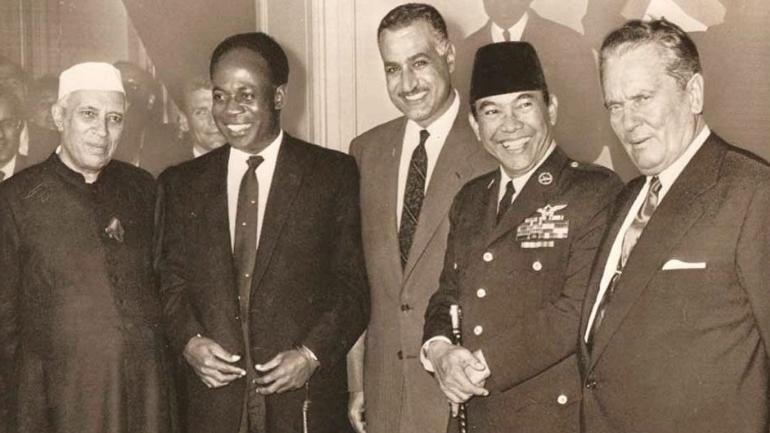
For much of the ‘Third World’ the Cold War was the Good Old Days


Nonaligned Meeting

When looking at the potential for future multi-polarity in world affairs it becomes important to consider what kind of multi-polarity is preferable and what is not. Surely, no one but the most diseased wiki-youtube edgelords of the alt right and neoreactionary movements pine for the days before World War II, where the entire planet was either exploited by rapacious colonial powers or had to live in fear from the periodic eruptions of late-comer powers with a world war or two in tow. But between the endless devastation of the first half of the Twentieth Century and the increasingly schizoid overreach of the dying post-9/11 neoliberal consensus, and the foul upswing in religious and ethnic identitarian non state actors it has unintentionally spawned, lies a far more instructive period of history to what our near future could learn from.

The Cold War, like any era, was a time filled with horrors of its own. It should never be the point of the serious historian or strategist to grow sentimental, idealistic, or above all become afflicted with that disease of critical thinking…nostalgia. But some time periods are simply more constructive for examples of this issue than others. Then, as now, the world lived under the threat of nuclear weapon armed powers. Now, perhaps as then, such enforced great power stability could give smaller and more independent countries the room to grow both diplomatically and developmentally. If they are up to the task anyway.

There were epic disasters in that time period, of course. The Khmer Rouge, the multiple attempts by outside powers to subjugate and divide Vietnam, the rule of Idi Amin in Uganda, Apartheid South Africa, Pakistan’s attempt to retain Bangladesh, the Soviet intervention in Afghanistan, and many more. But none of that outshines the vast achievements in human economic development made across the planet in this time-achievements that would slow or even reverse with the end of the Cold War and the triumph of neoliberalism. This is because the end of the Cold War also led to a diminishing in the power of small states diplomacy for the omnipresent dictatorship of a globalized market. We see the results of this now.

In countries like America and Britain we sigh at the decadent boomers who think with hard work and gumption you can get a college degree for the price of a used car and view hoarded wealth as a sacred entitlement. We rightly condemn that generation’s war on the postwar consensus of their actually hard working forefathers for the sake of tax breaks while gutting civil society and the planet itself with no regard for future generations This effect, however, is still restricted to the victory addled Anglosphere more than the rest of the world. While North America and the North Atlantic lived off the accumulated fat of times past, and even made some gains with it, other places actually did have to build from nothing. Many succeeded.

In much of the rest of the world the destruction of the final colonial powers (Japan, Britain, France) as well as the large scale stability of the situation between the United States and the USSR and the removal of the perennial German threat saw a massive wave of development guided by various modernist visions of a future for newly independent states. Perhaps more importantly, the ability to extract aid, technical advisers, and good deals from the major powers was increased by the fact that they were in a constant state of rivalry. Egypt under Nasser was particularly adept at using diplomacy to aid development and to grow living standards, but others would soon follow suit.

When the paranoia of the immediate post-Stalin Soviet Union and post-McCarthy United States started to peter away, more and more of the astute started to realize that this too was simply more of a great power competition than any ideological battle. In addition to the loosely affiliated nations of the so-called Non-Aligned League, it became more and more possible with time to seek a more fluid status in the international realm by rejecting the thinking of binaries. France, despite its pro-western tilt, made concerted efforts to reach out and develop connections with Eastern Bloc nations, while communist Yugoslavia maintained both NATO and the Warsaw Pact at equal distance-which in turn helped it extract better aid and trade deals from both as well as boost its international position with other independent states. Technological developments too were spread not just from the defense budgets of the competing powers (a la space exploration) but also in a desire to show off what they could do and how they could be of use to the Third World. Nowhere was this more apparent than the Green Revolution in agriculture whose spread was assisted by experts being encouraged to come to other nations. While both Washington and Moscow often tried to compete with technologies and aid in a way framed as a competition between capitalism and communism, the truth was they were using their technological advantages to buy influence and allies. And this was often a net boon for many newly independent countries. This was not a company hiring a few locals as it extracts raw materials for profit. This was genuine developmental assistance.

With the end of the Cold War, this favorable conjunction for national development would also end. While new opportunities would open up to a select few who had reached a level of development strong enough to take advantage of the changes that came in the late 80s and through the 90s (mostly, and perhaps tellingly, in already partially developed post Soviet countries such as Kazakhstan and Estonia), the majority of the Third World effectively lost its bargaining power. Even leaving aside that the collapse of living standards in much of the former USSR was the largest peacetime loss of human development in recorded history, the consequences for the Third World would often be quite dire as well.

Much aid dried up almost immediately. The US lacked a need to compete with anyone. Meanwhile, the type of economic exchange between the North Atlantic plus Japan and the rest of the world moved towards a more unchecked and predatory phase. Many developmental and technological advisers were replaced by voluntourists and vulture capitalists. While trade increased, development often slowed or stopped at the same time more and more resources were extracted. While the most extreme forms of poverty has continued to reduce since 1991, the majority of the people who experience that boon are in China, a country far less tied to neoliberalism than most others. Many other successes come from nations who had already set up a path to success before ’91. Meanwhile, the countries targeted for regime change such as Libya and Syria have seen an utter collapse of living standards in systems that once two were somewhat independent and working towards developmental success. To further this, the very pioneers of the present economic order are now facing rising poverty rates, especially in rural and post-industrial areas.

In a world were all gains are temporary but can at least be made somewhat long term in the right circumstances, it behooves us to think about what opportunities could be returning to developing countries as the Chinese economy reaches out to challenge America’s. For all the various dangerous multi-polarity can bring, there could be a bounty of opportunities for the independent nations of the world…ready to open a bidding war of experts and assistance between the great powers.

Its either that or give in to nostalgia as the only refuge.


Despite all the Agent Orange, the Jungle Grows Back

Fighting wildfires

The DPRK-USA summit in Vietnam is about to start. Given the generations that have passed since a frozen armistice was put in place and the decidedly erratic character of the American president I will withhold from speculating on how effective such talks will be. I do support having them, however. Everyone should. There is not a person on this Earth that would benefit, long term, from renewed hostilities on the Korean peninsula. Even the usually gleeful for conflict types in policy and business would suffer when China, now a nuclear armed nation came to the DPRK’s defense. Though we do not presently look like we are are staring down the barrel of such a confrontation, leaving the festering sore of nonexistent relations between Pyongyang and much of the rest of the world is of little benefit to anyone.

My concern here is that Pyongyang has an astute eye on Venezuela, and rightfully so. Saddam Hussein had no up to date weapons of mass destruction but for domestic reasons could not come out and say it. His lack of them hardly prevented the war that came his way. Qaddafi then saw an opportunity for his nation to be lifted from U.S. sanctions and in return give Bush a (minor) victory by renouncing such weapons. This failed to save him from an attack launched by the Obama administration under heavy pressure from Britain and France. This taught the world, and especially Syria, that it wasn’t worth giving up your WMD’s. In fact, it might be just what you need to make more powerful foes think twice. Everyone knows Israel, which once was subjected to endless conventional attack, has not been so attacked since it (unofficially) became a nuclear power. Everyone knows that North Korea’s bargaining position has been stronger since it became one. The intercontinental ballistic missile is the ultimate sovereignty guarantor.

Meanwhile, while this noteworthy and laudable attempt to normalize relations with North Korea goes forward, the US is attempting at the very same time to topple the government of Venezuela. This is extremely counter productive and will put Pyongyang on edge. Considering that all factions in Venezuela are unpopular, and that so far most of the army seems to be sticking with Caracas, it flirts with the risk of conflict or disruption that could set off another wave of migrants and conflict. Even if it does not, outside of private corporate interests who seek the Venezuelan economy opened to them, the average American stands no chance at benefiting from any major US-backed operation there…but will no doubt pick up the tab for it as always. Indeed, Maduro’s popularity is extremely low but not lower than Macron’s (who arguably treats opposition protesters worse), and opposition to US military intervention in that country is significantly higher than even the percentage of the people who want Maduro gone. If they want him gone, they will do it their way.

So far of candidates running for high office, only Tulsi Gabbard has raised a voice of opposition to our destabilizing actions in Venezuela, particularly at this sensitive time. The odds are high that if reaching a deal is more difficult than expected this would be the reason why.

This is just one issue among many that one could point to in order to make the counter-point to a growing Beltway-Lanyard narrative about America’s supposed withdrawal from the world. Robert Kagan, a well respected prognosticator despite a very long record of supporting failed policies, uses the phrase ‘the jungle grows back.’ We often see this narrative used increasingly by democrats and ‘never Trump’ conservatives to critique Trump from the neoconservative right. They are setting up a false binary where we must choose between pure isolationism and endless brushfire-war militarism. This is obviously false because there is quite simply no way the worlds largest economy could return to anything resembling prewar ‘isolationism’, much less give up its numerous diplomatic ties.

There is this assumption that undoing World War Two, the crucible of American world domination, lurks as a potential in every part of the world. But the Second World War was not normal, it was bizarre. Most of human history does not have quite so large conflicts in all out total war for global hegemony where the triumph of one side was so clearly preferable than to the other. The circumstances that made the prewar era do not exist any longer. And most tellingly, it would hardly be the United States to which much of the world would look to for deliverance at this point in time. This is because rather than intelligently shoring up its position once its last remaining true rival, the Soviet Union, fell in 1991, the United States has gone on not to uphold the stability to the post Cold War world but to endlessly undermine it. In so doing it has not only undermined its own position through over-expansion, but also made itself the most feared and least trusted nation on planet Earth. Trump’s bumbling obviously doesn’t help, but this problem dates back on some level to the over-expansion of NATO in the Clinton administration and especially from the unhinged Bush Jr. presidency. If the rest of the world doing its thing is the jungle, then we are Agent Orange. And the overreach of so much of our consensus foreign policy has made a lot of those jungle dwellers nostalgic for the days without chemically induced mutation.

In my time at the State Department I often found that the foreign service officers who had served in countries that struck an independent course of self sufficiency were often the ones more content with their ‘hardship’ (not fully developed nation) postings. Prewar Syria and Belarus were commonly lauded places to be. There is, perhaps, a reason why foreign service officers are restricted to two years per post abroad. You don’t want them getting any funny ideas about countries pursuing independent paths of development.

This needs to be kept in mind when doing big diplomatic negotiations like the one currently in Vietnam. A country that we dumped endless amounts of chemicals on, then left, and allowed the jungle to grow back. Now Vietnam is doing better than ever before in modern history *and* has positively warm relations with the United States. Diplomacy, its cheap and effective and our war to preserve the artificial construction of South Vietnam was for nothing. But in addition to hard power backing up diplomacy it also needs the soft power of knowing you are reliable and trustworthy.

Many in North Korea may be looking at Venezuela and wondering how many concessions it is worth giving the United States. It didn’t have to be this way, and it sure doesn’t in the future. There is a professional and political class in desperate need of replacing.

Beltway Ghouls Circle the Wagons

omarilhan_111518gn2_lead

On multiple prior occasions, some of which can be found in this blog, I have consistently made one prediction: that any attempt to question the ever expanding and increasing sclerotic U.S. militarism fostered upon the world would be the ultimate breaking point between those who recognize the desperate obsolescence of an insular and incestuous American foreign policy establishment, and those who would do anything to defend it. The past few days has proven my point to any who still somehow could have ever doubted it.

The new congresswoman, Ilhan Omar, found herself on the receiving end of numerous bipartisan attacks for daring to suggest that powerful lobbying groups, AIPAC specifically in her case, use money to wield disproportionate influence over the policy making process. In a world with the NRA, defense contractors, numerous astroturfed ‘tax policy’ groups, and Saudi cash to be found in almost every think tank in DC, this is hardly some out there allegation. Its simply fact. But likely because she is an anti-interventionist, and almost certainly because she is Muslim, an utterly hysteric reaction has consumed the establishment press demanding her contrition for peddling in ‘anti-semitism’. This was fueled by her retweeting Glen Greenwald, who himself is Jewish. The audacity of America’s gullible policy ‘wonk’ journalists and commentariat to the talking points of politicians never ceases to amaze me. This smearing continued today when Omar grilled Elliot Abrams on what his intentions towards Venezuela might be. Numerous denizens of the darkest caverns of mouthbreathing analysis sought to tie the two issues together by implying that any hostility to Abrams was also anti-semitism.

If you are familiar with this blog going back awhile you might gleam that while I might be opposed to intervention in Venezuela for a variety of reasons, Abram’s record isn’t one of them. I know ghouls because I *am* one, in a sense. The outsider ghoul. In the service of strategy or policy directives I supported I could take on all kinds of shady assignments for the sake of the art. Like those strategists of Warring States China or Renaissance Europe, there isn’t a single chauvinistic bone in my body towards foreign nations (unless its Saudi Arabia, of course) and I could, theoretically, offer my services from one group to another if we lived in such a context. I know that there will always be competing nations, and the art of grand strategy and diplomacy analysis is a cool job you can eke out knowing that and working with it. If someone presented me with an interesting project to undermine a country, or uphold one, I could do it making whatever broken eggs were necessary. I have never been anything but honest about this. I excoriate bad strategy, no matter who does it, and praise good strategy, no matter who does it. Hence why I am often impressed with how Iran, for example, plays a poor hand against a bumbling America. I would much rather live in America than theocratic Iran. But the Iranian foreign policy establishment of today is one I can *respect*. And I could still respect it were it my job to actively plot against them.

Abrams, however, shown by his indignant response to questioning, shows if he ever knew this he has clearly forgotten it. In the DC bubble, where careerists faun and flatter and boost each other into failing upwards regardless of skill, it might be an easy thing for one to do when they are complacent.

This brings me to what I really want to talk about which is related to the pure intensity and across-the-board ghoulery of this reaction to Omar’s comments. Because this howling chorus of lanyards, from the ever ignorant Max Boot types to the endlessly wokescolding ex Obama and Clinton staffers who always want to remind you to ‘believe women’ and ‘believe black women’ (unless they criticize AIPAC, the DNC, or the endless war state, of course) shows exactly the group think present in DC establishment institutions. This groupthink is not something I need to once again go over, but I need to specifically mention here is that it is not, despite what you may think, entirely cynical. Sure, some of it is. Party hacks on both sides of the isle have taken a cue from the Blairite melts in the UK who constantly smear Corbyn as anti-semetic for…well not being a huge fan of Israel. Leaving aside how they sloppily conflate an entire diasporic ethnicity with the governing elite of one country, this is a purely cynical move now taken up with relish by the Democratic establishment in particular who seek to prevent newer and younger elected officials questioning any of its canards. If such ridiculous call-outs continue to happen the fact is we will soon reach a point where to criticize wahhabiist terror or the Saudi monarchy will be conflated with anti-Arab racism…though I am sure some wokescold is already working on that thesis as I write this (its probably Shadi Hamid).

But not all of these howling bien pensants are so cynical. This is the core horror I can impart upon you, dear readers. After having lived in DC for over three years now I can say this with full confidence. Many of the people here, especially those in leadership positions of think tanks, nonprofits, and media organizations, but also low level people in government and business, actually believe their own bullshit. From American Exceptionalism to the magic of neoliberal markets, from ‘humanitarian intervention’ via the military to the view of America’s alliance networks as ‘values based’ to the cult of the billionaire entrepreneur…so very many of the people here actually believe this shit. Ever wondered how America could think going into Iraq with no post war plan and that few troops would work? Now you know. Libya? Moderate Rebels? And now the jaundiced gaze of the Beltway  ghoul turns to Venezuela.

That is the true horror. Horror to the strategist not indoctrinated into the cult. Horror to anyone who wants reform or substantive change. I’m both. As you can imagine, being here can often verge on a type of stark dread only to be found when Lovecraft dreamed of Yuggoth- where puffed shoggoths splash. These may not be all of the people that influence who governs, but it is far too many of them. And that is why they howl and hoot and holler in such rage and indignation when called into question, because you aren’t just disagreeing with them…you are blaspheming against their religion. The ghouls will circle the wagons when heresy from outside threatens their genteel discussions of insular theology.

But the problem with this faith is that we don’t have the luxury of waiting around for their elders to die off naturally or them to learn from the real world. The clock is ticking on the next insane war they are planning and the planet is warming and we simply no longer have the time when dealing with such people. We have only the shock of heresy to wield to remove and replace them.


The Universe of Repulsion


ravenstealssunboddhisatva

My own depiction of Pacific Northwest Raven as a Tibetan wrathful Bodhisattva, or perhaps anti-Bodhisattva. 

Concurrent with my 3 years of delving into speculative realist philosophy has been a simultaneous exploration of the historical intellectual thought in Buddhist and Hindu traditions. I remain as much a materialist and atheist as I have ever been, but find the intellectual journey of these religions far more interesting than that of the Abrahamic faiths I have been surrounded by for most of my life. In some ways I believe they can show glimpses of what intellectual life would be like in the western half of Eurasia (and its descended colonies) were it not for the rise of Christianity. Particularly in Japan, Mongolia, and China, where foreign religions largely integrated with pre-existing polytheism rather than simply replacing or expunging them. The only places in the west where such syncretism occurred is in Afro-Caribbean influenced places, some Native American modern beliefs, and New Orleans voodoo-and those of course are heavily dominated by surrounding Christian cultures.

Hinduism had outright atheistic and materialistic schools of thought, and Buddhism denies the immutable soul and upholds philosophical inquiry as dialectic exchange. Certain concepts, such as ‘Indra’s Web’ (shared by both), a concept of the universe as a web containing droplets where each droplet reflects the others ad infinitum, have a remarkable level of confluence with Whitehead’s process theory or to be much more contemporary Bryant’s ‘democracy of objects’- with the notable exception that the philosophical trends are expressed materialistic, and the religious concepts usually are the opposite. Still, much of this way of thinking effectively did not exist in the west from late antiquity until Shopenhauer and its interesting to follow its trends as thought in parts of the world where it was in effect never interrupted.

This bring me to my main point here with the post, and its a problem I have with both process theory and other adjacent to the new speculative turn schools of thought as well as those eastern religions. The problem is quite simple: sure the universe is all interconnected, but this certainly does not mean that it is all *one*.

One of the reasons I have always been partial to hard polytheistic cosmologies as cultural complex is because while there is the acknowledgement that the pantheon of (I would hold, symbolic) figures all takes place in the same world, they are fundamentally different and sometimes at odds. While many philosophical trends, secular and eastern, are superior to the brute certitude and absolutism of Abrahamism, they still can’t quite bring themselves to see the power of chaos and repulsion. In fact, repulsion seems one of the few universal values that can be said to observably exist.

I generally find metaphysics that are not grounded in actual science or natural philosophy to be nothing but faffing about and New Agey nonsense, and fortunately my background in being an astronomy nerd is in fact much longer and more robust than that of philosophy. Dark Energy, so far considered the dominant force of our universe, immediately comes to mind. If the concept of negative mass can be proven it will contribute to this. The fact that gravity is universal and omnipresent, but also weak compared to the forces of energy (dark or otherwise) also makes a case of interconnections not being enough to overcome repulsion. But this is, first and foremost, a humanities blog and there the immediate effects of repulsion seem most obvious.

In international relations we find the natural desire for all states, no matter their official ideological inclination, to balance and counter-balance each other so as to maintain the maximum freedom of action in an anarchic inter-state world that is possible. In culture and politics we see competition leading to rivalry which leads to divergence, and unity only possible when a majority is willing to countenance the use of force to keep such unity alive. Societal bonds break down both for oppression from an increasingly alien ruling class as well as in times of immense complacency and opulence. New mergers are often only possible when two groups fear a third group more, in which case unity itself is the product of an even higher level of repulsion. Foreign attack or invasion is the best way to create unity, because the level of general repulsion is often held to be greater than that which occurs naturally within a society when not under existential threat. When things are left to their natural anarchic state, repulsion is the norm. It is unity that is the artificial construct and temporary state, beneficial as it can often be. But repulsion seems to be the baseline all is working from on the macro-scale. As the Arab proverb goes (paraphrasing here): ‘My country against other countries, my region against my country, my town or city against my region, my family against my town, me against my family.’ What we see here is that unity is only truly reliable when a greater force of repulsion is present. Even those insufferable kinds of people filled universal love show this by the scorn they heap upon those that deny their vision and the hierarchies of condescension they create from those who follow the doctrine they espouse down to ‘the unenlightened’ who do not.

Some schools of thought in speculative realism, especially Harman’s Object Oriented Ontology, adopt a view more closely to what I am getting to with repulsion. Despite being more on the process theory side of things (as, I think increasingly, am I), Bryant talks about such issues as well. These thinkers speak not only of withdrawn objects and and the core of objects being inaccessible, but also of the real material basis for divergence between objects in thought. As stated before, I myself am not into the metaphysical side of things enough to bother as much with this aspect, but I do think that one can acknowledge that everything is interconnected through processes while still rejected the idea that ‘all is all one’-unless that one thing is base struggle. Interconnections need not mean monism or uniformity. In fact, rivalry and division are also a form of being connected to things. A kind of connection through repulsion-which is still a type of relationship of course but one of many rather than of one.

All of this is to quibble with semantics of course. But I feel for those of us who study the competition of societies vis-a-vis each other, or the unpredictability of change in any form, it is a useful rhetorical tool to have. It also has the positive value of being able to repel hippies and anti-intellectual ‘its like, all one mannnnn’ type people who deny the very real existence of power struggle and the importance of divergences in thought while still engaging with some concepts common in discourse that are not themselves wrapped up in Platonic forms or absolutism.

Or in other more flippant words, maybe interconnections through repulsion is the true, ahem, ‘middle path.’

Geotrickster is all in for Tulsi Gabbard

Geotrickster is all in for Tulsi Gabbard.

tulsi gabbard pic

First, a reminder that Geotrickster was ahead of the curve of Tulsi Gabbard, who announced her interest in seeking the presidency in 2020 today.

Congresswoman Tulsi Gabbard has been on my radar since 2013. She was the first non-Rand Paul voice criticizing the Obama Administration’s foreign policy towards the Middle East which was clearly starting to go off the rails around the time of the 2012 election. She has been a consistent advocate against the Bipartisan Perpetual War Party that has driven America and much of the world it claims to ‘police’ into the gutter so far in the 21rst Century. And she did this without being the opposite extreme of being an isolationist or far right crank.

Tulsi Gabbard has demonstrated, time and time again, that not only is American foreign policy off the rails and hijacked by special interests awash in their own self-congratulatory ideology, but that restraint is not only the less costly policy in terms of lives and money but also the superior way to combat extremism and avoid the alienation of allies. Having myself worked for the State Department in countering violent extremism in the past, I can assure you that this position of hers is correct. Regime change wars fuel Islamic extremism and sectarian division, diplomatic engagement can help diffuse them and build partnerships abroad. And with far less danger of direct blowback. While Trump alienates allies and the mainstream Democrats stoke hawkishness in a blind knee jerk reaction to his few better instincts, some few people, with Tulsi in the lead, represent a proper realist alternative that understands the need for cost/benefit analysis over ideological devotion. Besides, being Saudi Arabia’s bitch is no good for us.

But despite the foreign policy focus on this blog, this is not the only reason I want to express my happiness at the declaration of Tulsi Gabbard. Congresswoman Gabbard is among that rare clique of Democrats who are reform minded away from the destructive, self-consuming, and ultimately right wing-neoliberal policies of the Clinton Consensus that has dominated the party since 1992. She does this without being a starry-eyed idealist or beholden to some teleological world view about the end of history. And considering her strong endorsement of indigenous rights and environmental action, she can be taken seriously on the most pressing issue of our time: climate change. It is for many of these reasons that she has Democratic, Republican, and Independent admirers alike. If there is anything the 2016 election shows, it is that having appeal outside the closed world of partisan hacks is necessary for national elections. Both casual voters and nuanced non-partisan voters are desperately seeking a candidate that represents an alternative to the ossified nature of center-left and far-right.

It is important to acknowledge that Tulsi Gabbard, especially as a relatively anti-establishment candidate running within a party notorious for self-selecting right-to-centrist-wing candidates for the sake of the donor money and ‘expert’ strategist hires it is so fond of, is going to come into a large amount of criticism in the time ahead. The Democratic establishment as much if not more will attack her than the Republicans do. We will be subjected to the intense irony of people who support the mass bombing of the Middle East calling her Islamophobic for preferring diplomacy to endless war. We will see her former record on gay rights be called into question. She will be called an isolationist. Many of these critiques will not just be from rote liberals but also proper leftists.

My response to them is as follows. I know I am not alone in finding the level of leeway Islamic ideologies are given by people who are supposedly so secular at home. This represents the dangerous infiltration of postmodernism into the issue and ignores that many secularist individuals and movements also exist in Muslim majority societies. Weaponized Islamism is a danger in some parts of the world much like far-right evangelism is in North America. It is wise, not foolish, to remain devoted to security issues around this topic. It is, however, a problem for police and culture, not for militarized intervention. Gabbard recognizes that Islamist ideology is dangerous and requires a firm hand, but that war is usually not the answer. One can-and should-hold both of these positions.

Gabbard is also not an isolationist. She has endorsed a smart, rather than bullying, position for overall US policy. Such a powerful country cannot realistically retreat from the planet without leaving a dangerous vacuum-and few actual people endorse isolationism anymore. The problem is that the neoconservative-dominated foreign policy establishment will use the phrase ‘isolationism’ against anyone who is not ready to constantly and reflexively support their dangerous and wasteful militarism. But it is America behaving like a rogue state since 2003 that has left it more isolated than at any point after the 1930s. Just look at how America is viewed abroad.

As for gay rights, a lot of people, including the entire country itself, has changed its mind on these issues with relative rapidity in recent times. A change in position could be opportunistic, as it was with Obama and especially Hillary Clinton, whose virulent homophobia in the 90s seems to have been utterly excised by much of her more recent wokescold fan base. But Gabbard’s story on social issue evolution came before the country at large, which disavows it being beholden to polls. Furthermore, this evolution was the result of changing views based off life experience, i.e. seeing the disadvantages of social conservatism while being deployed in Iraq. This cannot imply an opportunistic John Kerry style flip-flopping at the drop of a hat or poll numbers, but the genuine changes of belief that happen. Her constant advocacy for minority rights since assuming national level office is proof of this. And in an era of rank racism and climate change denial from one party and complacency from most of the rest of the other she represents a true viable alternative who could connect with significant alienated parts of the present electorate.

After all, I used to be a libertarian and no one could accuse me of holding those views now. I learned through experience and am better for the process.

Her biggest negative is some casual sympathies to Modi’s government in India. While I myself am not a fan of this on the personal level, good relations with India are inevitable for a future America one way or the other. And while I have my strong reservations about the BJP, they are the government of India in the present time and diplomatic use could be made of such connections. India is not Nicaragua or El Salvador. The opinions of US politicians will matter little for its domestic policies. It is large, powerful, and established. Compare this dynamic to the bipartisan establishments many connections to Saudi Arabia and Israel which are not only beyond casual, but positively financial influence peddling many in DC as well.

First the Democratic Party and then hopefully the nation at large will have a choice in the near future: continue the failed Manicheism of two mutually hostile and increasingly aged political parties, or field a barrier breaking candidate running on actual issues rather than media signifiers, the status quo that has failed so many, and fear of criticism. Having learned the lesson of Obama, that charisma without a specifically attached set of policies will ultimately produce little, it is time to support the first candidate for high office who has an issue-driven career and platform and the sense and thoughtfulness to use it pragmatically.

I have seen myself how people across the board tire of endless deregulation and warfare. And I have seen that one of the few people elected in congress today that is well looked on by all of these people, who are largely unrepresented by officer holders,

It is time for Tulsi Gabbard. She is the best candidate I have ever seen to announce a run for the presidency in my entire life so far.

………………………………………………………………………….


P.S.

It is important to remember, in the media hysteria relating to the (correct) position to withdrawal from Syria and the resignation of General Mattis, largely due to his own disapproval of any policy that reigns in an over-extended American empire, that Tulsi Gabbard was one of the few public figures who had a record of grilling his pas ‘sage advice.’

And lets not forget the time she endorsed Bernie publicly at Hillary’s coronation:

Astropolitik: A Hypothetical Near Future

Sulaco_approach

On a three dimension plane, where does a country end? If nations have such things as air space then the question of how high that space goes must be asked.

In the present day we have agreed that while satellites can be the property of a nation or a corporation-and so Earth orbit itself seems to be a neutral zone-this could change. Trump’s much derided ‘space force’, while hugely preemptive and likely just a PR gig for the time being, is still a very real future we Earthlings will face in the future should our technological capacity (and ability to support it) continue growing. This may provoke some kind of renegotiation for space and the power projection and militarization of it.

My personal hope would be that we could, in fact, put our Earthly differences aside when in the vast leagues of the solar system. But I know from history that hope is a hopeless bet. So long as there are multiple advanced nations on Earth a future of a solar system wrapped up in our power politics is very likely.

The Earth rotates of course, so unless we wanted to deal with the annoyance of an eternal airspace that oscillated throughout the cosmos based on Earth’s spin it seems most likely to me that competing space powers of the near future would seek to carve out distinct ‘zones of influence’ (mostly for mining and research stations) in specific locations. The earlier powers to Space Race 2.0 would have a huge advantage in finder’s keepers–though this could inspire the first offensive combat fleets from the late coming revisionist powers to take their fair share in turn. Certain asteroids and moons with deposits of useful materials would be the first stage of potential conflict zone. Whichever nation (or multinational) which held these in the long term would be given in turn a huge boost to their position back on Earth.

Keep in mind that one difference between all of this and present terrestrial warfare would be timing. War is faster and more instantaneous now than ever before…but that is just on Earth. Space itself and the distances under our present technological limitations drag out the pace of operations. Even information warfare that could be effectively conducted at the speed of light would no longer seem as instantaneous as it does back home, with such actions now having to be measured in light minutes and hours. Speed would matter more than anything else, including speed of physical weapons. Perhaps some kind of electronic equipment frying wave is the first attack followed by guided kinetics. The levels of sophistication in any conceivable future probably argue for a focus on larger, durable, and versatile vessels.

Let us push a few more hypothetical generations out. As a species we have managed to outdo my expectations and actually started the process not only of solar system colonization, but of terraforming. This means colonies are not little space-supplied pockets of experts but rather baby societies in the making with a self sustaining populations and basic tech levels.

It seems quite possible that if there were multiple nations on Earth with space-faring capacity, there would be nationally oriented colonies. Far less likely than see expensive and possibly pointless war between colonies on different celestial bodies, we would see multiple national colonies on the same most valuable celestial bodies. Think the Seven Years War in North America. So if Mars and Europa are the best place for colonists you would have multiple competing colonies on each. Geography, and geopolitics, come back into the fore in this new and more established phase of astropolitik. The underwater colonies of Europa, for example, moving towards negotiation over the space between the ice shelf ceiling and the sea floor in diplomacy with fleets of submarines to bolster their claims. The open nature and low gravity of Mars might be a boon for vehicles who can change from high to low altitude with great speed for a variety of technical purposes which could, in turn, be harvested strategically.

Of course, as  colonizing itself becomes easier with logistical improvements new colonies might bud off from the older ones which diverge from national origin and become ideologically or sectarian based. Political dissidents, religious fanatics, utopian experimenters, escaped prisoners, etc. This is the kind of future phase extremely well portrayed by my personal favorite computer game, Alpha Centurai, despite that game starting out with the initial settlement already being ideological rather than national. Think Pitcairn Island, the Gulla culture, Iceland being settled and then settling Greenland, the Qara-Khitai Khanate, etc.

But if the core assumption of geopolitics is that geography shapes the strategy (and historically, the people) of a place then this colony on colony rivalry eventually might give way to greater levels of solidarity against Earth. Food and basic tool production, once achieved on the colonies, makes them more functionally autonomous. The various second tier non-national colonies begin to influence their mother societies (for better or worse). Colonial conflicts might increasingly become more akin to civil wars, where one faction seeks to take the entire body of settlements for itself, or remove some kind of dangerous local pest, rather than its mother nation. Mother nations back on Earth, in turn, might themselves collapse leading to colonies being stranded, independent, or being absorbed by others. New home grown factions topple loyalists allied with the Motherworld to make new deals and institute reforms unwanted by home base.

In the end, the distances, assuming we never develop the truly impressive drives made necessary for storytelling in so much of science fiction (it does seem improbable to happen anytime soon from today’s vantage point) practically ensure many colonies become independent. Some might go a Qin Dynasty route with a Shi Huangdi type figure forcibly unifying and then making a whole celestial body uniform. Others might be anti-Earth (or anti-other colony) coalitions that are domestically autonomous. Some might descend into total city-state style colony on colony warfare once a common external threat is no longer viewed as possible. A truly successful terraforming project coupled with exploitation of some new abundant locally available resource might even see a colonial power come to rival or even out-class Earth itself…which might in turn be a boon for peace on Earth as the common, now properly ‘alien’ threat might just bring those fractuous nations of Earth together for once.

Of course, Africa begat humanity and the Middle East begat urbanized agrarian civilization, and those have never yet unified in the face of outside threats so…there is always the chance that powerful colonies than completely reverse the process and begin fighting with each other on Earth over slices of Earth proxies and junior partners. You have to admit, there is a certain humorous irony in that. Especially if it eventually ends up creating Pan-Earth-Solidarity through anticolonial resistance to the occupation of the ex-colonies.

For this entry I was keeping solely with what seems realistic for a future expanding multi-polar humanity to achieve. In the future I might consider a less reality rooted hypothetical of faster-than-light transport and what it would mean for an interstellar empire or a few of them. If you are new to the blog and want to see the few other times I have talked about science fiction you can find my take on Star Trek: Deep Space 9 and IR theory (specifically neoclassical realism) here, and the overlooked but interesting concept of geopolitics and anticolonial war in Heavy Gear here.


Cheers and Jeers, Not Tears for Dead Missionaries

North Sentinal Island (Creative Commons A-NC-SA) Credit: Christian Caron

‘Come in and meet our Gods,

This is not your day.’

~Korpiklaani

North Sentinel Island is a place most people never heard of before this week. I recall finding out about it about ten years ago when I saw an article and some photos about a helicopter being driven away by the impressively long range arrows of the inhabitants (known by us, if surely not themselves, as the Sentinelese). I had forgotten about it for quite some time until I was reminded this week of the place because of the death of missionary John Allen Chau.

One thing that makes me overjoyed is that the overall reaction of people, if the internet is any judge, is one of overwhelming hostility to this man and his mission. Had this story came to news prominence in, say, 2004 or about, no doubt reactions would be split 50/50 in the American media as we were still in a mindless post 9/11 fervor where rallying around the flag also meant rallying around the cross for many. And no doubt the people who recognized that such a person would deserve their death would have still treaded on eggshells disproportionately. This was, after all, the time of the Bush administration- evangelical alliance’s height before a countless barrage of sex scandals and their total inability to not make asses of themselves caused the growing brand of theologically inclined social reactionaries to start crawling back under the rock from whence they had first emerged in the 80s.

But not today. John Allen Chau is clearly and rightly seen by most people as anywhere from dangerously deranged to downright evil. His attempt to contact a tribe that has kept the outside world at an arms length for tens of thousands of years was a monstrous breach of any sense of remotely logical ethics, if for no reason than the very real danger a man of globalized world’s bodily pathogens coming into contact with an isolated people who are likely to have very few immunities to anything he might be carrying. To put it succinctly, he very well could have committed unintentional genocide of an entire culture just so that he could spread his religion. A culture, by the way, that no one off of the island can even communicate with.

This is the first and obvious take away from this situation. Sure, the Indian government wants to protect people from the tribe, who have clearly taken an isolationist stance since they were first invaded by a small British exploration force in the Victorian era, but they also want to protect the community from literal biological death. It has happened enough (and often at the hands of missionaries themselves) in human history that this should be a no-brainer. While it is clearly irregular for a group of humans to still be so isolated, its uniqueness also argues in favor of protecting them. They might survive in situations were many of the rest of us would not. And to maintain constant habitation of one place for so long clearly implies they want for little and are clearly doing something right. I am no romantic primitivist, I know far too much of history for that, but what works works in each ecological niche. And part of appreciating human diversity is appreciating that individuals and groups alike also have the right to opt out if they so desire.

But this is where I stop giving you the typical arguments you can find anywhere, and were I go into territory many commentators won’t. This is where I get mean. Because Chau was not a misguided but good hearted man, or even just a criminally negligent man (though he certainly was that too), but a bad man. The kind of man we should discourage from even showing their faces in a remotely self-respecting society, much less other societies.

Even if it were not for the obvious biohazards of the situation, I would still laugh and cheer at the death of John Allen Chau and people like him. Not only do I believe that the Sentinelese acted in self defense, I also believe that they did the world itself a favor. Be it tribal, rural, or urban, human society has had enough Chau’s in the past two thousand years. Such people are the lowest level of scum to be found on this planet. If you doubt me you need only be aware that according to the diary his own family released that he wrote, he referred to North Sentinel Island, possibly the most stable and by some metrics successful society on Earth still around today, as ‘Satan’s Last Stronghold.’  Yup. Swell guy.

Christianity and Islam, those two incestuous brothers of trying to take a Jewish ethno-cult and turn it into a universal global religion, are by far the biggest two ideological scourges on this planet. Both past and present. The reason they are so uniformly prone to aggressive expansion, thought policing, and being unable to rest while The Pagan Other still lurks ominously in their fever dreams is because they have only one absolute god, who they also maintain is the god of everyone. And the only way to get closer to said god, of course, is to kowtow to their theologians who have only the correct interpretations. In its most diseased sects they can also stress that pure belief, rather than community or being useful to society, is the most noble of goals.

This, which could be argued is the true invention of virtue signaling as ideology, has to have been the worst idea any human has yet had. It has delivered no measurable or material positives while also giving many negatives, especially in regards to the destruction or near destruction of numerous cultures of people and artwork. Including literally all of the Americas. Pagan gods could be ruthless, but it was an honest ruthlessness that didn’t pretend also to be your Very Concerned and Loving David Koresh like Father. Gods across the polytheistic world were adopted in each other pantheons or merged together all the time. People of various personality and professional persuasions had their own gods and cults far better suited to their interests of choice than one bland, homogenizing, and yes dare I say, neoliberal, omnigod who was to be all things to everyone at once. Despite the many artistic accomplishments of Christian and Muslim artists once the initial fires of fanatic faith burned out (leaving the craving for culture in its wake) these achievements still remained at periodic risk due to revivalist and reformist movements who often re-awakened the latent puritanism of the original dark days of the faith. From Calvinism in the 17th Century to Wahhabiism in the 18th Century and ISIS and Pentecostalism today, all of us who live within majority Abrahamic societies must live in fear of the worst messianic instincts of our foolish fellow citizens who follow such ideologies rising up in periodic resurgences of insanity. All of us who deviate from their norm in thought, sexuality, or creed must always stand on guard to protect the precious innovation that is secularism simply because such people exist.

But lest I go over previous treated ground on a sad cultural legacy of monotheism and fanaticism and how it still lives with us today, I want to specifically mention the sheer entitlement of the modern American Christian missionary and why they, as a class, are never to be mourned when they die doing such ridiculous cultural invasions as that of Chau on North Sentinel Island.

While I started this essay with an expression of happiness at the overall attitude toward this fool’s death exhibited by the public, there are, of course, dissenters. Almost all of whom are evangelical and fundamentalist Christians in America and (probably also) Western Africa and enclaves in Latin America. I’m not going to drive up any of the traffic of these fool websites and commentators, but I can sum up what I have found.

There is a near universal consensus by such types that they are a persecuted people. They point to people being mean about their fellow traveler online and how the Indian government will not prosecute (someone even called the police for this ‘murder’-the American police no less-these people are beyond parody). They try to draw a connection between the Modi government of India and this totally excluded and autonomous island. But lets be real, a fundamental aspect of Christianity has been and probably will always be crying ‘persecution!’ They do it when they are the majority community who sets all the standards, they do it when they are the *only* people around and then subdivide into numerous warring sects for they apparently cannot even exist without sectarian strife. They do it when someone they are oppressing merely complains about their being oppressed, they do it when they see something they disagree with, and they do it when people don’t buy shitty chicken sandwiches from a chain restaurant. Their societies have enslaved and exterminated too many to tell and yet the deaths of those at the hands of societies that resist is somehow an attack on all of them and a great tragedy. And naturally, if you point this out they say ‘not all Christians!’ For a people so eager to generalize all of the planet that exists outside of their yoke, they are remarkably adamant that you never generalize them.

Foolish ‘secular humanist’ types can also follow this trope by lamenting the loss of life, as if pacifism ever got anyone anywhere. But a humanist is just a secular Christian when it comes to values so the point still stands. History is not a teleology with a heroic endgame or moral platitude that triumphs, its a mass of cycles of chaos and circumstances alone determines who stands and falls. But on those rare moments when a choice can be made…just shoot the fucking missionary.

When we see such events as Chau’s misguided adventure and death we should not hesitate to be as mean about it as possible. We should celebrate such victories as many of us would be better off had our societies resisted the missionary as well. He had it coming. That empty-headed smile he shows in his selfies is a testament to the bland mediocrities who often crawl through this planet with designs of ‘saving’ the world from divergent thought. He is the photogenic Christian version of those smiling jihadist selfies of those wreaking devastation on the culture and people of the Iraqi/Syrian border but bourgeois and socially acceptable. The policies of the 17th Century Tokugawa Shogunate and 19th Century Kingdom of Madagascar to remove the Christian population as harbingers of a coming colonialism and as a matter of national security were not misguided, but correct. Religious freedom can only work under either polytheism or secularism, which means the freedoms of those who don’t believe in freedom must be curtailed. Knowing this its about time to make the profession of missionary as extinct as that of court eunuch, foot binder, or witch hunter.

For a Finnish musical take on this topic from the correct perspective which I quoted at the top, see: