Two Reluctant Cheers for Authority

hadrian

In today’s discourse you will almost never come across someone self-identifying as ‘authoritarian.’ In fact, the word seems merely to exist as a straw man for half baked and childish libertarian ‘political tests’ which are superficial and designed to make literally everyone on the planet think they are secretly libertarian. Of course, my own test based on the same axis is much better as it captures the essence of everyone and everything in all times and places which ever once had a political opinion of any kind.

But maybe the term authoritarian requires at least a partial resurrection. Coming off of the heels of a century of unprecedented state-directed terror this may seem odd, but that was also then, and this is now. As John Gray so accurately points out in The New Statesman, it is the stateless parts of the world which are the problems now more than the overly-governed.

This is not to say we need an overreaction which apologizes for the excesses of the NSA or admires the more terrifyingly over-regimented societies on the planet. As Gray reminds us, this is not a question of good and evil and freedom versus slavery. All political stances are in fact the decision of who to regulate and who not to, rather than some simplistic quest for freedom for beautiful caged birds who write poetry standing at odds against regimented hordes of riding crop wielding jackbooted thugs. A regime which is free to one kind of person can be unfree to another and vice-versa. So if merely to call for a recognition that the state is still the best form of self-organization we have, and that we should not be so quick to topple those of others lest we threaten backlashes which can make our own less free is to be authoritarian, by all means, let us be ‘authoritarian.’

Personally, I fear the political backlash to terrorism more than the acts themselves. They are far more likely, proportionally, to affect me directly. But it also means we have to be serious about what kinds of freedoms we want and don’t want. And we also have to acknowledge that most likely we will not be the ones to decide. What is relevant right now is that authoritarianism may very well make a come back, and that doesn’t have to be *all* bad. And no, I don’t even think terrorism will be the main reason it comes back, but rather ecological catastrophe. Whatever terrorism brings us now in debates on state power is merely the prelude to a greater debate on responding to a rapidly changing planet.

And this is where authoritarianism might be selectively helpful. We have already seen how some kinds of regimes in sectarian-divided countries keep minorities safer than they would be otherwise by being undemocratic. We also know that authoritarian states have a pretty good record at crisis response. Particularly on environmental issues. The world’s largest polluter and most rapidly developing country, China, is also the one going through a crash course in large scale sustainable energy which puts its rivals and some developed countries to shame in ambition and hopefully effect. But let us go further.

When Jared Diamond’s book ‘Collapse’ came out in 2005 I was a sophomore history major in college and a fan of all things Diamond (in many ways I still am-this post was originally going to be ‘Hooray for Determinism’ after all before recent events changed its nature when I got around to it-though I might still write such a thing)  and also a libertarian. Having that simple (and oh so American) world view, I found myself invigorated by the challenge he presented. The two large scale examples he presented of a state successfully responding to ecological crisis were both very authoritarian states. One, the Dominican Republic, a blatantly racist and fascistic government under Raphael Trujillo, and the other, the mega-centralizing hyper-bureaucratic Tokugawa Shogunate. These were the states which he lauded for foresight. Two opposite poles of me were in a delicious conflict over what position to take on this issue.

Well, in about three years I made a full recovery from libertarianism and I knew the answer. Though to be fair, the materialist always lurking inside me probably made this inevitable. Libertarianism is, at its core, a type of Taliban-style liberalism of just taking one non-material ideology and ramping up it to 11 with philosophical purity as its key point. With this discarded, I could acknowledge that Trujillo may have been one of the biggest dicks to ever live, but a broken clock and all that. One doesn’t have to endorse a Shogunate as an ideal type of government to acknowledge there are many things that particular one did right, from public health administration to education and infrastructure. And of course, a national forestry system with an eye on conservation-in the 17th Century no less!

Weak states and loose confederacies are better at doing many things than stronger more centralized states. And I will always defend federal style systems as ideal for learning about the divergences in policy execution in the laboratories of regions and adapting accordingly. But crisis response is not one of them. Terrorism is only the tip of the iceberg. It is the less media sexy but slow burning fuse of ecological collapse which will drive state reaction in the long term. And we might just find certain types of authority useful.

After all, many of the greatest periods of multicultural cohesion have been under monarchies and pre-victorian empires. Many on the far right betray their true colors when they imply that a society which can accommodate many kinds of people is a threat to the social cohesion of democracy. Maybe they are right in some instances, but the Roman Republic appeals much less to me than the Roman Empire does. I would give up the vote before I would give my access to material goods of diverse origin and interaction with people of greater backgrounds. I doubt there will ever be such a dramatic either/or choice and I am largely playing devil’s advocate here, but should such a turn come, I will chose multicultural authority over monolithic democracy. History makes a better case for it in terms of overall case studies. Sure, one can always say most people are political idiots in any context, as it is I have already railed against the naive cosmopolitanism of liberalism on this very blog. But as a lesser of evils, wouldn’t you rather have a variety of idiots than the same kind repeated over and over again? Awash in a sea of vatniks or their American or whatever equivalent is a future far too boring and horrible for any type of interesting person to even fathom.

Previously, I waxed poetic about my love of the Heavy Gear setting for looking an a non-utopian science fiction of international relations. One thing I always really liked about the setting is that the Southern Republic was the best representation of a complicated authoritarian order. It was a zero tolerance regime for criticizing the government, but in exchange it was a patron of the arts and a subsidizer of the common citizen. It also allowed social libertinism unseen in other competing states of the setting. This reminds me of the Tang Dynasty, the early Mongol Empire, High Rome or any other period of effective cultural flowering. Of course, being able to the criticize the government is a right I would loathe to lose, but let us be honest-for most people food, sex, and housing matters most. If one can’t have it all one can get their priorities in a proper hierarchy. Principles be damned in the face of impoverishment or even in compromising the epicure.

As I stated at the start, this isn’t a post glorifying state power. It is a post building upon Gray’s call for a mature discussion of what freedom and authority really are without devolving into enlightenment baggage of good and evil and free and unfree. The world moves fast and change is constant. State collapse increases the negatives of this and as our biodiversity collapsed and our rapacious need for resources grows unchecked, its time to move beyond lame establishment narratives of NGOS and hippie activists saving the planet through fundraising and talk about what might be necessary for states to do.

And not to do.

P.S.: I love the Shadowrun games and find them (and the original rpg setting) a pretty brutal look at what a technological yet stateless society would look like. It aint pretty, even with all the cool magic and creatures. Its a setting which is clearly influencing one of my present creative projects in fact so it is on my mind. So, I leave you with the most recent (and best) entry in the series very good soundtrack. It gets much better in the second half by the way.


A helpful reminder of history

Its nice to see establishment publications running articles on this topic-the very cause of this blog. Nial Ferguson is a historian I can have a complicated relationship with, but I love his writing and his deep perspective. He, and also Graham Allison who wrote this article, have a true understanding behind why Kissinger was so unique in American foreign policy and in so being so much more effective than any other Secretary of State in history. It is why this blog holds Kissinger up as one of the archetype trickster-trolls (in the best sense) of foreign policy.

Americans, are by and large, shockingly ignorant of history and philosophy. The fetishization of the short-term practical has made a nation of boring technocrats in policy circles whose knowledge base could fit in a watercolor set. This comes from a preference for immediate fads over deep temporal understanding. This is also a problem in contemporary European philosophy as well, at least since the 80s.

Well, I guess I know what book I am getting for Christmas. It is interesting of all the biographies I have read I have never done a Kissinger one.

I know my posts have been short lately compared to before, but I have a pretty cool idea for something upcoming which will be one of my longer and weirder posts. I have really come to like taking various IR theories to fictional settings and so far have done it twice for science fiction settings here and here. I was thinking it was time to give fantasy a turn. And no, it will not be Game of Thrones or Lord of the Rings. Much less expected than that. There are two different ones I wish to do actually, so we will see what comes first, but stay tuned.

Just a brief thought on the Russo-Turkish Fiasco

I’m kind of thinking two things which are not exclusive:

Turkey shoots down Russian plane to sabotage greater Franco-Russian collaboration in Syria, which undermines their little shitshow on the ground with the terrori-I mean rebels.

Russia intentionally violates Turkish airspace in order to force some kind of rupture in the already crumbling NATO over this issue and the fact that Turkey’s popularity in the alliance is plummeting largely over Syria-Iraq issues.

Both could be wrong, but one or both could be right.

The biggest problem is that the most powerful individuals in each of these nations are both clever but also dangerously ambitious and beholden to terrifying domestic (and in Turkey’s case international) constituencies. A crisis which takes a life of its own is the last thing anyone wants even if the cause is simple pilot error. It probably was, but considering the convoluted nature of everything going on there now, let’s keep our eyes open.

One does wonder what the South Caucasus equivalent to Plevna would be…

The White Girl’s Burden

Take up the White Girl’s Burden,
Send your kids to Africa to serve their social media needs,
To build without skill and instruct without knowledge,
To complain of local food and send forth tweets of their deeds.

Take up the White Boy’s Burden,
A school roof fixed for proof of gain,
Give logo shirts of your mission trip,
And for every retweet, a Kony slain.


Multipolarity or Unipolarity for Eurasia’s Future?

russia-china-bears

Answer: I don’t know. Let’s dig deeper! Here is a good article from The New Statesman. I have a few additional points I would like to add to it.

Moscow is only going to take expanding Chinese influence in the region for so long without some sort of give and take, especially as they have potentially more to offer. Its hard to see the ultranationalist and increasingly xenophobic Russian state asserting itself towards the west and giving up in the east. Of course, that might also be the idea. Secretly Moscow might see such a bend as inevitable and thus the immense pride and low risk force projection towards geriatric Europe and world-hated ISIS is the cover for a massive but calculated preparation to take junior status to China in all but name on the world stage.

Either way, the United States and its allies are doing everything they possibly can to shoot themselves in the foot right now as a big part of what draws these powers together is the scheming of Atlantic nations who have little strategic gain in the region but at least superficially and sometimes directly support opposition movements anyway. It is fascinating to watch American grand strategy drive two natural rivals closer together based on nothing but overconfidence and overreach. We don’t just have a military-industrial complex, we have a liberal-humanitarian NGO complex too. Both influence strategic decision making in often unwise directions.

I would be willing to bet that the Sino-Russian relationship would have already started breaking down by now if not for the complacent imperial overreach and narcissistic Wilsonianism of the US and its allies. And if they keep pushing they risk making this otherwise temporary arrangement of convenience a permanent one, locking them out of the region entirely for sure.

But no matter what happens in this arrangement Russia might still be the loser. A rivalry with the US is much less dangerous than a rivalry with China for them, whereas a rivalry with Russia is significantly less dangerous for China. Expanding influence into Central Asia seems a much less risky move than the South Pacific on the part of Beijing. Any such action could be more exploited by the US to divide the powers. Of course, if these countries do hold onto a Eurasian lock together against the odds long term they really would have made the first large scale and successful multi-regional check on US ambitions…well, possibly ever.

It is a fascinating time for grand strategy, that is for sure. There is nothing else (contemporary, anyway) I would rather study.

The Coming Multipolarity, or, ‘Damn it Feels Good to be a Horder’

Yes, I meant ‘Horder’ as in Horde and not ‘Hoarder’.

So in my last post I mentioned in passing how freakish unipolarity actually is as a part of talking about how the people in American foreign policy circles who advocate constant interventions, lest they confront a decline, are actually the ones causing said decline. The once and future restoration of multipolarity, whether it comes in a decade or a century-I know not the time scale- is actually a subject that interests me even more than what I wrote about last time. To talk about it, I am going to do something a bit dangerous in IR-if only because there is a sad lack of historical knowledge in many quarters of the discipline-I am going to make a historical analogy to what I think approximates the future of return to multipolarity and great power behavior. I am going to talk about the Golden Horde.

Mongol warrior rearing

If anyone knows the artist please let me know so I can give credit and find more of their work! It is just such a cool image.

Now studying this topic is kind of my bread and butter, I did write a book on the influence of nomadic people in Eurasian geopolitics after all. It is, however, a niche topic and after dealing with it explicitly in graduate school and in book adaptation form you are only going to get the summary here. But I have to say that I think the strategies enacted by nomadic people are an interesting pre-modern analogy to what we might see in the future, albeit in an obviously different form.

Previously on this blog I have talked on multiple occasions about my affinity for Neoclassical Realism and regime survival theory. According to scholars such as Beckwith the primary political arrangement of the Eurasian steppes was a type of enlightened despotism with high levels of mutuality and dependency of the ruler with his in-group elite. Depending on the example, this in-group could be anything from family members, military leaders, adopted foreign administrators, and in some cases all of the above. The Mongol Empire was one of those ‘all of the aboves’. More importantly to the theme we will be examining here though, is how it viewed self/other relations on the international stage. In other words, their approach to International Relations. Now, the Empire was large and diverse, and after a couple of generations it split into several increasingly different kingdoms. Though all of these states shared many attributes we will be looking over, it is ideal for brevity to pick the best successor state for looking at the messy world of multipolar relations. This is the Golden Horde, also known as the Kipchak Khanate and the Ulus of Jochi.

When the Mongols invaded Russia to stay they broke all that Basic History Bro received wisdom of never attacking Russia in winter. In a large land filled with poor-to-nonexistent roads which was often forested or swampy in much of the year and where cities lied almost exclusively upon rivers, this made sense. The cold-adapted Mongols used the frozen rivers as highways to hit city after city, which fell to their rapid mobile horseback armies backed by the new acquisitions of Chinese siege techniques and the new (to Russia) technology of gunpowder explosive. It was a remarkable campaign which further added to the laurels of the general Subotai Bahadur’s already amazing reputation, and ensured that Batu, son of Jochi, would have an impressive inheritance.

But Batu Khan was not just some spoiled scion of the Mongol royal family riding the coattails of their greatest general, but rather a keen politician. This was good, for his domain of the empire began with unique challenges and required more autonomy than was yet normal due to its distance and remoteness to Mongol power bases. A small number of nomads now had to control a territory that did not always favor them as well as greatly larger numbers of subject people. Their advantages were in speed and intelligence, not numbers, and their distance from the Mongolian core (and integration already of many other Turkic people into their system as they moved west) meant their position was different.

Batu, like other Mongols, believed in the efficiency of indirect rule. But he would take it further then the rest of them yet had. He allowed all Russian princes who surrendered to keep their lands, and those who never fought against him in the first place could get elevated positions in his hierarchy. Rather than stretch his forces out or occupy places, he relied on the threat of his rapidly moving horsemen to serve as the stick to the carrot that was being integrated into the booming Mongolian trade network. To top it all off the Mongol Empire gave freedom of religion and tax exempted clergy as well as administered a postal service. It offered an attractive package especially when the alternative was punishment expeditions which could result in enslavement or utter destruction.

The Horde constructed a wall of these buffers, many of them willing, to bolster its frontier with the large and then very powerful Grand Duchy of Lithuania. Reaping the taxes of its subjects without the costs of occupation and even being able to ‘offshore’ some of the fighting was a good deal. An empire made by sudden conquest essentially turned to become a remarkably defensive player. Attacks served only to weaken foes or secure pasturage. To put it in World Systems Theory terms, the core exploited the periphery due to their unique military and trade managing advantages. Only in this case the core were the smaller amounts of ‘less advanced’ (by settled societies’ standards) nomadic people and the periphery were the cities and farmers.

Batu and his descendants spend most of their time on the steppe, they even built what became two of the wealthiest cities in the world for that era off of the Volga. Cities of which little remains due to the later campaigns of Timur, though which many records of travelers speak of their immense multicultural settings and wealth.

So why is this relevant to the future of multi-polarity? Well, for one thing since at least the Second World War if not the rise of steam powered naval vessels, speed and rapid deployment of multi-functional forces has returned to world political and military calculations in ways not seen since the impressive medieval armies of Inner Eurasia. Indeed, it now far surpasses them. Another factor is the rise of transnational trade and resource extraction networks, which pillage on a scale Chinggis Khan could never have dreamed of, but remain vulnerable to geopolitical breakup just as his did. If Mongolian trade networks suffered with the collapse of the empire, then they must have been partly a product of unipolarity. So too are the shipping lanes and grand trade deals of the United States no- doubt temporary artifacts of its own power. Like the Mongols, the United States uses a smallish elite military capable of immense speed of deployment to keep such a system open. Like anyone, past present or future, this system cannot last forever.

In a non-unipolar world all powers must tread lightly with each other but also have the luxury of being quite brutal with smaller powers in their respective zones of influence. Repeated failures and some extremely expensive successes with things like peacekeeping and anti-guerrilla warfare was made most leery of directly occupying places. And yet in a world with several competing power-poles there will be no one else to do the dirty work of securing economic hegemony for powers towards their own periphery. They will have their own markets, their own needs, and wildly divergent internal structures. Rather than seek to impose these structures on each other or even their ‘vassals’ they will simply seek to support their own regimes however they can at home while getting what they can abroad. When two power-poles enter conflict it might be over proxies or even entirely *through* proxies. Either way, the wonders of modern technology enable plausibly deniable warfare to be fought abroad without necessarily increasing war fatigue at home.

All of this means that special forces and elite columns will matter more than mass armies-at least as long as the conflict remains peripheral and doesn’t break out in total war (always a possibility in any multi-state system). But even a big breakdown bringing back conventional war using today’s (or the future’s) technology would be one prioritizing speed and firepower over numbers, as things currently stand anyway. A Subotaiian force deployment, if I can coin an awkward new phrase, adds on to this levels of utilizing organized crime backchannels and cyber warfare and you have yourself a 21st Century recipe for whatever the new equivalent is of ‘Golden Hordeing’ by living large on the steppe with occasional shows of force abroad.

If this does come to pass, and it already seems to be manifesting in the early stages in regards to Russian policy towards Ukraine, Moldova, Georgia and Tajikistan, you might see more of the continuation or exploitation of frozen conflicts so that larger powers can project their influence without directly invading anyone. Although increasingly a specialty of the Kremlin, this is hardly unique to Russia these days. From South Pacific islands and Taiwan between the US and China to France in many parts of western Africa and increasingly other powers there as well, it seems the best way of building a protection network is for technologically or logistically advanced nations to insert themselves as arbiters in perpetual conflict zones. Now imagine that without a stabilizing power. So, the princely states between Lithuania and the Golden Horde in the 13th Century seem suddenly relevant.

I do not know if this arrangement, should it come to pass, will be an overall improvement or a downgrade. I can see certain issues and peoples losing out and others gaining. As typical in the humanities it would most likely be a mixed bag with people’s reactions coming from where they are geographically and in terms of economic station. The good news is that there won’t be a drive to impose a uniform socio-economic vision on everyone else (always a quixotic and ultimately disastrous cause which the Mongols were astute enough to avoid except in rhetoric). But, the bad news is of course that there could be more conflict, and that with looming ecological disaster waiting in the wings such division might finally occur right when we need collective policies the most. Of course, one look at human history shows that when the chips are down people turn against each other when resources are on the line most of the time. So one could always hold out hope that the divergence of geopolitical blocs beyond what we have now might create new creative policy dynamism to confront ecological degradation, leading ultimately to a type of ‘survival of the greenest’ which in the end might help in dealing with the problem.

But if history has any lesson-a statement one should always be dubious to make-it is that history has no linear path like the hard sciences. Politics and philosophy is basically the response to conditions which arise from resources, conflicts and deals struck about them and the physical world we live in. It is adaptation, and like natural selection while all branches might die in the end, some will fair better than others in particular moments of crisis. Whatever those adaptations may be, any breakdown in multipolarity is going to go through a phase which is at least Golden Horde-like for the more powerful countries which may exist at that time.

And even in the unlikely event of one unipolarity giving way directly to another through unexpected catastrophic collapse concurrent with canny rise (say USA to China) this has just delayed the inevitable. Unipolarity, as I said, is a freakish occurrence. And much like a supercontinent, it is a temporary arrangement between cycles of greater division. One day great powers (whoever they may be) will find themselves hoarding smaller countries to create their own little NATOs all over the world. Some arrangements may be nice to their clients, others cruel, most a mix of the two, but in a world so used to only one or two true superpowers it is good to occasionally remind people that you can look at Imperial Rome all you want as a glorified example of past and present analogy, but its the various Hordes who people might be studying in the transitional future. It sounds apocalyptic, but for all we know it might be awesome. Or both, whatever. The tides of history know no morality either way. And I just want to examine as many strategically relevant things in the past and present as possible. And listen to Tengger Cavalry of course.

For further reading on these specific topics I recommend Dilip Hiro’s ‘After Empire: The Birth of a Multipolar World’ and Charles J Halperin’s ‘Russia and the Golden Horde: The Mongol Impact on Medieval Russian History.’

Nation Building Sucks and the United States is Particularly Bad At It.

afghan kunduz

In Max Hasting’s massive book ‘Armageddon: The Battle for Germany 1944-5’ he makes numerous observations comparing the Allied armies in the later stages of the war with each other. The hard lessons learned by the post-purge USSR in combating the German army are contrasted with the bungling and occasionally disastrous performance of the British anywhere outside of North Africa and the overly cautious hyper casualty-conscious strategies of the Americans. Though he hardly judges it as it makes sound strategic sense when one has the luxury of a much larger and more ruthless ally to do much of the heavy lifting, it is a worthwhile point you will not hear much of in the triumphalist Atlantic oriented popular history of the Second World War.

Eisenhower quite correctly saw how adverse to mass casualties the United States was in the immediate post-isolationism era. But catering to this need would not have been a remote possibility had the USSR either not been a participant in the war or had been knocked out of it by the time the USA was in full force. While it is undeniable that the United States played the most decisive role in supply, logistics, and defeating Japan in a largely naval and limited amphibian war(those tend to have smaller amounts of overall casualties than big pitched land battles even if they are economically more challenging to sustain in many cases) the amount of sacrifice it would have taken to have gotten unconditional surrender from Germany (or to conventionally invade Japan) would have necessitated a negotiated peace or the mass deployment of nuclear weapons again and again on most of the cities of both countries.

Debacle in Vietnam reinforced this trend right when it was starting to expire. Multiple wars of choice since the 90s were conducted in such a way as to minimize American casualties as the first priority and securing objectives a second. This is a problem, and not because these luxury wars of choice need to be fought better-but rather because they are totally unnecessary.

With the renewed and potentially perpetual US commitment to Afghanistan coming at the same time NATO countries are doing everything in their power to unseat the Assad regime while seemingly either oblivious or indifferent that such actions may create a new safe haven for radicals perhaps it is time to re-examine America’s greatest weakness as a tool which could be its greatest strength: adversity to sanguinary military operations. If one thing is going to re-align a fundamentally moribund foreign policy strategy it could be this.

There was only once as a fully independent and established nation that the United States both mobilized for total war and was willing to accept truly enormous open ended sacrifices with seemingly no limit to bring a war to a decisive end and that was the Civil War. The partially botched nature of Reconstruction and the truly appreciable percentage of the nation’s populace killed or wounded produced a souring which meant that a single year in the trenches of WWI reinforced quite the fear of mass casualties…and the further from home they were the more suspicious they could be. One could imagine that in an alternative Second World War where the United States gets involved reluctantly to shore up the Allies against the Axis without a Pearl Harbor to inspire a desire for revenge as one of being careful and fearful to deploy forces in the decisive quantity. Though as a naval power in two oceans, it would retain great defensive bonuses and initiative.

But despite constant fearmongering over China’s rise, there is no power which on its own or even in a league with another power could challenge the current status of the United States unless it gets perpetually overextended and bogged down. Its offensive actions in the Second World War and its simply holding out and assisting the collapse of the USSR indirectly ensured the closest approximation to a unipolar world order since the Mongol Empire-and a much more global one that even that was.

Even the most paranoid of security fiends should realize, looking beyond instinctual and trained reactions of pride and ‘sending messages’, that there is no need for the United States to take the offensive. Indeed, doing so overburdens its resources and will and risks an isolationist backlash. Using naval power to secure and control trade routes and economic power to guarantee central airline links as well as supplying a defensive reserve to allies is all that is really needed. And no, it is not ‘defeatist’ but merely a good cost/benefit ratio. After all, history is full of examples of people who declined not because they ceased by somehow ‘vital’ (as is commonly supposed by bitter old men and Basic History Bros alike) but rather due to overextention. As it is, the United States is an overindulgent ally, and in its mad quest to re-make the world in its own image, often a full blooded ally to some when mere friendliness would suffice. Coupled with the lack of understanding to other contexts this means not only are nation building efforts done with money and air power over real on the ground results, but more importantly, the nations in question are not being built to be their best as they are, but their best as America wishes them to be.

If steps are not taken to change strategic course some spirally over-indulgent intervention somewhere will make the people demand it. No one but the neocons is going to be able to tolerate the bumbling id-cop routine much longer. Lest we be subjected to a fate where the United States literally becomes the nation-state variant of ‘Mitchell.’

The fundamental problem is that the United States sees itself as the sole unique nation. The one who can remake history to suit its own domestic mythology. This has never been true of any nation and it is not true now.

There will one day come a world which is again multipolar. It will come sooner if the United States is too ambitious and too over-active in non-critical regions to its interests, not later. And the nature of that multipolar future will have no room for world-changing universalist creeds. In fact, in my next post I will discuss the closest historical analog to what I think great power politics will be like. So stay tuned.

The Postcolonial Complexities of the Heavy Gear Universe

heavy gear blog

After ranting previously about the horrors of ‘Awareness Movies‘ I then presented, with the example of DS9, how popular entertainment and science fiction allegory is much more effective at dealing with the subject of International Relations and politics than all the pearl clutching of Meryl Streep, Robert Redford, and NPR reviewed movies combined. It is a theme I would like to explore further.

I know that previously I suggested that the next time I would delve into great fictional settings which overlapped with international relations I mentioned Battletech would be the next post on this topic. That is not to be so. Battletech is a setting which I have loved since I was a kid, and it is a great example of the theory of offensive realism and balance of power in action. However, it, like the previously covered universe of Star Trek Deep Space 9, is a great-power focused setting. Having done that last time, I feel that something else is in order. After all, most nations today on Earth are not great powers, and it is intra-state conflicts such as civil wars which are the most typical forms of strife in our present era. Additionally, many nations around today are the products of colonialism and are still dealing with the aftermath of that. Many are divided into hostile factions because of this, even if the factions share hatred of common foes from the past.

Now let me introduce you to the world of Heavy Gear, one in which all of the above descriptors of conflict in our world strongly apply. Heavy Gear, a product of Dream Pod 9, began as a tactical tabletop board game in the 90s. It reached its peak fame with two games released at the tail end of the mech based land simulator craze in the late 90s. Heavy Gear I and II were games which I found by far the most fun (if challenging) to play as a kid in this genre, and the second one in particular became my favorite land combat simulator of all time. It still is. Though getting it to run on any computer system from any time period after Gary Condit’s congressional career is notoriously difficult. In fact, I was only recently reminded of its existence full-force after a long time of neglect due to finding out about the upcoming Heavy Gear Assault, which reminded me of my love for this often under-the-radar series.

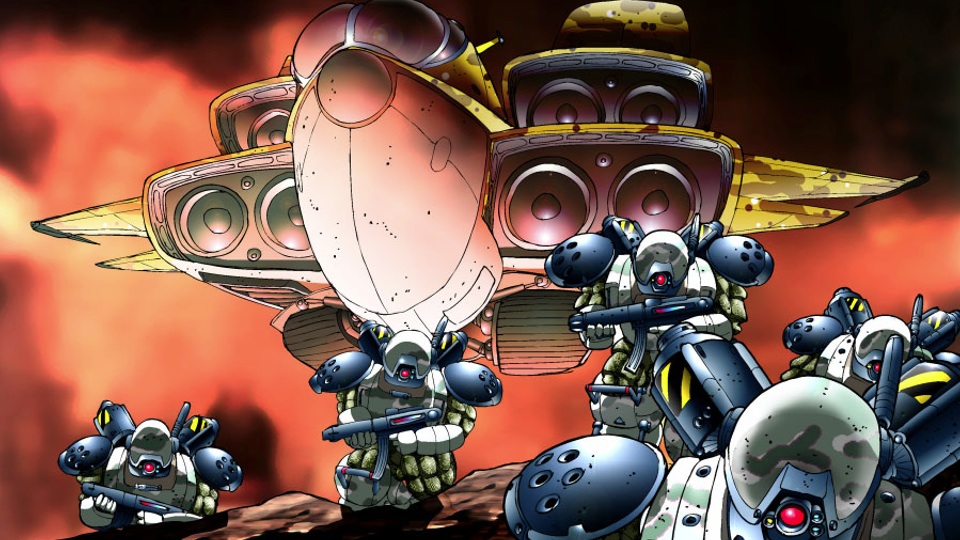
In addition to the fluid and unique control scheme, the setting offered a lot of new stuff to a then-over-saturated genre. Gears were small (about three humans high on average), using maneuverability and tactics along with the flexibility of going prone, crouching, and launching mortars from their backs to bombard enemies from ambush. They had a kind of ‘stealth-mode’ in the form of passive sensors (vs active ones) and in the second game you could customize camouflage patterns-though this had no real effect on the game, it was still a cool touch. Gears effectively functioned as elite warriors and special forces, but were by no means the sole core of military forces. Many large tanks in a stand-up fight were more powerful than gears, and hover vehicles, APCs, infantry, and even floating hover-battleships all worked together in combined-arms fashion. Given that Gears had the most interesting missions and versatility (not to mention skates for moving over flat land fast), that was what you played as in the games. And it was a blast. It also made sense. Sure, anthropoid combat vehicles make little sense in an era of heavy firepower with those high target profiles, but the gear felt much more feasible if less awe-inspiring than the conventional mechs of other series’ when it came to imagining future warfare.

But what really interests us right now is the setting. Heavy Gear does not traipse across the galaxy chronicling the rise and fall of massive star empires. Its setting, in fact, is a single planet. Terra Nova, once the jewel in the crown of Earth’s expansionist empire, now a world divided into two hostile geopolitical alliance networks made up of multiple nations. With its focus on a single world, the Heavy Gear setting allows geography to matter once more. Strange anomalies in magnetism enable massive floating battleships and carriers to act as navies on a world where most water is underground. Most of the population is clustered near the more temperate poles of this warm planet while the equator is a desert band with few people but much in the way of resources. It is this that forms the rough border (and primary disputed territory) of the Northern and Southern leagues (more on this later).

Once Earth’s empire went into decline, its outlying colonies were abandoned. Cut off from support of the mother world, Terra Nova had to effectively start from scratch. The chaos of sudden and rapid decolonization coupled with that the planet was largely just exploited for resources under Earth meant that it did not have the requisite stability or infrastructure to thrive in the short term. Needless to say, this is a familiar story for many parts of our own world in the mid-20th century. Eventually, after much strife, coalitions were built around the poles. In the North, a common religion and political ethos facilitated an almost-equitable confederation, The Confederated Northern City-States. In the south, the rise of one particularly successful and powerful state, The Southern Republic, gave rise to a more autocratic system of alliances, where said republic dominates the other nations as vassals and proxies through the Allied Southern Territories alliance network. The setting, being well developed however, does not make the north the good guys and the south the bad guys. The more one looks, the more complicated the situation becomes. The North may be a more political success, but it is heavily influenced by a somewhat militarist and very morally strident religion and society priorities some fields much higher than others to its cultural detriment. The South is less unified, but its dominant state is a culturally dynamic place where people have many (non-political) freedoms that those in the north lack. Just as in most conflict zones today, it is impossible to declare a ‘good’ and ‘bad’ faction as an absolute, and rather your feelings as an outsider will be guided by your personal preferences. Certainly, neither side could be easily glorified. Even if my personal loyalties are always going to reside with the faction which deploys the excellent Black Mamba gear.

SnakeEyeBM

Especially the sweet Snake Eyes Mamba variant!

Between these powers, many smaller nations still continue to eke out a dangerous and fragile existence. Some, like the officially neutral autonomous arms manufacturer, Peace River, successfully exploit these niches to make lots of money off of perpetual frontier warfare between the northern and southern leagues, others find themselves courted or fought over by the larger powers.

From South Asian partition to the more recent splitting of Sudan and South Sudan, to the division of Korea, we in the real world are very familiar with such narratives. In many more cases we are also familiar with officially unitary states which are anything but in practice, much like the Democratic Republic of Congo. Largely, on matters dealing with space in the future, it seems there is little focus on planets having multiple hostile political entities-but on Terra Nova this is a reality. I see no reason, in a hypothetical future of human expansion off-planet, that this would not be the case. It is certainly in line with human history. Division and unity come in cycles, not linear narratives with clear ending points.

But what is most interesting about Terra Nova is that multiple conflicts over the Badlands have not dampened the general sense of Terra Novan solidarity when it comes to the old colonial master of Earth. When a resurgent Earth attempted to reconquer its old abandoned colonies centuries after it gave them up, it used its superior wealth and technology to take a few of them. But Terra Nova was a different story.

The defiant planet unified against the invaders. And using the Gears they had invented (originally for mining) as re-purposed war machines, they defeated the ‘Earthers’ and drove them from the world, leaving only a small cut off remnant behind, which quite fittingly is named Port Arthur.

Though with the withdrawal of the common threat came the resumption of traditional north-south hostilities, a special task force was set up of hand-picked warriors from all sides who would work for a unit that rose above planetary politics and safeguard the world from further revanchist operations directed from Earth. Indeed, being a member of this unit and leading a squad on a special off world mission to sabotage an interstellar mass driver ( I think) weapon being operated by Earth forces is the main story of the game Heavy Gear 2 and its very cool intro shows this pretty well:

This is the element of this fictional setting which I think has the potential to be the most interesting when pondering our real world future. In an era of rising multipolarity and where we can quite clearly see neocolonialist policies from some countries such as France in West Africa or Russia towards some of its neighbors, to name just a few, will we ever see collective bloc alliances among normal local foes on other  as a reaction to bigger more global ones? This will depend of course on the behavior of more powerful countries towards less powerful ones, but it is interesting to think about. The widely divergent Non-Aligned League of the Cold War, though not much of a real actor, is an interesting example of an attempt from the past.

Anyway, have some badass soundtrack music while I ever so reluctantly go back to studying the real world:

Pictures used are from Dream Pod 9.

Tipper Warnings: The Petulant Death Rattle of an Obsolete Liberalism

I realize this deviates somewhat from the normal topic of this blog, but as an ex-academic who sees many of these issues overlapping I feel it belongs here.

Brian Cox’s decision to boycott Warwick University gives me an idea. The hypersensitives overrunning and ruining academia today are a group of people who generally lack creativity, critical thinking skills, and the capacity for new and original ideas. Largely, they are just parasites badly co-opting the arguments of others and capable only of upholding the conservatism of their suburban backgrounds but with a thin coat of supposedly progressive paint. One does wonder if jealousy motivates them deep down. Not to mention that politicians are getting in on the action too like a pack of vultures.

Like their liberal precursor, Tipper Gore, they believe that the inherent corruption of ‘bad attitude’ in the public sphere will somehow compromise their righteous virtue, ignoring that being exposed to something is just as likely to make one reject it as accept it. It is, ironically, a remarkably evangelical attitude to have. After all, the rising crime rates and youth suicides of the 80s were quite obviously caused by the rampant neoliberal structural adjustment of the decade as well as a rough transition out of the last vestiges of the security of the industrial economy. Not to mention the revving up of the Drug War which did nobody any good. You know, actual real life factors. Politicians helped create that political environment but never once thought to blame themselves but rather shifted the blame to the entertainment industry.

PMRC

Tipper once proclaimed herself indignantly to Jello Biafra as ‘a proud liberal Democrat.’ And she was right. Now, on the internet and festering in certain universities we see the new version of that type of ‘progressive’ stultification. The crisis of contemporary liberalism clearly illustrated. Unable to admit their ideology is now nothing but a group of intellectually bankrupt status-quo centrists trying to defend a philosophical and political program increasingly long in the tooth and clearly running out of ideas, as well as lacking the will to come up with new ideas or admit their mistakes, they resort to greater and greater levels of witch hunting in order to construct the fantasy that they are the only real moral option left. Everyone else is compromised because they don’t acknowledge your feelings like the liberals do. You special, special snowflake you.

But a future filled with austerity, increasing environmental emergency, the failure of populist movements to increase living situations in the post Arab Spring world or bring about actual change in the case of Occupy Wall Street, and little to no remaining desire on both the once euphoric right and left alike for using great power politics to enforce some idealist program of universal human rights, it must be said that the reality of the situation is that liberals of all stripes, right, left, and center, have shot their load. The conditions that enabled their delusions such preeminence in the 90s are passing and what you see now in both the neoconservative remnants of the establishment as well as the youthful enthusiasm of Tumblr is its death rattle. No wonder 90s nostalgia is so popular in my generation-people pine for a time when they could believe they were the center of the universe and ignore all the negatives of such a time period.

So, getting back to the point at the start, what if the ‘ideas class’ boycott universities who cave to hypersensitives en masse? Having no ideas of their own, and being the unwitting dupes of institutions and a political system hostile to different ideas, the student councils and universities would break before the people seeking speaking fees would. And considering how profit motivated universities are these days, that would be the necessary incentive for them to stop kowtowing to middle class teenagers whose life experience consists of pressing ‘reblog’ and thinking its noble to shelter themselves from ideas they don’t like.

Whether one likes it or not, the present consensus is breaking down. That doesn’t mean we can control what comes next. We can’t. We aren’t the center of a ‘narrative’ be it of progress or anything else. We are creatures that respond to external stimuli with instinct that we rationalize later. But what that does guarantee is that the future is full of painful truths who only the adaptable and intellectually self-critical and self-challenging will survive and thrive in.

So let’s end on a note that hypersensitives and Tipper Gore alike would hate!

Beware the Humanitarians

save_darfur_poster

I can’t help but think that the massive increase of popularity of Syrian refugee issues in media coverage is indicative of some kind of growing future drive for a NATO operation.

If not yet, it now will be unless it interferes with the Iran deal. There is one obvious section of society that is always is pro-war because they are hooting and brittle cro-magnons who think its important to ‘show strength’ through constant macho posturing, but there is another which can always be made pro-war by going ‘ermagerd look at the suffering babiez!’ Neither is remotely interested in dealing with the consequences of the policies they unthinkingly support through their id-derived catharsis politics.

Hopefully the complicated alliance networks that the United States is increasingly learning to navigate with some degree of nuance will derail any further attempts to topple what unfortunately is Syria’s only real hope: the Assad regime. Or as it should be referred to-the internationally recognized Government of Syria. This is a very real possibility of course, but the explosion of media coverage regarding refugees should remind us of past examples were wars of choice were fought for dubious reasons.

While humanitarianism is most often deployed indirectly and often even unintentionally as the propaganda wing of other self-serving interests (Kuwaiti babies being murdered by Iraqi troops in ’91-a fiction invented for the wind up to Desert Storm, Germans raping through Belgium in WWI British propaganda, Kony 2012 stirring up tacit hipster support for the rapid and ongoing expansion of AFRICOM, etc. These are clearly P.R. campaigns that serve a valid, if often debatable, strategic interest for someone, somewhere. Thus, they are understandable whether or not you agree with the objectives behind them.

But there are indeed, as Robert Merry and others have pointed out, wars fought entirely for feel-good purposes. Somalia and Bosnia in the 90s *might* have been these depending on how you view them, and Kosovo in 99 certainly was. Victorian wars of prideful redress such as the British Expedition to Ethiopia or the US retaliatory action in 19th Century Korea also fall under a same ‘conflict as catharsis’ framework.  People (usually Democrats) who called for action in Darfur in the middle of the first decade of the 21st Century were also of this ilk.

The problem is two-fold with these knee-jerk reactions. The first one is that there is rarely a situation where such direct involvement can improve a situation, and when that is so it is often in the context of a greater framework. For example, the ending of Axis war crimes was contingent on the Allies winning the Second World War anyway-just as the removal of Pol Pot and the Khmer Rouge by the Vietnamese was tied to the greater geopolitical re-alignment of the Sino-Soviet Split. These were great and beneficial outcomes to be sure, but they did not exist in isolate.

The second is that when enacted by a superpower, these types of interventions can be divorced by more grounding influences which often mean their strategies are half-baked and lead to interventions with a big showy entrance and no exit plan. In effect, advocating such humanitarian interventions has the potential to lead to the same kind of quagmires that neoconservative hawks often inflict on the state and its people.

This is one of the great flaws in societies that often shunt the decidedly old-school field of military history aside. People will jump through any number of increasingly preposterous hoops in order to avoid coming to the stark conclusion that military conflict is dangerous for any power no matter how powerful they are so selectivity is key. But even more tellingly on this theme, many will assume something ‘can be done’ lightly, from the air, and in such a way as to minimize conflict exposure to the actors on the ground as some kind of god-like neutral arbiter of justice.

But that is impossible. An actor in conflict is either in it or not. That means pick your battles. And the only way to do that is to combine national interest with your desire to off a particular force. You want to end the Syria crisis? Extend an olive branch to Damascus and focus on the elimination of Daesh as priority. Winning over the worst faction-not helping everyone suffering-should be the first goal. But already NATO has integrated itself into the wrong dog in this fight. Let us hope this mistaken policy is not given popular support by a media and populace who base their views on their emotional reaction to news stories. Or else who knows what horrible scenario might happen.

Further reading from a somewhat different but still interesting perspective at the Stanford News site.