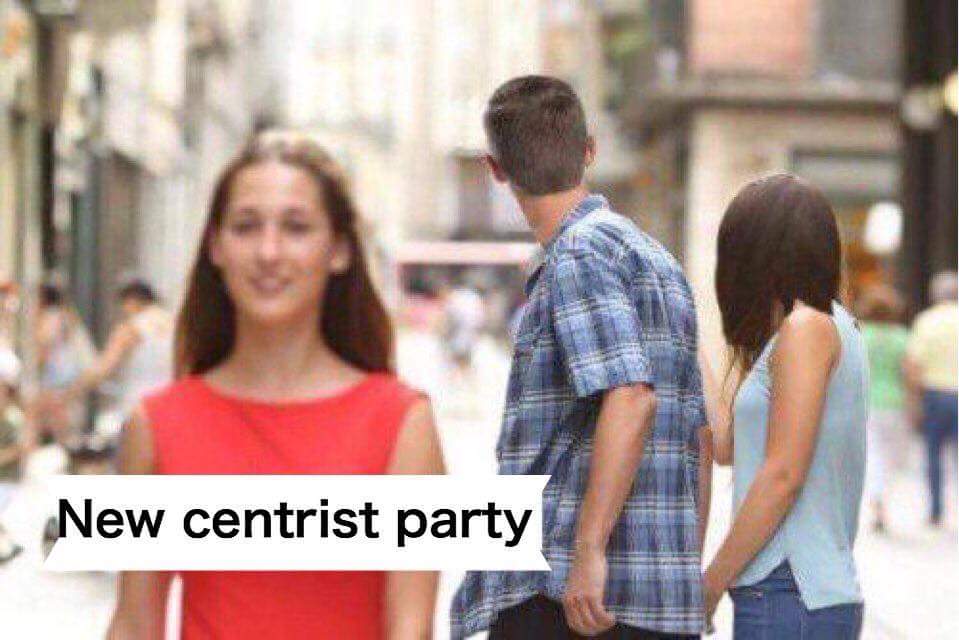
A friend of mine who is currently blog-less has submitted a review of a book which he recently acquired for the sake of morbid curiosity, ‘The Centrist Manifesto’ by Charles Wheelan. I have not read this book myself but given the suitability of the topic to multiple previous entries when I have mocked the claims of rationality, impartiality, and political viability of centrist projects as well as excoriated the idea that centrism automatically or even often equates to pragmatism, I felt that his self-proclaimed ‘book report’ was an absolutely essential addition to the Geotrickster canon. What follows below are the words of Brandon Hensley entirely:
————————————————————————————-
Several weeks ago a friend’s Facebook post pointed me towards Charles Wheelan’s “The Centrist Manifesto”. An admixture of lolz and apprehension greeted me when faced with the choice of signing my name to a “moderate” hopeful in some other state’s election in exchange for a free copy of what promised to be a more thrilling political commentary on the current moment than Mr. Toad’s Wild Ride. After several weeks of waiting, the Manifesto of the Radical Center arrived. The fact that my suburban Ohio home was in the middle of yet another monsoon was oddly fitting.
The first thing you notice about Wheelan’s manifesto is that it is appropriately thin. The ability to wave one’s manifesto in the air like a little red book is supremely important if you want to be able to disseminate nuggets of wisdom at a moment’s notice, such as “We need an insurgency of the rational: a generation of Americans who are fed up with the current political system, who believe we can do better, and most important, who are ready to do something about it. Are you one of those people?”. We do need an insurgency of the rational in the current political climate, and gone are the days of Bismarkian realpolitik as well as the halcyon days of Kennedy-style bipartisanship, but my enthusiasm for Centrism giving this back to us is low. Exhibit A:
We open our discourse on this American moment five years ago (copyright 2013) with “Something has to change. Our country is on a dangerous trajectory. We are mired in serious policy challenges, in large part because the political process has moved beyond gridlock to complete paralysis.” Wheelan is appealing to the lowest-common denominator with this opener. It is effectively tautological at this point to accuse DC of being unable to do anything useful. I get it though, we need the hook, and the communists already cornered the market on catchy manifesto openings. “A spectre is haunting Europe” is sort of like the virgin birth: only one gets to happen and after that nobody will believe you. So we can be charitable to the Centrists and allow them the tautology. Wheelan continues in this chapter entitled “The Big Idea” by accusing Republicans and Democrats of being equally culpable in the paralysis of the democratic system. He hits all the traditional talking points—fiscal irresponsibility, personal sacrifice, even job creators, along with a litany of woes affecting the world. He even has a remarkable moment of clarity when he takes to task the political system for what it is:
“Our political institutions reward the most extreme views in each political party. Congress has grown increasingly polarized and dysfunctional because we have built a system that elects extremists. Each party nominates its candidates in a primary. Who votes in primaries? The most extreme elements of each party.”
After the litany of castigations against the Republican and Democratic Parties and this raking over the coals of the primary and electoral system, you can be forgiven if you forgot on page 12 that his answer to this problem is yet another political party playing in the same political arena. In case you did forget, Wheelan reminds us that he has no interest in dismantling the political system itself: “The Centrist Party will introduce a coherent governing philosophy around which Americans disenchanted with the traditional fare will naturally coalesce.” Ah, yes. Strength through Unity, Stronger Together, Make America Great Again. “[T]he Centrist Party will take the best ideas from each party, discard the nonsense, and build something new and better.” Because the anti-fasicsts are the real fascists, amirite?
In explaining the basis of a Centrist Party, Wheelan takes a 180 on his previous strategy of admonitions against the Republicans and Democrats and instead praises each for what they do best. Republicans have a decent brain but Democrats have a noble heart, for example. He even reminds us that “in normal times, these are the kinds of things that pragmatic Democrats and Republicans would agree to do together.” He takes an additional 180 in a subsequent chapter when he returns to railing against the Democrats and Republicans. This sort of back and forth is a staple of the manifesto. What is disappointing is the historical illiteracy of Wheelan. The “normal” times he is appealing to, roughly 1945-2000, was hardly emblematic of American political history. It was an anomaly. The American “norm” historically resembles more of Trump and less of Kennedy.
Wheelan says that only four or five Senate seats would be enough for the Centrists to hold the strings of legislative ability. He describes how electioneering in the middle is what attracts the widest amount of voters, and reminds us that only a few Senators are needed to effectively kneecap Congress forever. He even takes a cheap shot at the Greens for being too on the fringe to win elections in the process, ignoring the actual electoral history of the fringe. Taken altogether, it appears that the Centrist’s strategy to restore normalcy is to win only enough elections to make their presence in the Senate annoying to everyone else. Hardly a recipe for Leninist-style accelerationism designed to break the system in order to replace it with something new.
Relevant to his shortcomings when it comes to replacing the electoral system is the proposal later for electoral reform. He proposes in his section on “The Centrist Process” a series of electoral reforms that border on populism—heresy for the Centrist. But it is admirable in its own way. If we must keep the American electoral system, we should at least endeavor to amend it. Wheelan proposes ending gerrymandering, “open primaries in which the top two candidates in a single primary election advance to the general election, regardless of their political party,” reform the rules of Congress to prevent the filibuster (this seems a little counter to his idea of hamstringing the entire Senate using four or five Centrists, though), and “constrain the corrosive effect of money in politics.”
Before we get there, however, we have to endure a great deal of finger wagging. After chastising America for not being more political involved, Wheelan appeals to the emotional heartstrings about how hard public policy really is with a quaint hypothetical about running a home owner’s association and throwing a community party. While the metrics he presents (movie preference, food choices, whether or not we should even have a party) are all valid metrics in formulating public policy, one can’t help but get the sense at this point that the earlier failure to appeal to something new and better over the current system might be emblematic of a larger issue in the worldview of the Centrist Wheelan is appealing to, that of being out of touch with the very demographic the Centrist thinks they represent.
A key moment of this “out of touchness” is when he points out the platitudinous nature of the paean “do the right thing”. He is right to point out that platitudes aren’t helpful, but in contrasting the private sector, he goes on to claim “[t]he whole point of government is to do things that the private sector cannot or will not do.” Wheelan fails to admit that the list of things outside the private sector’s purview is not a comprehensive list of things that government should do, and that, based on ideological concerns, the government will always choose to do some things as “the right thing” over other things. In his hypothetical hamstringed-by-the-Centrists Senate, what are the ideological moral hills the Centrist bloc will choose to die on? After stating that there is no objective metric to determine any best decision—a statement which is only right insofar as it also accepts that “best” is by definition subjective, something Wheelan does not admit—he expounds upon a lack of objectivity by…defining objective trade-offs? Using a variety of examples from college to medical care, Wheelan adopts the utilitarian position that what promotes the greatest welfare for the greatest number of people is objectively the best decision to make, and, therefore, should be promoted in public policy. But, again, what the greatest welfare is is already subjective, let alone the subjectivity inherent in deciding which road to take to get there. Chapter three is the longest section of the entire book and it only contains two useful bits of information: a list of Centrist “principles” and “The Centrist Process”. The principles are paradoxical given what Wheelan has given us so far; a Centrist Party that appeals simply to what is commonly and widely upheld from a policy perspective is devoid of principles entirely. To stake ones position in principles or ideology means alienating a portion of the public by default. To avoid an ideological position, one must default to axioms to determine what is and is not “good”. The problem is that “good” and “not-good” are not axiomatic. Both assume certain things about the world and different issues. I suspect Wheelan is aware of the uncomfortable position he puts himself in by listing a series of principles, none of which are hills to die on, which is why he introduces the process.
The Centrist Process: 1) Be pragmatic. Solve problems. 2) Talk about trade-offs. 3) Improve the electoral system. 4) Ask always, Where are we trying to go? What is a reasonably good way to get there? Other than 3, he is essentially describing a board meeting. What is especially telling is that in all of this, in a section that makes up more than half the total weight of the book, Wheelan still does not understand that you cannot answer 1, 2, 3, or 4 without a firm ideological foundation. Good sense and pragmatism are meaningless without the ideological trade off necessary to identify what the pragmatic solution is. Wheelan touches on this concern in his discussion of point 2, but he doesn’t actually stake an ideological position other than “…there are lots of options that are better than what we are doing now, and those better policies begin with a more sophisticated discussion around the issues. The Centrist Party will facilitate those discussions.”
Wheelan attempts to illustrate “The Process” regarding moral and ideological questions surrounding abortion and gun control by simply looking at data analysis and trying to compromise the two positions (see his claim on page 23 where he says the Centrist Party will not do this). Unfortunately, I have to laugh at his claim that no-one is pro-abortion. Not only because I am personally pro-abortion, but because he immediately contradicts himself by quoting a statistic that one-fifth of Americans think abortion should be legal in all cases. That’s twenty percent of the American electorate. That is hardly a “nobody thinks this way” statistic. In fact, the actual poll he quotes for these numbers shows as of 2011, 26% of the American public thinks abortion should be legal in all cases, whereas only 20% of the American public thinks it should be illegal in all cases, a segment of the American public that he dismisses as “only a small minority”. For a Centrist, he really doesn’t even grapple with the raw data he’s fetishizing very honestly.
Overall, Wheelan is emblematic of Centrism: it simply isn’t an attractive narrative. Instead of looking inwardly to say “why has the Center failed?” he lashes out awkwardly and unexpectedly to everyone else in a vain attempt to make Centrism appealing. He attempts to stake Centrism in some sort of moral and ideological purity, but contradicts his own vision of Centrism in the process. He stakes the entire enterprise on being pragmatic and then disregards pragmatism for propaganda when he willfully misrepresents statistics in opposition to one another to prove a point—that the larger majority of Americans are more ambivalent than all or nothing (shocking!). The biggest fault of Centrism as a political philosophy is that it doesn’t offer anything to the public and doesn’t pretend to want to, which is probably the biggest meta-joke to come out of this “manifesto”. Typically, modern rhetoric warrants opening a piece with a quote to set the stage for what is to come. I think it’s far more appropriate to close with a quote, to reflect on what Wheelan has or has not accomplished.
“Manifesto: man·i·fes·to, ˌmanəˈfestō/, noun: a public declaration of policy and aims, especially one issued before an election by a political party or candidate” -Google Dictionary

 The Trickster's Guide to Geopolitics