
This is not meant to be a comprehensive review of Star Trek: The Next Generation, nor is it a deep dive take connecting it to political theory like I once did for Deep Space 9. This is simply an overview of what it was like to rewatch one of the defining shows of my childhood from start to finish (albeit with some skips) for the first time since it was being broadcast in real time back when I was in elementary school.
This was the first non-cartoon television show I ever got into (not counting Rescue 911, which was ironically hosted by William Shatner), being introduced to it by a babysitter in what I imagine was the fifth season at the time. The show would have one new episode per week with the rest of its slot time in the week being dedicated to re-runs. This made it easy to catch up on most of the older episodes within a year or so of starting.
Despite the fact that I demanded action in my sci fi entertainment, and always preferred the more violent episodes at that time, the Enterprise-D quickly became a kind of fictional idealized home, a place that one could imagine “Maybe when I am older I can do something like that.” Because of this, I pretty much ended up liking all the episodes. It also inspired me getting into Micro Machines because there were so many Star Trek ones out there.
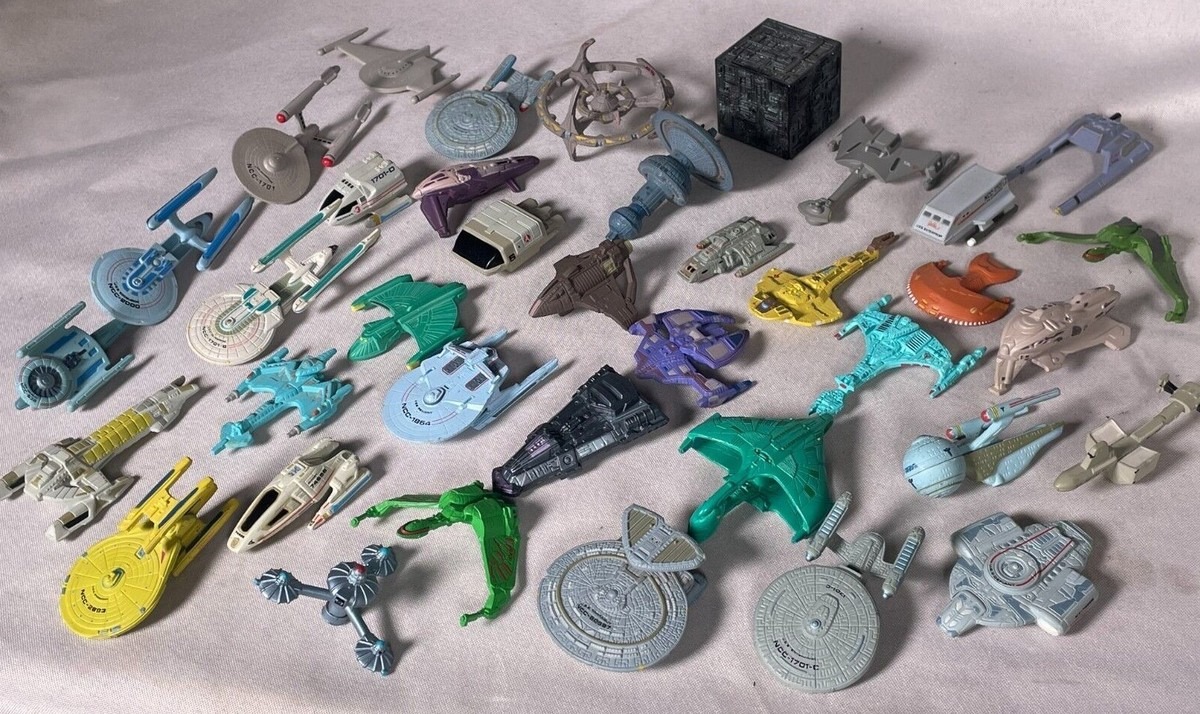
When the show ended, the final episode went a bit over my 9 year old brain and I mostly focused on how cool the alternate future Enterprise with the third warp nacelle was. I wasn’t too broken up about the end as I had found a local public access channel (remember those?) that played The Original Series and soon pivoted to that, which at that time I liked just as much. I was still too young and DS9 was too serialized and too adult to grab me aside from the occasional episode and the later Voyager just did NOT work after I gave it a couple seasons, so I ended up moving away from the franchise for over a decade. Only returning to it in my senior year of college when, sick with the flu, I ended up finding TNG and DS9 both on some of the channels the university network had access to. At the time they were playing seasons 1-2. The next year I moved to the UK where, interestingly enough, the novelty rerun station Dave (yes, that was its name) was re-running TNG’s seasons 6 and 7. In this time my primary return-focus was DS9 and the TOS movies so this spotty partial rewatch was hardly comprehensive and missed most of the middle run of the show. Ten years ago I gave DS9 a full rewatch, and last year I gave TOS the same treatment. These past 3 months I finally came back to my first show and did the long overdue same for TNG. I also decided to rewatch the first two of the TNG movies but not the later two, as I rewatched all of these under lockdown and so had recent experience.
Let us break the following down into sections.
My streamlined rewatch guide:
Want to do a beginning to end watch but not see every single episode? I have some easy but loose guidelines for you. It is easy to skip episodes because the show has relatively little serialization (though more, bizarrely given the other show’s premise, than Voyager ever did).
I strongly recommend skipping the majority of Season 1. To say the show had yet to find its footing would be understatement. It comes across as a bad parody of TOS. “Encounter at Farpoint” is necessary but more for how it bookends with the final episode and introducing the character Q then for any reason of quality. “The Battle” and “The Neutral Zone” are key establishing episodes for important themes. You can watch Tasha Yar die to a stupid slime monster just to see the end of that character arc and Worf’s promotion to security chief. Otherwise, it’s best to zip through this one. Season 2 improves upon it and has more episodes worth catching, but is still very much not the TNG you remember qualitatively. There are stand outs though, especially including “Q Who?” which is the introduction to the Borg and is one of the top 10 episodes of the entire show. Be sure to skip the montage episode season finale though, it’s the worst episode of the entire show if not the entire 20th Century era franchise.
For the remainder of the show’s run I recommend watching the majority of the episodes. Yes, including in the more uneven Season 7. The show is firing on all cylinders from Season 3 through 6 with bad or even lackluster episodes being the outliers. Season 5 was the high point for me, and it contains the best single episode, “Darmok” (the meme language one that encapsulates all that is best with Trek as a franchise). My general guide to what is skippable is all Lt. Barclay episodes except for “The Nth Degree”, all Lwaxana Troi episodes save maybe Menage a Troi (for the ending Picard monologue), and all Alexander and Holodeck episodes save perhaps the funny “Fistful of Datas”, which paradoxically is both an Alexander and a Holodeck episode.
Season 7 is an extra-special season and so I have extra-special thoughts on it. I was most curious going into this what I would make of it on rewatch. I found that, for the most part, I liked it. The writers clearly knew (and later in interviews they would admit this) that they were running out of ideas and just throwing things at the wall to see what would stick. This creates some truly awful episodes, chief among them “Sub Rosa” and “Force of Nature”, but also possibly the highest concentration of really stand out episodes such as “Phantasms”, “The Pegasus”, the so-bad-its-good “Masks” (you may hate but I KNOW you remember it), “Preemptive Strike”, and of course “All Good Things…” which is not just a series highlight perhaps the best show-ender of all time. Considering that most shows linger on well past their expiry date, I think it was great we saw just enough to want the show to end but not enough that it dragged. And what a finale! Upon rewatch I enjoy the ending so much more than I did as a kid. If only shows since had followed this path of ending on a high note.
And since I wanted to end the films too on a high note and not a mediocrity (Insurrection) or something outright vile (Nemesis- not even pre-fame Romulan twink Tom Hardy could save it)…so when it came to movies Generations and First Contact was the perfect endpoint for this rewatch. Generations is pretty mediocre in a lot of ways, but ends up just over the positive side for me on rewatch specifically due to its most criticized aspect: the offscreen and seemingly random death of Picard’s extended family in a house fire. This not only reminds us that in the relatively utopic future of the 24th Century life is still filled with unpredictable and random tragedy and how this can inspire both bad and good coping mechanisms for people. It also gives an emotional resonance to the main plot point of the film of people trying to recover an idealized past. Additionally, it is the end of the Enterprise-D and the Duras Sisters. Data getting his emotion chip completes his arc in a way, though whether you find it funny or annoying will vary with the observer. Plus, Malcolm McDowell. First Contact, meanwhile, is a great series send off because it is the best TNG film, introduces the beautiful Enterprise E, and completes the Picard Borg Arc by having a drawn out fight on a single ship, deck by deck and point blank range. Speaking of Arcs…
General Theme and Character Impressions
The Borg Arc is an example of how a not-very-serialized show can have a running theme. Hinted at only vaguely near the end of Season 1, encountered in a freak one-off in Season 2, properly confronted in the climactic “Best of Both Worlds” (and its PTSD follow up third part “Family”), then with occasional reference to a looming threat without overusing it. The drone Hugh is returned to the collective to sabotage it with individuality, which causes a single group to go rogue but otherwise does not remove the threat. Picard’s experiences with assimilation are clearly (but not directly) akin to a rape. They were aiming for a concluding confrontation in film form which is why I view First Contact as a necessary conclusion despite not agreeing with the introduction of the Borg Queen as an element in the lore. Also, we know now that this more restrained use of the galaxy’s ultimate threat was far more effective, with Borg episodes/movie being horror-lite forays into the dangers of techno-optimism which are needed to balance the general euphoria of the setting. Voyager would, of course, go on to totally ruin this by making the Borg almost a monster of the week, easily fooled and outwitted by a single ship. But Voyager was, of course, the beginning of the decline of the franchise as a whole.*
Something I found more interesting than before on rewatch were Prime Directive episodes. Starfleet’s first and foremost rule is to not interfere in the development of prewarp civilizations. I have seen a lot of hot takes, especially during our recently concluded Woke Era, by midwits online that this policy is somehow racist and bad. Implying that one cannot trust single-planet species with advanced technology. I think watching the show clearly should give the opposite impression- it is to protect weak powers from exploitation at the hands of great powers and safeguard the cultural diversity of cultures in or near Federation space. It is cool and good, the revisionists are wrong, and in the unlikely event we ever go into space outside of our own system ourselves and (even more unlikely) encounter sentient life, we should adopt a similar rule.
Prime Directive episodes, where inevitably the rule is broken, usually by accident in some way, thus became more interesting to me during this rewatch. “Who Watches the Watchers” is justly famous on this premise where contact must be initiated after an anthropological investigation is exposed to the natives. But even better is “First Contact” (the episode not the movie) where a race is deemed ready for contact by the Enterprise but the political situation quickly shows that it is not and the whole attempt has to be aborted and covered up, showing how contested these issues can be.
The astropolitical situation of the Alpha Quadrant is obviously something I was much more tuned into this time around. I know the actual explanation of things is that the writers were trying different races as regular arc-villians, starting with the Ferengi, mostly settling on the Romulans, and diving into Cardassians later as a hand off to DS9. But what this really shows in-lore is that the Federation is bloated, over-expanded, and needs to consolidate. It has too many cold wars ongoing, hence the need for an unfavorable peace settlement with a weaker power (Cardassia), perpetual fear of the peer-competitor of the Romulan Empire, and the need to hold the peace after the destruction of much of the Federation fleet in the first Borg invasion. Interestingly, this invasion did spark a revolution in military power, as seen by the ships we get in First Contact (the movie not the episode) and in DS9. And once again showing a realistic take on the unpredictability of power politics, most of these vessels would end up used to fight the previously totally unseen threat of the Gamma Quadrant’s Dominion, which would be the ultimate arc of DS9 if not the franchise itself. One cannot help retroactively fan-theorying that Q’s actual role was not to indirectly prepare the Federation for the Borg by forcing contact between the two- who were too distant from each other to immediately square up at full force- but rather to prepare them for the Dominion by way of a Borg-induced military upgrade. You thought the Alpha Quadrant was bad, you should see the other neighborhoods.
One theme I especially appreciated was to be found in “The Chase”, which might be the episode I have most upgraded from prior view to present estimation. An episode clearly designed to provide an in-universe explanation as to why most of the races of the galaxy live on the same type of worlds and all look the same save for different forehead ridges, “The Chase” does a great job providing a founding species myth to actually explain this otherwise improbable series of events. Sure the universal translator shows why everyone can talk to each other (even apparently when one party has it only) but the actual shared genetic heritage of the species shown via an archeologically themed thriller episode is great fun and ends on a poignant note with the Cardassians and Klingons rejecting the findings out of racism while the Romulans and Humans quietly nod respectively at each other and wonder when the galaxy will be ready to accept this knowledge of a common origin. At least now we know why different species can breed with each other, though billions of years of divergence still makes this…improbable to say the least.
Another great episode that lacks the fame of the typical “best of” lists (the rightfully famous episodes everyone talks about like “Yesterday’s Enterprise” “Darmok” “The Inner Light” “Best of Both Worlds” “Chain of Command” etc) is “Phantasms”. My personal favorite (after Darmok) episode and the one I always like more every time I see it. Data learning to dream and finding the dreams are utterly bizarre and an indirect portal to the subconscious is interesting enough, but as a person with intense and often utterly unhinged dreams myself it really speaks to me. It also has the best scene in the show. You know the one I mean.
My character impressions are as follows. Wesley is still annoying, but probably not as bad as you remember. The character was an expy for Gene Rodenberry’s self-insert instincts, whose death freed it to become less annoying. Ensign Ro was a way better helmswoman though. She was my favorite character as a kid despite appearing in only 6 or so episodes but that is mostly because she was my first crush. (Such is the power of Michelle Forbes that she convinced me from elementary until halfway through high school, no mean feat- It was only another science fiction film, Pitch Black, that would awaken reversal of the trend years later). Interestingly, the most impressive pilot and person who seems to appear most in the role is a character with maybe one speaking line in the entire show’s run, and who is only referred to by name about twice- Ensign Gates. Talk about the true unsung hero of TNG.
Geordi…uh…comes off way worse on later rewatches. He is just such an incel. One of my favorite characters from childhood is now, in my minds eye, the Ship’s Creep. Your spine will not survive watching “Galaxy’s Child”, I can tell you that much. Ah well, at least he’s an engineering genius!
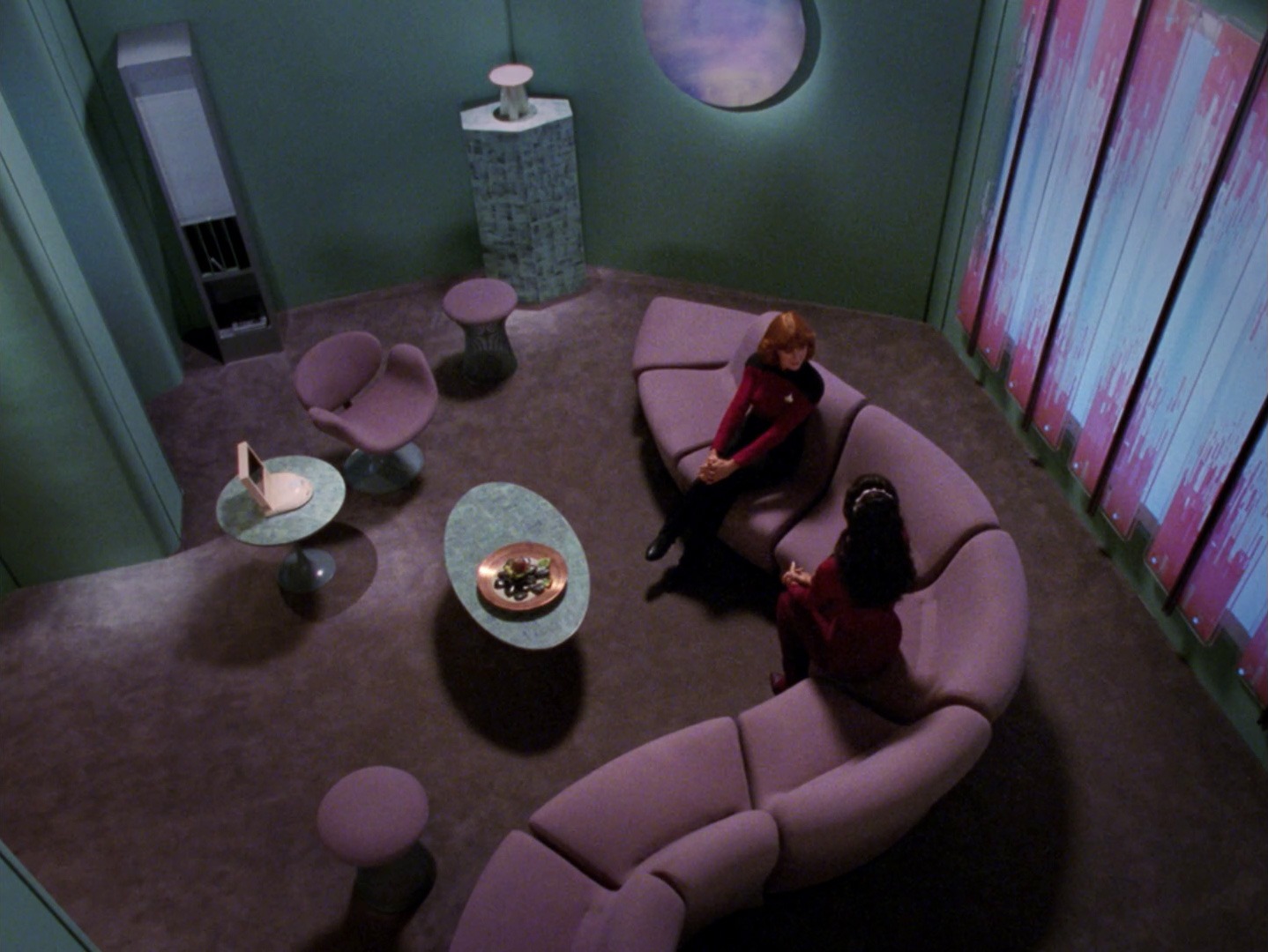
My least favorite character as a kid was Counselor Troi, called by my entire family at the time “Counselor Cleavage” due to her amazingly unprofessional early show attire. It is interesting how the writers made her better once Captain Jellicoe made her put on a real uniform. We went from “Captain, I sense anger” in response to some enemy ship threatening to fire on the Enterprise to actually being one of the funnier (intentionally) characters in later seasons. Even so, true 90s kids know Marina Sirtis’ best role was actually as Demona. Plus, her office perfectly encapsulates the nostalgic vaporwave interior of the Enterprise-D.
The D was never my favorite Enterprise on the outside, being beaten by the A-refit of the TOS movies and the E, but its interior is like a warm dreamy cruise ship ready to bathe you in slowed down reverb elevator music. Perhaps it is nostalgia from childhood, but I swear there is something to the D-interior that just makes it the kind of place you could happily live in even while facing mortal peril once on average of every week for seven years.
Another character who grew in my esteem was Dr. Crusher. Not just because it’s funny when Picard pronounces her given name as “BEBALY”, but because she has a habit of flying any ship she is in charge of into the nearest star. This happens more than once. She deserves to be captain one day just because it is hilarious.
Though if one wants to mark a real scene-stealing character who is not part of the main cast it has to be Gowron. This is a bit of a cheat because he has an even larger role in DS9, but TNG was his start as High Chancellor of the Klingon Empire and what can I say, the eyes have it. I would have also liked to have seen more of Commander Tomalak from the Romulan Empire as well, as he was a great foil for Picard. Denise Crosby coming back to play the half-Romulan Sela was not a full replacement for his presence, though I do maintain that Sela should have been used in DS9 as the primary Romulan character. That was also a wasted opportunity.
Conclusion
My concluding thoughts are that the show is not as euphoric as I remember. Its vision of the future is optimistic unabashedly but Trek is best when grappling with difficult ethical questions. Despite being an “End of History” era show on broadcast, it actually gave far more nuance than even the politicians and media entities of its time could towards exploring the future. Thomas Friedman and Francis Fukuyama were singing the praises of a society that had beat all challengers and could happily auction off the roots of its success to international finance capital, laying the seeds of terminal decline at the height of triumph. As the Chinese strategist Su Shi once said “It is at the point of victory that the greatest danger lurks”. Despite being a product of this era, Star Trek: The Next Generation did not do this. Its post-scarcity future was still one of messy compromise. Living standards could expand and knowledge could grow, but the wrestling with what it means to make difficult calls in the face of the unknown remained. Even if the future is nicer, it would be any better at providing simple absolute answers.
Sure it is a fun nostalgic show from a more hopeful time. Perhaps it would seem to modern audiences as quaint even. But it still makes for interesting and entertaining viewing today. And for me in particular as someone who finds television by far the worst form of entertainment media, being both passive for the audience and lacking the singular vision of film, it takes a lot to get me to watch, even re-watch, a long running series. TNG has that appeal.
Star Trek, despite the protestations of its fans, is definitely NOT hard science fiction. Its technobabble is a contrivance to engage in high space fantasy. Its exploration episodes are fun from a visual perspective but usually empty or only half-explored. Its strength, and Picard’s strength as captain in TNG, is in how it covers diplomacy. How the inevitably flawed compromise that decides the fates of millions is almost always for the better. How it is usually more desirable to show restraint than to dive headfirst into a crisis. And how, even with all of this, one will still fail and will need to take risks. But the inevitable failures to come do not diminish the effort it takes to keep the peace, to meet new people, and find new constructive ways to work with them.
—
* My personal theory is that the reason the massive Borg Collective only sends two one-ship attacks on Earth is that the Collective experiences lag between ship communications. The cube that attacked in Best of Both Worlds was a reconnaissance vessel responsible for the earlier destruction in the Neutral Zone (meaning it was already there before the first encounter of the Enterprise elsewhere) that gradually became sucked into an armed recon in force towards the heart of the Federation. Meanwhile, I think the lone cube with experimental time weapons we see in the First Contact movie was the originally encountered cube from “Q Who?” that had been effectively chasing the Enterprise’s direction of retreat for years and years, finally arriving perhaps with little detailed knowledge of what happened to the previous Alpha Quadrant assigned cube.


 The Trickster's Guide to Geopolitics