When the subject of International Relations is taught in universities, it often opens up with a discussion of the concept of ‘anarchy’. In this specific subject’s domain, anarchy neither denotes the political philosophy nor one of the rightly less-talked about Batman villains, but rather the classic definition of realm without governance. This may seem a strange topic for a subject/major which is ostensibly about state to state interaction, but what it effectively means is that there is no over-arching governing structure above that of states.
Protestations that this is not the case because of the UN or ‘values and norms’ should always be met with derision. After all, big states don’t have to do anything the UN tells them too, little ones often do depending on their relations with bigger powers.
Despite being an important introductory concept, I tend to find it is one that many people, not just entry-level students, struggle with. In earlier posts I have mentioned how common place but also delusional the Anglo-American view of a progressive international realm moving in a linear direction is, but I have yet to articulate why this is often the case. I can put it simply, believing in one ultimate power is akin to committing intellectual and suicide for the person seeking to understand strategy.
Even before the world was integrated and largely aware of, well, the rest of everyone outside of a particular region’s existence, where a single dominant power form of unipolarity could often rise a la Rome at its height or the Chinese Han or Tang Dynasties, such arrangements were not assumed to be perpetual perfections of humanity. Rather, the security they provided was a fragile construct worth defending…until it wasn’t anymore because the consensus upholding it had broken down. The Han were aware of the Qin before them, the Tang would be aware of the Han, and so on. Confucianism, often a boring conservative philosophy on so many issues, rightly predicted that no order, no matter how perfect, could last forever or be immune to change. The Byzantine Empire certainly recalled its glory days by never giving up the title of Romans even if they had long since left Rome itself behind.
Such unipolar arrangements are rare. Since 1991 we have seen arguably the only one to ever span the entire planet. It will not last forever. It once was taken for granted that it would by the complacent chattering classes of liberalism and conservatism alike, but now enough reality has set in that we face something just as bad-denial giving way to impotent rage and divisive fury. Where did America go wrong? Who is to blame?
Well, America is to blame. Just as the Cold War gave it the spending priorities and mobilization to build a space program and first class infrastructure, so too did unipolarity give it lazy navel-gazing narcissism. This is a process that happens to all powers (sorry, exceptionalists) but can either be delayed or accelerated by a variety of factors. One of them is buying into your own mythology. When your advertising brand becomes your very existential core of existence believed by the governing class itself, you have a problem.
The United States, like Britain before it and other spectacularly insecure powers, viewed itself as apart of history. A moral titan reshaping the world with the righteous energy of Christian values and liberal politics. But as is usual in politics, righteousness is really a code word for ‘strategically toxic and anti-intellectual while still being just as coercive as any other order.’ Herein lies the problem: cultures who believe (either actually or symbolically) in one absolute higher power suffer from massive handicaps to much of the population when it comes to getting the inter-state system and the ever-present anarchy that is an inevitable part of it.
The United States may be the most powerful state which has ever existed in all of human history. For all we know it might continue to be so for decades or even a century if one is being generous. It still does not rule the world. Nor could it. It merely can get away with more for less. That is what power really is in the end, the ability to shift the world’s various circumstances in one way rather than another through intention. It is why it is an invaluable, if incalculable, resource. An invisible resource created only by very real material ones.
And it matters because there is no authority. There is no God here. This is international relations- a realm of little highly specific gods whose fickle natures and epic, tragic feuds are the stuff of legend. As fortune weaves out fate their various importance in the hierarchy rise and fall accordingly. They uphold no values but that which geography and history gave to them, much like representative deities of specific regions, lifestyles, and careers. Or like packs of social and competitive animals. Much like the illusion of order is given by the United Nations, Mount Olympus is an imposing location of projected celestial unity which under closer scrutiny gives way to the back-halls of scheming and backstabbing. Comedy and tragedy abound in equal and intertwined measure.
And yet we treat the act of wishing this away for supernatural or philosophical paternalism as one of principle and heroism. It is anything but. It is in fact cowardice. The fear of the unknown, the fear of not being the good guy. But what we need is exactly people who are willing and able to see themselves as the villains in someone else’s story, and still be willing to carry one regardless. Maybe even revel in it a bit.
This is not a world of universal morality or high ideals. It never could be. It is a state of anarchy, and it is also a state of philosophical and circumstantial polytheism. This means that as far as an intellectual understanding goes, some cultures are better equipped than others to understand the fundamental principles of IR in both theory and practice. Obviously, many great strategists exist in all literate cultures, so its not a supressive effect. We do have Cardinal Richelieu after all. But in the Muslim and especially Christian worlds, those strategists were thinking against the currents of their time and often regarded as highly scandalous, whereas in non-monotheistic cultures such strategists were a utilitarian novelty. This is less an issue about strategists themselves than one of non-strategists learning about or from them. I do not find it a pure accident that the only sane person on foreign policy issues in the US congress right now is a Hindu.
In a world where the public (and often times even more the private) educational system emphasizes the inherited baggage of monotheism and its secular surrogates it risks creating a population of people with absolute opinions and no practical way to achieve them. As it is, most internet political culture in countries like America and those of Western Europe has become one where the greatest posturer is regarded as the default winner, rather than people who actually accomplish things. Specifically on foreign policy it creates a right wing addicted to war and a left wing addicted to war-like things which are not claimed to be wars but rather ‘interventions.’ This is because paying homage to some nonexistent order is regarded as more important than the more morally ambiguous and complicating of simply living the life of a hypersocial and tribal animal. ‘We have to do something’, they say, ‘it is our responsibility to uphold this order.’ They ignore that in domestic politics the state serves as the final arbiter, and their moralism can be translated into legalese and upheld. It is not so in the international realm.
I often make jokes at the expense of conservatives overfond of America/Rome analogies. The two societies are really nothing alike and its mostly a way for BHB’s to pretend to be educated about the past. But if you are going to make one, here it is: It is telling that the Roman Empire adopted Christianity most likely in an attempt to shore up a declining state by having a uniform religion. What actually happened though was that the need for uniform views itself led to internal strife unlike that ever seen in the pagan days, with theologians at each others throats and various factions only happy enough to jump right in, eventually expanding their disputes to competing foreign peoples. It was a conversion whose only real strategic effect was a massive amount of irony. Monotheism cannot even make itself true in a unipolar order. In fact, one could make the case that unipolarity increases the need for a more ‘polytheistic’ approach to strategic thought, as to acknowledge a state of nature beyond human ideals and aspirations is to be on guard against complacency.
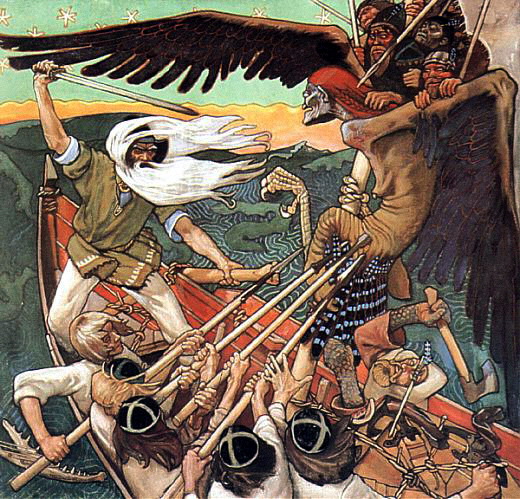
And yes, I know about Niebuhr. And yes, I am unimpressed. Because you are still just kicking the can down the road ineffectually if your argument is ‘humanity is just so rotten we can’t see the glorious unity of order and can’t take part in it until we die.’ Because there is nothing rotten about any of this. It is just how it is. People may call my views cynical, but the fact is I accept humanity as it is and don’t pretend it can or even should be something else, here or postmortem. It is what it is, get used to it. There is nothing ‘wrong’ with a multi-polar world, and there is everything right with one when it comes to debate, discussion, and diversity of ideas. But, the unipolar world only works when it acknowledges itself as a freak occurrence or a product of circumstance, not as a harbinger of world order and morality (also somehow conflated with economics by 20th century powers to ridiculous degrees). The more unipolar the world, the greater the necessity for a more diversified understanding of values and politics. It is worth remembering that at the end of the Finnish epic ‘The Kalevala’, Vainamoinen is being banished from the world by the arrival of magical baby (the Christian religion), yet he swears one day his people will need him and he will return.
After all, the trickster, the theme element of this blog, could not exist in a world of black and white and universal order. It would be an irrelevant concept. And yet the people who stand the test of time as thinkers were often those who stood against their own era’s received wisdom. But look around you in both folk legend and real life and you will see tricksters everywhere. Probably having a pretty good time too. And if not, making some over serious person have a bad time, which is just as good. There is a reason the myths and legends from cultures with many gods are always more fun to read anyway, it speaks to our actual multi-faceted experience in the real world.