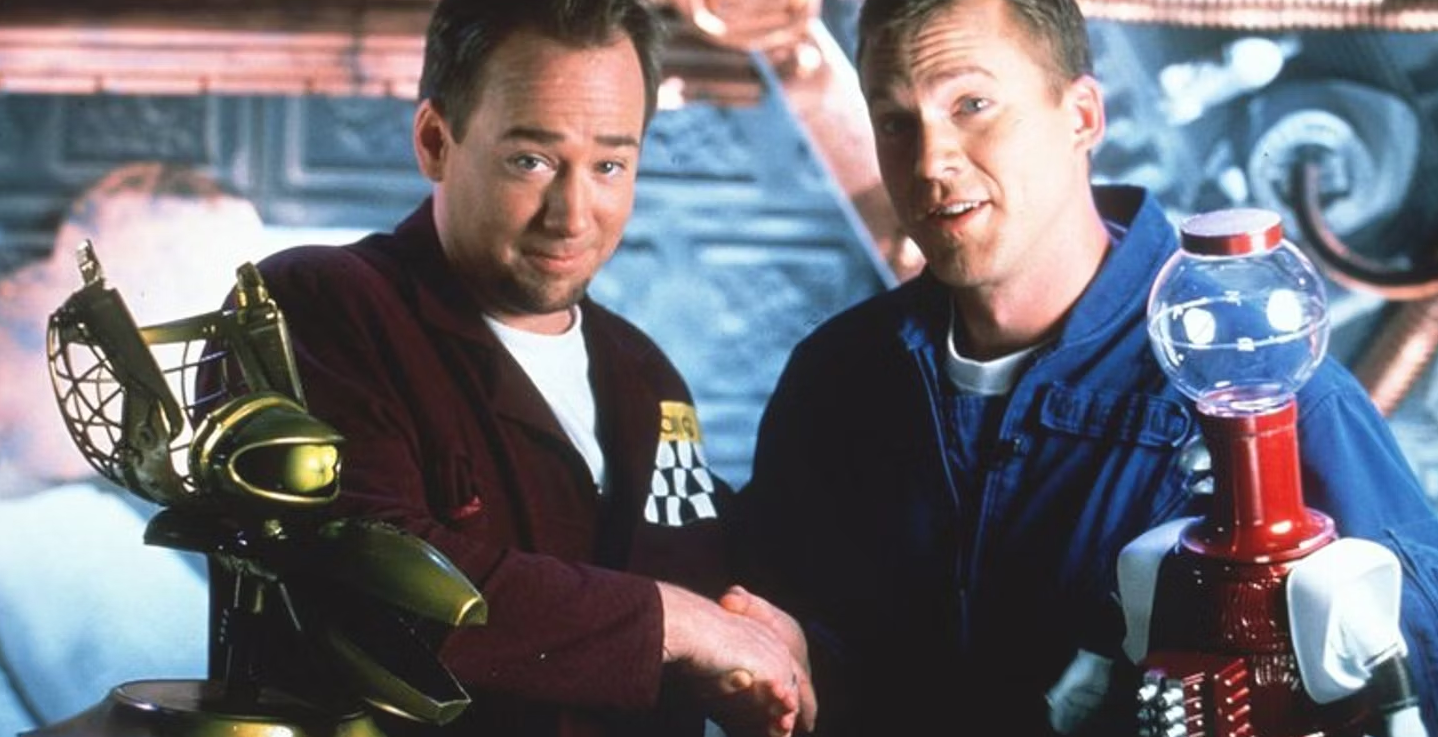
Mystery Science Theater 3000: A Cultural History is Matt Foy and Christopher Olson’s overview of the show that coined the term ‘riffing’ and launched a strange sub-genre of media made to parody other media. The idea of following people online or on television while they make fun of an old piece of media may no longer be quite the novelty it was when this former titan of comedy was at its peak in the 1990s, but I suspect the authors (as well as myself) feel the format has not yet surpassed its original incarnation.
MST3K was the creation of prop and occasional stand-up comedian Joel Hodgeson paired with producer Jim Mallon. Coming from a do-it-yourself first run in Minnesota public access television, the show’s premise was as ridiculous as the movies it would become famous for clowning on. A mad scientist (or more accurately over the course of the show, a series of mad scientists) imprisons a hapless janitor in an orbiting satellite and forces him to watch bad movies in order to research his deteriorating brain. To help him get through this trial, Joel builds sentient robots to serve as his compatriots in trashing some of the worst films ever made. Oh whatever, the show’s intro explains the whole thing in under a minute anyway.
Foy and Olson’s book does two things concurrently in its narrative: First, it narrates a straightforward history of the program from local Minnesota, to Comedy Central, to Sci-Fi Channel, to long hiatus and internet spin off projects, then a two season run in Netflix 20 years later and its return to independent creator control with today’s Gizmoplex. As it does this, the text singles out specific episodes of particular relevance to the show and its growing mythos (the show would come to riff itself too, drawing on jokes that referenced previous episodes more as time went on). Additionally, the book also intersperses commentary on the cultural effect of the show as it evolved and by midwifing the riffing genre which is placed between these historical sections. The fact that these two different sections are not separated from each other and are melded together within chapters dedicated to specific time frames is an odd organizational choice. While it takes some getting used to, it soon comes to make sense as the legacy and nature of the show is analyzed in time with its past evolution as a program.
A straightforward history of the program was needed, as most other books on this topic seem to be anthology series that primarily look at the cultural dimensions. Here, Foy and Olson have delivered something valuable. But their own cultural analysis is also worth reading on its own as well. Defining riffing as not just an audience interacting with media, but rather a triangulation of found media, intermediary comedy, and an audience, the book makes the case that the art form popularized by the show becomes intrinsically interactive in a way few things are. And, in one of the most insightful passages, the riff of a film becomes a subversion of not just the media itself, but how media is to be consumed in general:
‘MST3K demonstrates that movie riffing empowers riffers to reject or modify a film’s constructed binaries of good and evil. Villains can become laughable, just as heroes can become loathsome or ineffective. This deconstruction of heroic mythologies becomes useful when reading problematic films such as Space Mutiny or Mitchell, which glorify mindless aggression and violence as world-saving strategies. MST3K’s rejection of simple yet seductive binaries of good vs evil keeps the film and its characters open to reevaluation and audience self-reflection.’
This is followed up soon after with another passage referencing the cheap quality of many of the mocked movies in this vein:
‘On the surface, riffing on a movie’s gaffes and choices may come across as shallow mockery rather than critique. However, riffing on botched elements of a text’s craft should not be dismissed as mean-spirited because it fulfills a crucial and underappreciated function in active media consumption by keeping the constructed nature of cinematic storytelling in the foreground. Such riffs reveal that a movie (or whatever if being riffed) is a product crafted by artists and producers with a purpose. Films are generally engineered to immerse viewers into a manufactured universe, one crafted intentionally in the service of art, profit, or both.[…] Isolating and magnifying any element of film- obvious or subtle goofs produced by stress, indifference, or lack of skill- draws the audience’s attention to a film’s construction invites audiences to question not only how it was made but why.’
This perspective has obvious value outside of cheesy entertainment criticism. We do, after all, live in an era where established narratives have become so complacent and lazy that the wheels fall off of them constantly. A large media edifice exists to castigate anyone who notices these goofs, and in so doing often shows its own hand. This prompts us, the viewers of, say, world affairs, to ask ‘do you know what you are doing?’ and ‘what is this narrative even for?’
But I don’t want to over-intellectualize this too much, even if that is the point of the book and my review of it. The show’s motto is, after all, ‘Remember it’s just a show…I should really just relax.’ So let’s close out with something more personal.
I can’t deny that my own relationship to the show is almost as related to childhood nostalgia as it is to its role in comedy. I first came to the show when I was around 9 or 10 years old, having been told about it by an art teacher, and (thanks to catching re-runs of the original 60s Star Trek) in love with old B-grade sci fi jank. My family did not have cable, and so I saw one year later rebroadcasts of MST on a local public channel based out of Philly, perhaps fitting given the show’s roots (weirdly, I have a distinct memory of every single commercial break of the show running this Dining A La Card spot).
Naturally, I did not understand most of the jokes being made. It was funny robots making fun of a funny movie. My first episodes were Giant Gila Monster and Teenagers From Outer Space and the flimsy effects and forced acting of those offerings were good enough. The novelty of being in a ‘simulated’ dark theater with people more clever than one’s own friends gave the humor a strangely comforting vibe. Perhaps this was further enhanced by the fact that I tended to watch the show close up with low volume in the dark as its broadcast hours were late and therefore past my bedtime.
By the time the show went to Sci-Fi Channel I was old enough to watch it whenever I wanted (and had access to cable). This was also, in my opinion, when the show was at its height with Mike Nelson’s new hosting (which I originally viewed as a downgrade but eventually came to see as positive) bringing a cutting edge that really appealed to my tweenage self. Also by this point I had many friends who also enjoyed the show and we often watched it together at sleepovers, being especially fond of Japan-schlock episodes such as Prince of Space where the goofy chicken-man villain warlord could honestly carry the entire thing without the riffing.
Upon hitting some time in high school I just stopped watching. Probably because the show had ceased to exist. I never even came back to it, except as occasional joke references, until the Netflix reboot almost 20 years later inspired me to re-watch some favorites before moving on to the newer episodes. (I do like the newer three seasons, though I feel this guy sums up pretty well why they aren’t quite as good as the 90s run). Coming back to it as an adult actually made the show entirely fresh. No longer just some funny robots mocking funny movies show, I was now getting most of the jokes and commentary too!

This made me really appreciate the design philosophy of much of the humor to a much greater level. The creators of the show often said they were proud of how obscure many of their jokes were, knowing few would get them…but that the ones that did would really get them to the point where they would feel it was written for them. This ties into a theme that comes up in MST3K: A Cultural History frequently: something is strengthened by particularity. It is not for everyone. If it was, it would be diluted, ineffective, overly safe. Whedon-Reddit-Marvelized. The authors are right to constantly point out that the rootedness of the show in midwestern culture, regional in-jokes, and keeping its strange characters consistent around certain themes is an enormous strength. It is from a specific place, from a specific kind of person doing a non-typical form of humor, and this is what makes it work in a way that those seeking as large and non-specific an audience as possible can not.
I spent another few years not thinking much about the show until two months ago when I decided on a whim to watch as many of the 90s episodes as I could. Somehow, there were even a few I had never seen before. I had no idea this book was coming out when I began, but found out soon after and thus planned to read it once it dropped.
All of this re-engagement has been running concurrently with my re-reading of many of Thomas Ligotti’s stories. I have spoken at length on Ligotti before, but needless to say I see a hilarious halfway point that I believe I personally occupy between MST’s joyful good natured mockery and Ligotti’s treatment of the universe as built for horrific entropy and nothing else. Imagine that the universe and all its iniquities and miseries is really just the equivalent of a poorly put together B movie. Coleman Francis is a type of Gnostic Archon or mad creator. All of it built out of malice or incompetence or both. And yet out there in the cosmos there reverberates a cackling from the creatures who have found this B-move, and at least are having fun laughing at it- at all of us- and reveling in just how awesomely bad the whole production is.
Because, when you look at things that way, sometimes even the worst the Earth has to offer can be pretty funny. So long as you have a distant enough theater to watch the spectacle from, at least.

 The Trickster's Guide to Geopolitics