A Strategy of Restraint: The Inevitable Future with No Current Backers

posen restraint

Taking a grand view of American history, one conclusion seems inescapable: Americans are by and large apathetic or even downright hostile to caring about foreign affairs. The Second World War and the resultant uncertainties of its Cold War aftermath were enough to generate some amount of popular if superficial involvement by the public-at-large due to the massive stakes. However, with the end of the large scary oppositional power bloc that was The Big Bad Commies, the innate nativism was in danger of creeping back. But how then to justify the continued presence of numerous military installations around the world?

The answer was that America, as *the* global power, now had a positive rather than negative role to play with when it came to grand strategy. No longer having to deny the freedom of action of other powers, it could now globally take the offensive. A perpetual offensive of world-building rather than mere postwar selective nation-building. Naturally, sensing opportunity and the chance to act unfettered abroad the business community and the media followed suit, singing the praises of this messianic new cause. Intellectuals backed them up with glorious predictions of humanitarian causes and mutual integration through shared economic and political values.

Well, despite a promising and perhaps necessary coalition against Iraq in the 1991 war, and a relatively easy (if dubious in value) Kosovo operation in 1999 (let us ignore the Somalia debacle and the complete apathy regarding Rwanda here out of charity) this didn’t exactly happen except in a few specific cases. There is no need here to go over events everyone knows, but needless to say the marriage of liberal ideologues and right wing hawks which is the neoconservative movement capitalized on the events of 9/11 to push for even further and more radical world changing efforts. After all, what could be more shaking to this triumphalist narrative of eternal progress than the idea that a small group of retrogrades could suddenly call its effectiveness into question? The crusade had found its righteous causus belli to rally the masses.

But from the beginning the strategic limitations imposed by this thinking was apparent. Iran offered to assist the United States against the mutual foes of the Taliban, and they were brusquely refused. A chance to engage and fix a toxic relationship was thrown out, partly because it hurt pride, and partly-one imagines-because it hurt the narrative. Only now, after fighting against effectively the same people in conflict after conflict, has the U.S. begun to ponder the usefulness of engaging with Iran.

The completely unilateral and totally unnecessary Iraq War followed soon after. Needless to say, less than 200,000 troops and some set up elections did not magically transform a fragile society into a marketplace of reasonable property owners discussing the archaic nature of sectarian division in their salons and drafting rooms. The ridiculous idea of ‘De-Baathification’ (firing the entire armed forces, effectively) was founded on the hubris that what America had to offer alone could overcome history with the power of ideas. Instead, it led to a further inflammation of radical insurgency, and eventually the asymmetrical warfare and even large scale city battles such as Fallujah.

Ever since then its been a downhill collapse of U.S. popular self-confidence and willingness to engage in such operations. And yet, the policy establishment is undeterred by flagging popular support. William Kristol, the buxom bimbo equivalent who takes center stage in the neocon cheerleader formation, now blames tepid U.S. withdrawal from Iraq for the rise of Daesh-completely ignoring the first vital step in their creation was the very interventionist and regime-change supporting policies he championed. Even if you are for action against Daesh (and this blog most certainly is) we should not forget where they came from and that it is America’s mess and that America should clean up after itself. And yet, despite seeing the radicalization of the rebels and the dangers faced by minorities, these types still champion intervention in the Syrian Civil War.

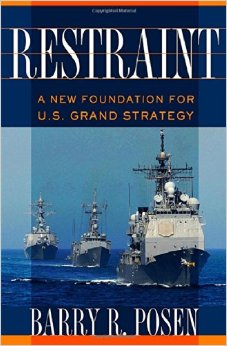
Into this world came the necessary backlash. Mearsheimer was the first big name to be raising the specter of necon/liberal hijacking of the American strategic establishment, and others have followed in his place. I myself went from a history undergraduate to a IR postgraduate because I wanted in on the backlash myself. One of the most recent is Barry Posen, whose ‘Restraint: A New Foundation for U.S. Grand Strategy‘ I have just finished reading.

I am not going to go through his arguments point by point so much as to point out what I see as the gist of them. Posen sees, like Mearsheimer, the United States as by far the most capable power in world history. But even this realization does not mean it is an infinite and eternally expanding world-changer. It still has limits, particularly if it wants to spend money on anything aside from defense. And these limits mean it can choose between a shaky, unstable but all-pervasive hegemony or a stable, easier, possibly less dangerous limited posture on how it sits on the throne. No one calls it this yet (that I know of) but for sake of description we could refer to this alternative method as ‘Hadrian’s Seawall.’

Posen is particularly focused on the lackluster role of America’s main allies, who are happy to save money by getting a free ride on the United States’ largess. This is hardly a new observation, but it is a valid one. Countries that face legitimate threats would have to raise defense spending with a U.S. scale-back. More ambiguous ones might decide a new ally is in order. The question is, to retain dominance how many of these allies does America need? Clearly not Georgia-even Bush wouldn’t intervene there- and now its disgraced former president Mikhail Saakashvilli wanders Brooklyn as yet another out of state trust fund hipster. No, really.

What struck me most about Posen’s work is that many of the signs of this scale-back already seem apparent on many fronts. The Obama administration has begun the much vaunted ‘pivot to Asia’ in strategic priorities, and despite nebulous expansions of black ops in Central Africa and Yemen there are noises from policy makers that the Middle East is to be reduced in priority, and the oceans-especially of the Pacific and Indian-will be focuses of the future. But there is at least as much backlash to these necessary structural readjustments.

This is where I found flaws with Posen’s work. Overall, I liked the book and think its necessary reading. What he neglected to do however is to examine *why* people oppose the necessity of his ideas at least being injected into public debate. He gives too much credit to his opponents in assuming that they care about strategy, their country, or even are thinking rationally. Maybe I shouldn’t be hard on him, after all, deconstructing the motivations behind bad strategy is my niche (maybe in the future, I hope) so perhaps he left me a gift. But one of the curses of mainline realism is that it assumes policy makers are rational actors or that domestic concerns don’t influence their strategy as a dominant concern.

In this case I think both of those factors are at play. Many in the business community benefit from U.S. influence expansion even if their own country does not. Think what America got from the Iraq War-now compare it to what Haliburton got. There is still loot to be gained from regime change, even if soldiers are no longer allowed to ransack homes. Once upon a time raids were launched by poor countries against rich ones, nowadays that paradigm could be said to have been reversed in many case studies. There are resources which the removal of a strong (if nasty) state opens up. Even state breakdown and chaos creates non-state actors which can be influenced through bribery. Hell, even some benign NGOs would be bereft of donations without new trendy conflict zones opening up, though obviously they do not hope for these invasions in the same way some private entities do. Such non state actors wield great influence over lawmakers, and so push for more hawkish policies. In D.C. connections are everything-and who is better connected than a lobbyist?

But even this, I think, could be reigned in as it requires cooperation from people who do not benefit so much from this arrangement. Even the media’s most milquetoast commentators are wising up to this. Alone, it could not mold policy in such an overt way. No-there is another ingredient missing: True Belief.

Faith is a hell of a drug. And the truth is, given the (relative) transparency of the American system you could not get average people to go along with securing diverse resources for increasingly international companies unless many of them truly believed that they were doing good. Indeed, that it was necessary and if we don’t do so we will have to fight them over here…or something.

Officially, legally, and constitutionally America is not a Christian nation-and certainly not a specifically protestant one. But culturally that is still the dominant attitude in society. A strident missionary creed is held by leftists and rightists alike, the religious and the secular, but through it all is this idea that ‘Our values are righteous, the world is black and white, and we are the ones to win it for the light.’ Needless to say this trope treats all fights as worthy, moral, and on a higher level than base strategic interest. It is a view so ingrained very few are immune to its apparent charms. This had always been a part of the American character, and the era of isolationism merely meant it was often directed elsewhere, but it was fully unleashed in the 90’s onto the foreign policy world.

But that hypnotic gaze which has attracted so many is that of the gorgon. It is outside the scope of this blog to debate whatever merits this view has (or doesn’t) on domestic or philosophical points alone, but on foreign policy it is nothing but a stumbling block at best and a deadly poison at worst. Many policy makers behave in ways which eschews long term thinking for short term applause lines. Pessimism (a vital ingredient in strategic thinking-perhaps a separate post later on that topic) is eschewed for saying the right things about ‘American Exceptionalism‘ or the blind faith in democracy and free markets to fundamentally reshape the world. Of course, the world doesn’t move in a clean linear path. Alliances, revolutions, social and economic trends, all of it creates reactions and counter-reactions. A despotic country becomes a democracy and a democracy can become frail or unstable-necessitating a despotism replace it. Powers rise and fall. History has shown every example of someone claiming that ‘now everything political will be different!’ to be a charlatan or unhinged. There are indeed things to be learned from history, and one of them is the fallacy of declaring it over. It usually comes down to famous last words before the tragic overreach. America is no more capable of being the missionary who attempts to recreate the world to reflect their values than Britain, China, or Rome were in the past-and the last two of those were so successful in the long term because they actually made no attempt to impose universal order outside of their cores anyway. It is merely the ultimate of superpowers-an extremely impressive achievement but one whose effects are still tied up in the greater world’s histories, rivalries, and passions. No matter how powerful, a country younger than many of the rivalries it seeks to police is not going to have any insightful or positive impact in remote conflicts outside core interests. Yet many remain convinced that this is necessary if even just for the self-esteem of the state itself. It is often an emotional and irrational commitment.

In addition to finishing Posen’s book another thing happened today in the realm of politics by the way:

Hillary Clinton

Which could very well mean that as necessary as a discussion on U.S. strategy incorporating the ideas of ‘Restraint’ could be, we are likely to see a race where all the major contenders are, to varying degrees, in the neoconservative camp. Right now, the signs do not look great for an open or refreshing debate on geostrategy in either political party.

There’s One Thing I Haven’t Heard Yet About the U.S.-Iran Deal….

US-Iran deal

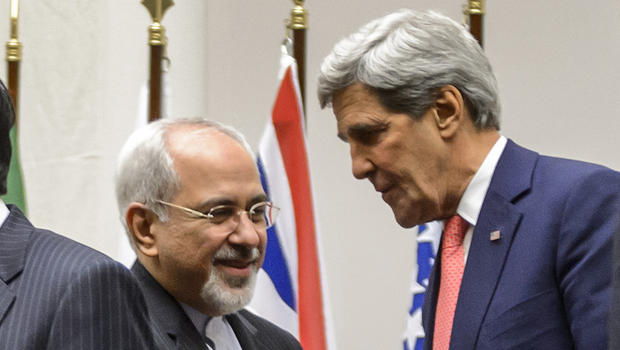
You can hear the discussions and the debates already: ‘A Major Middle-Eastern Re-Alignment’, ‘The Dawn of a New Era’, ‘From Foes to Friends?’ and on the litany of predictable headlines goes. And it is true, no matter what the future holds this was a big moment in the relations between two countries who have oscillated from low-intensity Cold War to outright hostility and back and back again numerous times since 1979. But now both sides realize the commonalities of interest outweigh the still substantial disagreements and there will at least be an attempt to deal with it. Whether or not it will be successful only time will tell. But hopefully it will be. Both nations share an enemy in combating Sunni extremism, which has much more global appeal and violent credit to its name than any corresponding Shi’a movement. In fact, last month U.S. airstrikes supported Iranian backed Shi’a militia offensives against Daesh (ISIS) in Iraq. Nothing like an even scarier foe to bring to former enemies together.

The question will be if this rapprochement is temporary or long term. Iran also wants more diplomatic options, an end to sanctions, and greater levels of flexibility than to be forced into becoming a junior partner with Russia. The U.S. on the other hand no longer has the will to bluster about constant large scale conventional intervention and also needs more options in the region-particularly if it is going to downplay its presence in order to focus on the far more important (to Washington) Asia-Pacific and possibly even European spheres of interest. It may also be desirable to remind the Saudis and Israelis who is boss in the relationship with Washington, but good luck getting anyone to acknowledge that in any official capacity. Both sides have a lot to gain and even more to lose. Nothing is settled yet but the gamble just might be worth it. After all, look at Yemen. A Saudi led coalition as well as (allegedly by some but unproven so far) an uninvited Israeli guest are stepping up bombing runs on Iranian-aligned Houthi rebels who are making gains at the expense of the government. Now this is a wild card for both parties as it introduces independent action from their allies separate of their own negotiations. It is so convoluted that it actually has captured a fair amount of media attention relating to the talks-as it should.

But one thing I am so far not seeing mentioned, except in passing, concerns less about new-found chumminess in Iraq against a common foe or even the dangers of the situation in Yemen, but rather the still ongoing and far more deadly than either of those examples Syrian Civil War.

When the war began there was no question as to whose side Iran would stand on. Syria under the Assad family was a die-hard Iranian ally, all the more important for really being the only one. Naturally, this meant that the United States and its allies jumped on the rebels bandwagon (this was of course those dark and far off days of 2011). Syria also of course had close ties to Russia (The Tartus Naval Base in Syria being Russia’s only external military installation not in a part of the former U.S.S.R.) and a quite obvious minefield of ethnic and sectarian divides. All of this made direct intervention a la Libya not an option. But short of invasion or no-fly zone, the U.S. and Iran went to work on a proxy conflict as the once sealed Syrian state splintered apart.

The problem of course was that so did Saudi Arabia. In fact, nations like Saudi Arabia and Qatar were much more gung-ho about such an intervention than even the U.S. seemed to be (neoconservative fantasies of then Secretary of State Hillary Clinton aside). The extreme form of Islam often championed by elements within these states, coupled with the fact that the Assad regime had long since made alliances against the majority Sunni population of their nation with many of the various other minorities basically guaranteed a particularly nasty division of society. Something that the Iraq War should have given the U.S. foreign policy establishment much more pause when contemplating entering the fray.

Once it became apparent that the Syrian government would not fall quickly-or perhaps at all-radicalization within the rebel movement was pretty much a guarantee. Gradually, the Islamist elements became a larger and larger part of the Syrian opposition, to the point where any hopes of a moderate-only victory became about as likely as a Green Party candidate winning the American presidency.

I remember watching the early stages of the Syria conflict unfold as a doctoral student familiar with Syria’s general demographic makeup. My first thought was ‘if the government doesn’t crumble in a month or two this is going to be nasty on all fronts-how I hope the U.S. doesn’t interfere!’ But so it happened. How much of an effect this had on the war is debatable, but once the war was guaranteed to be long it very much served U.S. interests to hope the regime-yes the Assad one-would be the faction which emerged triumphant. Rebel victory increasingly looked like a scenario where the price of getting rid of one family and their nepotistic gang would demand a terrible price for ethnic and sectarian minorities alike, not to mention the empowerment of religious fanatics who respected no borders. And yet, the American foreign policy establishment still hedged its bets with the rebels who at best could deliver only the most questionable gains in the form of Iran having to spend money and arms on aid to Damascus.

Perhaps the United States realizes its errors on this issue. Perhaps not. But this brings us back to the recent Iran-US talks. Iran and Russia are the only state level external actors that pull weight with the Syrian regime. It would be wise-if the U.S. wishes to take back its Syrian mistakes-to be using those secret talks in order to negotiate something on Syria, namely to agree to stop any indirect support for the rebels in order for something else.

Considering the way things can go in such negotiations, it would hardly surprise me if that ‘something else’ was acknowledging Iranian influence in Syria and maybe even assisting them against Daesh there (where they are even more entrenched in than in Iraq) in exchange for Iran agreeing to make its Shi’a militias in Iraq loyal to the Iraqi government at least once the current conflict is over. Or it could be for Iran to have its proxies hold off from hostility with the Kurds. This is of course speculation, but its the kind of deal I would strike. If it is not that, one suspects Syria still comes up, and that the U.S. could very well be looking for a face-saving way to distance itself from that country or for further collaboration between all parties opposed to Daesh-something Iran could very likely provide.

Simply because this is the one issue being sidelined by the media covering the US-Iran talks makes it by far the most interesting one to me. If indeed this is being actively discussed the ramifications of it could be as big as any nuclear program or shift in alliance networks.

Anyway, have a pretty jumpin’ propaganda song.


Edit: 4/13 to clarify that the claims of Israeli involvement in Yemen are so far unsubstantiated.

Trickster was going along…

The intention of this blog is to explore the very establishment field of geopolitics from a non-establishment perspective. The mythological figure of the trickster (think of Hermes in the classical world, Coyote for the Plains Indians, Raven for the Pacific Northwest, Loki in Scandinavia, the Tanuki in Japan, Reynard the Fox in western Europe, Anansi in Sub-Saharan Africa, Monkey in China and many more) was a perennial outsider whose influence upended previous received wisdom and changed the nature of the order around them.

The thing with International Relations (IR), and the particular sub-set of it that is focused on alliance networks, grand strategy, and other related fields called geopolitics which we will be exploring in this blog, is that the great achievements of diplomats and strategists often follow similar paths in history to the meandering and surprising journeys of the trickster in mythology. The problem is that much of contemporary IR scholarship is focused on the predictable. Quantitative theories attempt to predict the future of states with mathematics while many qualitative theories forget the big picture in order to indulge in contemplating the feelings engendered by ones identity or media consumption. These approaches and others like them may have uses for particular fields, but when it comes to the core of big issue IR-geopolitics and strategy- they have caused the discipline to lose much of its way.

In addition to highlighting the role that outsider thinking has shaped strategy in history as well as today, it will also be the purpose of this blog to advocate on behalf of viewing the world devoid of fashionable jargon. Like the legends of trickster, when coming upon an idea which is held by many and therefore assumed to be true no mercy will be shown if said idea is lacking in actual merit. This of course does not mean that all popular or fashionable ideas are wrong, and rote contrarianism would become boring and predictable on its own anyway, but merely that whether to dispute or defend an established theory, an outside perspective is always beneficial.

Hopefully you will enjoy the ride.