Swords Against Nerdery: A Khaldunian Theory of the Sword and Sorcery Genre

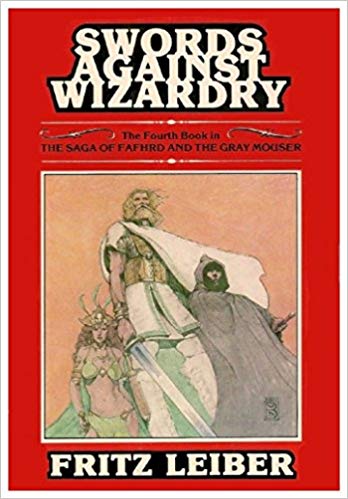
swords against wizardry

I’ve been a stalwart fan of the Sword and Sorcery genre and its iterations for a very long time. It is second only to horror and weird fiction for my fictional genre enjoyment. I have also been just as much a foe and hater of high fantasy for an even longer period of time. I never really gave much thought as to why this is until recently, assuming that the rank corniness and ethical Manicheism of high fantasy as compared to the more ambiguous and earthy nature of sword and sorcery were alone enough to clinch the deal for me. But my recent discovery that cultural commentary need not all be a horror show of religious fanatics, entertainment industry neoliberals, and blue-haired-septum pierced woke scolds jarred some thoughts about this topic. Indeed, the people mentioned in the sentence above-the ruiners of cultural critique-are a big part of the difference between traditional fantasy and sword sorcery, and more importantly, the kinds of people each appeals to. Plus, if your rivals are going to use such language in the real world, ridiculous as it is, you might as well be able to meet them on a level they can understand. Much like a sophisticated vocabulary is not a good idea when speaking to children.

What makes S&S what it is are protagonists with base motivations, magic being rare and mind-bending if not outright a cosmic horror, glories being relegated to a mythical past if even mentioned, and above all the love of a good tale about powerful outsiders, usually barbarians or criminals, and the decadent magical and political forces they often find themselves at crossed swords with. There are no grand battles of good vs evil or light vs darkness here. Large conflicts tend to be one local petty kingdom vs another with the protagonist happening to find themselves on one side or the other through chance, personal vendetta, or mercenary motives. This is the stuff of Robert E Howard, usually considered the inventor of the genre (as well as the maker of its two greatest incarnations, Kull and Conan), not of Tolkien or his many many increasingly terrible imitators. This is the less famous and far more interesting world(s) of Imaro, Fafhrd and the Grey Mouser, Kane, Jirel of Joiry, and Nifft the Lean.

What I like most about the genre aside from its general fun, of course, is its Ibn Khaldun-derived general view of human nature and of societal processes. Unlike the dominant ideologies of our time (which are reflected in our dominant fantasies apparently), history isn’t a teleology. It isn’t going along some pre-determined path. It is rather a series of competitive crisis managements that fail or succeed to different levels amongst a series of cultures and societies that were born into some form of success or stability and have been declining towards their fall and replacement ever since. Then the cycle begins anew. This is neither the reactionary thought of a Burke, the Catholic Church, or of modern-day patrician centrism, where a magical tower is continually built towards the heavens, nor is it the edginess of the pure radical, who revels in the demolishment of all for a wholly new leap in the dark, but rather sociology as a natural process. In fact, both of these extremes are often the antagonists of S&S stories. The first as the cloistered evil wizard or decadent king in their ivory or onyx tower, the second as a re-awakened cosmic horror or the monsters that dwell out in the wilds. Often, one is summoned by the other.

The protagonists of this genre tend to share things in common too. An outsider status, tight but rare friendships in an untrustworthy world, and a disdain for declared authority. Most importantly, many of these characters follow the Khaldunian path of barbarian nomads by eventually leveraging their advantages into kingship, toppling the old order but replacing it with a new and more vigorous one. Conan, the most famous hero of the genre, becomes king of Aquilonia. Kull was king of Valusia aeons before him, both were barbarians who started out fighting those very kingdoms. Fafhrd and the Grey Mouser eventually end up as the local bigwigs on a subarctic settlement, Imaro as a legend across the lands with a mixed reputation. All come across dark entrenched forces that more live by inertia in entropy than by dynamic action. Most importantly, the various wizards, sorcerers, and the like are usually not world-threatening menaces but rather merely another cog in some kingdoms political machine, or a criminal guild’s most prized member, or the secret forces behind events within kingdoms. The decadent throne of Valusia was only given vigor by Kull, and first he had to survive assassination attempts by literal lizard people who had secretly controlled the kingdom and held it in bondage to old ways by puppeting previous kings. If that is not a conspiracy theorists fever dream come to life, I don’t know what its. But symbolically it resonates much as Pizzagate is obviously an (ironically hilarious) farce that no one should actually believe, but it speaks volumes about how many view our present ruling classes. It was after all only after the various housecleanings of Conan that Aquilonia entered its golden age, even if this, like all times before, could not last.

kull

S&S is, in effect, the Virgin vs Chad meme of fantasy genres. Cold steel always outperforms the elaborate machinations of a bunch of tower-dwelling neckbeards, court eunuchs, and inbred aristocrats. In a temporary, ever-fluctuating world, only the right use of force and alliances can see you through. This is not a glorification of violence and always taking the offense either. The vast majority of S&S heroes, when not being thieves, are usually wronged before they act. They do not seek fights, but rather respond decisively when such battles are forced upon them. The kingships of Kull and Conan are remarkable for how much less warlike they often are compared to their neighbors, with the real battles being keeping the decadent dying courts of rivals at bay.  Meanwhile, all of these outsider protagonists tend to be extremely well traveled, multiple language speaking, highly analytical thinkers. The Nerd-Wizards, on the other hand, so haughty and proud in their rote-learned intelligence, are almost helpless without prestige, ceremony, and dependency on established power networks. Their lack of contact with the brute reality of the world is their undoing.

It all reminds me of recent commentary I read somewhere (source presently slips my mind) about the superiority of speculative realist philosophies against correlationist ones, with the hobbies of the thinkers compared with their thought. It basically broke down that the realists tended to like hiking, travel, adventure, while the correlationists and idealists were often desk bound thinkers. This was shown by the nature analogies used by each, with correlationists tending strongly towards inanimate solitary objects like furniture and the realists using animals, plants, ecosystems, and weather.

And look, there I managed to tie this post into my fascination with Speculative Realism too. Anyway, back to the point.

It is these decadent courts whose thumb we presently dwell, tolerant as they are of neckbearded nerd-wizards in their towers and court lanyards that are the most aggressive threats to the world arise. Lacking true fortitude and strength as intrinsic character traits, they must rather pretend they have it through fraud and posturing- a far more dangerous proposition. Fantasy Bill Kristol types in effect. And if some group or leader came about who actually was interested in changing these entrenched interests they would face plots and palace coups aplenty from the dark forces that fester in the shadows of the kingdom. But that’s no reason not to try anyway. Even if you fail it will make for a good tale around a few pints, anyway. And someone needs to Hold the Sword against this high fantasy loving nerd tyranny we live in, where neoliberal nerds who identify their politics with the entertainment they consume are the predominant cultural force of strange cosmic horror summoning sorcerer class. If we must live in a nerd-dominated culture, then we can at least speak the language of the Chadliest of nerds…and that is of Sword and Sorcery. It is not like high fantasy represents anything but the pathologies of both liberals and reactionaries alike and their presently collapsing world views.

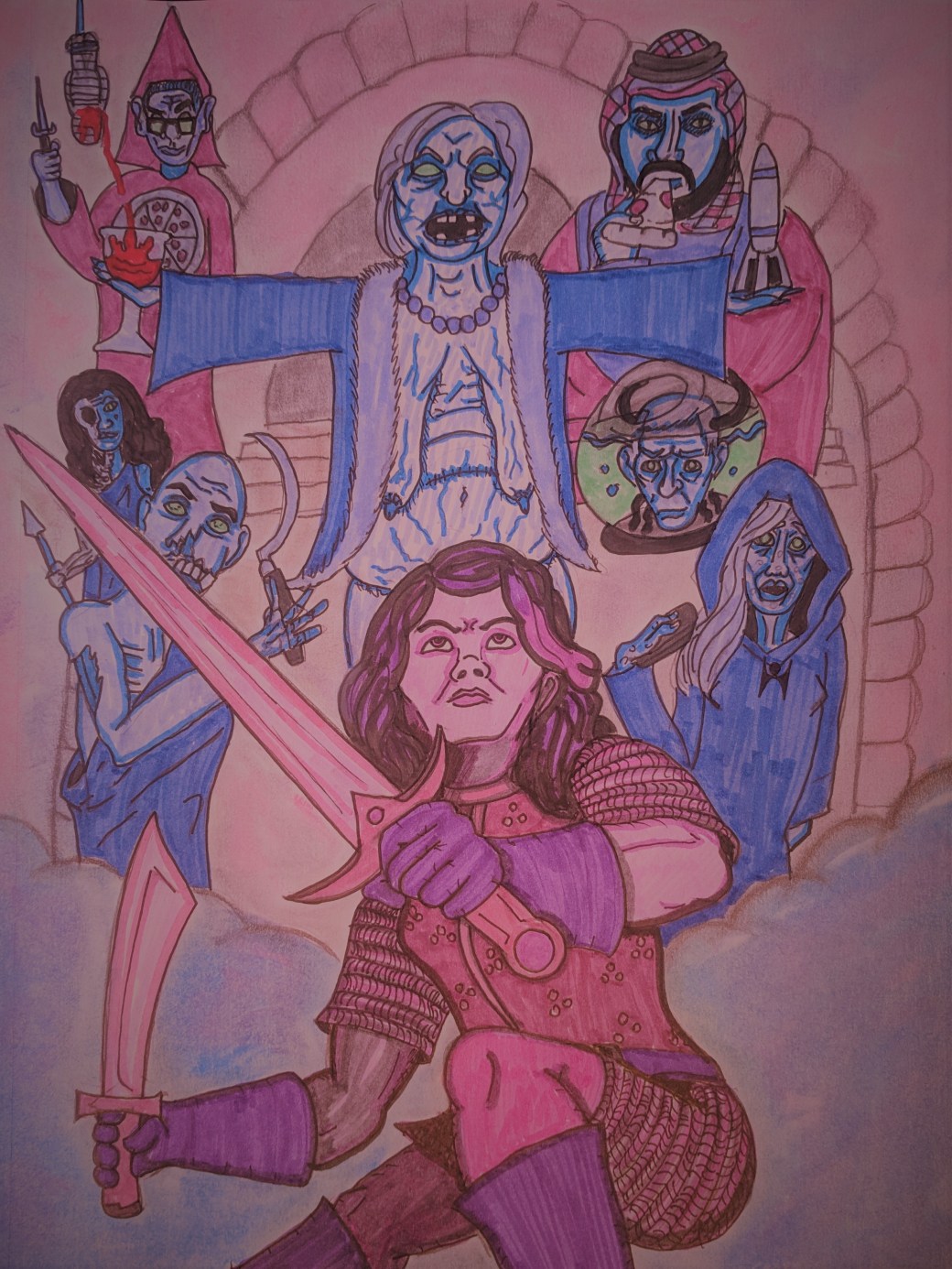
Anyway, here is a picture I did for a Mandy style movie poster (Mandy may take place in the 1980s but it is very much a S&S genre film-trust me) of Tulsi Gabbard clearing out the wretched dungeon of the Democratic establishment (special guest MBS, with Hillary, Booker, Harris, Podesta, Biden, and Power all thrown).

Tulsi Mandy Style Dungeon

But seriously, read nonfiction first for real commentary, people. Actual history and philosophy will always rule at the end of the day. But maybe…maybe sword and sorcery can help on the propaganda front anyway. It certainly can break up the high virgin fantasy monotony.


Black Mahakala: Macro-History as Annihilationism

mahakala

I just finished reading Speculative Annihilationism by Matt Rosen, the newest entry of note in the growing canon of speculative realist philosophy. I have posted on this subject before, in particular about my working side quest of integrating Object-Oriented Ontology and adjacent thought into geopolitics. But Speculative Annihilationism (let’s use SA from here on out) is something that works with macro-level history in general at least as well.

A short summary of Rosen’s argument is that materialist archeology shows the way to handle the snuffing of anthropocentrism in philosophy across the board. So much of what we study at the archeological level is already extinct. Australopithecus, the dinosaurs, civilizations whose genetic descendants may still live but whose cultures, languages, and cities do not. The extinct lack the ability to engage with correlationism and phenomenology, yet their existence is undeniable if there is enough evidence for the archeology of their past to even happen. Therefore, we are forced to reckon with extinction, no matter our feelings about it. To quote the author:

‘SA’s dark perversion is this: deterritorialization always has the upper hand over reterritorialization. At the core of every assemblage-materiality is an unavoidable fragility, a tendency towards discontinuity, disparity, and extinction, a becoming-nothing at the core of every becoming-something-this is what it means for a species to be a species-towards-extinction. Cataclysm, annihilation, and extinction are the rules; assemblage, coming-together, and being-something are the strange, uncanny, and interruptive exceptions.’

Rosen’s argument has many facets and subtleties that someone like me who views metaphysics are largely back burner stuff to policy and scientific questions is inadequate to fully explain. Suffice to say that it is worth reading in its entirety and also a powerful case that extinction, entropy, and the like is the ultimate reality. If one takes casual time as a measuring stick we are all already dead in a sense, since death is the inevitable end process of life. So too is it for species and the self, all of which are in fact reducible to breaking down physical processes whose intangibles we construct outside of science as the humanities. Whereas much of currently existing speculative realism is constructive, hearkening to process theory and seeing a culmination of material events, SA brings us back to decay as the norm and construction as the outlier. Extinction, in the end, for everything. In truly and unambiguously material terms.

I believe this is incredibly useful as a philosophical and linguistic tool for deep history, particularly for the materialist. If we view all states, nations, cultures, cities, religions, and artforms as dead on arrival-or more practically always living on borrowed time-with extinction the only given, we are liberated from the curse of teleology and trying to make sense of every societies place in history and better able to appreciate it on its own terms. Terms that do not need to be those of the purely subjective and idealistic such as found in postmodern schools of thought. It also levels the playing field between long-dead states and currently living ones for the purposes of study. They are subject to the same overall experience of unexpected rise (most attempted state formations fail after all) and predictable decline and fall so it is just as enlightening to study civilizations across the world that lie in different ecologies and time periods no matter where they are. A wide knowledge base across the board gives you a vaster repertoire of case studies and minutia even if you know how it all turns out.

It is also worth noting that SA, much as it does on the individual level, provides a great counter-example to the hubris of presentism. Something all too common in current dominant cultures, as well, no doubt, as future ones. I often speak of my favorite historiographer, Ibn Khaldun. One thing about his evolution of thought that is often overlooked is that he grew up in North Africa in the late Middle Ages. North Africa’s heydey of global relevance had already come and gone. The Sahara was already growing and the crop yields shrinking, even then. In such a setting there were as many ruins as there were currently occupied cities and buildings. The leftovers of numerous cultures dotted the countryside and signs of a glorious past leered mockingly through the dust of time at the less prosperous present. It is easy to see how Khaldun was molded by this experience to help him come up with a cyclic theory of state formation and state death. One I think is still among the most accurate macro-historical thesis of all time. In his works is implicitly a shared assumption with SA-that construction is more the outlier, and degeneration the more common norm. Entropy is ever present and can only accelerate due to time unless a very unlikely event interrupts it. State formation is so fascinating and impressive precisely because it is so rare compared to state degeneration, be it dramatic degeneration or slow motion.

Unlike many other speculative realist philosophers, who betray their continental roots by more often being Eurocentric to the extreme, Rosen draws some direct comparisons to Hindu thought in his conclusion. This is long something I have advocated. Though I am neither Hindu nor Buddhist, certain branches of these religions philosophies overlap with many trends in speculative realism. Over the past few years-my most intense time brushing up on that philosophy-I have also been re-engaging with reading about these religions as well.

The figure that best shows the overlap of Speculative Annihilationism in particular with these thoughts is Mahakala. In Hinduism, Mahakala is Shiva’s most wrathful form, the ultimate destroyer, and consort of Kali. In Vajrayana Buddhism, he is the ultimate meditative figure for contemplating the void and the eminent entropy of all through time. Whether taken as a literal god or a symbolic figure of a process, Mahakalan History (I’m now coining this term) is applying the concepts of SA to macro-history. Especially, in my case anyway, to the macro history of states and civilizations. The end point is taken as an unavoidable extinction, but the process of getting there, of engaging, in Rosen’s terms, with ‘the putrifying other’ is always enlightening. Beneath the facade is the degenerating process, past, present, future, other and self. We are, after all, along for the same ride they once were.

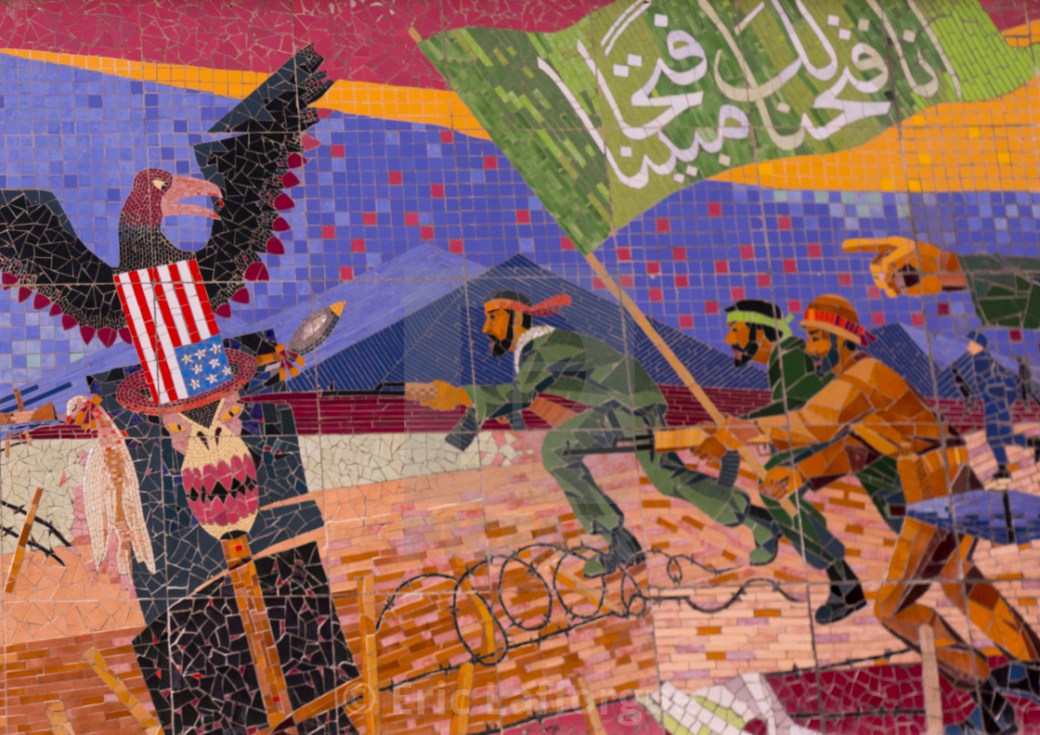
What if Iran kicked America’s Ass?

iranian poster

The war drums in Washington are beating the steady staccato they often do when the hint of conflict is teased to a conflict-hungry media and war-weary public. While I get the impression that Trump himself does not want a full-blown conflict here, he is easily impressionable both by America’s more unsavory allies as well as people in his administration. Right now, even if he is just being used as a public face of the stick in a carrot and stick approach, John Bolton is easily the most dangerous man in the world.

But I have made my views quite clear on dangerous and flawed U.S. policy towards Iran on multiple previous occasions. I want to examine a more interesting issue right now…what if the worst comes to pass and there is, in fact, a U.S.-Iran war in the near future? More specifically, what if Iran far outperforms expectations, or America far underperforms, or both?

It is not as much a position for provocation’s sake scenario as you might think. While its nearly impossible to see Iran winning a conventional conflict against America, they would obviously not be foolish enough to fight in such a way like, say, Iraq did in 1991. The First Gulf War was such an overwhelming American military victory that basically stopped everyone-for the time being-from seeking to directly challenge the US with vast formations of tanks and planes. In a strange way, that victory has unintentionally been bad for Washington, which is far less skilled outside of such conventional warfare.

While every strategist around the world must know that Iran would be a far tougher nut to crack than say Iraq or Libya, and private conversations are almost certainly filled with such concerns among military brass, the public face of the issue so far has been one of self-confidence. For all we know it may be warranted, but there is a stronger case to be made for Iran being able to do serious damage to the U.S., and possibly even come out winning more than losing in a direct confrontation. I feel there are military officers who know this and who could talk down the more ridiculous congressman into continuing our present low-level siege warfare. But with Bolton, Tom Cotton, the Saudis, and possibly the Israelis all pushing for a greater escalation, it is quite possible that a cascade of events could drag countries to places even against their own wishes a la summer of 1914.  Here is how that could happen in the very real possibility that Iran outperforms the expectations of our political elite:

Iran today has probably more raw potential military power than North Vietnam did in 1964, if a far smaller pool of battle hardened veterans. Its ability to strike throughout the region is greater, and its population’s strong desire-no matter their politics towards the present government-to avoid a return to being an American puppet could be forged into a type of total war mobilization that would never be able to be replicated in the U.S. The Forever War and the various mistakes of the United States policy leadership since 2003 and onwards have alienated the public from the Pentagon and the interventionist mindset far beyond repair. That already gives Iran a leg up on morale for a long haul battle.

Iran’s special forces have become as hardened in Syria as U.S. forces are through their constant deployments. They have built long term relationships with state and non-state actors alike in Syria, Lebanon, and Iraq (and possibly to a much lesser extent, Yemen), all of whom know that while the United States will not always be in their near abroad, Iran always will be.  Meanwhile, Iranian ally Hezbollah showed in 2006 it can be called upon to tie many Israeli forces down if needed. Their performance in Syria more recently also is impressive.

Iran would most likely cede the air to the overwhelming superiority of American jets, but it’s land-based missiles could wreak havoc on the ships that launched them and their logistical support. They could bypass many American technological advantages by the use of physical and human communication and launch terrorist attacks against American allies-especially European ones who are far more reticent about U.S. hawkishness towards Iran. Meanwhile, oppressed Shia minorities in Saudi Arabia (which tend to live in the regions with the countries oil fields) could be mobilized as a fifth column to damage that notorious and unpopular government from the inside.

Even assuming that the initial stages of the conflict go quite well for Washington, Iran’s ability to damage American allies and dependents combined with its ability to hold out in a conflict longer means that in order to squeeze out a victory the U.S. might be forced to use ground troops in the region. This might work in Iraq where the terrain and local divides could provide an in, though the casualties would be immense as a civil war was touched off. Most likely, I think, Iraq tries to play the neutrality card between the two countries. Either way, to bring about some kind of victory at this point U.S. troops (and more and more naval and air resources) would have to be dispatched, possibly entering Iran proper. A country filled with mountains and large cities. If they even could. After all, a U.S. military exercise in 2002 (with estimated Iranian capabilities than being less than they are now, and American power stronger and more belligerent at that point than at present) showed they might not even be able to land.

As the current Syrian War shows us, cities play the role of castles and forts these days more than ever before. A great place to bog down an invader and give them lots of PR when it comes to the infliction of human misery on people. Around these cities is the difficult terrain of the Iranian plateau and who knows how many emergency cave complexes and hidden bunkers to back up the asymmetrical fight. All of these points, once again, towards Iran being able to last a long time.

And the longer it lasts, much like say the United States in the 1770s, the more likely foreign support for Iran increases. This support could be direct (Russian jets from Syria over Iraq and Iran) to indirect, with an increasingly distracted America coming under pressure in the Taiwan Strait, Ukraine, the Baltic, or Afghanistan from coordinated Chinese and Russian action. If so, the cost of even a hard-won victory and the fall of Tehran would fatally undermine the U.S. global position not just in the Gulf but around the world. This means the Pentagon will be reluctant to commit the full and decisive forces it would need to truly beat Iran, and thus Iran’s chances of outlasting, embarrassing, and undermining America increase. Meanwhile, the hard anti-American left and right alike are driven to win in Europe as a new flood of refugees pours out of the region, radicalizing the internal politics of American allies and moving these countries from seeing Washington as a guarantor of peace into the primary underminer of it. As it becomes more and more obvious that Saudi Arabia and the UAE have the most gain from the belligerence-and are most likely working directly with Al Qaeda type organizations to fight a fully sectarian war, people around the world-perhaps especially American troops will start to wonder why anyone would die for the Gulf Arab leadership and their jihadist friends.

For the most dramatic outcome, you just might have Iran being the spark to create a truly global anti-American balancing act. An event which for many powers in the world probably feels far overdue. America’s ability to act unilaterally outside of the Western Hemisphere will be effectively gone for good, and the embarrassment would probably set off a political bloodbath at home. I believe this analysis holds true even if the war is a technical victory for Washington. Considering that this would have resulted from a war of choice, it would go down in history as one of the biggest great power self-owns in history. Upon the level of Austria-Hungary declaring war on Serbia in 1914, The Soviet intervention in Afghanistan, or the numerous Carthaginian attacks on the city-state of Syracuse-that latter example being the very one I am currently reading about which inspired this post. No one would have predicted that little Syracuse could have drawn with and even occasionally defeated the western Mediterranean’s then-greatest power, but with terrain, audacity, and a greater appetite for sacrifice than their opponents, they did. Considering that present day Iran lives under such existential threat by American power that their military and strategic apparatus is likely far less complacent in terms of promotion, doctrine, and self-confidence, it was easy for me to think of this connection. Especially when reading about Carthage’s vast sums of money not being able to offset their extreme adversity to casualties when fighting abroad.

Of course, considering the regional and international coalition that Iran would face, it is also true that even an Iranian victory would be incredibly costly and thus they would wish to avoid all-out conflict in the first place. Let us hope Washington’s notoriously bumbling elites can be convinced to see present events in the same light.

There we are. I guess its time to be labeled an Iranian shill now.

Facts Don’t Care About Your Grifters

Grifters

Its been a bad couple of months for the grifter. Hot on the heels of the implosion of the Russiagate spy thriller industrial complex and the sudden flailing about of its most shrill and conspiratorial partisans we have also been the witness to two utterly unsurprising and overdue reckonings with the more traditional conservative grifter.

First came the much vaunted Peterson vs Zizek debate, which you can watch here. While I have little invested in either of these two famous commentators I was curious as to how an obvious carnival barker such as Peterson would perform against an actual intellectual like Zizek. Zizek, it must be noted, is not a philosopher I consider myself a huge fan of in many ways. I am firmly on a realist and he on the idealist. He loves Hegel, who I cannot stand, and is part of a long-running unfortunate trend of left-wing thinkers who are aligned first and foremost with anthropocentrism. That being said, he is undeniably a philosopher and an intellectual, words that Peterson aspires to be but has always come up short on attaining.

What happened in their debate is mostly notable for how unused to being challenged Peterson was on his own talking points. He has based most of his career on conflating Marxism and Postmodernism (two ideologies that really could not be more different) and has never had to confront the fact that his image of Marxism was entirely divergent from its actual real world manifestation-as well as that the cultural feed for the social justice nuts he decries has much more to do with the inherent pathos of the classical liberalism, individualism, and Christianity that is part and parcel of the very ‘west’ conservatives love to champion.

Hardly a surprising result of the debate of course. But then it happened again even more recently. Ben Shapiro, an even more blatant fraud than Peterson (though beloved by the same demographic of alienated and terrified young men and bitter divorced dads who create such spawn) showed how utterly unused to being challenged by critical questions he is on live television.

The similarities between these two and others like them, aside from apparently voiceboxes that approximate various tones of a deflating Kermit the Frog, is the nature of the conservative grift. Conservatism by its very nature often trends towards the anti-intellectual. ‘Don’t rock the boat’ and a reflexive desire to defend entrenched power is hardly conducive to critical thought, even if a conservative position happens to be the more correct one. Naturally, however, said entrenched powers know they need a propaganda wing too, hence the vast amount of astroturf funding that goes out via think tanks and various organizations affiliated with big money to prop up things like Turning Point USA and the like. If you were actually to leave public discourse in its natural state, critics and not defenders would thrive.

This creates a money pit. The grifter may or may not actually believe what they say but senses an opportunity to make bank. No trickster could fault such a tactic, and be sure that I do not. It’s a rough world out there in the post-recession hellscape. The problem is that these artificially buoyed people become both convinced that they themselves are wholly responsible for their success (which jives nicely with the ideology that they expound) and then enter into a feedback loop where they begin to believe their own bullshit-assuming of course that they already didn’t. Such incestuous behavior leads to Peterson inventing his own political theory in a vacuum or Shapiro writing his own articles about himself in the third person and giving them self flattering and hyperbolic titles. Meanwhile, both take immense pride in being expert debators but (until recently) only debated psychologically frail college students and utterly superficial news anchordolls. Much like Uri Geller, the spoons only bend when the spoons have been chosen by the person who claims to be able to bend them.

It is worth noting, however, that this is not new. The last proper conservative intellectual in the English speaking world was Edmund Burke, all the way back in the late 18th and early 19th Centuries-and even he was not recognized as anything near an orthodox conservative in his time. While overly reactive against the (legitimate and inevitable) class basis of the French Revolution, he was still a person of nuanced thought who charted a course rooted in history and against many of the dominant tides of thinking in his day. There hasn’t really been a conservative political thinker of such importance or impact since in Britain, America, or their offshoots. Despite what people try to say (including desperate liberals who like to maintain the facade of the rational conservative as someone to hash out the enlightenment project within the salon, god forbid they have to talk to anyone left of them or of unorthodox persuasion) the entire experience of conservatism has drifted far away from anything properly intellectual since basically the industrial revolution. It is telling that the figure of the last generation most held up as an example of former conservative rationality and class was William F Buckley, himself a Bill O’Reilly style pundit more than any kind of proper thinker with anything of substance to say.

But there is money in it and fools aplenty willing to eat up bargain basement level platitudes and superficial gotcha moments packaged as philosophy. In this way, the mainstream right resembles the hypersensitive and hysterical trends of the moralistic wings of the left. Much like two sectarian branches of the same religion, both despise each other more for their similarities than the differences. Both are also clearly cultural inheritors of the protestant reformation and liberal patrician thought and their respective glorification of virtue signaling intent over action and accomplishment. The irony is that while this world views only work in a vacuum, they can only be disseminated in public forums. With the right challenger, they can be made to look utterly foolish under the disinfectant of exposure. It is important to hold interviewers to a high standard in order to best combat these grifters and their influence lowering public debate to that of the tattletales of the elementary school classroom. If so confronted, as Peterson and Shapiro have been recently, their influence will be undermined.


The War Comes Home: A Book Review of ‘The Management of Savagery’

jihadjohnmccain

In the aftermath of the First World War there was a famous example of ‘the war coming home’ in the German Freikorps, which largely fought as anti-Bolshevik forces in the power vacuum of Eastern Europe before returning home and disproportionately joining far right movements that would be eventually subsumed under the Nazi Party. The famous and impressive Czech Legion which found itself stranded and forced to cross the length of civil war Russia to escape the other end in coastal Siberia experienced a similar phenomenon. Perhaps most analogous to modern day audiences, and the one with by far the most soldiers deployed abroad was the Japanese Army in Eastern Siberia. They were those who played the largest role in the Siberian Intervention and arguably did the most to secure the deliverance of the Czech Legion.

Japanese troops were kept fighting a low level guerrilla war of occupation in Siberia past the end of the rest of the intervening powers in that war. Although their presence succeeded in extracting oil and gas concessions in the region before departure, it was a failure in its main (if unstated) goal of making Primorye partially detached from the nascent USSR and open to business with Japan (see ‘Japan’s Siberia Intervention‘). A long and expensive intervention soured the public and domestic pressures brought the troops home. Some troops would terrify the home country with the influences they had picked up from the reds. Many others of those troops, specifically the officers, would go on to influence the growing cadre of right wing radicals in the army, a faction that would one day go rogue in the seizure of Manchuria and then go on to usurp the government, setting the Japanese Empire on an inexorable path towards self-immolation in World War II.

Max Blumenthal’s new book: ‘The Management of Savagery: How America’s National Security State Fueled the Rise of Al Qaeda, ISIS, and Donald Trump’ is far more contemporary, but is charting a very similar process to these events that happened almost a century ago. But this time there is only one seemingly unstoppable world power and a host of non-state actors.

I was fortunate enough to attend the book launch where I purchased my own copy and had it signed by the author. You may recognize his name, along with his colleague Ben Norton, as the co-hosts of the podcast ‘Moderate Rebels’, which is my personal favorite podcast which I have referenced a few times before. At that event, Blumenthal referred to the book (whose release had to be delayed and relocated due to complaints from a combination of Beltway lanyards and Syrian rebel backers) as ‘the most dangerous book in Washington.’ Its not hard to see why this could be so.

The book charts the rise of American-backed Jihadism, a process that really swung into full action with the Soviet War in Afghanistan and the golden opportunity for the CIA to inflict revenge for Vietnam on the arch-foe. Though most people in DC know of this story and the reverberations of it (Steve Coll’s quite good book Ghost Wars is a common staple around Washington) there seems to be a collective cultural and political denial that this still happens. Not only that, but that this process, only really briefly interrupted by the immediate post 9/11 rush to combat the Taliban (itself a partial creation of these policies, if unintentionally) also has domestic blowback similar to the kind once experienced by multiple nations in the interwar era.

9/11 was used by many of the more hawkish elements of the American defense establishment, as well as a crisis hungry media (I was overjoyed to see I am not the only person who remembers that the top news panic story of summer of 2001 was the false claim of a rise of shark attacks world wide-its referenced directly in the book) to roll out an ambitious neoconservative plan of reckless expansionism. This parade of wars, botched operations, and flagging public support soon after Iraq turned sour in turn led to the rise of various media grifters seeking to make a buck (or a public profile) off of the War on Terror. Both Islamists often recruiting from the west to fight in regime change wars coming home to commit terrorist attacks (The Manchester Bombing for instance) as well as radicalized far right racist terror of a more indigenous persuasion not only fed off of the blasted detritus of American policy failures abroad but also each other directly in the domestic field.

The events are recent and many of them I have written about here before. But Blumenthal weaves a convincing narrative about just how interconnected all of this is, and how the neoliberal/neoconservative center is the ultimate enabler of the extremism it claims to be the bulwark against (see my last post for more on what I call ‘Trident Theory’). Right wing grifters and Jihadists alike feed off of each other. ISIS recruitment documents prove they intentionally provoke this as a strategy. The smarter people on the far right must know more terrorist attacks by Islamists are good for them electorally. Perhaps Steve Bannon himself wants to secretly and indirectly ‘adopt a muj’.

Much of this is enabled by conscious decisions by foreign policy elites in various countries. The grotesque tableau of the humanitarian warrior who loves refugees so much they want to make more of them by leveling their country allied with the Bolton-hawks who are just in it for the fireworks and the forceable opening of new markets abroad. For the specifics of this tale of woe we have all lived through, knowingly or not, I cannot recommend ‘The Management of Savagery’ enough. Especially as Representative Ilhan Omar faces critiques both by the xenophobic right and the increasingly pro-neocon center and center-left and the media does it best to drown out the necessary issues driven candidacy of Tulsi Gabbard.

To bring this full circle I am reminded of the first college essay I ever wrote that I could be genuinely proud of. It was a comparative study of a historical and (then) contemporary event, presaging what I often do now. It was an essay for a history class on the Japanese Empire taught by the excellent Professor Roden of Rutgers University. I first cleared with him that I could add contemporary elements and he graciously accepted.

It was about the Japanese Empire’s fall to radicalization to an extremist elite that festered in the military and intelligence services. It spoke about the connections of the rhetoric of the ‘Greater East Asia Co-Prosperity Sphere’ as compared to what was then Bush’s Second Term and ‘Freedom Dividend’. It spoke of traumatic events leading to sea changes in public opinion (The Great Kanto Earthquake, 9/11), the lack of a unified or bold opposition, and debilitating wars that only expanded with time-all under the ideological impetus of a form of national exceptionalism.

I was an undergraduate then and aside from its core ideas it probably wasn’t very good by my current standards. If it still exists anywhere its on an old computer in storage or a lost thumb drive. But I will say this: despite all the insanity of politics in our present time one thing that is decidedly different from both the interwar period and the early to mid oughts is that there really is opposition to this stuff. Perhaps not yet unified, but it is there. The effects of these policies, after all, are undeniable and all around us. There is more dissent today. Maddening as the present can be I know I felt far more alienated from discourse in the Bush Jr years. In very real material terms Bush killed far more people pursuing the quixotic dreams of American Exceptionalism, expanded far more of the surveillance state, and had more of a media lock than Trump-so far- has. People never would have believed back then that a common Middle Eastern moniker for extremist Islamic sects was ‘American Islam’, or that the Iraq War’s greatest beneficiaries was Al Qaeda, who was given a second wind by the chaos there, but the amount of people willing to hear such uncomfortable truths is far higher now.

I had no hope then. I have the modicum of some now. Take from that what you will.


Let’s Rescue Nuance

frank_frazetta_sacrifice2

Frazetta painting of the climax of Robert E Howard’s ‘Black Colossus’ where the capable princess regent of Khoraja is saved from the clutches of the evil cult leader and wizard by Conan.

The old internet of niche interests and experimental news outreach has given way to a mob of braying basics all hoping for reinforcement of their pre-existing beliefs. The old media such as cable news strives for relevance by salacious fearmongering, as it has since the dawn of Fox News in the late 90s. Conspiracy theorists, scolding virtue signalers, racist movements, and religious fanatics flourish as never before. Meanwhile, the people whose failures have largely created these problems, the complacent defenders of the status quo, squeal for ‘nuance’ and a return of the experts to save them from the populist menace.

But as has often been remarked upon both by me and by others is that the great defenders of expertise are often rubes and faith based prognosticators themselves. In a kind of ‘trident theory’, the center, as much or perhaps even more than the far left and far right, has debased discourse and knowledge in order to prop up a faltering ideological project. They have done this by making a mockery of the term ‘nuance’ by equating it with assuming the present ruling classes and objectives are empirical, non-ideological, and fundamentally sensible. Meanwhile, growing wealth gaps increase global instability, the neoliberal order contracts along with the influence of its primary patron powers, and the planet cooks.

But none of this is to justify the shrieking palace of wokescold moralists and reflexive contrarians on the left or the pathology-driven zenophobic revanchism of the right. No movement of any stripe can possibly provide workable solutions if it rejects nuance. It is therefore imperative to rescue nuance and expertise from its hostage takers in the center as well as its detractors on the various wings. An intellectual campaign against The Trident of Ignorance is necessary.

Even only focusing on the main theme of this blog, that of foreign policy, we see a media climate where to be questioning of Democrats is to be pro-Putin, where to be against Trump is to be pro-Clinton, where a person is not allowed to be both against the Taliban’s return to power and against the United States permanently occupying Afghanistan. People on the left who (rightly) critique the mainstream of American foreign policy degenerate into lazy anti-Americanism and even pro-Russian narratives. People on the right (and increasingly, center) who castigate nations like Russia and China give a free pass towards western nations who engage in the same behavior. No one seems to get the realist position that in an anarchic international world there is no morality but only successful and unsuccessful strategy (my default position).

Liberals say they are pro-refugee but also often support the very policies that create refugees in the first place. Conservatives are against more refugees coming to their country but blame the people migrating rather than their own country’s actions. Centrists, the most heinous on this issue, seem to directly support both creating refugees abroad through sanctions and bombings, taking the migrants in, and then turning against them once the issue starts empowering the right. See Macron’s dismal present performance in France for what an alternate history Clinton administration would look like in America right now. Meeting people with non-nuanced views halfway neither holds off the worst or mitigates the sides, it exacerbates the problem for everyone. True nuance is to think outside The Trident of Ignorance for a workable but also comprehensive changes to overhaul failed policies. It has no time for tepid band aid solutions.

The nuanced thinkers of the left, such as Angela Nagle, Amber A’Lee Frost, and others are castigated for putting results and big picture issues above moralistic showmanship. It is heresy for leftists to make a case against blanket open borders despite very real structural concerns that could cause. The nuanced thinkers of the conservatives, Andrew Bacevich, John Gray, etc, are effectively exiled from their anti-intellectual dominated home bases and have gone rogue. People of all sides scream at those who dare to appear on ideologically non-adjacent media outlets as if getting ones message across to those of different persuasions was a bad thing and some kind of betrayal of purity. If a thoughtful writing of someone is posted the first reaction from a purist as criticism will almost never be substantive but rather this person is for/against [unrelated issue], as if not being part of an insular monoculture is an ideal to be strived for and gives one credibility. This is cult behavior. But when so much of discourse is held hostage by various cults how do you deprogram so many?

This anti-intellectual culture cries out to be corrected by experts. And not the tired neoliberal consensus experts who are so dangerously mired in out of date groupthink. One’s analysis of the war in the Ukraine needs to be neither pro or anti American, Russian, Ukranian, or whoever. To recognize one countries’ policy failures need not be assumed to be support of a rival nation. To be opposed to the puritanism of the Pence right does not make one a supporter of the Cancelkin left, nor the inverse of being opposed to wokescolds should mean sympathy with their psychological equivalents in the evangelical movement. And to be opposed to both does not mean that one is in the center, where all critical thought apparently goes to die in the Twenty First Century.

On issues of policy, just as in issues of day to day social interaction, ones world view should first come from a synthesis of case studies rather than trying to shoe horn everything into one grand universal theory. We all make decisions based on experience and inclination. We all can’t get along because invariably many people have divergent interests from each other. This seems obvious, but I think cultures in the Anglosphere, Scandinavia, and the Middle East particularly struggle with this. These are the regions which have been afflicted in (relatively) recent history with virulent religious reformist movements who elevated blind faith over reason and a nebulous concept of righteous salvation over civic duty. The political became performance and thus performance was the height of the political in the minds of the ignorant go-getters. The most dangerous people became not the entirely ignorant and apathetic, but those with just enough engagement with the world to pretend authority but who lacked the critical faculties for actual complexity of thought. From the Wahhabist movement and the Reformation on through the racial purity and social justice circles of today, much of discourse remains hijacked by what is in effect Alt-Protestants. If current trends continue I would not be surprised if it becomes increasingly difficult to have intelligent conversations with anyone in these parts of the world.

Nowhere is this attitude of complacent privilege more obvious than in ‘no platforming’ speakers you disagree with. I will uphold anyone’s right to protest those they do not like, but not their right to remove them from public speaking in the first place. The fact that so much of this occurs in universities is of no surprise. As the university has moved more and more to privatized cash-for-diploma neoliberal models, the only way for young people to assert their vanishing modicum of power is to be aggrieved consumers who, like a suburban mom in a retail store, ‘need to speak to the manager.’ This culture also dominates as a form of memetic brainrot in much of social media.

Perhaps in the age of mass information-and disinformation-Ibn Khaldun’s theory of the rise and fall of ruling elites also applied to intellectual discourse. The solution to a decadent and complacent dominant elite is not to abolish elites (and up with Twitter call out culture mobs), but rather replace them by ones with new vigor forged on the periphery away from the sapping group think of the core-but that are still able to not be so niche or exclusive as to prevent them from taking and influencing that core. In an age where technology ensures the mass democratization of discourse, its time for a new set of experts to assert themselves. These will be the people who truly understand nuance and the only ones who can rescue it from its currently moribund state. It becomes necessary for us to create a culture where more people who meet this criteria will thrive. I am increasingly certain this cannot happen under neoliberalism, and know that it certainly never will happen through the endless screeching of the Alt-Protestant mob that dominates discourse today.

The Ball Most Media Dropped

We called Russiagate being more dud than bombshell here on Geotrickster a while ago. But rather than take a victory lap as the issue was always peripheral to my interests, I just want to acknowledge the proper and professional skepticism shown by actual journalists such as Glenn Greenwald, Aaron Mate, Matt Taibbi, and others. A small group who were all but barred from mainstream media outlets for sober critiques while the only Russiagate skeptics given airtime were Trump partisans and hacks who obviously had a vested interest in their arguments. We see the price for that exclusion now. But among such people defending Trump was never the point. It was wanting to remain focused on a variety of other issues that got swept under the rug by the spiraling spy thriller narrative spun by various grifters.

As it is, one would think Americans would be relieved to see no evidence of the subversion of their entire political system by a foreign power.

My concern both before and now are the stories given short shrift by many in the media because of this obsessive focus. Even leaving aside the intense irony that the most Russiagate invested Democrats are the ones that tend to be most offended by Ilhan Omar’s critique of Israel’s overwhelming and proven influence on the DC establishment, I feel like so many stories were short shifted or just plain lost in the noise.

Because of the foreign policy focus of this blog I will simply state the issues more relevant to that field, lest we be here all day. The Pentagon budget and accountability problems, which predate the 2016 election, are still largely unremarked upon as if we have decided en masse that this state of affairs is simply acceptable. Directly connected to that is of course the fact that the wars Obama expanded from Bush Jr have been further expanded even more by Trump. With little oversight into these policies of an endlessly growing military commitment to more and more peripheral conflicts where the national interest becomes yet more opaque. The biggest single coverage loss in the shadow of Russiagate, however, has clearly been Yemen. The American media has both downplayed the devastation there as well as the American role in enabling it. The local complexities of the conflict, when mentioned, get boiled down to some trite and not entirely accurate narrative of simply being a Saudi-Iranian proxy war. Multiple stories over the past 2 years have pointed out MSNBC in particular for this coverage gap, FAIR running one of the more recent ones.

I remember the first year of news before 9/11. It was the first year I ever really paid attention to news or politics. American news, lacking a real threat of a fear based enemy, decided to invent them while ignoring real world issues. Fear sells after all. We were fed a diet of then Congressman Gary Condit’s affair with a murdered intern, a supposed (but not really) ‘epidemic’ of shark attacks across the world, and discussions of the public morality of Brittany Spears performing with a live snake. Real things were, of course, still happening. Despite the then dominant mythology of ‘The End of History’, the bombing of the U.S.S. Cole, the conflicts in the Democratic Republic of Congo, the first staring matches between major powers across the South China Sea, and the ever tempestuous India-Pakistan relationship, and so on, showed the world was still moving onwards. This complacency apparently was also shared by the government then, as they ignored warnings about Al Qaeda’s plots towards the United States. Until it was too late of course. Then policy elites and the legacy media they consumed alike were not thinking rationally and behaved in a purely reactive capacity. We see the results of that today.

Context is important, and so is a good quality standard of coverage of world issues. My main problem with Russiagate was not even its implicit xenophobia applied to its critics or its fuel for money making interests, but rather that in the future things will happen to take the public and possibly even policymakers by surprise for the simple fact that they stem from events that saw little to no coverage before they could no longer be ignored.

For much of the ‘Third World’ the Cold War was the Good Old Days


Nonaligned Meeting

When looking at the potential for future multi-polarity in world affairs it becomes important to consider what kind of multi-polarity is preferable and what is not. Surely, no one but the most diseased wiki-youtube edgelords of the alt right and neoreactionary movements pine for the days before World War II, where the entire planet was either exploited by rapacious colonial powers or had to live in fear from the periodic eruptions of late-comer powers with a world war or two in tow. But between the endless devastation of the first half of the Twentieth Century and the increasingly schizoid overreach of the dying post-9/11 neoliberal consensus, and the foul upswing in religious and ethnic identitarian non state actors it has unintentionally spawned, lies a far more instructive period of history to what our near future could learn from.

The Cold War, like any era, was a time filled with horrors of its own. It should never be the point of the serious historian or strategist to grow sentimental, idealistic, or above all become afflicted with that disease of critical thinking…nostalgia. But some time periods are simply more constructive for examples of this issue than others. Then, as now, the world lived under the threat of nuclear weapon armed powers. Now, perhaps as then, such enforced great power stability could give smaller and more independent countries the room to grow both diplomatically and developmentally. If they are up to the task anyway.

There were epic disasters in that time period, of course. The Khmer Rouge, the multiple attempts by outside powers to subjugate and divide Vietnam, the rule of Idi Amin in Uganda, Apartheid South Africa, Pakistan’s attempt to retain Bangladesh, the Soviet intervention in Afghanistan, and many more. But none of that outshines the vast achievements in human economic development made across the planet in this time-achievements that would slow or even reverse with the end of the Cold War and the triumph of neoliberalism. This is because the end of the Cold War also led to a diminishing in the power of small states diplomacy for the omnipresent dictatorship of a globalized market. We see the results of this now.

In countries like America and Britain we sigh at the decadent boomers who think with hard work and gumption you can get a college degree for the price of a used car and view hoarded wealth as a sacred entitlement. We rightly condemn that generation’s war on the postwar consensus of their actually hard working forefathers for the sake of tax breaks while gutting civil society and the planet itself with no regard for future generations This effect, however, is still restricted to the victory addled Anglosphere more than the rest of the world. While North America and the North Atlantic lived off the accumulated fat of times past, and even made some gains with it, other places actually did have to build from nothing. Many succeeded.

In much of the rest of the world the destruction of the final colonial powers (Japan, Britain, France) as well as the large scale stability of the situation between the United States and the USSR and the removal of the perennial German threat saw a massive wave of development guided by various modernist visions of a future for newly independent states. Perhaps more importantly, the ability to extract aid, technical advisers, and good deals from the major powers was increased by the fact that they were in a constant state of rivalry. Egypt under Nasser was particularly adept at using diplomacy to aid development and to grow living standards, but others would soon follow suit.

When the paranoia of the immediate post-Stalin Soviet Union and post-McCarthy United States started to peter away, more and more of the astute started to realize that this too was simply more of a great power competition than any ideological battle. In addition to the loosely affiliated nations of the so-called Non-Aligned League, it became more and more possible with time to seek a more fluid status in the international realm by rejecting the thinking of binaries. France, despite its pro-western tilt, made concerted efforts to reach out and develop connections with Eastern Bloc nations, while communist Yugoslavia maintained both NATO and the Warsaw Pact at equal distance-which in turn helped it extract better aid and trade deals from both as well as boost its international position with other independent states. Technological developments too were spread not just from the defense budgets of the competing powers (a la space exploration) but also in a desire to show off what they could do and how they could be of use to the Third World. Nowhere was this more apparent than the Green Revolution in agriculture whose spread was assisted by experts being encouraged to come to other nations. While both Washington and Moscow often tried to compete with technologies and aid in a way framed as a competition between capitalism and communism, the truth was they were using their technological advantages to buy influence and allies. And this was often a net boon for many newly independent countries. This was not a company hiring a few locals as it extracts raw materials for profit. This was genuine developmental assistance.

With the end of the Cold War, this favorable conjunction for national development would also end. While new opportunities would open up to a select few who had reached a level of development strong enough to take advantage of the changes that came in the late 80s and through the 90s (mostly, and perhaps tellingly, in already partially developed post Soviet countries such as Kazakhstan and Estonia), the majority of the Third World effectively lost its bargaining power. Even leaving aside that the collapse of living standards in much of the former USSR was the largest peacetime loss of human development in recorded history, the consequences for the Third World would often be quite dire as well.

Much aid dried up almost immediately. The US lacked a need to compete with anyone. Meanwhile, the type of economic exchange between the North Atlantic plus Japan and the rest of the world moved towards a more unchecked and predatory phase. Many developmental and technological advisers were replaced by voluntourists and vulture capitalists. While trade increased, development often slowed or stopped at the same time more and more resources were extracted. While the most extreme forms of poverty has continued to reduce since 1991, the majority of the people who experience that boon are in China, a country far less tied to neoliberalism than most others. Many other successes come from nations who had already set up a path to success before ’91. Meanwhile, the countries targeted for regime change such as Libya and Syria have seen an utter collapse of living standards in systems that once two were somewhat independent and working towards developmental success. To further this, the very pioneers of the present economic order are now facing rising poverty rates, especially in rural and post-industrial areas.

In a world were all gains are temporary but can at least be made somewhat long term in the right circumstances, it behooves us to think about what opportunities could be returning to developing countries as the Chinese economy reaches out to challenge America’s. For all the various dangerous multi-polarity can bring, there could be a bounty of opportunities for the independent nations of the world…ready to open a bidding war of experts and assistance between the great powers.

Its either that or give in to nostalgia as the only refuge.


Despite all the Agent Orange, the Jungle Grows Back

Fighting wildfires

The DPRK-USA summit in Vietnam is about to start. Given the generations that have passed since a frozen armistice was put in place and the decidedly erratic character of the American president I will withhold from speculating on how effective such talks will be. I do support having them, however. Everyone should. There is not a person on this Earth that would benefit, long term, from renewed hostilities on the Korean peninsula. Even the usually gleeful for conflict types in policy and business would suffer when China, now a nuclear armed nation came to the DPRK’s defense. Though we do not presently look like we are are staring down the barrel of such a confrontation, leaving the festering sore of nonexistent relations between Pyongyang and much of the rest of the world is of little benefit to anyone.

My concern here is that Pyongyang has an astute eye on Venezuela, and rightfully so. Saddam Hussein had no up to date weapons of mass destruction but for domestic reasons could not come out and say it. His lack of them hardly prevented the war that came his way. Qaddafi then saw an opportunity for his nation to be lifted from U.S. sanctions and in return give Bush a (minor) victory by renouncing such weapons. This failed to save him from an attack launched by the Obama administration under heavy pressure from Britain and France. This taught the world, and especially Syria, that it wasn’t worth giving up your WMD’s. In fact, it might be just what you need to make more powerful foes think twice. Everyone knows Israel, which once was subjected to endless conventional attack, has not been so attacked since it (unofficially) became a nuclear power. Everyone knows that North Korea’s bargaining position has been stronger since it became one. The intercontinental ballistic missile is the ultimate sovereignty guarantor.

Meanwhile, while this noteworthy and laudable attempt to normalize relations with North Korea goes forward, the US is attempting at the very same time to topple the government of Venezuela. This is extremely counter productive and will put Pyongyang on edge. Considering that all factions in Venezuela are unpopular, and that so far most of the army seems to be sticking with Caracas, it flirts with the risk of conflict or disruption that could set off another wave of migrants and conflict. Even if it does not, outside of private corporate interests who seek the Venezuelan economy opened to them, the average American stands no chance at benefiting from any major US-backed operation there…but will no doubt pick up the tab for it as always. Indeed, Maduro’s popularity is extremely low but not lower than Macron’s (who arguably treats opposition protesters worse), and opposition to US military intervention in that country is significantly higher than even the percentage of the people who want Maduro gone. If they want him gone, they will do it their way.

So far of candidates running for high office, only Tulsi Gabbard has raised a voice of opposition to our destabilizing actions in Venezuela, particularly at this sensitive time. The odds are high that if reaching a deal is more difficult than expected this would be the reason why.

This is just one issue among many that one could point to in order to make the counter-point to a growing Beltway-Lanyard narrative about America’s supposed withdrawal from the world. Robert Kagan, a well respected prognosticator despite a very long record of supporting failed policies, uses the phrase ‘the jungle grows back.’ We often see this narrative used increasingly by democrats and ‘never Trump’ conservatives to critique Trump from the neoconservative right. They are setting up a false binary where we must choose between pure isolationism and endless brushfire-war militarism. This is obviously false because there is quite simply no way the worlds largest economy could return to anything resembling prewar ‘isolationism’, much less give up its numerous diplomatic ties.

There is this assumption that undoing World War Two, the crucible of American world domination, lurks as a potential in every part of the world. But the Second World War was not normal, it was bizarre. Most of human history does not have quite so large conflicts in all out total war for global hegemony where the triumph of one side was so clearly preferable than to the other. The circumstances that made the prewar era do not exist any longer. And most tellingly, it would hardly be the United States to which much of the world would look to for deliverance at this point in time. This is because rather than intelligently shoring up its position once its last remaining true rival, the Soviet Union, fell in 1991, the United States has gone on not to uphold the stability to the post Cold War world but to endlessly undermine it. In so doing it has not only undermined its own position through over-expansion, but also made itself the most feared and least trusted nation on planet Earth. Trump’s bumbling obviously doesn’t help, but this problem dates back on some level to the over-expansion of NATO in the Clinton administration and especially from the unhinged Bush Jr. presidency. If the rest of the world doing its thing is the jungle, then we are Agent Orange. And the overreach of so much of our consensus foreign policy has made a lot of those jungle dwellers nostalgic for the days without chemically induced mutation.

In my time at the State Department I often found that the foreign service officers who had served in countries that struck an independent course of self sufficiency were often the ones more content with their ‘hardship’ (not fully developed nation) postings. Prewar Syria and Belarus were commonly lauded places to be. There is, perhaps, a reason why foreign service officers are restricted to two years per post abroad. You don’t want them getting any funny ideas about countries pursuing independent paths of development.

This needs to be kept in mind when doing big diplomatic negotiations like the one currently in Vietnam. A country that we dumped endless amounts of chemicals on, then left, and allowed the jungle to grow back. Now Vietnam is doing better than ever before in modern history *and* has positively warm relations with the United States. Diplomacy, its cheap and effective and our war to preserve the artificial construction of South Vietnam was for nothing. But in addition to hard power backing up diplomacy it also needs the soft power of knowing you are reliable and trustworthy.

Many in North Korea may be looking at Venezuela and wondering how many concessions it is worth giving the United States. It didn’t have to be this way, and it sure doesn’t in the future. There is a professional and political class in desperate need of replacing.

Beltway Ghouls Circle the Wagons

omarilhan_111518gn2_lead

On multiple prior occasions, some of which can be found in this blog, I have consistently made one prediction: that any attempt to question the ever expanding and increasing sclerotic U.S. militarism fostered upon the world would be the ultimate breaking point between those who recognize the desperate obsolescence of an insular and incestuous American foreign policy establishment, and those who would do anything to defend it. The past few days has proven my point to any who still somehow could have ever doubted it.

The new congresswoman, Ilhan Omar, found herself on the receiving end of numerous bipartisan attacks for daring to suggest that powerful lobbying groups, AIPAC specifically in her case, use money to wield disproportionate influence over the policy making process. In a world with the NRA, defense contractors, numerous astroturfed ‘tax policy’ groups, and Saudi cash to be found in almost every think tank in DC, this is hardly some out there allegation. Its simply fact. But likely because she is an anti-interventionist, and almost certainly because she is Muslim, an utterly hysteric reaction has consumed the establishment press demanding her contrition for peddling in ‘anti-semitism’. This was fueled by her retweeting Glen Greenwald, who himself is Jewish. The audacity of America’s gullible policy ‘wonk’ journalists and commentariat to the talking points of politicians never ceases to amaze me. This smearing continued today when Omar grilled Elliot Abrams on what his intentions towards Venezuela might be. Numerous denizens of the darkest caverns of mouthbreathing analysis sought to tie the two issues together by implying that any hostility to Abrams was also anti-semitism.

If you are familiar with this blog going back awhile you might gleam that while I might be opposed to intervention in Venezuela for a variety of reasons, Abram’s record isn’t one of them. I know ghouls because I *am* one, in a sense. The outsider ghoul. In the service of strategy or policy directives I supported I could take on all kinds of shady assignments for the sake of the art. Like those strategists of Warring States China or Renaissance Europe, there isn’t a single chauvinistic bone in my body towards foreign nations (unless its Saudi Arabia, of course) and I could, theoretically, offer my services from one group to another if we lived in such a context. I know that there will always be competing nations, and the art of grand strategy and diplomacy analysis is a cool job you can eke out knowing that and working with it. If someone presented me with an interesting project to undermine a country, or uphold one, I could do it making whatever broken eggs were necessary. I have never been anything but honest about this. I excoriate bad strategy, no matter who does it, and praise good strategy, no matter who does it. Hence why I am often impressed with how Iran, for example, plays a poor hand against a bumbling America. I would much rather live in America than theocratic Iran. But the Iranian foreign policy establishment of today is one I can *respect*. And I could still respect it were it my job to actively plot against them.

Abrams, however, shown by his indignant response to questioning, shows if he ever knew this he has clearly forgotten it. In the DC bubble, where careerists faun and flatter and boost each other into failing upwards regardless of skill, it might be an easy thing for one to do when they are complacent.

This brings me to what I really want to talk about which is related to the pure intensity and across-the-board ghoulery of this reaction to Omar’s comments. Because this howling chorus of lanyards, from the ever ignorant Max Boot types to the endlessly wokescolding ex Obama and Clinton staffers who always want to remind you to ‘believe women’ and ‘believe black women’ (unless they criticize AIPAC, the DNC, or the endless war state, of course) shows exactly the group think present in DC establishment institutions. This groupthink is not something I need to once again go over, but I need to specifically mention here is that it is not, despite what you may think, entirely cynical. Sure, some of it is. Party hacks on both sides of the isle have taken a cue from the Blairite melts in the UK who constantly smear Corbyn as anti-semetic for…well not being a huge fan of Israel. Leaving aside how they sloppily conflate an entire diasporic ethnicity with the governing elite of one country, this is a purely cynical move now taken up with relish by the Democratic establishment in particular who seek to prevent newer and younger elected officials questioning any of its canards. If such ridiculous call-outs continue to happen the fact is we will soon reach a point where to criticize wahhabiist terror or the Saudi monarchy will be conflated with anti-Arab racism…though I am sure some wokescold is already working on that thesis as I write this (its probably Shadi Hamid).

But not all of these howling bien pensants are so cynical. This is the core horror I can impart upon you, dear readers. After having lived in DC for over three years now I can say this with full confidence. Many of the people here, especially those in leadership positions of think tanks, nonprofits, and media organizations, but also low level people in government and business, actually believe their own bullshit. From American Exceptionalism to the magic of neoliberal markets, from ‘humanitarian intervention’ via the military to the view of America’s alliance networks as ‘values based’ to the cult of the billionaire entrepreneur…so very many of the people here actually believe this shit. Ever wondered how America could think going into Iraq with no post war plan and that few troops would work? Now you know. Libya? Moderate Rebels? And now the jaundiced gaze of the Beltway  ghoul turns to Venezuela.

That is the true horror. Horror to the strategist not indoctrinated into the cult. Horror to anyone who wants reform or substantive change. I’m both. As you can imagine, being here can often verge on a type of stark dread only to be found when Lovecraft dreamed of Yuggoth- where puffed shoggoths splash. These may not be all of the people that influence who governs, but it is far too many of them. And that is why they howl and hoot and holler in such rage and indignation when called into question, because you aren’t just disagreeing with them…you are blaspheming against their religion. The ghouls will circle the wagons when heresy from outside threatens their genteel discussions of insular theology.

But the problem with this faith is that we don’t have the luxury of waiting around for their elders to die off naturally or them to learn from the real world. The clock is ticking on the next insane war they are planning and the planet is warming and we simply no longer have the time when dealing with such people. We have only the shock of heresy to wield to remove and replace them.