If I were an Iranian Strategist…

The one and only downside about leaving academia for first the policy and then the policy analysis community is that almost everything has to be framed as in the American interest. Now, since I wish to change my own country’s policies, this is hardly a bad thing on the whole. But boy does it ever make me long for times when I studied other countries’ strategies on wholly their own terms.

I wish to do that now, in what I am sure will be a scandalous exercise to centrists and journalists everywhere. Good thing its just my personal site and I will also be writing about concepts indecipherable to those still stuck at a 5th grade reading level.

Though many years have passed and the differences in details are now many, I have made the case before that Iran would most likely be a tough nut to crack for the U.S. and especially Israel. This is no half-failed Arab state with arbitrary borders drawn from a colonial office in Europe. At the same time, I want to acknowledge that the government is deeply unpopular with young people, is a ridiculous theocracy, and the government subordinating so much of its own national interest to the cause of Palestinian liberation has been a disaster for its own self-interest. I also don’t think (edit: more on this here) the toppling or weakening of a single government could knock a proud civilizational state out of commission for more than the short term. A better government would probably end up an even more potent regional rival to Tel Aviv in the end.

That aside, let us look at the short term. We now exist in a situation where either Israel will continue striking Iran unilaterally (no doubt with American assistance in intelligence and logistics) or will bring in America either partially or full force on Israel’s side. With the exception of some logistical support across the Caspian, I do not expect Russia or China to meaningfully intervene. China is happy to stay out of the region and let its rivals bury themselves in loser-wars. Russia is bogged down due to its own over-extension. So let us assume that Iran has to do this basically on its own.

Israel on its own can be stalemated, hence Tel Aviv’s desperate quest to ensnare Washington.

A full-blown U.S. intervention on Israel’s behalf represents the worst possible scenario for Tehran. There will be no choice but to withdrawal to extreme defense as a national war of survival. Though Iran’s networks would enable it to offensively unleash indirect chaos elsewhere, especially in Iraq and Yemen. These could exacerbate population migration pressures and alienate Europe. Inevitable casualties and cost for fighting such a turtled foe would grind down the American public and its low-morale military which has seen nothing but ruin in the Middle East. This would be a repeat of North Vietnamese strategy in a sense, though with a far less robust home front. Iran would itself be in danger the longer the war went on, as its own popular support would be strictly relegated to that of national defense. Either way, the only winner of this exchange is Turkey, who would gain in the region at everyone else’s expense and possibly even up as the peacemaker to the conflict.

Nothing too interesting yet, but lets turn to what might be the most likely scenario…a primarily Israeli war with US supporting air and naval assets in direct action but no ground war. Here is where Tehran’s opportunity lies.

Israel launched this war either knowing the US would be in on it, or assuming it could be forced into it by seizing the initiative. Tensions now exist within the alliance. The majority of the US public is opposed to military action. This might tick up as populations are fickle when bombs fly, but overall skepticism reigns. Israel seeks to lure Iran into attacking US forces in order to ensure greater American involvement. Iran would be foolish to fall for this trap. It should so thoroughly avoid doing this that should anything happen to US forces, many will suspect Israeli false flag operations or a repeat of the USS Liberty incident.

Most importantly, if the US strikes Fordow or any other target with its air force, Hypothetical Iranian Strategist Me would take the no doubt internally unpopular position not to retaliate…on the US. But there would be retaliation…on Israel.

This would be the crux of the plan: Every US attack invites a massive missile barrage on Israel as well as increased Hezbollah activity against the Israelis. The more the US acts, the more Israel is punished. The messaging would be that Israel had started the war and was trying to dogwalk the US into it. It would resonate with many parts of the public because it would be self-evidently true. If Fordow goes, so goes Haifa. If Isfahan is hit, so will Tel Aviv.

US logistics would still be strained by this as Israel ran out of interceptors and other equipment. The lack of American casualties would increase the antiwar voices in American media at the expense of the pro-war ones when discussing the threat Iran poses to the US. The Houthis, after all, already do a form of this with Israeli ships but not most other people’s traffic. Discontentment with Netanyahu would grow at home and abroad. He would have failed to bait the US to go fully in. His cities would be under attack, the economy of the country suffering. The Israelis will demand more from the US, ever more histrionically, and the US may often refuse them. Questions will arise, third parties will demand a negotiation. The Israeli elite would have to rethink the present government, whose justification for continuity is entirely based on Netanyahu’s proven record at manipulating America. If he has that, he has nothing. Domestic antics ensue. And then the Israeli public figures it out…more American support means more attacks on them.

In a scenario where Israelis die but not Americans, the rest of the world will shrug and point to Gaza when confronted with Israeli Exceptionalism/Chosen People Syndrome. It is at this point the Iranians state that they will allow their nuclear program to be observed by a neutral international commission if given full security guarantees against Israeli attack by international agreement, with the caveat being that they will fully reactivate nuclear development if Israel attacks them again. Trump, ever mercurial, might just want to claim a win and move on at this point. Israel, running low on supplies, would at least need a breather.

Such would be my strategy anyway. I don’t envy Iran’s position though. Attacked by some of the most duplicitous actors abroad and governed by some of the wackiest boomers on Earth at home, they have to navigate this security dilemma on the backfoot.
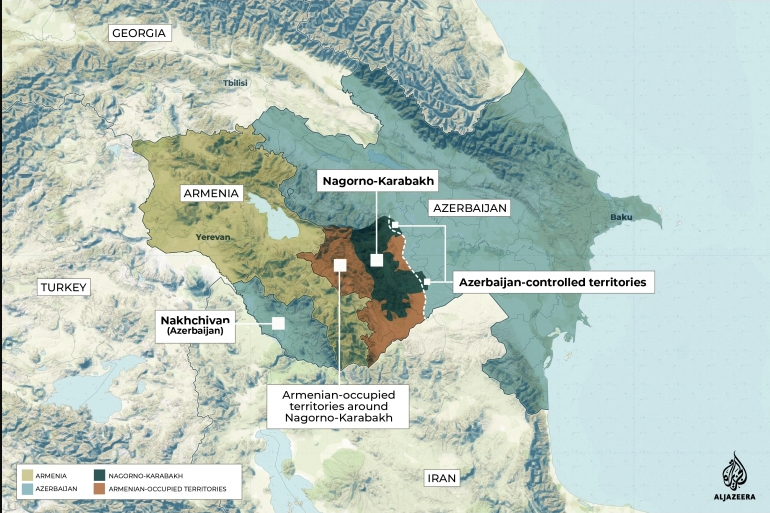
Global Geopolitical Alliances and Nagorno-Karabakh

Can I call it, or what?

Of course the possibility I neglected to mention when I last wrote about this subject here almost four years ago was that Azerbaijan would use its greater levels of diplomatic and economic connections to rebuild and re-launch its armed forces. It was a possibility I considered, but as my primary focus on writing was on the concept of small scale territorial disputes in general and not this one in particular, I didn’t bother to go into it. I should have.

The struggle over the ultimate fate of Nagorno-Karabakh, which broke out before the Soviet Union even officially fell between constituent republics of that late superpower, ended strongly favoring Armenia, putting the Armenian-majority part of Azerbaijan within the control of that nation, though the territory is still internationally recognized by almost everyone as a part of Azerbaijan. Though it is worth noting that in addition to the properly disputable Karabakh region, Armenia has also occupied some large parts of Azerbaijan that are not Armenian-majority in order to create a defensive perimeter and to negotiate from a position of greater strength.

In the time since the first fighting ceased in 1994, the balance of power has been slowly changing. Azerbaijan has sought closer ties with its patron Turkey whilst still retaining its relations with Russia, while Armenia has gone fully into Moscow’s camp. Though Armenia clearly won the first war and has had greater success building up its civil society, Azerbaijan’s economic growth and diplomatic efforts outside the region have borne fruit and made it a valuable trade partner to the region whose pace of development has been impressive. In the brief flare up in 2016 it was apparent that Azerbaijan could roughly equal Armenian military performance. In the current struggles so far in 2020, preliminary imports show that unless a major reversal now occurs that Azerbaijan holds the advantage.

Russia tilts pro-Armenia but not yet in a decisive manner. France has taken a position opposite of Turkey by backing Armenia, dividing NATO on the issue. The prevalence of Armenian diaspora communities throughout much of the world has tilted many otherwise indifferent countries media coverage towards Yerevan. China retains a position of support for the Azerbaijani position but without compromising its relations or interests in either country, as both are needed to court various Belt and Road projects in the region. Perhaps most interestingly, the strongly allied governments of Syria and Iran have diametrically opposite positions on Karabakh. Iran’s largest ethnic minority is Azeris, who make up most of the people of its northwest regions that border Turkey and Azerbaijan. It has expressed support for Azerbaijan’s position on the dispute in the past. Syria, on the other hand, views Turkey and its allies as its greatest existential threat and contains significant Armenian minorities within its borders, and therefore backs Armenia. It seems that most powerful countries would prefer the present fighting ends rather than continue and risk drawing in more actors. The field is ripe for diplomacy and mediation, but not interventionism. There is a clear international consensus, Turkey excepted, of not wanting to internationalize this conflict any more than it has been already.

But this may change should Azerbaijan be foolish enough to enter Armenia proper. They are winning, and they certainly don’t have to. They must not let victory disease go to their heads, especially as the problem of the disputed region still being majority Armenian isn’t going away anytime soon.

One of the more interesting things is how conflicted the U.S. establishment is on this issue. America has a large Armenia diaspora community with political clout, particularly in California. But this tilt is quashed by the fact that Azerbaijan has more connections with the U.S. through geopolitical alliances with those tilting away from the Moscow axis, notably Georgia and Turkey. This has led to a kind of awkward media silence. Normally, U.S. media dutifully drums up support for one side over the other in a bid to do its job preparing the public for intervention on someone’s side, but that is simply an impossibility here. Sadly, rather than get even-keel coverage, it basically means your average American gets none. It is also interesting because a similar calculation holds sway in Iran but in reverse. Despite Azeris being an enormous domestic part of Iranian politics, Tehran’s highest level policy makers are most likely more sympathetic to Armenia due to the Azeri-Turkish alliance. The more complicated things are for Turkey the less Turkish proxies have to be fought by Iran and Syria outside of Idlib. But Iran cannot take a position hostile to a country made up of its second largest ethnic group, where support for Azerbaijan is nearly universal. This is the most awkward position of any of the regional powers.

It also presents a great opportunity to re-open communications between Tehran and DC. Neither side wants a greater escalation-and what a great excuse this would be to get these two countries talking again. You can bring in Russia who clearly does not want to sever relations with Baku despite its pro-Armenian stance. But I won’t hold me breath.

The only logical way to make sense of this conflict is to hope that it remains entirely local and does not precipitate a greater crisis among larger powers and alliance networks. Any other opinions should be restricted to just the two combatants on the ground given all the above stated convolutions. Despite my ‘to the victor goes the spoils’ view of the 1994 war, I cannot help but have tilted more and more pro Azeri on this issue as this decade has unfolded. Azerbaijan has offered diplomatic solutions multiple times in recent history offering the full autonomy of Karabakh with a bonus connecting strip to Armenia proper in exchange for Armenian evacuation from all the many non-Karabakh territories it has occupied around the region. While it was logical for Armenia to occupy a cohesive defensive perimeter, there never was a reasonable solution to this conflict so long as so much of Azerbaijan-outside-of-Karabakh was under Armenian occupation. By refusing to bow to this reality as Azerbaijan’s international position grew and Armenia’s shrank, Yerevan effectively forced Baku’s hand by indirectly admitting that only a military option could bring them back to serious bargaining at the table. The fact that they started referring to the adjacent to Karabakh occupied territories as part of greater Armenia, if informally, didn’t really help. There isn’t much of an international market for Armenian Lebensraum.

The closest option I can see for a relatively equitable peace would be that Azerbaijan, showing foresight, offers this exact same deal again plus both sides recognizing some kind of regionally autonomous status. A weakened Armenia would have to acquiesce to such a fair deal. It would avoid Russian intervention against them while making Baku look magnanimous. Azerbaijan gets its core territories back sans Karabakh, but the Azeris forced out of Karabakh can return home. There is an international peacekeeping area of no-contact set up to oversee the territorial realignment. The danger to this scenario is of course that Turkey and Russia ramp up their involvement even more, or that Azerbaijan, seeing the winds in its favor, keeps the war going to the point where they lose control over it and can no longer appear as the magnanimous grievance settler. Just as Armenia’s annexation of Karabakh set off a never ending problem leading to sanctions and bloated military budgets, so too does fighting an Armenian insurgency in Karabakh and dealing with all the bad press from that threaten to undermine Azerbaijan’s recent gains. If the Azeris complete what looks like a clear victory with a peace that eschews chauvinism for a just redressing of grievance, they will gain much in the long run. Then they can join the Azeri-Iranians across the border in song. This is my hope. But real world experience shows me that knowing when to stop when one is winning is a rare thing in policy makers. I expect they will push for pre-Soviet breakup border delineation. It will be impressive if they actually get it, but it will be a poisoned victory that risks setting off internal problems or turning a victorious operation into a quagmire.

Almost everything we know about this war is through selective leaks and context-free combat footage. No doubt current attempts to analyze the battlefield situation will not hold up well. This being said, it is clear that we are seeing drones used at an unprecedented scale in conventional warfare. Probably even more for artillery spotting than for direct strikes, even though most of the footage out of Baku-linked sources are from attack drones. Vehicle casualties are high on both sides as the terrain largely favors infantry and drones that can hover over defensive positions. The Azerbaijani advances have been enormous in the south, where there is comparatively flatter terrain, and quite limited in the more mountainous north. What remains to be seen is what the plan of Azerbaijan was at the start of the conflict and what it has become. Did they think they could sweep over the region in one big offensive? Unlikely, but if so that clearly hasn’t quite worked out. Was this operation launched as a test of Armenian defenses a la the 2016 fighting and turned out to be unexpectedly successful so they went with it? Also unlikely, given the amount of logistics clearly involved in the offensive (though more likely than the grand blitzkrieg the Armenians are claiming to have heroically thwarted).

To me it seems the most likely option is that the Azeris went for a double envelopment that bogged down in the north and won big in the south. Given the terrain, this is probably what they expected at some level and they just wanted Armenian forces tied up in multiple places before they dumped their main focus on the south and the cutting of Armenia off from Iran and swinging Azeri columns behind the road connecting Karabakh to Armenia proper. If so, then the plan is working pretty close to intention. Here is hoping everyone can keep their heads and return to the negotiating table.

————————————————————————

Sidenote: I cannot help but notice that so many of the people who love accusing those that disagree with them as being ‘Russian bots’ or ‘Kremlin stooges’ have taken a reflexively pro Armenian stance recently. Part of this is constituency (see Adam Schiff), but Armenia is a Russian ally nonetheless. Its almost as if evaluating conflicts on their own terms is a complicated place with no room for moralistic Manicheanism in how different countries’ alliance networks work. Shocker! So, of course backing Armenia doesn’t make you a Russian stooge. Just like my support of Syria’s right to crush its rebels and spare the world another jihadist enclave doesn’t make me a Russian stooge. This point is fundamental for conversations with people who try to turn geopolitical strategy into a morality play. All politics is first and foremost local, and unless someone is paying you to construct a grand strategy or you cannot divorce yourself from your home country when doing an analysis, you should first understand it on that level. It does not make me a Russian stooge to support Syria’s sovereignty nor does it make me a Turkish stooge to think Azerbaijan is owed at least some of its occupied territory back. Neither does it make me convoluted because on two separate issues I tilt towards different partners in two competing alliance networks. It simply is what it is, the tragicomedy of international relations. When things get that complex the only logical conclusion for those not directly involved is a desire not to become involved.