I just completed a quite excellent biography of the Emperor Diocletian, “Diocletian and the Military Restoration of Rome” by Lee Fratantuono. The author tells the story of what had to have been, adjusted for circumstances, one of the most successful emperors in Roman history.
After the crisis of the 3rd Century, with the empire constantly torn between domestic upheaval, civil war, and foreign invasion, a military commander who was of lowly birth (either a freed slave or a descendant of slaves) named Dioclecian was the most successful of numerous bids to the throne in a time of yet another imperial deposition. The empire having been subjected to generations of turmoil at this point, security and restructuring were in order. Diocletian went on to have a remarkably successful reign as an imperial restorer. Pushing back barbarian tribes, taking Persia down a notch, and restoring stability to the Nubian frontier.
His domestic record would be more mixed, but still impressive given his difficulties. Understanding, presciently as we know with the benefit of hindsight, that the empire was too large and unwieldy to be ruled by a single emperor and court, Diocletian set up an interesting experiment in government with the Tetrarchy: a division of the empire into four administrative units under two senior emperors more focused on running the state (Augustus) and two junior emperors (Ceasars), one under each of these, handling the field and frontier priorities.
Diocletian also turned towards the internally divisive rise of Christianity, which he tried to stamp out in the army and public life after multiple public disorders had been caused in its name. Interestingly, his concerns with the religion seemed to be in line with the much later history written by Edward Gibbon, that they were a force disruptive to Roman unity due to their unwillingness to put the interests of society at large over the interests of their ideals.
20 years of largely successful reign led to Diocletian retiring (the first emperor to voluntarily do so) to his seaside villa (which still exists today) to grow produce and live in post-political quiet. When people would ask him to return to power later he would famously remark: “If you could see the vegetables I grow with my own hands, you wouldn’t talk to me about empire.”
The Tetrarchy worked so long as everyone involved in it knew each other and had worked to save the empire together. Without Diocletian it began to decay, and would fall apart after his death. The experiment had worked in an initial crisis but it had no lasting power. Likewise, Diocletian’s persecutions of Christianity came too late to be effective. Despite their unprecedented size, they could not check the growth of the religion. Ironically, his administrative saving of the empire would facilitate the rise of Constantine and the beginning of the triumph of that religion, fundamentally changing Rome, though not in a way that would ever stop even the long-lived eastern half of it from being in a state of longform decline. Alternatively, it seems quite possible to me if Rome had collapsed during the Crisis of the 3rd Century that the religion would have been far less successful, having no hegemonic power to facilitate its propagation. But the Emperor was a patriot and he probably valued the saving of the state above that of the saving even of Hellenic culture.
I thought of two other historical figures while reading this book as comparison points. One, Tokugawa Iemitsu, I have already sort of written about and likely will write about more next year in a more professional capacity. Another, and one already ancient when Diocletian was reigning, was Horemheb, of New Kingdom Egypt’s 18th Dynasty.
Like Diocletian, Horemheb was a commoner who had risen up the ranks of the military from a nobody to a scribe and an army commander. He had witnessed the rise of Akhenaten and the attempt by the royal court to impose Atenism, arguably the first known incarnation of monotheism, upon the state. Though the push to convert the kingdom ended after Akhenaten’s death, his possibly sickly son Tutenkhamun, most famous today for being so forgotten about no one even remembered to rob his tomb, did not exactly live long enough to reverse what had happened under his father’s cultural revolution. Replaced by the elderly administrator Ay, who in turn died leaving Horemheb the opportunity to claim the throne as a usurper, it was Horemheb who would complete the counter-revolution against Atenism. In due time he would initiate large scale legal and administrative reforms as well, bringing, as Diocletian would do a millennium and a half later, welcome stability after a time of upheaval.
But whereas Diocletian’s reforms would bring only temporary reprieve in his various projects, Horemheb’s would lay the groundwork for the eventual greatest height of Egyptian power and prestige- despite the fact that he did not have any living descendants and represented the effective end of the 18th Dynasty. It would be the 19th that would reap most of the long term benefits of his rule.
The similarities of Horemheb and Diocletian are obvious: both were outsiders who earned their way to power through skill, bravery, and cunning, rather than inheritors. As such, following the Khaldunian (or Howardian) path of an outsider who more clearly sees the problems of a decadent state than its entrenched establishment does. The differences, I would argue, was twofold:
1. Horemheb reversed top-down changes, Diocletian attempted to reverse changes coming from the bottom up. Though a majority of the Roman population was pagan (and many would remain so for generations after Constantine) it was not yet something affiliated with the dying empire, but rather a response to its many past crisis. The Atenist experiment in Egypt, however, was undeniably tied to the government and its self-creation was a crisis which previously did not exist.
2. The geography of the late Roman Empire was a bloated mess with often hard to defend borders requiring a massive military presence in almost every region. Without the unprecedented regional unipolarity and prosperity of the situation from Octavian through Marcus Aurelius, unified policy on domestic matters was difficult. Egypt was far more rooted in a specific geographic context, even counting the New Kingdom’s expansionism compared to previous eras. To command the religious establishment to revert to more localized cults reflecting thousands of years of polytheism was not only easier, it could be done without fear of splitting the state or creating schism.
When these two differences are noticed, one conclusion jumps out at me; it is easier to renew a society without compromising its identity and cultural legacy if said society is restrained and regional, rather than having pretensions to universalism and perpetual hegemony. The Romans would eventually see in Christianity a continuation of their empire, a single creed to rule over all. The Egyptians, more ancient and secure and never having left the Nile as their core, held on to their already aeons-old sense of self for another 1500 years, only losing out later because it was a province of Rome. The two went down together, but it was Egypt that held the line of continuation far longer. In a world where everything eventually dies, this is all the more impressive.
I was reading this book on Diocletian for my own historical reasons, not for any contemporary reason. And yet the dropping of the White House’s 2025 National Security Strategy coincided with this activity which explicitly talks about the failures of hegemony, idealist interpretation of foreign policy, and the importance of civilizational states. Parts of it read like I could have written it myself. I still have some major disagreements with it, and think the present administration’s idea of what a civilization actually constitutes is undercooked and misguided, but this is a discourse I have been preparing for in the past few years. Rather than chasing a trend, it has been my goal to be ahead of and independent of them and I look forward to more of this. As it is, I am presently at work on a co-authored project for professional release early next year on the geographic nature of civilizational states. As such, it is always worth considering how large unwieldy empires can adapt to a necessary bloat-cutting phase of strategic reappraisal and retrenchment. Understanding why some could and others couldn’t accomplish this in a variety of times and places in history is key to assembling a full picture.
So expect more on this front in the future. If civilizations are the core of large powerful entities, and there are to be more than one, as there always is, then it is not a famous ‘clash’ of values that should be sought, as the crusader wing of the political right wishes to conceive it, but a Metternichish concert of civilizations who disavow dreams of the universal empire or values for coexistence in balanced polycentrism. It is a future someone like Horemheb would have a better chance at understanding than our current missionary-elites, as he patronised not just temples to Amun, but also to Isis, Horus, and Set. All of whose temples existed at the same time along the ever-flowing Nile River. All of them were already ancient in the time of Akhenaten and had still yet to exist for long after his memory had been erased.
Running themes on this site are historical trickster figures, explorations of books on relevant subject matters in detail, and past parallels to present challenges. Here, I will bring you all three in addition to some original ‘artwork’ from myself at the end.
Despite being primarily interested in other eras and parts of the world, it should be obvious to regular readers that I have developed a recent fixation on 17th Century Europe and in particular Britain. This is not because it conflates with most of my actual historical interests, as it mostly does not, but because it is the time that is so culturally similar to our own and thus demands closer examination. Those with little to no historical knowledge have a tendency to reach for over-used and often ill-fitting periods, such as the Great Depression and World War II, but the world we live in looks nothing like the Inter-War era in actual substance. This is merely hyperbolic rhetoric from neoliberals who have no comparison point to the fairly regular occurrence of localism re-asserting itself against internationalism.
Today does, however, look a lot like Europe of the Thirty Years War and the Britain of the era of its civil wars. Indeed, the ideologies and struggles of that time plague us still. Our present era, I would argue, is a very Cromwellian one. For those of us who oppose this and find it the potential start of a new dark age, it becomes relevant to familiarize ourselves with how this happened before and how such a time was overcome and displaced. Having already dealt with the lessons that can be learned from the Thirty Years War before, I now wish to move towards the British origin point of so much of present ideological pathologies.
Since the analogy is obviously imperfect, (there is no conventional war yet, for one thing) it should be understood that I am more focusing on the cultural and philosophical life of political society rather than claiming an exact parallel in events. Nevertheless, you may find yourself surprised by the overlaps between then and now. Wokeness, Christian evangelism, universalist liberalism, creationism, and many of the other afflictions of the Anglophone world were born or revived in this time. And now, as the cultural dominance of that world begins to recede in our present era, it comes forth once again with full force and with a cacophonous death rattle…knowing the time to remake the world in its image has come to a close but seeking one last great push.
The Commonwealth and Protectorate’s Messianic Endeavor
‘If He that strengthens your servants to fight, pleases to give your hearts to set upon these things, in order to His glory, and the glory of your Commonwealth, besides the benefit of England shall feel thereby, you shall shine forth to other nations, who shall emulate the glory of such a pattern, and through the power of God turn into the like.’ ~Oliver Cromwell
The British Civil Wars began in Scotland and ended in Ireland, though they are often erroneously called ‘The English Civil War’. In the end it would be England dictating the peace for the others. The union of the crowns that had begun with James VI of Scotland becoming James I of England upon Elizabeth I’s death had finally brought inter-state warfare on the British Isles to a close, but sectarian and domestic political struggles would tear the country apart under his inept successor, Charles I’s rule. Parliament would emerge victorious in the resulting civil war, and then eject various other groups from power in Ireland and Scotland. Charles I would be executed, his family driven into exile, and an attempt to set up a republic would ensue. Cromwell himself would end up shutting down parliament and ruling as a dictatorial “Lord Protector” not long after this.
Paul Lay’s ‘Providence Lost: The Rise and Fall of the English Republic’ is an Anglo-centric yet nevertheless engaging read about the state that existed between the fall of Charles I and the restoration of Charles II. He describes a state that began with so much experimental promise but descended into factionalism and moralistic hypochondria. Something akin to if the American Revolution had been immediately co-opted by an alliance of Cotton Mathers and Tipper Gores right after the Treaty of Paris.
Sadly, this could not have been a surprise. Even before the war was over it was soon apparent that, demographically, the Parliamentarians were far more puritan than ‘leveller’ (the term given to people who wanted a universal male franchise). In a situation that should strike familiarity with anyone who has followed the Syrian Civil War, what looks on the surface like a noble cause can in fact be nothing but a sieve for fanatics and sectarians. People throughout Britain soon learned this as a government that was supposedly committed to freedom of religion began to persecute anyone not clearly of the Puritan ilk, including former allies of theirs like the Quakers.
Messianic regimes, especially new ones, cannot justify themselves without outward expansion. And so, the powerful military edifice built to win the Civil War would be turned onto Spain. In particular, its enormous New World empire. But the invasion of Hispaniola ended disastrously amidst tropical disease and local Spanish soldiers who knew the terrain. As a consolation prize the defeated English swept into barely-defended Jamaica. It would be their only gain from an expedition with dreams of driving the Whore of Babylon out of the New World and introducing a new Protestant reign for Central America.
In a pattern all too familiar to moderns, failure abroad led to a bizarre rise of extremism at home. Cromwell entered a kind of existential crisis. He had not failed in such a way. Surely, it must have been the nation itself that had yet to repent for its wickedness. And so, loyal generals were appointed as satraps throughout the country with explicit instructions to crack down on irreligion, drinking, the arts (especially theater) and even folk festivals. A life simmering within unadorned churches would be the only publicly sanctioned form of culture for the masses. It was this that made the people turn against the government in large numbers. But living in a literal garrison state, there was nothing they could do but grumble. Lay has a particular section that describes the goals of this society which is designed to strike us today:
‘The concept of a tirelessly interventionist and inescapable God might be compared to social media, resulting in comparable levels of anxiety and paranoia. Facebook, Twitter, Instagram are realms of round-the-clock surveillance, where one’s thoughts and actions, beliefs and appearance are posted and preserved for all to see and subjected to constant comparison and judgement. The shame, vindictiveness, and piety that social media generates would not have felt out of place among seventeenth Century Puritans. But one can opt out of social media, however addictive. There was no such option in the world God had created, nor in the next.’
The various sects denounced each other constantly. To borrow a phrase from Angela Nagle, ‘competing over a scarcity of virtue’ in order to prove who was the most humble and the most ideological pure. Cromwell himself cared only that people were Protestant, but the forces and style of governance he had unleashed catered to only the worst and most extreme of ideologues. Fortunately, this government did not survive Cromwell. His ineffectual failson and chosen successor fled the country as the disputes between Generals and ex-Parliamentarians threatened to tear the islands apart again. But no one wanted a sequel to full blown civil war. A compromise was reached, if the exiled son of the late king would sign on to acknowledging the existence of Parliament in government, he would be invited back to bring the country together and avoid calamity.
The Restoration Undoes the Era of Hysteria
‘The King spent most of his time with confident young men, who abhorred all discourse that was serious, and, in the liberty, they assumed in drollery and raillery, preserved no reverence towards God or man, but laughed at all sober men, and even at religion itself.’ ~James Butler, Duke of Ormond.
‘He spends all his days
In running in plays
When in his Shop he should be poreng;
And wastes all his Nights
In constant delights
Of Reveling, Drinking, and Whoreing.
~Anon, ‘Upon His Majesties’ Being Made Free of the Citty.’
One would have expected had he lived the life planned for him King Charles II would have been a diffident, if witty, failson not unlike Richard Cromwell. At least he wasn’t that other and most cursed Charles II. The problem with monarchy is the sheer sheltered entitlement it breeds in those growing up expecting to inherit it. Due to the Civil War, however, Charles did not have this luxury. He fled the country, tried to rally support in Scotland only to be held hostage by the fanatic Covenanters and forced by Archibald Campbell, their de facto leader, to sign away much of his powers to them. Then, Cromwell had defeated the Scots (largely due to religious fanatics firing their most experienced commanders for ‘drinking and whoring’ on the eve of the Battle of Dunbar). Charles had to flee again. Crossing much of the country in disguise as a commoner and having many close calls, the heir to the monarchy slept outside, hid in trees, and developed a knack for socially integrating himself with common people he otherwise would not have. Once he made it out of the country, he would end up living an impoverished yet interesting young adulthood in the Netherlands, France, and Spain. Largely existing as leech on related aristocratic families in those countries.
When he returned to England he did so to a totally changed country. But not more changed than himself. In her book ‘A Gambling Man: Charles II’s Restoration Game’, Jenny Uglow documents how Charles’ unconventional and roguish new skill set served him well to meet this particular moment as the restorer of the monarchy in England, Scotland, and Ireland.
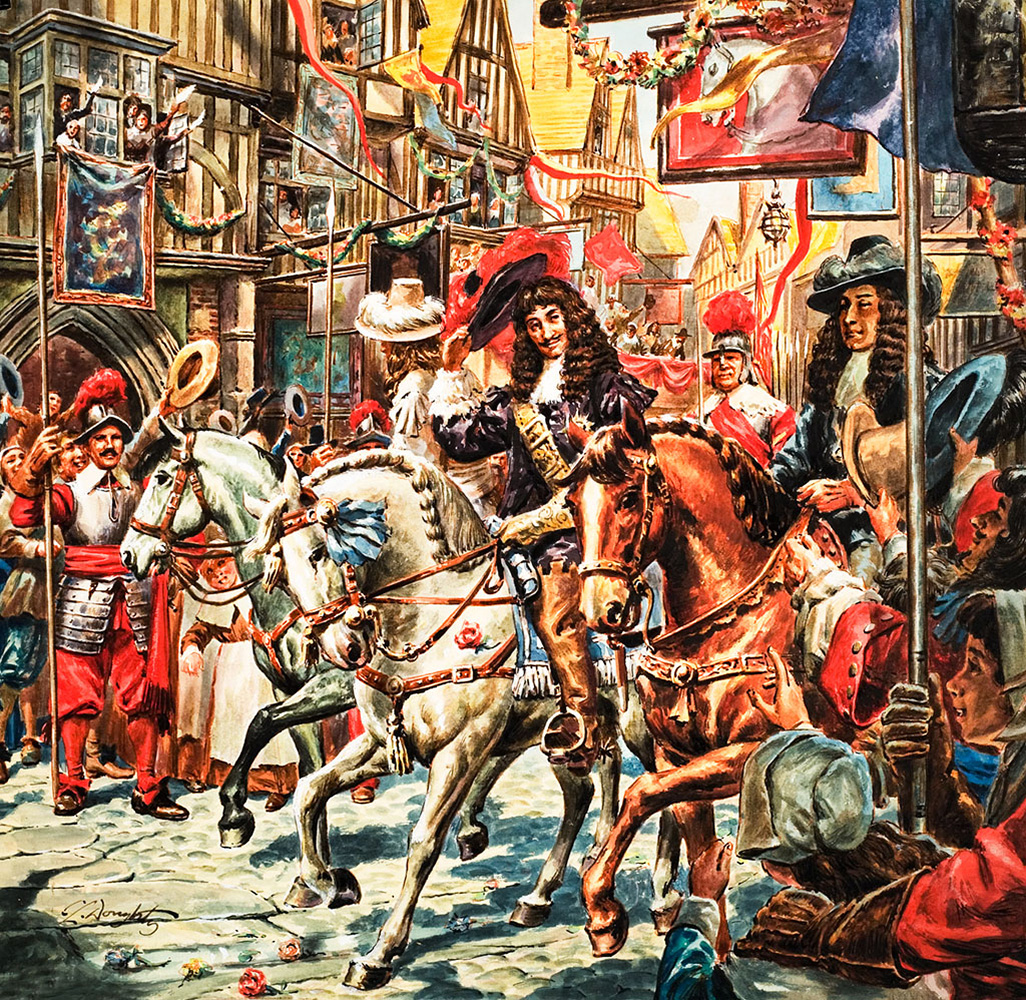
Charles II had a victory procession of sorts, but it was not simply pomp. As he disembarked in the country that had once tried to kill him, he was met by crowds of people relieved that there would be no civil war or continuation of Puritan rule. Formerly powerful general submitted to his authority, and he used his political capitol to disband the radical-infested army. This not only removed his most dangerous enemies, but also freed up immense amount of finance for the state. The regicide parliamentarians were hunted down for execution or driven into exile. Archibald Campbell found himself publicly executed in Edinburgh, and Cromwell’s body was disinterred for a mock execution and display.
But what followed this score-settling would be even more interesting. Charles was both a monarch who liked to throw massive court parties, indulge in the arts (which he of course re-legalized and came to patron) but also was an accessible ‘man of the people.’ He was at ease with people of all backgrounds and often struck up conversations with random people he met on the street when walking his dogs (of the breed now named for him). Rumors that he ‘rolled from whore to whore’ incognito as a commoner abounded and seemed to actually increase many people’s affection for him after the dour Cromwellian cultural revolution. When the Great Fire of London threatened to engulf the entire city, he not only led the response in an official capacity, but was smeared in ash and smoke, working the firebreaks and hauling buckets of water with the crowd at the worst of it. I can personally attest from years living in multiple locations in the United Kingdom that there are many pubs named after him to this day. And, of course, there is that Horrible Histories song.
But Charles was not simply a people’s partier. He was actually a fairly competent monarch in his own right. His diplomacy showed immense flexibility and his limited naval wars, though often considered indecisive or even losses by conventional historians, did encapsulate his move towards international trade access and naval power. The gains made in this conflict would, in fact, end up with the acquisition of New York and New Jersey, unifying the English colonies in North America into one band of coast-the first springboard for a future great power Britain. These pickups were made possible by the money he made selling indefensible colonial outposts in other places like Tangier and Calais. A keen eye for geography, and the centrality of the offshore stance in Europe but expansion elsewhere, showed the way of the future for an island nation. People back then didn’t know it yet, but Charles II’s reign would lay the seeds of Britain’s future at the expense of its (then) more powerful rivals in France, Spain, and the Netherlands.
Charles would make some major errors too, most importantly designating his thick-headed brother as his official successor knowing it would cause another sectarian crisis. Some people have said this sympathy for a Catholic brother stemmed from Charles’ own secret conversion. But Charles, it seems to me, cared little for religion and made this conversion to gain war subsidies from Louis XIV of France. After all, he did get the money and didn’t even convert until he was on his death bed. He never ended up converting the court, meaning he got one over on his superpower cousin. But the point here is not to say Charles II was a perfect ruler to whom we should aspire, but rather that he was a cultural force. The right counterbalance at the right time. He singlehandedly ended Britain’s first Woke-Evangelical Era not with frothing reactionary policies, but through levity, pragmatism, and disdain for all kinds of cultural extremes. In so doing, a hot mess of a country prone to regular bouts of rebellion and sectarian strife began to transform itself into a future financial and industrial powerhouse.
For a time anyway. All gains are, after all, temporary. Something the Puritan can never understand.
Accepting the Hobbesian Bargain
‘The obligations of the subjects to a sovereign is understood to last as long and no longer, than the power lasteth, by which he is able to protect them. For the right men have by nature to protect themselves, when none else can protect them…the end of obedience is protection.’ ~Thomas Hobbes
‘The losers are the real victors. The victims are the real winners.’ This was the sentiment of puritanism, and it is the dominant sentiment in the Anglophone world today. So much of our present-day culture war (which was declared by and waged in service of the right before it became the lefty cause du jour of the present moment) is an all-pervasive and multi-ideological trend. But it is a trend that can be defeated. This can be accomplished by the marriage of two things often not thought of as partners: the marriage of state power and the levity of humor.
Anyone who has ever interacted with ideological cliques such as anarchists knows that it is often the people who fear the state who are the most authoritarian and censorious people imaginable. Radical cliques often degenerate into cults where people psychologically abuse each other for clout and differences between people are not tolerated. Individualism is ineffective for every cause, so when one does not believe in the arbitration of the state, one must create a sect to compensate. The sect, ironically, often tolerates less dissent and divergence than does the state. This is because all they have is ideology, whereas the secular state (whatever form it takes) is a more situational and territorial arbiter. Its concerns (when it is working anyway) is to maintain the peace over its sovereign location and to maximize its autonomy vis-à-vis other states. This is true for all states and state-like entities no matter their internal ideological and traditional structure. Though states that forget this are very likely to degrade the sanity and effectiveness of their governing class and become more like those sectarian cults that spring up in their absence.
Let us return once more to the 17th Century. Thomas Hobbes was an intellectual and instructor who had royalist connections. He missed the civil war due to his job as a private tutor having taken him to France beforehand. When Charles II was in exile in France, Hobbes became his personal instructor. It was at this point that he published his most famous work, Leviathan. Leviathan’s blatantly irreligious, pragmatist, and materialist nature would cause scandal in the Stuart court-in-exile…despite the fact that it made an implicit argument for the Stuart style of governance. Fearing retaliation from religious cavaliers, he fled to Cromwell’s Protectorate. He reasoned, rightly as it turned out, none of the members of that government had yet read his works. He also made it clear that the necessity of government he wrote about could apply to any form of statecraft. Sovereignty was not held by divine right, but by power over the land and the execution of the prerogatives of the state itself.
When Charles was restored, he invited Hobbes to enter the court. It was there that the already old man, known today as a dour sourpuss due to the nature of his thought, made himself indispensable through his wit, jokes, and ability to disregard superstition and religious dogma (Hobbes himself was almost certainly an atheist in private). This is when people really began reading him.
Hobbes’ political thought lacks the subtlety of Han Feizi or even Confucius. In his concept of the mediating sovereign which protects individuals and groups from each other, he is far too supportive of the idea that the subject must support the sovereign no matter what-so long as their security needs are met. He wallows in constant fear of rebellion for obvious reasons given the times he lived in, but the long view of history shows plenty of rebellions that replace an inferior sovereign with a superior one. He does not grapple with the problem, innate to his thinking, of sovereign capriciousness from one head of state to another upon succession and which is particularly common in monarchies.
All of this being said, Hobbes is worth engaging with as his primary observation, that society can only thrive under conditions of sovereignty where a state is the primary mediating influence between actors, is correct for any society larger than that of the tribe. It is also, though this was not Hobbes’ intent, a better model of achieving freedom of conscience and securing the ability of divergent people to live with each other than more ideologically motivated models of conversion. Leviathan, it turns out, is a better guardian of private liberty than even the ideal of private liberty itself. Just ask any non-Islamist and non-liberal Syrian today, especially if they come from a minority group.
In his book ‘The Two Faces of Liberalism’, John Gray examines this lost liberationist aspect of Hobbes. Most useful to us today, he makes a case that the best of liberal values can be saved only by rejecting the worst of them. Specifically, the freedom to live one’s life as they please in the cultural and lifestylist sense by sacrificing liberalism’s tendency towards universalism and messianic behavior. These two impulses which are endemic in the philosophy are at war with each other, because universalism cannot abide competitors and those who opt out of it, and, on the other side, divergence requires a morally neutral pragmatist state to balance interests without adopting a mission of its own aside from the survival and maintenance of the state itself. This restricts communal projects to the realm of necessary material needs for a community like security and infrastructure.
Whether we like it or not, we live in a very liberal society. And so, to convince those in power to change policies, we must all be liberals to some degree. Gray’s reappropriation of Hobbes is a way to do that which makes the messianic culture war obsolete. Indeed, Gray admires Hobbes’ Leviathan as a model which could ‘Extend the benevolence of indifference’ to issues of private lifestylist and social spheres so long as the political order that upholds this indifference is not challenged by the subject. He points out that such arrangements were the norm in the ancient and classical worlds, before messianic religions took hold, and are often still the norm in places like East Asia, were they never came to be powerful at all. They also tend to exist in early modern states like the height of the Ottoman Empire, and, most obviously and perhaps at its greatest extent, in medieval states like that of the Mongols. For a modern example, he cites Singapore as a country that guarantees freedom of religion but bans missionary activity. The liberals did not invent toleration, they merely invented a form which was a successor to the Christian world it was rebelling against. But as such, this toleration inherited many preexisting problems.
Despite liberalism being the pervasive default setting in the Anglosphere, but not in these other examples, Gray wishes to learn from such arrangements as ways to have a collective civically minded state that does not engage in enforcing ideological or cultural uniformity but still maintains a civic unity. I contend that, in order to appeal internally to this Anglosphere’s tradition and common historical experience, that the reign of Charles II serves as a potential in-house model for such an arrangement. Not because I am a monarchist (I am definitely not) but because it came from a similar age of hysteria and ended up dissolving many of the problems it inherited. While Charles II is a bit too establishment to fit my mold of previous historical trickster figures, he had a similar personality as those past examples and thus can cross the bridge of communicating these issues between more outsider and insider persuasions. This, naturally, applies to the international system as well as the domestic. Whatever ways we find around our present impasse will differ from the solutions of the past, but we can certainly learn from events that preceded us nevertheless.
Modus Vivendi, as Gray calls his proposal, is not only the acknowledgement that no one way of governance can work for everyone, but that the very idea of political hegemony through one ideology is a potential declaration of war upon much of the domestic population of a state and thus cannot exist in a world where pluralism is the natural state of things. Two Faces of Liberalism is a short book and worth reading in its entirety, so I won’t mass quote it here, but there are two passages in particular I wish to conclude with:
‘Modus Vivendi expresses the belief that there are many forms of life in which humans can thrive. Among these are some whose worth cannot be compared. Where such ways of life rivals, there is no one of them that is best. People who belong to different ways of life need have no disagreement. They may simply be different. Modus Vivendi is liberal toleration adapted to the historical fact of pluralism.’
And:
‘…When liberals set up one regime as a standard of legitimacy for all the rest, pluralists and liberals part company. For pluralists, a liberal regime may sometimes be the best framework for modus vivendi. At other times a non-liberal regime may do as well or better.’
Context reigns. Acknowledging that means there is something we can learn from the experiences of all types of governments. When the chips are down I consider myself more in favor of republics than monarchies, but should I therefore dismiss the experiences of all monarchs or all kingly states? No. Just as it is no great scandal to learn strategy from thinkers of all backgrounds why not also governments? It is this intellectual flexibility that keeps us from falling into the farce of Manichean culture war. That and the right kind of King Charles style levity that acknowledges that while running the state might be serious business, there is no reason it has to be too serious. Platonic absolutes do us no favors here. And those who are interested in working out the practical can do so with anyone else, regardless of that other person’s inner life. Speaking from personal experience, I can say that the only times I take part in culture war is defensively or where there is a codified legal imbalance that needs to be adjusted. If people do not seek to inflict their preferences on me then I have no need to do the same to them. But I have never been so insecure as to seek to convert others save on issues of real and pressing policy that affects the entire state. Those are the true structural issues that affect everyone-economic, foreign, and infrastructure policy. And those are the issues that supermajorities of people could, theoretically anyway, come together much more effectively if they were prioritized over the social. Obviously, those content with the status quo therefore have a vested interested in fueling rather than dousing the culture war and its attendant surveillance and cancelling network. But bad policies of the state cannot be challenged by disregarding the state itself, but by coopting or replacing it with another state.
Thoughts to meditate on while regarding the Wrathful Party King Charles Bodhisattva.
And if for some reason you do think it would be nice to have a monarch once again with this personality type, may I recommend the fashionable and party boat owning King of Morocco?



 The Trickster's Guide to Geopolitics