A Subcontinent of Toddlers

You do not have to be the biggest fan of how the Trump Administration negotiates. You can, like myself, see the blustering towards Canada and Mexico in particular as extremely counter-productive, to say nothing of the clownish (and possibly dangerous) Gaza proposal. But the Europe stuff…come on, that’s fucking hilarious.

Vance scolding them in both just and right ways as well as ways reminiscent of the liberal internationalists he rightly despises served as a wakeup call that the End of History was over. It had never really begun, of course, but certain parts of the planet (Canada, Northern Europe, American media liberals) had bought into this self-flattering fiction because it centered the deindustrializing parts of the world as still, somehow, the primary drivers- perhaps even protagonists- of history. But when someone finally said this was not true out loud, the self-vassalized classes of Europe publicly wept. The American elite may be a cynical, fractious, and even ignorant bunch, but they have a theory of governance and diplomacy. Europe, so used to being a satrapy, has seen its once more accomplished elite become complete colonial recruit subalterns. Their best and brightest, the people allowed into power, genuinely believe this post-power politics shit. They weep when the mirage crumbles.

Frankly, its pathetic.

Were I European I would find this both funny and disturbing. I would immediately demand people who actually know about how the world works represent me, and appoint people to the foreign policy apparatus accordingly. I would castigate all the trendy postmodernists (closet liberal ideologues) and hard-constructivists (also closet liberal ideologues) for what dogs to America they really are and their role is gutting training for actual honest and forthright policy makers. The failure to prioritize a regional Europe over global ideological crusades has harmed EU countries at least as much as it has the US. Arguably more considering the backwash of the refugee crisis from Libya, Iraq, and Syria.

But since I am not European I merely need to sit back and watch, appraising how fast a society high on 30 years of pure ideology goes through the stages of withdrawal and grief.

I previously mentioned how (northern) Europeans in particular have a strange smug entitlement and unearned sense of self-importance when their only real impact on the 21rst Century seems to be outliers of enshittification to domestic political realignments. This might be worse than that, though. The pathetic Chamberlain-at-Munich analogies and blind faith in a bill of goods the US is (thankfully) no longer selling reflects an inability to even think of a future, only a romanticized and ahistorical past. Statecraft isn’t about bringing into being the hideous undulating many-tentacled beast of German Idealist philosophy, where human thought creates reality through a mystical immaterial process yet to be explained, it is about medium term solutions to immediate problems while understanding permanency is fleeting. It cannot be a playground for navel gazing. People have clashing interests. Always have, always will.

The Age of Discovery and the subsequent Age of Victorian imperialism is long since over. Coasting along as ducklings in America’s wake somehow enabled many in Europe to believe that they had transcended history and were still vital global actors. But the unlearning of statecraft actually meant they were stumbling in to being its victims.

The world today resembles not the dreams of the 90s, but the pre-Discovery balance of power. The great civilization-states of the east are back and growing their influence. Europe, meanwhile, has reverted to its older position of being the western peninsula of Asia. The faster the Europeans can grow up, the faster they can adapt to this new reality.

Effective Philosophy Hones Instinct Over Intellect

I have recently returned from Shetland and one of the stand out moments of that trip was observing a literal cliffside city of gannets numbering in the thousands. Their existence predates recorded history and possibly even predates human presence in those isles. Preying on fish might seem a simple life and pointless life to many in our species, but it is certainly a more long-term sustainable one than trying to force civilizational evolution. It also works because the gannets feel no need to question themselves. They act as evolution fated them to, and can not only fly but dive to depths unfathomable by most non-aquatic creatures to hunt.

So much of talk about philosophy extols its virtues as providing a way to transcend or overcome one’s supposedly base nature. This rests on the assumption that one can take the idea of a future version of themselves (something that does not yet exist), and project upon it a form of sculpting that will bring this imaginary being into reality. While I do not deny that one can intentionally and unintentionally influence their future self, the result will inevitably be subjected to the far more powerful forces of nature and circumstance (what the ancients called fate). This means that the imaginary future you see as the target for meticulous construction will never exist. It bears as much relation to your present self as a fictional character does.

Intellect can of course be honed. But I feel science, history, anthropology, and art is more effective at this. Especially as it does not automatically contain a mission like most of philosophy does. But this is not to say philosophy and its quest for the ‘good life’ is useless. I would simply rather reinterpret this from the academically focused ‘life of the mind’ into something else: the life of the instinct.

Philosophy’s true utility in an era where science has stolen so much of its former thunder is one of learning how to think differently. In the Anthropocene, this can mean learning to deprogram one’s sense of complacent entitlement towards humanity’s place in the natural world. A philosophy that reminds you of the precarious and ever-changing nature of everything is one that is enabling you, despite your domesticated circumstances, to be readier at the re-activation of instinct. And this, in turn, could increase the odds of acting correctly not through thought, but via unthought. A reconnection with atrophied instincts.

Instinctual behavior is usually rational behavior. It may be short sighted, and it might not always match with the situation, but it is always understandable and increasingly neglected in our overly-domesticated world. Philosophy as a whole is complicit in this domestication, which leads to its growing irrelevance. But it could be the opposite. It could be the key to breaking our disconnect with our evolutionary instincts. When we remind ourselves that so much of the ether we are surrounded with is socially constructed (i.e. fake) and that our animal nature is always waiting below the surface, we reconnect with the ability to act without thought and respond without half-measured hesitations.

Everything organizational is a pyramid scheme. The point of civilization is to make the pyramid scheme last long enough that multiple generations can avoid its collapse before the unlucky one gets settled with inevitable entropy. But it will collapse. When this happens it is those more in touch with the natural instincts that build the next order. In addition to natural inclination, I suspect that it is also those who used philosophy to gain some distance from civilization who will have this advantage. So it is not philosophy that enables us to ‘transcend’ our natural selves that will be of use, but philosophy that re-engages us with nature which enables us to transcend the limitations of presentism and domesticity.

One interesting and newly discovered fact about gannets is that after their communities were ravaged by avian flu in 2022-3, the survivors often had their irises turn black. This apparently has not ruined their eyesight. It merely serves as a striking visual marker of survival. A black metal reminder of nature’s ruthless and ever-churning gauntlet.

Review of John Gray’s ‘The New Leviathans: Thoughts After Liberalism’

The New Leviathans: Thoughts After Liberalism‘ is the philosopher John Gray’s latest book-length work. As long time readers may be aware, I am a huge fan of his. This was one book I could not wait for the official U.S. release of, and ordered a U.K. copy early so as not to have to wait until November to read it. It helps that it will be used, along with some other of his works, as part of a longer term research project I am just beginning to embark on.

Those who are unfamiliar with much of Gray’s work will find this book bracing, unique, and a welcome antidote to the normal neoliberal consensus/culture war echo chamber of our decaying order where nations pretend to be fighting for the angels of light against the forces of darkness, and mediocre politicians such as Gavin Newsom and Ron DeSantis square up to have debates over who can be the better Not-President.

Those who are familiar with Gray’s work, however, will find little new here. The Ukraine War has given Gray an extreme fascination with historical writers and thinkers in Russian history, which colors most of the central portion of the book. His (correct) disgust at early Soviet attempts to create ‘a new man’ becomes a tad overdone in his list of aphoristic anecdotes, to the expense of the first and closing sections of the book, which, in my opinion, are superior. If you have read Black Mass, Soul of a Marionette, Two Faces of Liberalism, and The Immortalization Commission, however, you will not find wholly new material here. Only new combinations centered loosely around the framing of Thomas Hobbes.

The overall argument is one I have made before myself, while citing Gray and his prior work no less, Hobbes -along with Spinoza- was the true and original liberal (before it began to mutate into a messianic religion starting with Kant and Rousseau and reaching full apotheosis in the present day neoliberal). His Leviathan, for all its flaws, was a useful and practical attempt to escape the delusions of endless sectarian warfare and the social engineering of Puritans by creating a society that could arbitrate between different groups, allowing diversity to exist below the state while retaining outward facing unity.

As society has changed, however, so too has this Hobbesian state edifice-the Leviathan. I myself have written before about its becoming an out of control beast that is no longer restrained by human-tier comprehension. (Considering Gray has a subsection on Lovecraft in this new book, I cannot help but wonder if he has read this blog). Gray wants to focus on how the Chinese social credit Panopticon and the Russian theocratic-mafia edifice are also now rival leviathans to the neoliberal-woke hybrid in the North Atlantic. Not just to let his readers know that the world is currently multipolar and the liberal internationalist experiment has failed, but also to lament the passing of the old secular Leviathan. A Hobbes brought forward in time might recognize Singapore or some of the Latin American states, but would not recognize these three creatures.

For in place of the old has come the Leviathan taken over by the very forces it was meant to control and dissipate. The Leviathan of the missionaries which seeks total control over the private as well as public sphere. The old and perpetually failed project of directed human betterment to bring about the great teleology which is always claimed to be around the corner, yet never arrives. There is no diversity and keeping the peace, no navigating the necessity of a balance of power, only eternal war of The Elect against all who are not Elect. The very thing the Leviathan was meant to prevent is the thing it is becoming. It is mandatory inclusiveness in sectarian war.

Gray once had a bunch of reactionaries who gravitated to his thought. Such people suddenly stopped writing about him favorably once Seven Types of Atheism was released and it became obvious that his true target in attacking humanist pathos was the religion that inspired it. In New Leviathans he reminds us of why this was with his bracing honesty at the intellectual lineage of the dire process he speaks about:

All four of the defining ideas of liberal thought are continuations of Christian monotheism. The primary of the individual is a secular translation of the belief that each human being is created by the deity, which has an authority over them that transcends worldly power. The egalitarian belief that human beings have the same moral status reproduces the that all human beings are equal in the sight of God. Liberal universalism- the belief that generically human attributes are more important than particular cultural identities- reflects the idea that humankind is created in God’s image. The belief that human institutions are indefinitely improvable replicates the theistic faith that history is a moral narrative of sin followed by redemption.
The ancient pre-Christian world accepted that the evils of human life recur in unending cycles. The secular humanist faith in progress is a pseudo-solution to the so-called problem of evil, which arises only with the belief in a benevolent and omnipotent creator-god. […] This Christian message inflamed the millenarian movements of medieval times and the secular revolutionaries of the twentieth century. It underpinned classical liberalism, and inspires hyper-liberals today. In woke movements, victimhood confers moral authority, as it does in Christianity.

This book is a warning. It may not be one needed by those already familiar with Gray, but it is one that more people should heed. Though perhaps I might be more likely to recommend Black Mass or Two Faces of Liberalism above it. Nevertheless, the central thesis holds up. To quote from the conclusion:

The deification of the human animal was alien to Hobbes’ way of thinking as the divination of power. Leviathan was mortal just as every human being was mortal. There is no final deliverance from the state of nature. This is Hobbes’s hidden message, which he never fully accepted himself.
If Leviathan is human artifice, politics is a necessary art. The task of the age is not to bind to the new Leviathans, as was attempted in the late liberal era, but to bring them close to what Hobbes believed they could be- a vessel of peaceful coexistence. In recognizing that peace can be achieved in many types of regime, Hobbes was a truer liberal than those that came after him. The belief that a single form of rule is best for everyone is itself a kind of tyranny.

“Not True [Platonic Archetype]!”

I am aware of the tired No True Scotsman trope. But if you extract it down to its core Platonic essence you really do have something worth talking about.

We have all heard it before when a low-knowledge person with extremely strong ideological attachments feels backed into a corner: the exhortation that actual historical examples that show that their attachments are not so simple in practical outcome are not representative of what they believe but aberrations. The militarized expansions of various supposedly peaceful ideologies? Clearly this must be the misunderstandings or willful interpretations of doctrine! The collapse in living standards caused by various economic experiments? Corruption! The takeover of causes by sociopathic personalities? It must be infiltration!

Plato was the philosopher of the ideal. Of reaching for the most perfect form of what something could be. Of always striving for perfection. This is contrary to observable reality and philosophical materialism and pragmatism implies that this ideal is a chimera. A false promise. What matters is circumstantial, situational, and results oriented. Therefore, the calls of ‘not true Islam’ and ‘not true capitalism’ and ‘not true communism’ can all be dismissed out of hand by those who do not claim to be idealists.

Let me take it a step further. Whatever belief or result is the majority viewpoint in any given camp *is* that camp, because what they have done and are likely to do matters far more than than what they intend. Organizations are made up of people, and groups of people have trends. This is likely to vary with time and place, of course, because in the end all things are local and temporal. Yet further reasons to distrust claims of the eternal and transcendent. If social justice, for instance, is dominated by an alliance of corporate HR and younger clones of Tipper Gore, than that is what social justice is right now. If MAGA is dominated by Q Anon and Stop the Steal, than MAGA is a front for those groups first and foremost. The true essence of a thing is the power of who commands it, not some ethereal and idealized promise of something to come. It reminds me of how the Book of Revelation was clearly written in the expectation that the End Times would come within decades of its compilation, and that the thousands-year-ongoing Christian meltdown we are still living through is a failure to come terms with the failure of this promise time and time again. ‘But surely this time..!’ they say each time assumptions are overturned, only to be proven wrong again. It is easy to believe oneself the protagonist of the culminating act of the story and harder to accept most individuals are merely background characters in a story that began far before they were born and either will never end or will only end long after they die. More importantly, it is easy to imagine oneself as just on the cusp of some breakthrough that will justify prior belief no matter how many times it has failed before.

Of course, one does not have to do this. One could simply acknowledge that the chaos of events do not move in any particular direction and so picking a tribe is just that: a tribal preference rather than a quest for universal truth. This, of course, requires giving up belief in some true eternal form of good ideology. It takes a certain amount of courage to admit that one supports a real-world messy compromise of a policy platform, contingent as it is on fate and historical circumstance. But I think if everyone was honest about merely trying to push greater forces in generalist directions rather than achieving some totalizing and ideal program it would be easier to talk with people who are from different backgrounds and forge new coalitions. Good diplomats are situationalists and opportunists. Ineffective diplomats take their cues from Woodrow Wilson.

If you declare yourself to be in support of any particular movement, you have to accept who dominates it. This means you can say ‘I really don’t like current trends in my faction, but I think the cost is worth it for the following reasons…’ This is fine. Cost/benefit calculations are really the only rational way to think about principles and they are far superior to Platonic idealism. Even better, though rarer for the thinking person, is when you are totally ambivalent and/or supportive of what others might consider a group’s flaws. In this case you don’t downplay them or apologize, you own them. This serves as a reminder than morality is not and can never be universal. So, when critics of political realism accuse me of belonging to a group known for seeing people as pawns being moved about on a great amoral game of Go who behave more along the lines of instinct than freedom of will, I answer with ‘Yes! Yes!’

Black Metal Epicureanism: a review of ‘Aztec Thought and Culture: A Study of the Ancient Nahuatl Mind’

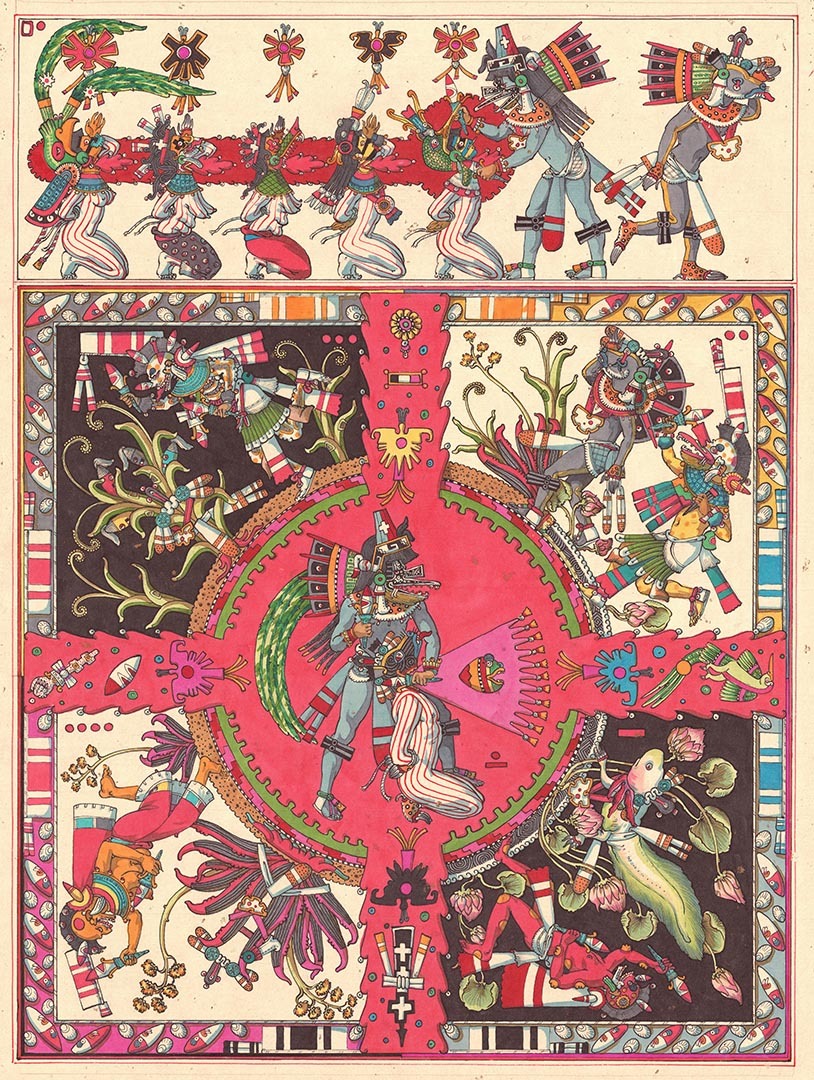
The Birth of the Fifth Sun. Artwork from Chicome Itzquintli and the Mexica Heart site.

‘Aztec Thought and Culture: A Study of the Ancient Nahuatl Mind’ by Miguel Leon-Portilla is a circa 1990 attempt to extrapolate the metaphysics of Nahuatl-dominated Mesoamerica based off of what surviving sources are available. Much was lost, destroyed, and hidden in the Spanish conquest, not so much due to the war itself as much as the subsequent invasions of priests and missionaries who insisted on demolishing, ISIS-style, as much of previously existing culture as they could. This has left us with imperfect records to work with, yet the Mesoamericans were an incredibly literate people and some had the foresight to safeguard many things until later and less fanatical eras.

Leon-Portilla has an interesting way of approaching this anthropology-meets-philosophy overview. He likes to let primary sources speak for themselves. Only after listing the excerpt he wishes to reference does he then move on to repeating it but while deconstructing each line or paragraph in turn with modern interpretation. This is an atypical way of conducting this kind of analysis, and it takes some getting used to. However, it works extremely well and made me wonder why this method is not used more often.

The author is interested in figuring out the rise of philosophy independent of mythology and religion as much as he can (in many cultures there is not a clear line of division between the two and such is the case here as well). Nevertheless, we must begin with the cultural context of Mexica myth. We get a breakdown of religious beliefs and cosmology but also see that many scholars doubted these accounts going back to the start of what in today is known as the Aztec Empire (actually a triple alliance of three city-states in the Nahuatl culture complex dominated by the Mexica people). Most importantly, there is a summary of how the Mexica people saw their right to rule in the origin of the present Fifth Sun Era. All previous suns had been specific to past eras that had all ended in cataclysm. This current era would be no different, however, its ending could be delayed by honoring the covenant of sacrifice that had made it possible in the first place. For, after the initial creator duality-god/god couple created the other gods, those gods had in turn brought about this new era through the self-sacrifice of two of their own members, Tecuciztecatl and Nanahuatzin. The first showed hesitation thus could only become the moon. The second who jumped right into ‘the God Oven’ became the sun. In order to keep this new and most beneficent sun going, Nanahuatzin/the sun must be periodically recharged with human blood, which holds power when shed due to it having a link with the gods as well. As gods sacrificed themselves to make the world livable for men, so too should men return the favor if they wish these conditions to continue.

Naturally, this also gave the expansionistic Aztecs a great ideological foil to pursue an empire. As the prestige of taking captives for sacrifice fueled war, so too could war fuel growth. Growth, in turn, was tied to a special pact of their empire with the maintenance of divine order. It upheld the cosmos for the Aztecs to expand. If they stopped expanding their world would end.

It becomes apparent that skepticism of religious literalism was quite common in that society for a long time. This put many ‘wise men’ on a different path than that of the religious establishment. Fittingly, since the Mexica saw the most important creator god as one of duality, a core dualism emerges in Aztec thought. There was the priests and the warriors going out and growing the empire through war and sacrifice, but there were also highly respected wise men who taught of empathy in a world of constant entropy, and the utility to practical Epicurean-like pleasures through harm reduction at home. This led to a philosophical emphasis on what we might now call universal primary schooling, with an enormous percentage of children literate and learned for a pre-modern society.

This example also, along with that of, say, the British, pretty firmly puts to bed the idea that educated societies become more peaceful.

The purpose of this new Mesoamerican society was to cultivate a ‘face and heart’, a personality in our terms, that understood the temporary nature of things and the necessary fatalism to cope with it while also building themselves up as distinctly useful for society as a whole. The author emphasizes that while Aztec political culture was collective (hence both public education and public sacrifice spectacle) its concept of personal life was in fact more individualist. Only in a well running collective could things work to allow the arts and philosophy, and only through the arts and philosophy could individuals differentiate themselves from each other in order to better contribute to society by meeting their true potential. While societies with similar civic bargains to this have existed elsewhere, few I know of were so specific in making this their intention. There quite literally is no self/society divide because the self is in service to society and vice-versa.

Mexica intellectual pursuits were dominated by an understanding that all things pass in time. They were also enormous weebs for the previous Toltec culture, using the term ‘Toltec’ to describe things that were well made in a material sense. Much like the Japanese concept of mono no aware, it was the fact that the Toltecs has passed into history but still left moving monuments that inspired the Aztecs to make art. The temporary nature of things was inevitable but beautiful. It was part of nature and life. And it was a reason to build a society with a highly cultivated aesthetic sense. What these thinkers thought when it came to the necessity of blood sacrifice to prolong the apotheosis of the now, it is unknown. I suspect many were skeptical.

Yet, strip the symbolism aside and you really see a society far more honest with itself than that of the moderns. Expansionist orders are founded and maintained by blood. The Aztecs tied a frank openness about this to their very being and even promised a higher destination in the afterlife for those sacrificed than those who died naturally. Compared to our high culture, which lives in total disavowal and denial that our empires are much the same in effect towards other people, and which rigorously seeks to hide our bloodletting far away from view, the honesty of the Aztec tableau is a bracing comparison. For many in the contemporary world, our ritualistic bloodletting goes towards no less a mythical edifice than theirs, as the constant laments from our priestly class for ‘upholding the values of the liberal world order’ imply. At least the Aztecs got a great show for their efforts. We just get to be on ‘the right side of history.’

It also shows us the limits of absolute duality. For it is not that high culture exists despite its gruesome elements, but often in total tandem with them. The lake city of Tenochtitlan was larger than any in Europe at the time of its height. It was remarked upon by the very people who conquered it and enslaved its inhabitants that it was a place of remarkable cleanliness, order, and urbanity. Another water-based city, Venice, exists as an admired tourist attraction to this day not in spite but because it experienced its first golden age as a result of rampant piracy and the looting of Constantinople.

The Aztecs were very fatalistic towards the forces of nature, and the caprice of their gods reflected this. While you would be judged in life by how you lived, you were still going to the afterlife designated for you based off of the method of your death regardless of conscious action. Yet their obsession with self improvement shows that fatalism is not mere passivity. Fatalism can be the call to self-improvement. Being unable to remold the world, one can remold one’s reactions to it. And if enough people do this together- albeit in their own particular ways-this changed response creates its own impetus to not just live life for what its worth, but to contribute to it through the arts. To quote directly from the book’s conclusion:

‘Nahuatl philosophic thought thus resolved about an aesthetic conception of the universe and life, for art, ‘made things divine’ and only the divine was true. To know the truth was to understand the hidden meanings of things through ‘flower and song’, a power emanating from the deified heart.’

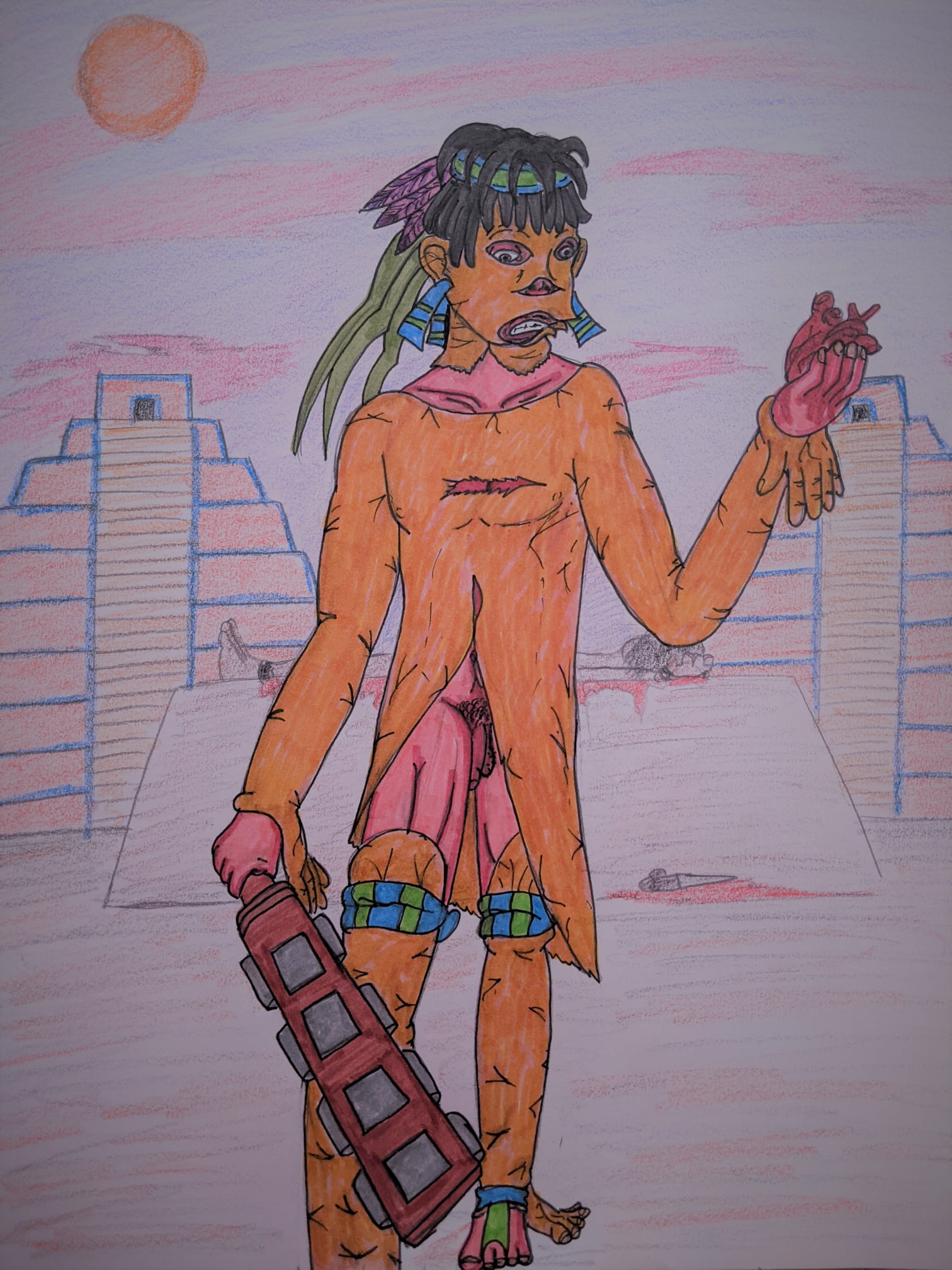
Anyway, on the subject of art, have some OC content:

Priest of Xipe Totec, the flayed god of agriculture, warfare, and renewal, also called ‘The Night Drinker’. At certain sacrificial events these guys would cut the hearts out of victims, flay the flesh, and create a skin suit out of it to then dance around for a few days. At the end of the ceremony they would strip off the rotting human pelt and bury them under the main temple in jars. This represented Xipe Totec’s shedding of his own skin of foliage with the seasons and bringing about the renewal of the next corn crop.
Some sources I’ve seen say they painted themselves pink or red under the pelt to really get that raw muscle look peeking out from under the hide, hence the skin coloration here.

Hanging Out With Spinoza and The Coof

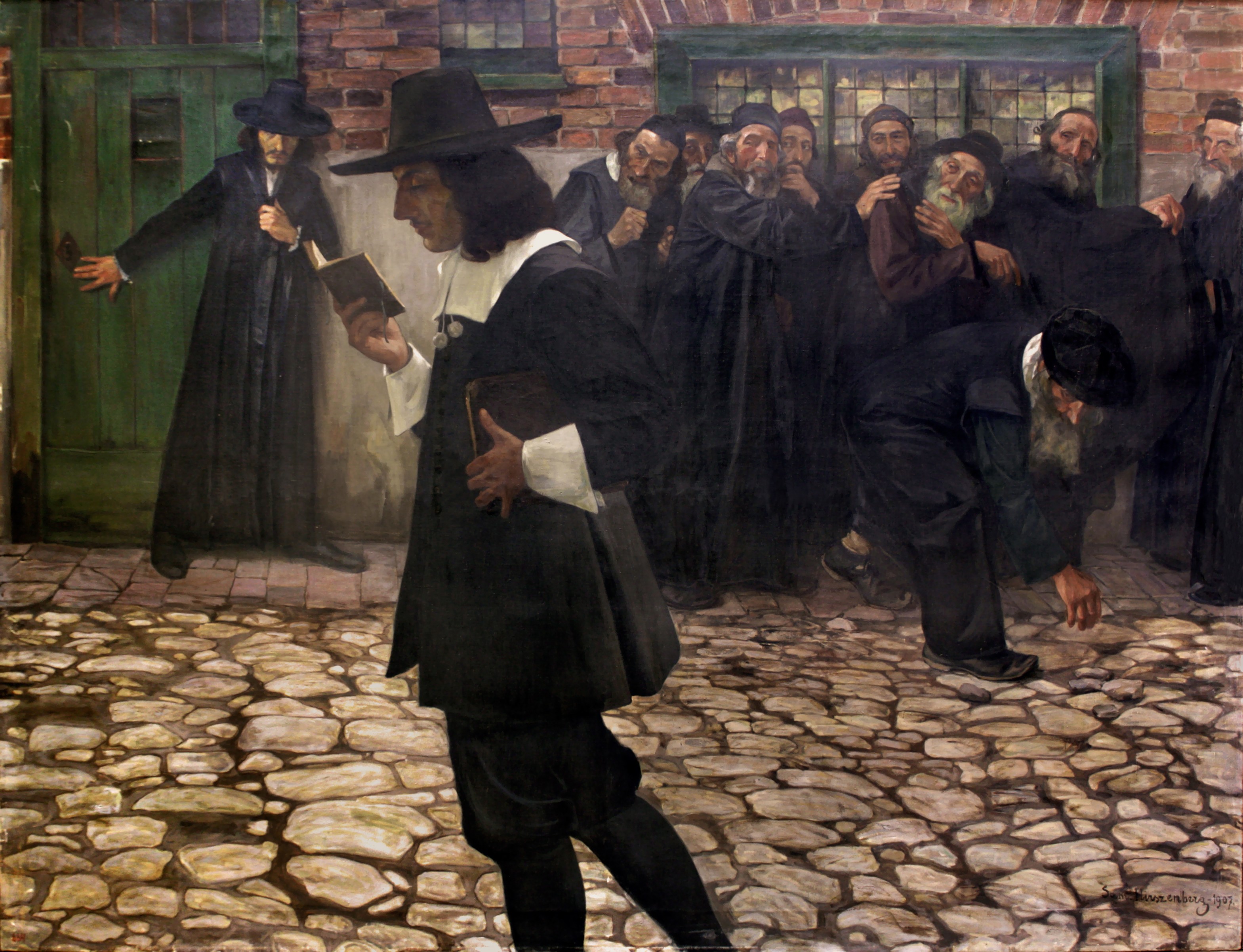
Excommunicated Spinoza by Samuel Hirszenberg

This is going to be a brief and unstructured post as I have a vaccine-breakthrough case of Covid-19 and thus am not at the height of my mental faculties.

But while I linger here in inglorious self-isolation, I have been reading the collected philosophy of Baruch Spinoza. I am not finished yet and I do not mean to give a comprehensive take, but it is worth mentioning that I came to this task via a book I recently read for work that compared and contrasted various historical definitions of the concept of sovereignty. I knew Spinoza by some philosophical concepts but had no idea that he was a thinker on such relevant (to my interest) political concepts. The ideas that I read about in that book made me want to know more.

Spinoza is most famous today for his metaphysics and his radically materialist concept of a pantheistic god, rather than a spiritualist and religious one. This interests me much less than his politics here, but serves as a fascinating example of materialist thinking in a deeply spiritual age. He comes across as similar to an early Tantric thinker with elements of Vedanta philosophy but in a 17th Century Dutch context. His god, such as it can be called such, is really a combination of the will of energy serving as the connective force for all of matter. To Spinoza, this matter is the same everywhere and thus the creative energy may as well be ‘god’ because this is the only way things may happen by forcing change and interaction. Of course, we know now through the hard sciences that matter can indeed change its nature in many circumstances and that it can be converted into energy. This punctures his need for the god language, but was information that was unavailable to him in the time of his life. Therefore, we get an interesting example of a fully materialist god with the characteristics of the theology of the Dharmic religions. Good and evil are pointless, as is faith. The majesty of being leaves no use for the simple moralism of man. And it is the simple moralism of man that the Abrahamic faiths, of course, hold as supreme.

No wonder Spinoza’s Jewish community in Amsterdam excommunicated him. Then so did the Protestant Dutch municipals of that city. After death, his writings would be banned by the Catholic Church. Cancelled by three different religions, now that’s a guy I can respect! He would never end up joining any faith community again and lived the rest of his life as a private tutor and lens grinder, apparently content and with his own circle of friends from many outlier communities. Honestly, he sounds like a cool dude.

While his attack on the specifics of the Abrahamic God, (a being much more like Miura’s Idea of Evil than Spinoza’s omni-nature) and his creation of a deterministic world view of moderation and autonomy in service of living with nature while also exploring it would be his most famous contribution, what I really find interesting in his political philosophy.

Spinoza is an extremely interesting contemporary and counter-point to Thomas Hobbes. Both believed in the ultimate sovereignty of the state as the enabler of human thriving, particularly in societies that had grown large enough to have dense populations. Both sought state control over religion to quash sectarianism and outside societies interfering in domestic affairs. Both looked down on violent rebellion but left themselves each specific escape clauses when the situation became dire. Both, most interesting to me, upheld the right of different countries to have different political systems based in their own culture and untampered with by the designs of others…even if their personal preferences were for different kinds of systems. Both were aware of one another and Spinoza at least read Hobbes’ work.

The differences are more interesting, however. Whereas both Spinoza and Hobbes saw a strong state as the most effective way for maximizing human flourishing, Spinoza emphasized the state’s capacity to uphold freedom of thought, religion, and the press whereas Hobbes viewed such things as potential dangers to the state. Hobbes also sought a centralized state whereas Spinoza sought a more decentralized one, where the dynamic tension of regions and their differences sparked an engaged citizen-culture that would, over all, actually strengthen the state against outsiders. Hobbes’ personal preference for monarchy also contrasts with Spinoza’s personal preference for republics. But both, I will re-iterate, did not believe there was one universal best form of government for all places and peoples. In fact, Spinoza was insistent that a political system will always be regionally and situationally unique. He was also even more of a realist than Hobbes when it came to social contracts, finding that power, not safety, was the true ultimate determinator in who got what. And that power came not from ideas, but by living within nature and understanding it enough to get the most out of it.

Here we have a thinker who denies progress, teleology, and idealism for a fully deterministic and materialist world view, yet comes to support freedom of the press and secularism in service of a republican civic virtue. Is Spinoza a liberal with all the stupid bits cut out? Or a realist with a modern sense of nuance lacking in Hobbes? Or both? Nevertheless, you can see why I am interested in him.

To create an artificial binary here, I am probably more personally close to Spinoza’s world view than that of Hobbes. However, I will maintain that so long as certain caveats such as adding economic security to the Hobbesian bargain are done, that Hobbes might still be the more relevant thinker on sovereignty for much of the world. Why? Because the dynamic tension of Spinoza is often preferable but too dangerous to work in fragile or besieged societies. A very strong and secure society can afford a level of decentralized experimentation, but a weak one cannot. Hobbes wrote in the aftermath of an apocalyptic war and its resulting fanaticisms in his home country. Spinoza wrote exposed to fanaticism as all in 17th Century Europe would have been, hence his desire to relocate from region to region to avoid antagonists, but also in a society at its financial and military peak. The Dutch Republic was in a far stronger place than England in that period. It could afford to be experimental. The British would only shift to a more mixed political system once they pulled ahead of the European pack.

We see this today in the world’s conflict zones. Embattled states either fail or become more Hobbesian to avoid failure. And so, as I am want to do, let us bring in Ibn Khaldun to add a third corollary here: the passage of time matters. Personal bonds create a new ruling elite, the ruling elite, if successful, creates a Hobbesian (or Chinese Legalist or whatever) state focused on survival and establishing itself as the dominant force in a territorial unit. Then, the Hobbesian state can (and possibly should) morph into a Spinozan state, strengthening itself by more fully integrating its citizens into its body and allowing dynamism to survive the loss of the original solidarity provided by security needs. The cycle will eventually repeat itself again, of course, but the transition to a Spinozan state could delay the inevitable decline in the final phase, meaning while upheaval is still inevitable, it is less common. This is not to ignore, of course, that a state could go from a Spinozan position to a Hobbesian one as a matter of necessity due to security concerns and internal division. Indeed, this is to be expected as well. But if the state survived the crisis by doing this, it could always pivot back to the Spinozan position once things clamed down.

And now, because that is the most effort I have been able to put into anything for the last couple days, let me leave you with a Spinoza quote that I think sums up both his metaphysical and his political views quite well:

‘Whenever then anything in nature seems to us ridiculous, absurd or evil, it is because we have only a partial knowledge of things, and are in the main ignorant of the order and coherence of the whole, and because we want everything to be arranged according to the dictates of our own reason; Although in fact what our reason pronounces is bad is not bad in regards to the order of laws of universal nature, but only in regards to the laws of our own nature taken separately.’

Book Review: X-Risk, How Humanity Discovered It’s Own Extinction

Taken from here.

‘I have seen the dark universe yawning. Where the black planets roll without aim, Where they roll in their horror unheeded, Without knowledge, or lustre, or name.’ ~H.P Lovecraft, Nemesis.

Over 99 % of all species that have ever existed on Earth are now extinct. A tiny few died off while leaving radically different descendants much like the birds which came out of the dinosaurs, but most leave no trace but their fossils. Humans may be the first species that we know of to be aware of the concept of extinction itself, but we have only begun to entertain the idea that it could happen to us in relatively recent history.

X-Risk: How Humanity Discovered It’s Own Extinction‘ by Thomas Moynihan, is a history of human mortality as it was experienced on an unfolding basis by thinkers and authors. A work of immense scope and a truly impressive level of research, ‘X-Risk’ shows us that contemplating human extinction is a surprisingly modern idea. Old myths and fables that postulated an end to humanity were not the same as they postulated the greater world would also be ending in supernatural cataclysm. Everything was either going into the twilight all together or being subjected to a hard reboot. Human extinction is a different concept, one that says that the universe will continue on without us, unheeding of our departure. Perhaps, on this planet anyway, even with other species relieved by the passing. Much as we are unbothered by all the lost former species on this world, so too will the greater ecology of Earth not miss our presence as birds and bats colonize the rafters of our empty and fossilizing cities.

This realization began with the Copernican Revolution and the knowledge that neither Earth nor the sun was the center of the universe but rather one star among many in the heavens, dethroning us from our previous assumptions of protagonist syndrome. But an even more important often overlooked revelation came not from the stars, but from the ground beneath us as more details about geology and the fossil record came to be understood in the 18th and 19th Centuries. The planet was undeniably a graveyard. A tectonically active and weather beaten charnel house that was hiding who knows how many bones from a still unknown amount of species that had once called it home.

Moynihan gives us the history of this revelation and the cultural and philosophical reactions to it from thinkers, scientists, and creatives alike. This is the majority of the text of his book, and it is truly a unique a necessary addition to contemporary philosophy. Though he comes out early on the side of the more hopeful revisionists who said we can or should at least try to fight back against our extinction, he gives summaries of the thought of all types of reactions including those who actively embraced the prospect of an end to humanity. In the end, Moynihan pleads with us to embrace expansion into space. Not, thankfully, as part of a unified euphoric destiny like so many mindlessly do, but in order to further diverge our species in different environments. This would make us harder to wipe out by fate as our genetics and what we adapt to carry on the human legacy beyond one world, one lifestyle, and one model which could become obsolete at any moment. His version of space exploration is less like Star Trek or even Foundation and more like Alastair Reynolds (especially the excellent novel House of Suns) or Jack Vance. Diversity and divergence is the key to Darwinian survival. All your eggs in one basket is a recipe for disaster when it comes to adapting to existential danger. A point that seems uncontroversial today until you realize most contemporaries in academia, media, and government in many societies never include the ideological aspect of diversity when they nod along.

Since the book is both good and informative and I obviously recommend it, I figure it would be more interesting to bring up the points I diverge from it rather than just spend the rest of this review stating the now obvious fact that I enjoyed reading it and outlining the examples that you could read for yourself in the text if you are so inclined. This is what now follows:

The Fermi Paradox Is Not Actually Interesting.

Like many thinkers interested in astronomy or the ethics of the future, Moynihan opens with The Fermi Paradox, the famous thought experiment trying to figure out why with our modern telescopes and hyper sensitive detection tools we have so far failed to find any signs of intelligent life out there in the cosmos. But all discussions of this inevitably (if you are speaking with a sane person anyway) break down to the likelihood of the most mundane explanations. Intelligent life is rare enough that the spaces between them is too great to see the signs. The Lightspeed barrier might be truly unbreakable, and so even the most advanced civilizations are at best confined to a handful of stars in one cluster, and of course, there is not just distance in space but distance in time. We are probably more likely to find planets one day which *could* have advanced life but haven’t evolved to that level yet, or planets that once did and left behind ruins. The threat of extinction is not just for us, after all. As far as I am concerned, The Fermi Paradox is just an interesting college dorm tier discussion framework and nothing more. Hardly a game changer one way or the other.

Extinction, Like Death, Is Hardly To Be Feared.

While I love reading pessimistic authors because they offer such a welcome break from our relentlessly euphoric public culture, I am in the end an indifferentist rather than a pessimist. And while there are things I fear like becoming paralyzed or imprisonment or declining living standards, I have never been afraid to die. Maybe this makes me an outlier for my species, but I find the concept of every story coming to an end not only inevitably true but also good. What value could something eternal possibly have? Lingering past ones time has always struck me as not only boring, but malignant on the future for others. Sure, no one loves old stuff more than me, but that old stuff would lack value if it was omnipresent and everywhere. It would just be more of the mundane rather than the special places and objects that allow us to remember there were once different peoples and eras. This has the effect of making me remarkably indifferent to the fate of humanity long past my own demise. In a time when I won’t be there and neither will anyone I will ever know around today, what care I? It is fun to speculate about, of course. But that is about it. I guess it is for this reason that I never saw the appeal of the concept of an afterlife or life extension biotechnology either. Even your favorite movie would get boring if it never ended. The temporary nature of things, mono no aware, if you will, is what makes the burden of human consciousness bearable.

Moynihan gets very concerned with these questions of inevitable endings to the point that I find quite hard to fathom. Though his instinct is obviously correct that the species as a whole has a survival drive, and he is right to point out constructive ways for us to harness this as a policy recommendation, he is also far to quick to jump on planning for the far future when it would be much more efficient to plan for the short term future. Here we are, on Earth, suffering from climate change. If you want to get to point C you must first cross point B. And that includes listening to what the pessimists have to say about humanity. It is better to be prepared for worst-case scenarios than to not be.

We know now that the universe will most likely either die or face a hard re-set. Not unlike ragnarok after all. Be it the cyclic model of a big crunch or rebirth through the extremely mind-bending conformal cyclic cosmology, or the path of heat death or tearing apart that dark energy unchecked might well be leading us to, our perpetuation does not transcend the end of the stage our play is acted out on. All things around now will one day be unrecognizable, whether we survive long term or not. And this brings me to my final point of divergence.

Consciousness Conflation?

Moynihan is very into the idea that people are happy to accept the concept of extinction so long as they can believe that somewhere out there in space or time other beings are conscious too. This means that he implies that as long as we can only prove ourselves to be such beings, we must tend this fire as it could very well be unique in the universe.

Since we have no data of other life elsewhere in one way or the other, but know for a fact it arose here, I find this a strange conclusion to jump to. Other forms of consciousness might be utterly alien and unrecognizable to us, even horrifying. Or they might be comically similar to the point where we have to confront that consciousness itself is just a biochemical adaptation mechanism like any other behavior (my personal suspicion).

But this isn’t my main criticism. Perhaps its the international relations scholar in me, but my main critique of this point is actually that humanity would find aliens threatening whether they were mundane and caused us to question our specialness or if they were radically different. We wouldn’t be happy to share the universe with such beings so much as on become guard, threatened, and whatnot. Sure, there would be an initial euphoria, but we tend to react negatively when our position at the center of existence gets dethroned. While thinkers may feel some reassurance others elsewhere are thinking about them, for most people I would say that they are not reassured by this. Our species comes first, its in our genes. Our willingness to accept extinction or not will come down to our own survival drive no matter what else is out there. Therefore, this will not be a factor in either making us complacent or fueling a death drive.

Additionally, in order to make this point of our apparent specialness, the author disavows the possibility that conscious life has arisen before and could do so after us on Earth as unhelpful. As a person who recently finished a graphic novel script on humans finding dinosaur civilizations out in space on one side and being threatened by the rise of sadistic sentient dolphins back on Earth, I tend to find the opposite is true…not because I fear being a lone conscious entity, but because the questions of how to use consciousness are far more interesting if we demystify it and remove anthropocentrism for the equation of our hypothetical thought experiments.

My Own Conclusion

All species have survival drives. I do not worry, like Moynihan, that we will end ourselves intentionally (accidentally is a very different proposition). The author is correct to advocate for his position and in turn give us a wonderful history of humanity’s surprisingly modern engagement with thoughts of its own demise. But there is a reason some ancient cultures divided up people based on their engagement with greater society into renunciates and householders. Householders have something at stake in all of this, renunciates are less interested in merging with the mass and more interested in detached observation. I am, myself, certainly part of this other group.

This may seem surprising since I work in the field of policy advocacy and strategic re-alignment. And I am not about to claim that I am fully detached or even want to be. But I have found that it helps ones ability to critically appraise or offer more usefully unique analysis if one is at least somewhat removed from investment in the ‘normie’ world. Even going back to childhood I never wanted to have children because it seemed like too much of an anchor in the rest of humanity (not to mention an invasion into my treasured solitude). Once I got over the hormone rush of puberty I also realized I never wanted a spouse either for similar reasons. It is for reasons like this I think I make a better analyst than many of my contemporaries, as I have little attachments to things than ruin observing the present as fully integrated into the past and the future as one moment full of fads like any other. I can advocate positions to make life better for lots of people, indeed, I view having a sense of civic duty quite highly, but I still do so with the knowledge that these moments in crisis will fade in time. We are managing problems in the relative short term only.

I love ruins. I love to wander amongst them. Possibly the coolest place I have ever been are the ruins of Pagan, in Myanmar. Once it was a thriving temple-riddled city and capitol of an empire whose ground water was inadequate for continual occupation and who never survived its sacking by the Mongols. What it left us is an entirely unpopulated city of stone and brick buildings. Wandering amongst such a place, which, at that time, was almost totally undiscovered by foreign tourists (it is different now, I hear) gives one a true sense of cosmic wonder and connection with Graveyard Earth. Moving this same sublime sensation forward into the future, imagine even our most terrifying ruins and the effect on legend and travel experience for future entropic Epicures.

I feel connection with cultures and peoples lost not because it was a tragedy they are gone but because they remind us that all our current struggles too will one day be lost too. This is what makes life not terrifying, but bearable. Perhaps Moynihan would admonish me in the words of a Clark Ashton Smith poem for becoming a ‘phantom among phantoms‘ who is lost in the space between ruins, but not all of us have to be on the same boat here. It is our cultural and psychological divergences that serve as a check on the whole species following just one rigid path after all. In the ideal space-expansion future both he and I seem to want, that of endless divergence in the stars, there will be planets of renunciates as well as euphoric strivers and many different balances in between too. The strives will no doubt have more numbers, but the renunciates won’t care.

And one of those planets, perhaps, will be Earth herself. Where eccentric curators wander the halls of an emptied out planet turned over to be part museum and part nature reserve, archiving data and giving tours to visitors.

It sounds like a fun place to live to me.

Tabletop RPGs and Understanding Chaotic Probability

The gamemaster screen for the excellent Mörk Borg

Chaos Theory is often misunderstood by those who have never actually looked at it to be the simple triumph of randomness over order. It is in fact the natural replication of order, but in an imperfect and ever-evolving way whose specifics are unpredictable but its patterns recognizable. Outlier events dominate when they occur, but are rare. Nothing is certain but patterns exist. A humanities equivalent might be ‘History doesn’t repeat, but it rhymes.’

It has become increasingly apparent to me that explaining the deficiencies in how dominant ideologies of the present day process events needs a simple and readily accessible analogue for the general populace. Sure, my habit of blaming the extreme and (supposedly) opposite wings of monotheism and postmodernism for being the partners of maintaining an obsolete neoliberal order in our present age of global stupidity and breakdown is something I maintain is correct, but its also inaccessible to many. To get why I have this opinion requires an explanation of historical events and materialist philosophy that most people would not be interested in, if they even have the time for it. People know something is wrong, and they know that most of the people hired to explain these concerns away are lying to them or out of touch. They also know that many of the people proposing alternatives are very intense and extreme. Thoughtful but not formally educated people generally find the extremism of wingnut rhetoric and the hollow rear guard denials of unhinged centrism equally alienating. Surely, there is no panacea for our problems. Likewise, we clearly have to start looking further afield than the presently acceptable and ascribed solutions. Absolutism and relativism both are failures when taken to be universal principles. Abraham and Derrida both have much to answer for in their own special ways. Philosophy, politics, even the ways people communicate are hobbled. As do those with money and power who patroned them for their own ends. Probability, not certainty is the most important thing that must be accounted for by anyone who wishes to have a sensible opinion.

So how do you introduce the idea of a pragmatic probability to a general audience? By talking about real life places where it applies. Where both chance and skill interact together to create a situation where preparing and improving oneself is rewarded, but always under the knowledge that the roll of the die or the shuffle of the cards has final say. You can improve your odds always, but you cannot achieve certainty even a you do so. This can be analogized in many ways. Gambling, sculpture, game theory, the study of active volcanoes, traditional wargaming, your grandma playing Bejeweled. The way it should be talked about is determined by the nature of your own audience as well as what you know best on your own terms.

For me that is tabletop role playing games. At least, outside of geopolitics. But once again, more people are likely to be familiar with the former than the latter-especially when it comes to the fundamentals of practice. These are games where someone sets up a story and other players go through it not unlike a multiplayer computer game, but with the final determinator being not a software program but the actual game master, a human as capable of dynamic response as the players are.

I was introduced to tabletop RPGs as a kid in the mid-90s with Second Edition Dungeons and Dragons, Werewolf: The Apocalypse, and Call of Cthulhu. By my early teens around Y2K I was already running Call of Cthulhu games as a ‘Keeper’, better known as a Dungeon Master (from DnD terminology) and henceforth referred to as a Game Master to include all potential games. I have played, and most often ran, games ever since in a variety of systems. Call of Cthulhu remaining my constant favorite with many others jockeying for my affection right below it. I tend to prefer more tone and story driven games to ‘crunchy’ rules-heavy ones, but as my Edinburgh-based former Pathfinder team can attest, I am also capable of running the more war-gamey ones as well. But even with my less complex preferences, it is important to me to run a game where dice rolls and chance play a major part so that the experiences transcends mere interactive storytelling and predictability.

Dice go beyond just pass/fail and enter into a new realm where there are multiple kinds of successes and failures and varieties of responses. The non-mathematical storytelling element that responds to roll results allows both the game master and the player to think far more creatively than any computer game could allow. At the same time, the random element means that no one is fully in control. What emerges from this interaction between fate and human input is something neither entirely determined nor entirely free. One in which dice might doom the best prepared players and spare the most incompetent, but only as outlier events. You can never achieve certainty, but you can increase your odds through smart builds and smart play. Sometimes by a little, sometimes by a lot. Over time, the proportion of players who play wisely (as well as creatively) will be the ones more rewarded. Not only in enjoyment of the game, but in material benefits to their character in the game-world.

Even games where the players are pretty much guaranteed to be doomed the longer they play, such as Mörk Borg or Call of Cthulhu, this can serve as a kind of death analogy. We are all going to die one day so why try to maximize performance? Well, because you make gains along the way anyway-at least for a time. You’ll think back on your story of how you got there as you die, most likely. Its not about the destination but the people you met along the way. Sure, the knowledge gained in Call of Cthulhu will drive your character stark raving mad, but it is still knowledge. And knowledge can be many things from power, to a greater appreciation of the arts, to a lessening of the fear of failure. Having a character that survived long enough in that famously lethal game to become a stark raving mad and phobia-riddled savant of occult lore with an impressive library of forbidden tomes is one of my greatest accomplishments as a player.

But for most people who don’t share my pseudo-tantric black metal world view this might not be so effective. That is fine, as most tabletop rpgs aren’t like the examples above. In traditional fantasy or science fiction games one gains power and riches the longer they survive and keep adventuring. From the many Old School Renaissance games up through present day DnD Fifth Edition (the best and most accessible DnD version hence its surging popularity right now), there is enough danger and reversal to keep you on the your toes but the rewards are worth the attempt by any standard. Perhaps most interestingly, there also exists a variety of games between these poles that do a good job modeling both the power fantasy element of traditionally popular games with the more morally ambiguous and complication-riddled side of the darker ones. Here I am thinking about Werewolf: The Apocalypse (and other World of Darkness settings), Conan: Adventures in an Age Undreamed Of, and The Dying Earth RPG. These are games that specifically work into the gameplay immense ups and downs to create a roller coaster of experiences where the character is always growing, but not necessarily in a linear fashion or through constant victory.

The Conan game, in a great nod to its source material, actually has specific mechanics for both incentivizing winning gold and fame and also having to use these acquired resources to recover mental and physical health through debauchery and carousing. If you want to keep gaining stats you have to keep adventuring, but if you want to keep adventuring you have to recover through squandering your ill-gotten gains. On top of this is the momentum/doom system where successes lead to more die for rolls and failures compound into more counter-die for the game master to use against the players. The players and game master end up trading literal dice to increase their probabilities in rolls they want to fudge up, turning near misses to near hits (or vice versa). Fate can be played with, but only temporarily as somewhere down the line ones accumulated dice-karma will come back for them. The Dying Earth RPG takes an even more direct approach, with all rolls being based around six sided die with 1 being an critical fail and six being a stunning success, greatly increasing the odds of a ridiculous outcome in any direction. The game is built specifically so that epic failure is as entertaining and almost as desirable as epic success. The GM rewards players who play into their extreme results with a sense of panache with experience points, regardless of if those results are a failure or a success.

Even traditional games on the ends of the tone spectrum have variants that fudge the line. DnD has the Planescape and Dark Sun settings to create a darker and more surreal or survivalistic tone to its normally high fantasy system. Call of Cthulhu has Pulp Cthulhu, which adds an bit of Indiana Jones style punching out cultists and traveling the world for treasure to the staples of madness and unspeakable horrors lurking under the surface. Interwar dungeon delving with a cosmic horror tone.

The fact is that tabletop gaming still does what its more popular computer based descendants cannot do in both randomness and in player input. (There is one possible almost-exception to this rule, however). Anyone who has played-and especially ran-these games enough knows no plan for a module, be it the module itself from the game master or the player’s tactics at tackling it, ever survives fully intact upon contact with the random elements. But at the same time, a well designed module or player tactical plan is going to work far more often than a poorly thought out approach. Much like navigating life, politics, the sciences, metaphysics, the stock market, or even the overall span of societies, tabletop rpgs show in a clearly communicable way to a general audience the interplay of forces both outside and within a person’s control and how those come together to create a probability-dominated world where nothing ever turns out as you plan it. This unpredictability is part of the intrinsic nature of the game and usually makes perfect sense of even outlier events in hindsight. Dice results may disappoint or elate you, but they don’t lie. And how you respond to those stark numbers rolled out on the table can be everything. There is always an excuse for failure at something challenging, but never one for not being prepared as much as possible before the challenge roll.

A Speculative Realist Review of ‘History of the Tantric Religion’

chinnamasta

Those who have followed this blog since its inception in late 2015/early 2016 know that while it is mostly an international relations, politics, and history blog it has also gradually become a place to explore my journey into the new philosophical school of speculative realism. I have been gradually working my way through constructing a geopolitical take on speculative realism. In so doing I have also been inspired to engage with philosophical positions that come from South and East Asia as I have seen some obvious parallels between some of those schools of thoughts and the rebirth of metaphysical materialism in some sectors of ‘western’ philosophy. Above all, the worldviews with a Tantric side seem to offer the most interesting overlap.

Tantra is not in fact what most westerners who hear the term believe it to be. According to the school of Californian Buddtology, Tantra is feeling all mystical about having sex in weird postures. While it is certainly true that contemporary Tantra has some optional sex practices as part of its ritual culture, I have a feeling your average Cilantro-Botoxian from the Hollywood Hills would find little in common with the philosophy behind the movement if they ever actually bothered to read about it.

As an atheist and hard materialist myself, I naturally wanted to read about Tantra from as secular and scholarly a source as I could find. Fortunately, I was able to locate the second revised edition of N.N. Bhattacharyya’s ‘History of the Tantric Religion.’ I am not interesting in converting, after all, but rather understanding more fully this school of thought that presaged speculative realism by thousands of years. And this book delivered.

It is both a history of the thought trend and also an exploration into its themes. Many of these themes have been diluted or merged with more mainstream thought over time, leading Tantra today to have the reputation of something that is more about technique rather than a distinct world view on its own.

In its beginning, Bhattacharyya shows us that Tantra was an anti-establishment impulse that came from women and the lower castes of society. In direct opposition to Brahmannical divorce from the real world to follow abstract ideology (insert joke about woke neoliberal overlords here) an organic take on Hinduism and Buddhism arose which centered not the abstract goals of a priestly caste but rather the physical, real, and material. This was most evident in the relationship between physical objects-especially that of the human body, the natural world, and substances both foul and delightful- what could be consumed (meat, alcohol, bodily fluids, etc). Many Tantra-aligned schools of thought dabbled in atheism, skepticism, and controlled ritualistic hedonism. The violation of preexisting social taboos was important to challenge complacent thinking and transcend the rote wisdom we are saddled with that stops us from seeing the flow of nature as it really is. All of these schools were interested in the natural world and how the human body and the gods reflected this material existence. When gods were used they were explicitly stated to be symbols of natural forces to which we are only separated from by the illusion of human difference.

Sadly, over time most of these traditions would end up weakening and merging with the greater normie culture of medieval and early modern India. Others, such as Vajrayana Buddhism (who longtime followers of this blog know I have an obsession with the aesthetic of) effectively came to rule entire regions in the Himalayas. But having become the establishment those too largely lost the contrarian and material nature of the original school of thought as they degenerated into Llamaist theocracy.

Still, several core elements of this rebellious and wonderfully base philosophy still survive in many various deity cults and practices in South and Himalayan Asia today. These could be summed up (my own take here, be warned) as ‘the only way out is through.’ In other words, the way for a human to recognize their place as part of an unfolding natural process is to de-emphasize socially constructed protocol (caste, class, moralism, absolute idealism) for confronting the base nature of everything head on. Afraid of death? Spend time meditating upon the charnel grounds. Afraid of becoming a slave to the passions? Indulge in all of the passions in a disciplined manner so that you eventually grow tired of excess and regulate them in a rational manner. Afraid of violence and strife? Adopt the iconography and terms of war and slaughter in the form of wrathful deities, whose fearsome aspect is then turned from something shocking potentially directed against you into something powerful that is now on your own side. The practice of focusing on ones personal selection of deities is often a major part of this, as the gods most associated with Tantric practice (such as Chinnamasta, pictured above) are often grotesque, their power overflowing in fountains of gore, limbs, bones worn as decorations, and yet dancing through it all. They show that the most terrifying things can be internalized into something powerful and helpful, and turning fear from something to avoid into something to co-opt into bravery and critical thinking.

When I think of people around the speculative realist movement who do this Graham Harman and Ray Brassier come to mind, if in different ways. Harman wants to rub the fact that you are an object, and therefore that ‘objectification’ is not only not a bad thing but an honest and true claim, in your face. Brassier wants to bring philosophical nihilism out from the edgy teenager/depressive persons territory and claim it as simply objective truth to be confronted directly as fact before moving on to anything else.

In a way we all do this to some level without realizing it. People enjoy horror movies for cathartic or thrill seeking reasons even if (and sometimes especially if) they are the kinds of people who shrink from conflict and danger. I professionally advocate for tearing down the perpetual war state for strategic reasons but love military history and war movies. I can also speak from personal experience that the most effective means I ever came across for confronting and managing my situational depression when it flares up was to indulge it critically. This meant  treating it more like an annoying acquaintance than an enemy, indulging it just enough to integrate myself with the experience before realizing it didn’t really matter because it was just systems responding irrationally. Interestingly, the most effective way of speeding up this process is very Tantric…I watch as many depressing movies and read as many depressing books as possible. Eventually, by charging directly through you end up punching right past being stuck. It becomes a challenge of a sorts, ‘oh you think that is bad? I’ll show you worse!’ By the end of it you sort of win the game or you get sick of playing. Either way, crisis averted because now you are thinking entirely differently from when you started. In the process you learn self-discipline so the potential for even gaining knowledge is there too.

In an era where shrinking violets control the discourse and seek to avoid uncomfortable topics is a moralizing version of anti-intellectualism, I can think of no better way of thought to counteract this Tipper Gore-ish trend than that of subversive Tantric methods of thinking.

Guess that explains my love of black metal. If there is one genre of music that could fit this topic, its surely that.


Facts Don’t Care About Your Grifters

Grifters

Its been a bad couple of months for the grifter. Hot on the heels of the implosion of the Russiagate spy thriller industrial complex and the sudden flailing about of its most shrill and conspiratorial partisans we have also been the witness to two utterly unsurprising and overdue reckonings with the more traditional conservative grifter.

First came the much vaunted Peterson vs Zizek debate, which you can watch here. While I have little invested in either of these two famous commentators I was curious as to how an obvious carnival barker such as Peterson would perform against an actual intellectual like Zizek. Zizek, it must be noted, is not a philosopher I consider myself a huge fan of in many ways. I am firmly on a realist and he on the idealist. He loves Hegel, who I cannot stand, and is part of a long-running unfortunate trend of left-wing thinkers who are aligned first and foremost with anthropocentrism. That being said, he is undeniably a philosopher and an intellectual, words that Peterson aspires to be but has always come up short on attaining.

What happened in their debate is mostly notable for how unused to being challenged Peterson was on his own talking points. He has based most of his career on conflating Marxism and Postmodernism (two ideologies that really could not be more different) and has never had to confront the fact that his image of Marxism was entirely divergent from its actual real world manifestation-as well as that the cultural feed for the social justice nuts he decries has much more to do with the inherent pathos of the classical liberalism, individualism, and Christianity that is part and parcel of the very ‘west’ conservatives love to champion.

Hardly a surprising result of the debate of course. But then it happened again even more recently. Ben Shapiro, an even more blatant fraud than Peterson (though beloved by the same demographic of alienated and terrified young men and bitter divorced dads who create such spawn) showed how utterly unused to being challenged by critical questions he is on live television.

The similarities between these two and others like them, aside from apparently voiceboxes that approximate various tones of a deflating Kermit the Frog, is the nature of the conservative grift. Conservatism by its very nature often trends towards the anti-intellectual. ‘Don’t rock the boat’ and a reflexive desire to defend entrenched power is hardly conducive to critical thought, even if a conservative position happens to be the more correct one. Naturally, however, said entrenched powers know they need a propaganda wing too, hence the vast amount of astroturf funding that goes out via think tanks and various organizations affiliated with big money to prop up things like Turning Point USA and the like. If you were actually to leave public discourse in its natural state, critics and not defenders would thrive.

This creates a money pit. The grifter may or may not actually believe what they say but senses an opportunity to make bank. No trickster could fault such a tactic, and be sure that I do not. It’s a rough world out there in the post-recession hellscape. The problem is that these artificially buoyed people become both convinced that they themselves are wholly responsible for their success (which jives nicely with the ideology that they expound) and then enter into a feedback loop where they begin to believe their own bullshit-assuming of course that they already didn’t. Such incestuous behavior leads to Peterson inventing his own political theory in a vacuum or Shapiro writing his own articles about himself in the third person and giving them self flattering and hyperbolic titles. Meanwhile, both take immense pride in being expert debators but (until recently) only debated psychologically frail college students and utterly superficial news anchordolls. Much like Uri Geller, the spoons only bend when the spoons have been chosen by the person who claims to be able to bend them.

It is worth noting, however, that this is not new. The last proper conservative intellectual in the English speaking world was Edmund Burke, all the way back in the late 18th and early 19th Centuries-and even he was not recognized as anything near an orthodox conservative in his time. While overly reactive against the (legitimate and inevitable) class basis of the French Revolution, he was still a person of nuanced thought who charted a course rooted in history and against many of the dominant tides of thinking in his day. There hasn’t really been a conservative political thinker of such importance or impact since in Britain, America, or their offshoots. Despite what people try to say (including desperate liberals who like to maintain the facade of the rational conservative as someone to hash out the enlightenment project within the salon, god forbid they have to talk to anyone left of them or of unorthodox persuasion) the entire experience of conservatism has drifted far away from anything properly intellectual since basically the industrial revolution. It is telling that the figure of the last generation most held up as an example of former conservative rationality and class was William F Buckley, himself a Bill O’Reilly style pundit more than any kind of proper thinker with anything of substance to say.

But there is money in it and fools aplenty willing to eat up bargain basement level platitudes and superficial gotcha moments packaged as philosophy. In this way, the mainstream right resembles the hypersensitive and hysterical trends of the moralistic wings of the left. Much like two sectarian branches of the same religion, both despise each other more for their similarities than the differences. Both are also clearly cultural inheritors of the protestant reformation and liberal patrician thought and their respective glorification of virtue signaling intent over action and accomplishment. The irony is that while this world views only work in a vacuum, they can only be disseminated in public forums. With the right challenger, they can be made to look utterly foolish under the disinfectant of exposure. It is important to hold interviewers to a high standard in order to best combat these grifters and their influence lowering public debate to that of the tattletales of the elementary school classroom. If so confronted, as Peterson and Shapiro have been recently, their influence will be undermined.