Since the run up to the 2016 primaries, when it was obvious that the neoconservative movement was beginning to gradually migrate (back) to the Democratic Party in preparation for what they saw as an inevitable Hillary Clinton presidency, I have been constantly making a joke to describe the process: ‘Dick Cheney, next key note speaker at the DNC!’ Well, with Cheney endorsing Harris in the current presidential race we are ever closer to that eventuality. Bill Kristol, welcome to The Resistance™, John Bolton, welcome to The Resistance™, Perpetually Screaming Two-Headed Alfredo Stroessner Clone with Mouths for Eyes, welcome to The Resistance™.
Cheney’s endorsement could have (should have) been ignored by Harris for purely electoral reasons, but it was met with mutual praise instead. Dick Cheney, one of the primary architects of the Patriot Act, the Iraq War, a global torture program, extraordinary rendition, Haliburton shortchanging and grifting the U.S. military, and fan of the unitary executive theory of governance, is apparently worried about our democracy and civic health. But it was Cheney who did more to harm these things than even the odious Trump which he fears. Worse yet, everything he did he did incompetently. No respectable supervillain, this perpetual master of failing upwards makes everything worse but for little demonstrable gain for anyone who isn’t some kind of government contract speculator.
And the liberals who once quite literally called him a Hitler-like figure now seek his praise. It makes you wonder what they will be saying about Trump in 15 years. “Former President Trump really took a strong stand against President Incel_Sniper1488 today! Sanity and decorum prevails!”
There are many reasons we are in the sad state of decline we currently find ourselves in today. In applying blame, The George W Bush Administration holds the largest single share.
It makes me think of the ‘Hope and Change’ of 2008. A major flaw in the Obama Administration’s philosophy of governance (itself largely cribbed from the ridiculous farce that was Sorkin’s West Wing) was unity and togetherness. That is the mantra of someone who barely squeaked into power, not someone who won a huge blowout election and came with a de facto mandate for change. Obama, of course, went on to serve as effectively Bush’s third and fourth terms. But respectably.
More importantly, that tone of unity, moving forward, and just moving out of the divisive culture war and endless conflict of the Bush years had the opposite effect. All of these things doubled down. They were made worse, I would contend, because we (collectively) never punished anyone from the Bush Administration. We forgave them. And in so doing, we made a cabal of people who left office with a 25% approval rating look like elder statesmen.
There is a lesson here about not listening to any sanctimonious ideology about forgiveness or ‘rising above vengeance’. That is for very specific situations and long term settlements, it is not for enacting a break with failure or an internal housecleaning. The failure of so many to actively punish people like Cheney, to show them and their reputations no mercy, simply means that such people must be continuously inflicted upon us like repeated outbreaks of herpes. Cheney should have been purged, his family driven into exile. His reputation blackened to the extent that he could never return to relevance. Failure to seize that opportunity means that not only is he back, his policies are too.
Forgiveness is bandied about like a virtue, but I feel like just as often it is a vice. A psychological coping mechanism meant to bring closure, which can be understandable, but the act is often selfishness masquerading as the opposite. The assumption that one must forgive those who wrong them is ridiculous moralism. You only do so if they have done something meaningful to undo the wrong. Without reciprocity, forgiveness means nothing but a virtue signal. It fails even as a necessity for ‘self-help’, for if one moves on from something one surely does not need to forgive, but rather merely to move on in silence. To even do this would, of course, require that the threat dissipates. But in the case of the neocons the threat is always there, learning nothing and seeking to drive its host country and who knows how many others into a maelstrom of ruin.
Too much forgiveness, like too much of anything, becomes an idealist Platonic principle onto itself rather than just one tool out of many to navigate the chaos of life. A good balance contains the right combination of all things, proportions adjusted for circumstance. Wrath and vindictiveness, viewed by so many as uniformly negative, is a positive in situations when you need to be ruthless to spare problems later down the line. Like how an effective immune response, it kicks into overdrive now to spare you more problems later.
Wrath, not forgiveness, should have been the order of the day back in 2008. A refusal to forgive the likes of Cheney could have spared us from the rehabilitation of his policies in the minds of his former opponents today. Its why I am glad I never forgave people like him, and why I know I never will. Hate, as Boyd Rice has put it, is inspiring. It forces you to be better than your enemies by giving you a standard to surpass. I would never want to ruin my clarity of mind by watering down such a tool with something so banal as forgiveness.
I have no idea if it is random chance or something in the aether, but recently I have seen many post-mortems on the ‘New Atheist’ movement of the late 2000s and early 2010s. Some of these offer insights. More do not. But one thing I have noticed is that they are as likely to reduce the ideological diversity of atheism just as much as the New Atheists did, replicating many of that movement’s initial problems and ultimately creating a shallow critique.
The problem with New Atheism that has gone unaddressed by so many of the modern commentariat is precisely that it could not escape its Christian roots. Because of this, it was unable to create the intellectual freedom it claimed to be making.
Before getting into this I would first like to explore what the New Atheist movement was and my own interactions with it when it was new.
Pope Dawkins declares a crusade.
New Atheism in Context
In hindsight, the 2000s seems to us today like the last gasp of organized religion’s outsized influence on public and political culture. It did not feel this way at the time. The Bush Administration was openly theocratic in its approach to both domestic and foreign policy. And in the brief window of the unipolar world there were no alternatives to moral panic neoliberalism, save global jihad. While Islamic radicals tried to expand their power in the Middle East with what was effectively a terror-for-media-coverage campaign, the United States played into their trap by doubling down into crusader rhetoric. While Bush waged what he claimed was a divinely sanctioned war abroad, he oversaw a homophobic moral panic at home which may have succeeded in securing his re-election. The government was staffed with Liberty ‘University’ graduates as political appointees and U.S. aid policy to Africa was subordinated to an ultimately doomed quest to tie programs to abstinence-only education. Most insulting of all, there was a concerted push by right wing culture warriors to push teaching creation science in public school science class. If anything, this last was the issue that really forced a strong backlash from an intelligentsia that had too eagerly jumped on the establishment bandwagon after the rally-around-the-flag effect of 9/11.
Enter the Four Horsemen: Daniel Dennett, Sam Harris, Richard Dawkins, and Christopher Hitchens. Though by no means starting as a coordinated effort, the very obvious open void created the space for the publications of these four individuals (and many of their imitators) to make an outsized splash on the cultural milieu by not just opposing evangelism on the defensive, but by stridently attacking it. Religion was not just a tool used by the powerful to deceive the masses, it was the mark of a foolish person. A willing dupe. And someone who stood against good government and a rational conception of civil society.
Another aspect of this ‘movement’ was that it was not just a rejection of theism, but also a rejection of postmodernism. The postmodern left, which in the pre-Occupy neoliberal era was the unquestioned left mainstream (arguably it still is, albeit increasingly more identified with center-left professional managerial class types) rejected anything incompatible with a totalizing relativism. Postmodernism could not say that creationism was inferior to science or even wrong, it could only equivocate. Another aspect of this was the left’s (still existing) bizarre fetishization of Islam, a value system that could not be more hostile to the one they profess, but which they allow a leeway of tolerance they would never give to their domestic Christian enemies (likely out of the bizarre belief that it thwarts U.S. foreign policy objectives to be publicly sympathetic to a religion that was once committing the same kind of ideological expansionism and cultural gentrification as the present American empire).* It has always been a funny irony that the world view that upholds relativism as its ultimate ideal is so often championed by people so hostile to nuance and prone to moralistic binary thinking, but I digress as, we shall see, the postmodernists would hardly be alone in this error.
So we had a new movement that dumped on the pieties of the politically correct left while stridently attacking the evangelical political establishment of the era. Both of those things were necessary and welcome reliefs from the trends of the time. They were a breath of fresh air in a stultifying political era where self-censorship was normal and the avenue for dissident expression was narrow. It was bracing and fun. I confess that I myself once (and thankfully only once) made the conscious choice to be seen reading The God Delusion on the train to test the waters.
But even early on, and despite all the fun, I had my doubts. The same kind of doubts that let me shed my religious beliefs in middle school were reappearing in my later college years. I owe this early turn against New Atheism to my dedication to the study of premodern history. This was something that kept me grounded and aware that what might seem like an inevitable trend could just be a fad. It also made me deeply skeptical of the core concept of New Atheism: linear progress. I remember upon concluding The God Delusion that it was ultimately a form of cathartic entertainment, but hardly a work of philosophical rigor. It contained many bizarre assumptions about humanity’s proclivity for rationality that were easily dispelled from historical knowledge. I would go on to find many of the works of Harris and Hitchens in a similar vein.
A Neconservative Handmaiden
It was actually Hitchens, the most charismatic and entertaining of the four, that would turn me against his ilk first. Hitchens was a die-hard Iraq War supporter, proving the hypothesis of ex-Trotskyists becoming neoconservatives correct in a very public way. His defense of that dismal operation on explicitly democratist grounds utilized many of the same rhetorical tricks and sloppy assumptions that the alliance of Evangelicals and Zionists he was supposedly opposed to made use of. A culturally righteous society had the duty to remake the world in its own image. To bring the others to heel for the crime of holding it back from its unified destiny. Not only was the world filled with cultures who were theorized to be destined to clash according to ideology, one of those cultures (the enlightened North Atlantic) was ultimately correct. And it seemed obvious to this freethinker that faith in the social engineering power of the United States military was a logical corollary to bring about what really was a missionary ideology. Needless to say, even 15 years ago I was always going to pick realism over atheism if forced to choose between them in an artificial binary.
These were the elect. The City of God against the pagans. Special praise was given to nations that were seen to have ‘defected’ and joined the club of enlightenment-by-conversion. Dawkins loved Israel, seeing it as the Enlightenment’s version of a neo-Outremer, as well as his recent declaring himself to be a ‘Cultural Christian’. Harris dreamed of an apocalyptic Revelation-style war with the Muslim hordes. All of them viewed many East Asian countries as joining the club of ‘civilization’ when in fact they had always had their own civilizations filled with inventiveness and innovation. In fact, the justifications for many modernization projects in the non-western world were often explicitly nationalistic and even anti-western. And even in the Middle East, outside of a few spoiled rich kid failsons and radicalized losers who wanted to die for a cause, the Muslim world never ‘hated us for our freedoms’. They actually hated us because we were interventionists.
There was also an inexplicable fear of China’s development and growing power on the world stage shared by the New Atheists. Here was an explicitly secular, even atheistic, state that had overseen the largest and most rapid reduction in overall poverty in human history all while taking an assertive role against global designs promulgated by evangelicals and jihadists alike…yet it was disdained and even feared by the Enlightened Gentlesirs.
Why? Because the real point of New Atheism was to support weaponized liberalism. And to do this the history of atheism would have to be rewritten to be one solely of liberal-humanism.
The Christian-Liberal Teleology
The liberal world view puts undue emphasis on personal and individual reactions to moral stimuli. Ceremony and group-affirmation ranks quite low compared to the singular unit, whose journey is (ideally) constructed to be one of personal growth. There is nothing wrong with this per se, but it is not how any society on Earth has ever worked in practice. Sure, societies can be liberal and this can bring certain benefits, but it is always in addition to something else- a pre-existing collective skeleton which the rest must be built upon.
Societies, in turn, are regionally divergent adaptive mechanisms meant to increase survival. This is done through resource surplus and strategy. When done well, it has little to say about moral progress. Any group that lives long enough to cross multiple eras will inevitably become unrecognizable to its past self. This pragmatism is actually a sign of success, as pure stasis would almost certainly mean death. In a world where everything is changing and chaos reigns, there is no final moral arbiter, no ‘right side of history’. There is only survival, and, if lucky, a brief period of thriving before an inevitable decline. We are no more entitled to eternity than the dinosaurs were. And they are still far more successful than we are in terms of sheer longevity.
If one does not believe in an ultimate moral arbiter, as it should be very clear that I do not, then why would one still believe that a secularized society should be guided by a universal mission? Especially a mission related to the spread of a singular type of civil society across the globe? Surely, the freedom to think outside of teleology means that one is liberated from the colonial quest of messianism. Once can cut back their efforts of conversion and focus instead on the real and material benefits of building and exploring. The diversity of the planet’s cultures (including political and ideological cultures) is actually a boon, not a curse. It means the blind spots of one society are not overlooked by the entire species. That the mistakes of one need not be the mistakes of all. If something goes right somewhere it can be reproduced elsewhere, but if something goes wrong it can be stopped before all of humanity is afflicted.
But to the militant liberal, as was the case for their Abrahamic forebears, a society can only be legitimate if it meets a certain credo. The Augustinian dedication to dividing societies into legitimate and illegitimate based on ideological grounds is done to impart a sense of universal mission to civilizations. That this will inevitably lead to hostility and warfare with all who disagree is irrelevant because righteousness will sort out the End Times/ End of History. This religious impulse has been with liberalism since Kant and Rousseau and New Atheism was a (probably unintentional) attempt to bring it back for a younger and more secular crowd.** Its media elevation at least implies neoliberals and their friends in the media understood that the many failures of the Bush Administration were causing the winds to blow against their Reagan Era alliance with political Christianity.
The making of a better human through moral effort merely changed from a spiritual cause sometimes supported by the state to a state cause supported by a new spiritualism. The problem with these arguments is that they rest on the work of Stephen Pinker and others of a similar outlook who effectively rely on the logic of ‘line goes up makes world more gooder.’
The problem here is that Pinker’s data is itself highly selective and suspect. Much of the improvement in living standards come from non-liberal societies. Other dollar based metrics fail to account for subsequent rises in living costs in places where average wages grow. Meanwhile, the flagship liberal society, the United States, has been seeing a steady decline in its standard of living for years. If there be progress here it is unconnected to liberal promises or simple linear narratives. Every order so far gets a rise sure, but they all fall too. It is a bizarre act of presentist faith to believe the current one will be any different just because we are the ones experiencing it now.
I believe it is this fear that anything can be undone by irrational circumstances, often beyond anyone’s direct control, that motivates a strident faith in enlightenment. But history is replete with periods where knowledge was lost and living standards declined. Oftentimes, it was true believers seeking to make a better world that played a role in this loss.
History is not progressive. Nor does it adhere to any unified set of human values. It was New Atheism’s fatal flaw to adopt Christianity’s worst and most Platonic assumptions about how the world works. You can invert the values on topical issues all you like, but the philosophical edifice is still the same rot of morally redemptive protagonist syndrome all the way down.
John Gray’s True Skepticism
Why should disbelief in God presume that humanity can be rational in the first place? After all, humanity felt the need to invent communing with the supernatural to compensate for something. Whether or not this is a vital social glue (and it is to many), it is not a rational behavior. If anything, humanity is the least rational species. A kind of ultra-performative ape which is the only one we know of that must invent elaborate rituals and justifications to get along existing. Something other species do just fine without such pretense. If I had to create a list of words to describe the human experience, ‘rational’ wouldn’t be anywhere on it. It is a nice idea, but an idea it remains. Perhaps open to rare individuals in some scientific and scholarly fields, but never to the whole of the species or a particular civilization.
The philosopher John Gray is himself an atheist, and began to rise in prominence in the 90s. Being one of the rare non-leftist scholars who took a decided anti-neoliberal and anti-end of history tone after the fall of the Soviet Union, he scorned claims of a rational destiny. He was lambasted for (correctly) predicting the eventual collapse of international democratic capitalism as the guiding policy lodestar of the future. He then turned against those who assumed Al Qaeda was a reactionary backlash by pointing out it was in fact one form of a hyper-aggressive modernity. His book, Straw Dogs, was the formative moment in my own journey away from whatever vestigial shreds of liberalism I retained. It was, interestingly enough, recommended to me by someone who challenged me to articulate my own world view. I confessed it was cobbled together from historical knowledge and not a preexisting philosophy. What I proceeded to describe was then responded to with ‘that sounds like John Gray’. Up until that moment I had never heard of him.
Straw Dogs is effectively an anti-enlightenment mood piece whose philosophical similarities draw more from Taoism than any western tradition. Just seeing such a thing in the early 21st Century Anglosphere was a bracing gateway to explore something new. Black Mass, arguably Gray’s best work, traces how religious apocalyptic thinking, especially that of the messianic religions, influences assumptions about the world from many secular ideologies and especially neoconservatism. The Silence of Animals drives home the centrality of irrationality in the human experience and the dangers of forgetting our true biological origins. These books questioned philosophical progressivism without being a knee jerk reactionary. Importantly, they were written to be accessible to a general audience. His most important book for this topic was Seven Types of Atheism. You can read my full review here, but the key thing to keep in mind is that he laments how New Atheism stripped away all of the varieties of preexisting atheism and tried to replace them with a single progressive-liberal vision in the popular imagination. Gray is mostly interested in reminding the world that atheism is a negation, not an affirmative ideology. As such it contains multitudes. Many of those alternatives fly contrary to the claims of New Atheism…and many of these, in turn, are the ones who actually broke more successfully with established religion’s dominant culture. A large proportion of the covered world views are indifferent or even hostile to liberalism.
Tellingly, many of Gray’s conservative fans, who glowingly reviewed so many of his prior works and who were probably primed for 7 Types seemed to have passed over this book in silence. I believe this is because the book critical of modern atheism was actually the most strident of all Gray’s works when it came to criticizing Christian ethics. Gray’s disdain for messianic teleology was the real fuel of his points on atheism- something the cultural right could not face.
This point should be so obvious as to be trite, but it goes to show how little ‘Freethinkers’ often move away from how they were raised. By definition atheism can never be a unifying project as it is merely the disavowal of a kind of belief. There never was going to be ‘an atheist community’ in the style of the pretentiously named ‘Brights’ or ‘Atheism+’. People who wish to be active in something communal should look at something else as the basis for organization (more on this later).
Besides, if your point is simply to register displeasure with the dominant theology of our times (spiritually or not) the devout are far more bothered by a rejection of their values than they are a rejection of their god. If you disdain Yahweh they assume you are simply mistaken, to be punished later or to come around in an act of redemption. But if you reject the very values associated with their tradition you are proof that their concept of light vs dark, good vs evil, is itself something that can be lived without. Villainous antagonists they can understand. Indifference or opposition to the very idea of moral melodrama? That wasn’t part of the prophecy.***
Where are they now?
The upcoming inauguration of President Incel_Sniper1488 in 2028, formerly Gary Wentler, President of the University of Wisconsin’s (Eau Claire campus) Secular Humanist Club from 2010-2013.
New Atheism’s attempt to become explicitly political in a ‘positive’ sense broke whatever unity it might once have had. The current soy male and legbeard womanchild nerd vs (equally unmanly) mens-rights neckbeard-chud-nerd divide that has poisoned younger Millennial/older Zoomer culture actually began from the (religious) schism forced upon the community by clans like Atheism+. It turned out that without Rick Santorum and the Moral Majority breathing down their neck there was nothing but divides. In other words, New Atheism spawned Gamergate, and Gamergate spawned the first round of the still ongoing post-Boomer culture wars.
So where are these people now? They have proven just how Christian their form of unbelief was considering the nature of their sectarian split by being divided between Catholics and Protestants.
In the case of the Catholics this is quite literal. Becoming a reactionary Catholic is the next phase in hipsterdom. The ‘alternative lifestyle’ (which never was anything of the sort) of the now is no longer loafers-with-no-socks, electropop-meets-southern-hip-hop, it is the ‘universal church’. This makes sense when you consider angry nerds clearly need an impersonal structure and sense of mission and belonging that they are often unable to get through the more natural social interactions they struggle with. Considering the incel culture of much of Gen Z, this is probably going to continue for some time before moving on. Kind of like New Atheism and hipsterism. These kinds of people are often urban and very terminally online.
The Protestant branch are the wokes. Though I have made this point many times before, I am hardly the only one who has noticed. Rather than seeking institutional authority, this branch simply seeks personal power by the vector of social media canceling campaigns. In this way they live in a perpetual position of re-enacting the Cromwellian Commonwealth and the Salem Witch Trials, individualism fueled by sanctimony to build the Kingdom of God on a new Earth. Ironically, they are fond of the phrase ‘we are the daughters of the witches you didn’t burn,’ while proving both by their demographics and their attitudes that they are in fact the descendants of the witch burners themselves. These types are more suburban/university campus but are also the most aggressively internet-brained of all demographics around today.
There is, of course, a New Atheism descended center too. These kinds are the Stancil-Yglessiai of the precocious up and coming professional managerial class. They all look the same, sound the same, and reference Pinker constantly. Their priorities are grand narratives of human development, though their cultural impact is nil. I personally suspect they may be a future febrile recruitment ground for strange cults and social movements once their vicarious causes end up going south.
There are two things these very disparate groups still have in common. One is that they come across as Reddit users (and this is the most damning thing I can say about them), and the other is that they ended up on paths that mirror the Christian upbringing most of them had. As it is, the philosopher Slavoj Zizek, who advocates for a ‘Christian Atheism’, and, unsurprisingly, seems to be undergoing a clash of civilizations/neoconservative rebrand, serves as a living example of what little common threads remain in a once much stronger movement.
Why, aside from historical knowledge, did John Gray, the speculative realist philosophers, or myself end up so different from these people? It is because we were completely different from Zizek. Almost diametrically opposed, in fact.
Pagan Atheism
I was an atheist long before the rise of New Atheism. I am still one long after its decline. Its impact on my life was that I could be less cautious about my unbelief in public around unvetted company. But this came at the cost of being associated with philosophically shallow cringe in the popular imagination.
Atheism is, as implied before, a negation and not an affirmation. The only thing that can be rooted in it is skepticism. This is a most noble virtue. But it is only one. The point of being free from universal morality (itself an artifact of moralism and Platonic idealism) is to accept that a variety of societies are free to diverge over values without necessarily threatening each other, and that others who share your position on religion may also do the same in divergent directions at the individual level. Therefore, this is not a principle I believe in organizing around unless a shared threat such as theocracy or an attack on the secular state arises. However, if one was to suggest the necessity of non ‘New’ Atheists having a common culture I would recommend this: learn from polytheism.
New Atheism was as monotheistic a world view as a non-religion could be. It saw freedom of will under a unified and moral universe as its lodestar. It saw a Pinkerite future for those who could only seize the power to become the new Enlightened Elect and usher in a world free from irrational superstitions. It saw humanity itself as a god.
Why not do something totally different? Why not seize on determinism, fate, and humanity as one aspect of nature among many? Why not recognize the very reality of a world of devouring food chains where mankind may be high but is not the highest? Values clash because there is no overarching moral truth outside of the objective material stage we all must share (and that stage itself is still of vital importance, being nature), and situational context and the ability to wield power will ultimately decide a variety of outcomes along divergent paths. This will be so in the future as it has ever been so in the past. No order lasts very long in the end. An explosion of cultural diversity awaits in the future as it did before. Deep time itself proves that the quest for teleology is a false one. But the quest for ritual, belonging, and to define both what one is and what one is not is eternal. The modern humanists may have lied about the possibility of changing human nature with ideals, but the reality of living in the real world exposes this deception constantly.
I am a proportional rather than absolute thinker. I believe atheism is most likely the correct philosophical position when it comes to the nature of reality. But it’s not exactly fun. By cutting itself off from a cultural context of mythic analogy, terrifying monsters, and powerful heroes it becomes easily infiltrated by halfwits and consumerists.**** It should not be so hostile to religions that don’t require faith or evangelism but rather inspire fortitude and courage. It can ally with religions that don’t seek to homogenize the world or care how many followers they have but rather seek to bring that irrational animal mind inside every human skull to revel in the uncanny of nature and fate.
I may not believe in the literal truth of Susanoo, Coyote, Dionysius, Apedemak, and Qetzacoatl, but in their clashing elemental forces and chaotic struggles I see a far truer reflection of the world as it truly is than in the sterile moralism of Levantine monotheism or the naive euphoria of liberal humanism. The world is ruthless and rudderless and it will sweep away us all, especially those too frail to face the bracing reality of its callous but freeing indifference to human concerns. But in the chaos lies endless creativity and a bracing fatalistic acceptance of the dynamic tension inherent in the natural world.
I love it so.
*It never occurred to these people that one could oppose regime change wars and sanctions on Middle Eastern countries without having to look like a fool by being sympathetic to such a religion. The fact that I was someone who both protested the Iraq War and took part in Draw Mohammed Day seemed to break many brains when it really shouldn’t have.
**If you ever need a perfect example of both Christianity and liberalism openly merging around cultural supremacism, please explore the literature around Just War Theory. It is a tiresome subject where various types of idealists attempt to give moral justification for chickenhawkery based around ideals rather than interests. In my experience in academia I found that the vast majority of people who do this are people who are both Christian and liberal.
***This is also why Satanism is extremely stupid and cringe. It is the acceptance of Christian cosmology but just with the values inverted. The anti-liberal equivalent to this is probably getting really into Russian Orthodoxy and ‘esoteric’ politics.
****I am reminded of the time Richard Dawkins waged war on children’s fantasy literature, creating a divide with his friend the author Philip Pullman. I met Pullman once when I was a very young child (and his biggest fan), he signed my copy of The Golden Compass with the line ‘to Christopher who asks all the great questions.’
The first politician I ever hated and the first non-Presidential political figure I ever knew the name of where one and the same person. Joe Lieberman was that man, and he is now dead. No matter how far back in time I go looking for an image, he did always look like the Crypt Keeper. As Lovecraft put it, ‘That which is not dead which can eternal lie, and with strange aeons, even death may die.’
What Tipper Gore was to music, the evangelicals to role playing games or sexuality, or Adam Schiff to national security, Joe Lieberman was that for gaming. When I was a middle school kid who just wanted to frag to take the edge off my increasingly hormonal and frustrating existence this guy would always show up in the news to create some moral panic and have all the adults freak out about a form of entertainment and, yes, art, that made life a little more fun. Despite the fact that movies and board games had failed to make humankind more violent, Lieberman just needed some tail-end Satanic Panic energy to set him apart from the pack. This would go on to become his brand and one of the centerpieces of his career. Of course his real lasting legacy would be to become immortalized in Postal 2.
Lieberman would continue on to become an internet censorship advocate and a voracious neoconservative ideologue along with his BFF John McCain. His path down the hating on gaming to chickenhawk war advocacy pipeline would soon be followed by Hillary Clinton. It seriously begs the question at the societal level, why do so many warmongers fear depictions of fictional violence? Why is the view of the dangers of make-believe so existential and hyperbolic for the same people who spare no thought to the very real world consequences of military interventionism, sanctions, and escalation? I don’t have the answer to this question, but I feel like it is an issue worth exploring. Looking at so many of the safteyism-coded issues of the day, its easy to see how they appeal to the messianic mentality and the insecure.
It is also worth noting that I, a kid who loved the color black and playing Doom, Quake, and Postal, ended up an advocate for foreign policy restraint. This wasn’t in conscious reaction to Lieberman when it happened (he was already old news by that point), but it goes to show just how if there is any relationship here, it is in the exact inverse of how ole Senator Droopy Dog imagined it to be. I even got to talk about him and his delusional calls for war with Iran on a radio show a few months back. But now he is dead, and gaming still lives. It is positively thriving. I am going through my second playthrough of the Resident Evil 4 remake right now, and heads are popping all over the Spanish countryside even as the real world continues to sour on the schemes of our endless war-loving elite.
Anyway, I like to imagine the last thing he heard before we was dragged down to the fiery pits and forced to play Quake III deathmatch for eternity against Iraqi pro gamers previously killed in the wars he championed was the Postal menu music.
With the neocons as much in ascendancy under Trump as any other being made apparent by recent actions in Syria, some general observations:
When, ever, on an issue of strategy have these people ever been right? Aside from boosting contractor stock portfolios I mean. They have never been right, yet the horrifying thing is that I increasingly sense this is not intentional by most, but the result of true ideological faith. American Exceptionalism meets Jonestown and Waco. The last desperate gasp of a dying and discredited ideology. The death rattle of the neoliberal world view.
The fear of internal upheaval has shifted the neocon/neoliberal center (the true and most long term powerful enemy of strategists and critical thinkers) from the GOP to the DNC and the fifty disproportionately influential ‘Never Trump’ Republicans that exist in the universe that the Democrats are convinced hold the fate of the nation and whose seduction is the most pressing issue in politics today (for them). To fight this cancer, one cannot be partisan but rather entirely against both major parties. Bolton on the right, the Clintons in the center, Power on the left. If this foe is a bipartisan alliance than an alliance which is much *more* than simply bipartisan must rise to fight it. Horseshoe theory may be the most laughable and childish of liberal self-congratulatory ideas, but it may be time to consider some amount of coming together against the center on foreign policy, at least. Divisions that cannot be overcome domestically certainly can and will always exist, but so long as over-funded think tanks and media conglomerates set the discourse, temporary issue-specific alliances may bear fruit. This is the ultimate lesson of realism, after all.
The Democratic establishment knows chasing the GOP for a vanishing and ineffectual center of wine moms and dealership dads is easier than internal reform, as they are just as dependent on mega wealthy donors as their opposition and any reform threatens their coffers. Hence MSNBC becomes the Fox of last decade in war cheer-leading and misdirection. The more right the Dems can go, they think, the bigger the donor share. Therefore you will see no meaningful opposition to disastrous intervention from their power-brokers than the purely performative. Legal quibbles but no alternatives. In effect you have a party controlled by the old industries of gas, oil, and coal-and an opposition party controlled by the new industries of Silicon Valley, entertainment, and established charity. Both, however, are equally enthralled to Wall Street and defense contracting. It is therefore at those two targets, that the primary offensive must be directed.
The phrase ‘welfare queen’ dominated the hollow discourse of the euphoric 1990s, but to no people does this accusation ring more true than against the Pentagon and the private contractors that eat the fat from its haunches. And to no nation is this phrase more true than that of Israel. Even the wretched husk of Saudi Arabia, easily the most odious of American allies, pays its own way in a sense. Israel as welfare queen-now that is at least a memorable talking point.
Idealism, however, is not the solution. These problems call for a sober and realist pragmatism. To see an enemy clearly is not to rail at his morality but rather to respect his success and seek to one-up it and undo it in new and more clever ways. To learn from the parasitic infestation of neoconservatives first, in order to build up both the antibodies and the keys to their eventual extermination. Study their methods of media discourse. To understand them is to undo them. It is not in my interest, and I would argue neither in yours whoever you are, to replace them with something equally detached from reality-but rather to replace them with something objectively better in a measurable cost/benefit calculation. A return to the realism of history as managed chaos and not teleology. The end of history (of humanity) will not come about due to consensus or transcendence but through the natural and inevitable extinction of the species. Until that point, however, we could at least try to reduce the net amount of misery within achievable parameters. This would, of course, require the maturity to acknowledge that these parameters would be both variable and potentially hostile to competition. There may be many different solutions going their own way rather than one.
A proper meritocracy should eliminate ethnic, sectarian, and gender discrimination in order to increase the mobility of its talent pool. In an anarchic inter-state system it should be obvious that states that follow such a reasoning will probably have a more intellectually robust policy class capable of more challenging internal discussions and thus more creative policies than its competition. This is a strong argument based not on morality but on strategic performance for the utility of what could be deemed an ‘intersectional’ approach to governing. One which I would support and could think of numerous examples in history where inclusivity in the policy classes paid real dividends. Amy Chua-of all people-even wrote a historically simplistic, if single-issue-convincing, book about this very subject called ‘Day of Empire’.
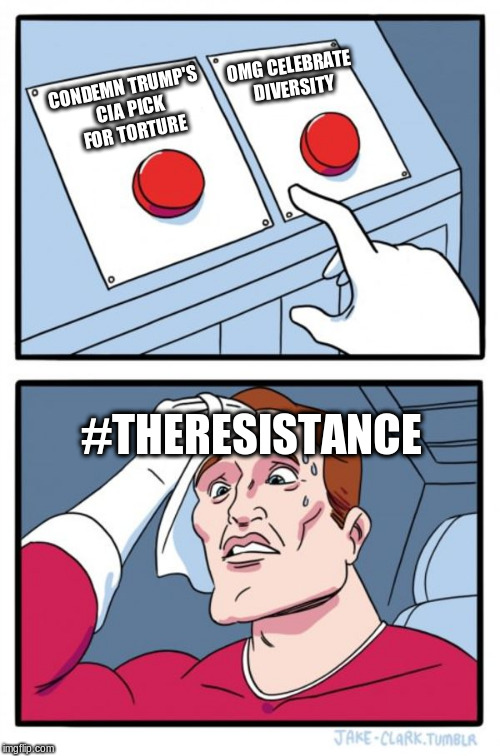
But acknowledging this should not make us blind to the usage of such policies in service of propaganda or an establishment which opens some doors while shutting others. Such is increasingly the case with the Woke Warrior Woman.
The Woke Warrior Women, or Wymynne if one is feeling extra spicy, are effectively the same lanyarded defense-nerds that have existed among the bipartisan consensus guys in American foreign policy circles. Support for military expansion and interventionism is always a net good, opposition to it is always at least misguided. American Exceptionalism is assumed to be at least somewhat true, and the agency or reasoning of foreign actors is often viewed on a scale of morality play vis-a-vis American norms and objectives. But now these types are more strongly identified as Democrats with solidly progressive chops on domestic (social) issues. Newly ‘radicalized’ by Trump and flush with the relative successes of the Obama years (fittingly, an administration that only truly succeeded on domestic social policy and reverted to Bushism on everything else), the WWW (W3?)’s believe themselves to be edgy and successful boundary pushers.
The actual effect of what they are largely doing in the present context, however, is to simply increase the size of the tent for the policies that are long since established as unchangeable and establishment-defended without actually changing any of those policies themselves. In many ways this is the cultural signifier for how the Democratic Party mainstream continues to drift to the neoconservative right. It is, in its own internal logic, a rational response in a way. If the international liberal order is no longer and inevitable end-destination of a humanity moving clearly on a linear and progressive path than perhaps this sinking ship can only be righted by taking it into battle and sinking all the other ships first. In this particular way the neocons were actually smarter than the traditional liberals-at least they recognized that their pie in the sky teleology was not reachable without hard power behind it.
Of course, rather than learn the lesson that perhaps the view of history as a universal and progressive process leading to a unified conclusion is far more faith than science (or even really humanities), it becomes easier for such people not to intellectually challenge themselves but rather just advocate more strident methods to keep their illusions going. The slipping of mainstream liberalism into neoconservative territory as reflected by the dominant wing of the Democratic Party is really a natural result of this type of flailing. They have to maintain that Iraq was bad-it is now entrenched as a partisan issue-but Syria and Libya were different because…reasons. Never mind both states were significantly better governed than Iraq ever was under Saddam or that Syria’s sectarian divisions are even more convoluted and dangerous than that of Iraq. Here come the Samantha Powers, and they know what is best! They aren’t some knuckledragging brutes, and so they can bring a different perspective!
Except that so far, they really don’t. Women, like men, are only allowed into the Beltway Consensus Club’s highest echelons if they tow that very consensus. In building a new government from scratch this may be necessary, but in an old and well established institution this can often be intellectual death. If growing the tent means the same ideological uniformity, then the tent’s actual potential for adaptability and new thinking is utterly squandered.
Madeline Albright’s enforcement of the sanctions regime on Iraq in the 90s was every bit as brutal in its effect and lack of results as the actual invasion was. Samantha Power’s complicity in aiding the Saudi intervention in Yemen is every bit of the policies she once criticized others for doing, and Gina Haspel’s running of an ‘enhanced interrogation’ black site was on the same level of support for bad policy that the once derided John Yoo used to give. Maybe Yoo wishes he once could have played the woman card. It certainly will be used by much of the media and political classes to dismiss criticism of Trump’s new appointee to head the CIA.
What most of this, of course, is that the defense establishment has smelled the winds of change. They tried to hold the line on being somewhat conservative until the repeal of Don’t Ask Don’t Tell showed them that, given shifting norms and the youthful demographic they seek to recruit, not only could they survive by adopting social liberalism but also that they could *thrive* with it.
This is not an unwise choice. The military was in fact throwing away endless amounts of talent before. It is perfectly reasonable for them to adopt this line as they move into a world where young people with socially reactionary views on gender and sexuality become smaller and smaller…But make no mistake, the goals of this type of marketing is just as much about getting on the good graces of the public and commentariat classes as it is expanding the recruit pool. If people nod their heads in agreement at the ‘wokeness’ (performative or otherwise) in the Pentagon or among defense contractors, they might be more willing to overlook the blatant financial malfeasance that goes on in such places, the mercenary like costliness of many private allied organizations, and the normalization of endless and unnecessary warfare.
If much of the establishment continued to hold on to the socially conservative front, it might be overextended when it also tried to hold on to its more bottom line fiscal and foreign policy fronts. You can only save so many dinosaurs at one time, and social issues represent by far the least amount of sacrifice for the old guard to dispense with. The military only looks better in the public sphere when ViceVox can write up an article about how Totally Tubular it is that These Women Drone Pilots are Spreading Wokeness over the Skies of Yemen!
One the other hand, though, at least their messaging has improved from the old ‘join the marines and slay green screen dragons’ days:
So the Obama era is almost totally over. I don’t really want to get into domestic politics as I have been doing that enough recently on this blog due to the upset election and which is contrary to its main purpose-but it should also be obvious from past entries that I have not always seen eye to eye with this administration on foreign affairs. If the Democratic Party is to have any future, however, either in domestic or foreign affairs, it is my sincere hope that it embraces the wing of Tulsi Gabbard and rejects that of Corey Booker and the Clintons.
So why, talking about a party that had all the signs of winning big in 2016 and lost to a meme candidate, am I saying ‘Thanks, Obama?’ on my foreign policy focused blog? Let me present you with a horrifying alternate history scenario that should chill your spine no matter what your politics looks like:
Hillary Clinton or John McCain wins the presidency in 2008. 3 years later, the Arab Spring Happens and ‘it’s 3AM in Tehran, who do you want picking up the phone?’
The neocon establishment is fully entrenched and unchecked, US military interventions in all affected countries including ground troops ensue. This further increases the horror and refugee crisis, spilling over the chaos into yet more countries. An entire region of military command is effectively immersed in something that makes Vietnam look like a playground fight.The U.S. is so weakened and possibly working in tandem with Islamists to pick up the on-the-ground slack that other powers jump in, backing more sustainable sides and gravely increasing the likelihood of great power conflict even beyond US-Russia rivalry in Syria today. Soon the fighting spreads south of the Sahara, overwhelming countries with poor counter-insurgency infrastructure.
To be a bit less serious:
‘Day 86 of the Siege of Nouakchot and while 250,000 US troops remain trapped amidst a sea of the rapidly growing Boko Haram Army, Islamist forces continue to advance northwards further east, pledging to exterminate all Copts and other minorities. Secretary of State, Michele Flournoy said ‘the march of democracy is full of broken eggs to make a Freedom Omelette. We will direct forces eastward and encourage the moderate opposition while we hold off the radicals in Mauritania.’
‘We will kill all infidel scum’ said obstensive U.S. ally Abdhul Al-Jihadi, ‘god willing they will all die by the blade like pigs.’
‘Don’t worry,’ added Flournoy, ‘They will calm down once they have an election.”
Domestic Politics? In *this* blog? It’s more likely than you think.
Of course, I really mean to discuss how American domestic politics impacts foreign policy. So it still fits the theme.
You would think that in a highly competitive primary season with both parties selecting from pools of candidates that there would be more interesting discussions on foreign policy in the United States. While it was true that Rand Paul was the torch bearer of sanity in foreign policy (if little else) earlier on, he has already become history. Donald Trump, who is grotesque and hilarious in equal measures, has at least forced a reckoning on Dubya’s legacy long delayed by the GOP-even if he has no coherent ideas of his own.
The candidates both party establishments clearly want to win are, unsurprisingly, the two most hawkish of hawks. Hillary Clinton and Marco Rubio are basically indistinguishable from each other on big picture foreign affairs. American Exceptionalism, delusions of grandeur, and a blind faith in military solutions when regarding small weaker nations ruled in ways contrary to American values. They both have track records of opinions which would meet the approval of Cheney and Kristol alike.
The Democratic primary is just as much wild card vs reckoning. No one actually knows what Bernie Sanders holds as views on foreign policy, if any are coherent at all. But then a very interesting thing happened…Tulsi Gabbard resigned her post as DNC Vice Chair to endorse him.
I am definitely not yet sold on the Sanders bandwagon, nor do I think endorsements matter as much as people think they do, but I cannot contain my joy at the following two things:
1. I remain convinced that Gabbard is going places. I have mentioned her previously on this blog as one of the rare realists left in congress. We have had decades of endless and naively conducted war with little grand strategic perspective. With a Sanders nomination unlikely she took a long term calculation to back him specifically because of foreign policy issues and to build her future reputation as the foreign policy realist (who is not Rand Paul). Its her career trajectory that most fascinates me rather than his. And if he does win, she will no doubt get an interesting cabinet post.
2. I am so thankful after decades of evidence that the Clintons are basically Dick Cheney Lite that someone is making a major point of finally calling them out for it. The media never had the spine to do this. It still doesn’t. They look at the quantity of titles on her resume without looking to see the quality and results of what they describe.
There is something beautifully Roveian (in the best ways) about destroying a foe’s strength. Going after Clinton on foreign policy is like a factual and justifiable version of swift boating, you sink the opposition’s main selling point-and this time you actually do it by telling the verifiable truth. Obviously Gabbard can do this, and Sanders cannot as he has no actually articulated foreign policy views or coherent record.
Maybe, just maybe, we can have a real discussion about foreign policy in this election season…for once. After all, this is hardly an issue that primarily affects Americans. One could say in fact it primarily affects people who are not Americans. That is why non-Americans tend to know more about American foreign policy than Americans do, by and large.
Plus, while you might think a trickster themed blog does revel in the chaos-or shadenfreude- caused by Trumps’ run, I would counter that Trump is just a shuckster insider who knows how to play the system created by decades of toxic (primarily conservative) social divide and rule politics. A quite typical figure actually in the mold of William Jennings Bryan, Vladimir Putin, or Marine le Pen. Whereas the first Hindu in congress (potentially, hopefully?) running with in some capacity a Jewish candidate against a bombardment of media hostility and entrenched interests is a much more interesting upset to the system. Trump after all hardly threatens any media oligarch tax brackets and thus no doubt they could come to accommodate him.
Even if the Sanders ticket goes down in defeat, as is probable, its run will have shaken things up-specifically in the realm least expected of it, that of foreign policy.



 The Trickster's Guide to Geopolitics