
A predictable outbreak of debate and reaction has washed over the United States and many of its allies in light of the joint U.S.-Israeli assault on Iran that is presently unfolding. This includes debates over what percentage of the Iranian people want to see their government overthrown against how many would fight against foreign attack, what the damage done to diplomacy in the region will be, and how dangerous the Iranian and Israeli nations are to the Middle East. What all of this is often missing, however, is geography itself. And when looked at through the lens of geography- so core a concept to understanding geopolitics that it is part of the name- something becomes apparent:
The Middle East is not a particularly vital region of the world for those who live far outside of it.
My perspective is based in North America, but much of this applies to other regions of the world too. Many countries have pivoted away from fossil fuel dependence on the Persian Gulf. The United States in particular is now the world’s largest oil and gas exporter. There is no major world power based in the Middle East nor is there one (as the endless War on Terror seems to be showing) capable of utterly dominating it. Locally rooted middle powers are the most dominant long-term actors, and they have the capacity to outlast the imperial flirtations of more outside powers with global interests.
For profit defense contracting is certainly a major influence, keeping an unbroken stream of revenue pouring in from endless conflicts, and made especially lucrative by both the United Arab Emirates and Israel’s constant addiction to behaving as interventionist powers in their near abroad. Such honeypots in turn fuel media advertisement which in turn purchases favorable coverage and lobbying. But perpetual conflicts also exist in Myanmar, the Congo, the Sahel, and, albeit frozen, the Korean Peninsula, and in none of those places is there such a drive to intervene and to internalize the struggles of various peoples as there is for the Middle East. There is a genuine and seemingly at least partially organic push by many to see the safety and even outright expansion of Israel as some kind of existential virtue on behalf of some grand civilizational struggle. Likewise, amongst opposition to this consensus, the struggle of the Palestinians has become a moral litmus test in a way few other causes are touted. How Iran is governed internally also has become interwoven into these local struggles that so many insist on making global. The push for an Israeli regional supremacism is generally given far greater credence in mainstream commentary than its inverse doppleganger. Up to and including the Wall Street Journal’s editorials salivating for the next war for Israel against NATO-aligned countries before the present is even finished.
What accounts for this constant return of the U.S. and others and the comparative enthusiasm it receives from many despite often dismal results? I would argue that it is religious identification. Numerous sects of Christians, usually Protestant in denomination (and almost always evangelical variants) view Israel as a chosen land governed by a chosen people. In alliance with the equally ideological objectives of the neoconservative movement, which is almost monomaniacally fixated on the support of Israel, they seek to disseminate a narrative of prophecy and apocalypse- a final showdown for the entire planet at the ancient battlefield of Megiddo. The Jews were chosen by the Abrahamic God to be a special people on Earth, even if Evangelicals effectively view them as a human sacrifice to usher in the Book of Revelation’s promise to bring about a final war of all that is good against all that is evil. The True Believers, who make no secret of their intentions to use the United States military as their crucible of prophecy, will enter the Kingdom of Heaven, and the rest of us evildoers will be cast down into Hell where we can no longer remind The Elect about such pesky principles such as nuance, balance of power, and the fact that geopolitics at its most rational is ultimately not about morality or absolutes. A calculation that would inevitably turn up a dim view of outside powers being involved in local Levantine power struggles.
This is an even more unhinged-albeit clearly related- version of the liberal-humanist world view of an ever-advancing wave of democratic-capitalist societies putting on the ‘right side of history’. Both, however, share a total disregard for any sort of sustainability and see human lives as expendable in the face of some grand globalist ideological project. As it is, many supposedly secular people from outside of the Middle East have still adopted a Middle East-centric world view as a kind of automatic cultural inheritance. The time to critically interrogate this baggage is now well overdue.
The monomaniacal fixation of being involved in smaller regional wars on the other side of the planet from one’s home has exposed the dangers of universalist ideology. And no part of the world seems to attract this ideology quite like the Middle East, the place where it was first born. The Abrahamist world view taught that the local and situational was to be disdained for the existential and the absolute. A world whose only distinctions were moral, not geographic or cultural. From U.S. Ambassador to Israel Mike Huckabee to the Mullahs in Tehran, to the wailing snake-charmers surrounding the present President in the Oval Office, all agree; the fight for the soul of the world lies in the disposition of this dry and dusky land once known as the Fertile Crescent.
The spatial focus that should be at the center of all policy priorities is rejected, and countries like the United States, who should be rooted in the Western Hemisphere or, at most, the Pacific and Atlantic littorals as an offshore balancer, is once again dragged by the baggage of someone else’s history into wading into a strip of land no more valuable than any other on the far side of the world. In the heads of the Christian Zionist, the pro-Israel activist, or the global jihadist, the center of the world lies in the Levant. Therefore, their priorities remain fixated first on what they consider the ‘Holy Land’.
But the U.S. (and many of its allies) are secular countries. The First Amendment declared that the state would have no established religion, likewise the 1797 Treaty of Tripoli explicitly disavowed that religious traditions of other nations were of interest to American diplomacy. Knowledge of the horrors of 17th Century Puritanism has prepared the new ruling class in America for the dangers of an overly ideological foreign policy. George Washington himself was primarily motivated by a non-ideological spatial conception of national interest– a legacy that would influence an entire century of U.S. foreign policy after him.
Looking forward, I would urge those who live far from the Middle East to reconsider what the concept of a Holy Land is or should be. Rejecting the cause of universal telos and apocalyptic revelation, all rational foreign policy analysts must know they should not be in the game of rapture-making but rather supporting the stability and prosperity of the homeland. Any world view that advocates for a focus on a distant land over that of one’s own home is one that engaged in a kind of treason against any rational concept of the national interest (something that must be wrestled with first as domestic politics) on behalf what is effectively a globalist mythology of eternal cosmic battle amongst abstract and otherworldly ideals.
The deserts and scrublands of the Middle East are a far cry from North America’s varied natural splendor. If I needed a holy land, this ancient and biodiverse land that contains everything from temperate rainforest to swampy bayou to wide open plains does perfectly fine. Its centrality in its own geospatial mandala must not be sacrificed to those who live amongst its abundance and yet would still place the fables of the Dead Sea above it in importance. Those who live elsewhere may come to a similar conclusion about their own lands and thus they too must resist the siren call of yet more interventions in a distant and utterly unholy land.
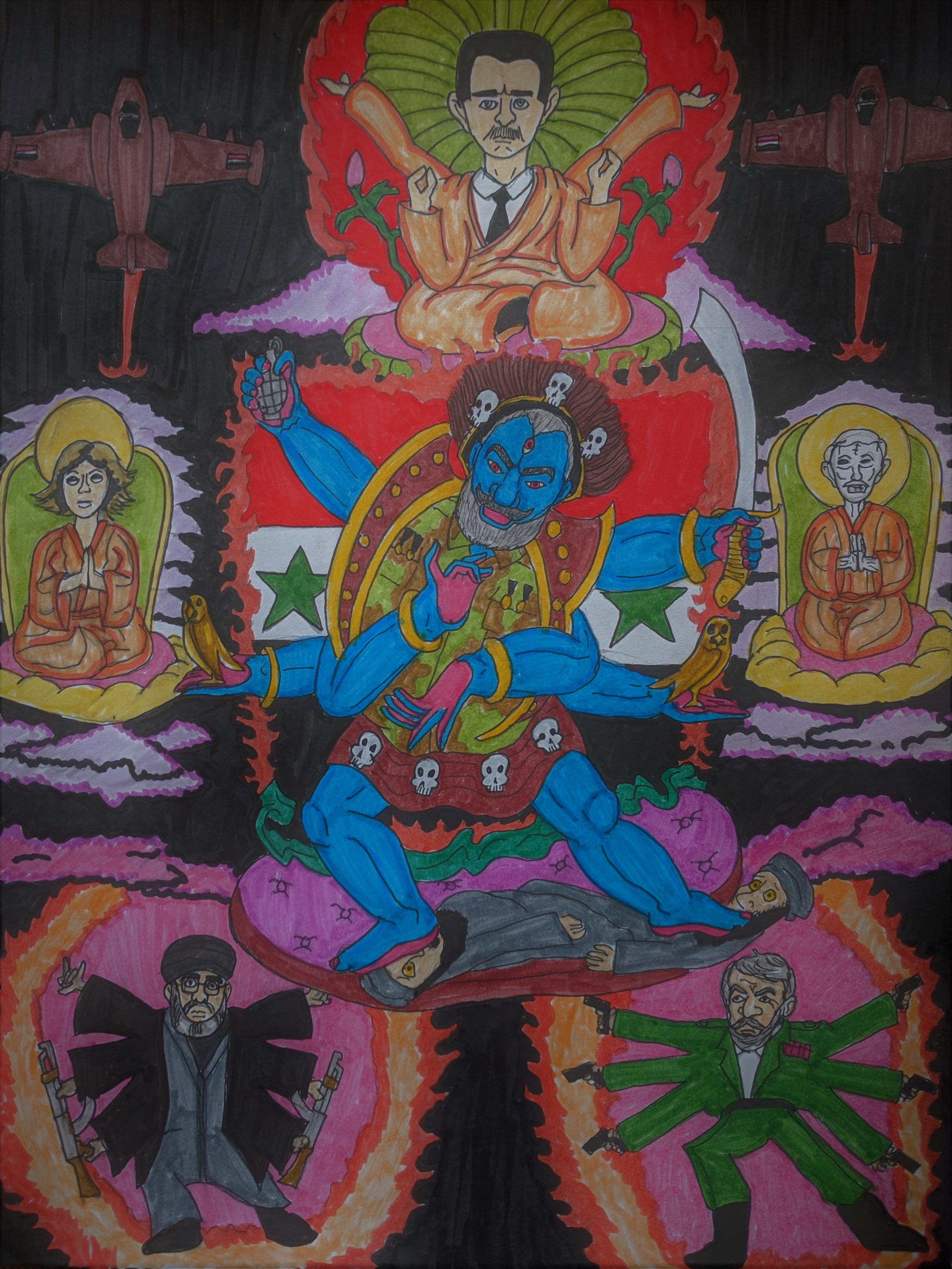
 The Trickster's Guide to Geopolitics