Laird Barron’s Carnivorous Cosmicism

Hunter by Justin Sweet

“”To know itself the universe must drink the blood of its children.” Her voice cracked like an ice shelf collapsing; it roared across an improbable expanse of inches. The talon pressed against my pupil. It went in and in.” ~Laird Barron, ‘Swift to Chase.’

“The foxes run. The foxes die. I mourn them, but I understand that there is a danger in mourning for those who would not mourn you in return. Empathy is for those who can afford it. Empathy is for the privileged. Empathy is not for nature.” ~Tanya Tagaq, ‘Split Tooth.’

Happy October. The best month is upon us so it is time to be thematic.

As of the time of this writing, I am one story away from closing out Not a Speck of Light, Laird Barron’s latest collection of short stories. I imagine that reviews of this specific work will be rapidly proliferating, so I am more interested in examining the overall themes of his oeuvre. All I will say about the latest publication is that it is excellent- as much so as his last collection Swift to Chase. As is normal, there are three or so stories on average from each work that really stick with me, a whole lot I enjoy thoroughly, and one or two that I am simply (but not negatively) baffled by.

Barron’s publicly available biography is well known because it is so interesting. Born and raised in Alaska, he worked in fishing and dog sledding, and spent some time in Washington State before moving to upstate New York. These three locations are extremely present in his works. Interestingly, he seems to be working backwards, with more recent stories being more likely to be set in Alaska. His earlier work was Washington-focused. There is also a novel series set in New York State, which retains the weirdness of his shorter fiction if more indirectly but is more focused on two fisted mystery and action.

Most of Barron’s stories are readable as self-contained and stand alone entries. Yet there is a clear overlap and greater cosmos going on here. Characters reappear, as do cults and monsters. Old Leech, an eldritch being who loves humanity “in his own way”, enjoys feasting on our suffering to sustain either his power or perhaps merely to slake his boredom. The world is animalistic and very much alive. But it is not a Live, Laugh, Love world- although you can do all of those things in it if you like.

Something that brings all of Barron’s work together, at least from my own perspective, is the same thing that has attracted me to for eleven years now: Its ruthless paganism. Barron’s protagonists are like Robert E Howard’s in the sense that they are tough and fight back no matter the odds. Unlike Howard, however, who was very much on Team Humanity, human supremacy never exists in Barron’s world. No one wins out over entropy. The food chain, like in Lovecraft of Clark Ashton Smith, is not stacked in favor of man. People fight back, but they often go down fighting. Specific underlings and odious toadies can get their comeuppance, but the protagonists don’t really win either in the long run. I have long maintained that Barron is really a modern Sword and Sorcery author more than even a horror author. That older and better form of fantasy was rooted in an earthy defiance of established order combined with naturalistic sensibilities. Horror was everywhere, but so was adventure. The world was predatory and so were its heroes.

A film example of sword and sorcery in the modern day which also goes unrecognized is the film Mandy, a movie I suspect Barron has seen, especially considering the direction some of his newer stories have taken in the past few years. In this way it takes one to know one as that film also influenced my own writing.

What you get with Barron is a kind of beautifully sparse and atmospheric writing style. Cormac McCarthy doing the pulps. But to say this is pulp is not to deny its literary value. In a culture where we are expected to be awash in Platonic idealism and a mandatory public moralism, it is of cultural value to take the human glasses off from time to time and see the surging tide of instinct and feeding that undergirds our experience. Life is visceral, and above such notions as good and evil. Suffering is everywhere, but so is the joy of combatting it. The pulps understood this drive, to see the awe in horror. Mysterium Tremendum made manifest. To choose life is to choose confronting, perhaps embracing, horror. Personally, I think these kinds of outlooks are extremely useful to meet many present challenges.

Barron shows us a world where everything eats everything else. An endless cycle of predation and consumption. It is perfectly in line with the view of the surviving shamanistic traditions or the old gods. This is the shamanic journey, where one is devoured by monstrous animals before being reborn with the devouring beast as a personal guide. One lives, laughs, and loves with a bloodstained mouth. As the musician and author Tanya Tagaq once put it while complaining about PETA’s demonization of traditional indigenous communities continuing to hunt: “We’re animals! We’re meat! We’re so stupid to think we are not.”

I am not one to become personally invested in people I do not know directly. When famous people I respect become ill or die it does not impact me like it does others. One very big exception to this, I found out, was when it was announced not too long ago that Laird Barron had a sudden and major medical emergency. A jolt passed through me fearing the worst. It was the fear that we would lose one of our best living authors. Someone who spoke to a reality lost in the endless publications of mainstream literary fiction with its endless focus on human subjectivity. Someone who had been one of the main reasons I had gotten back into writing fiction after years of inactivity on that hobby. Thankfully, he pulled through. Old Leech isn’t done digesting us yet. Here is to many more- both years and publications.

I can’t help but wonder if he listens to atmospheric black metal.

Swords Against Nerdery: A Khaldunian Theory of the Sword and Sorcery Genre

swords against wizardry

I’ve been a stalwart fan of the Sword and Sorcery genre and its iterations for a very long time. It is second only to horror and weird fiction for my fictional genre enjoyment. I have also been just as much a foe and hater of high fantasy for an even longer period of time. I never really gave much thought as to why this is until recently, assuming that the rank corniness and ethical Manicheism of high fantasy as compared to the more ambiguous and earthy nature of sword and sorcery were alone enough to clinch the deal for me. But my recent discovery that cultural commentary need not all be a horror show of religious fanatics, entertainment industry neoliberals, and blue-haired-septum pierced woke scolds jarred some thoughts about this topic. Indeed, the people mentioned in the sentence above-the ruiners of cultural critique-are a big part of the difference between traditional fantasy and sword sorcery, and more importantly, the kinds of people each appeals to. Plus, if your rivals are going to use such language in the real world, ridiculous as it is, you might as well be able to meet them on a level they can understand. Much like a sophisticated vocabulary is not a good idea when speaking to children.

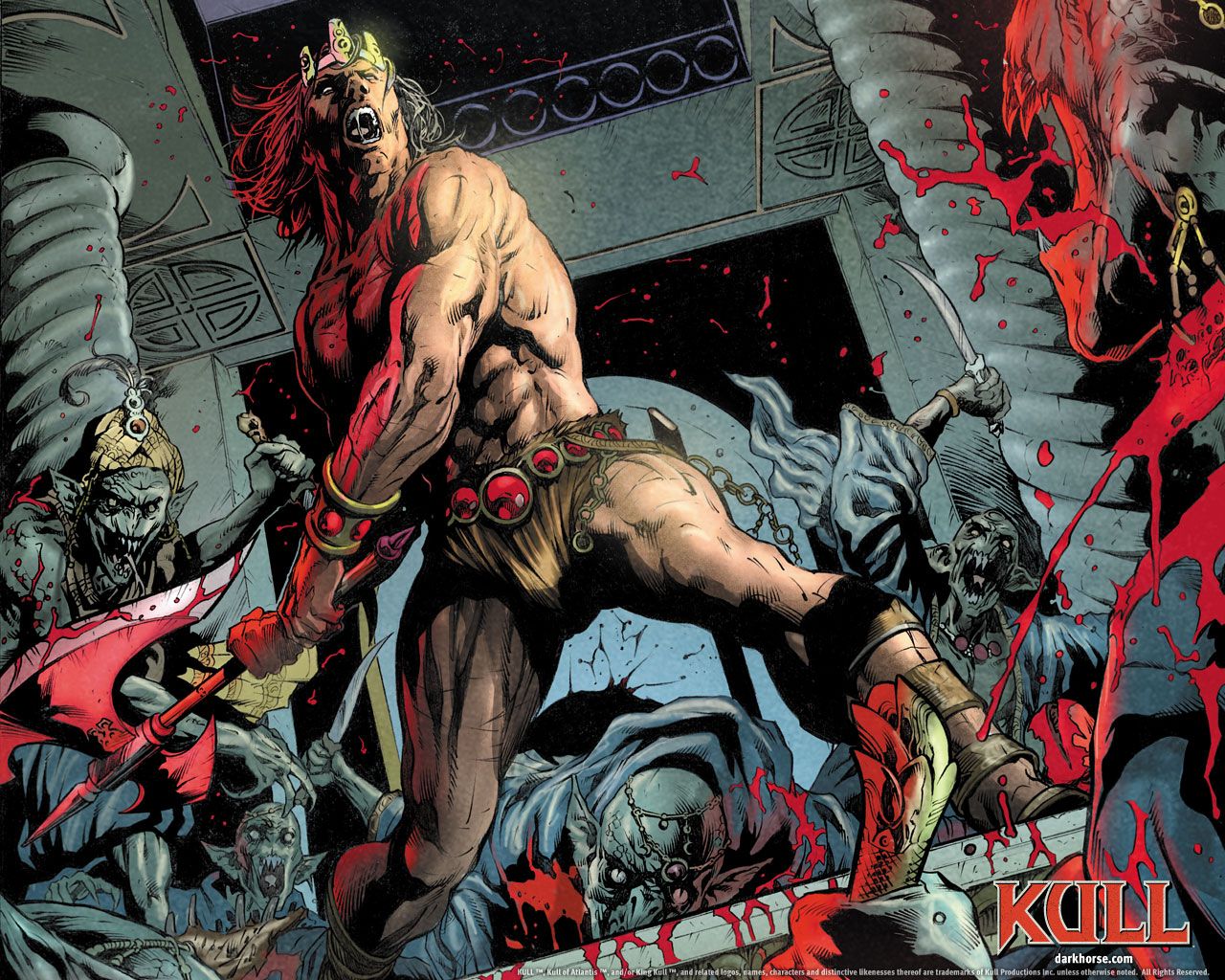
What makes S&S what it is are protagonists with base motivations, magic being rare and mind-bending if not outright a cosmic horror, glories being relegated to a mythical past if even mentioned, and above all the love of a good tale about powerful outsiders, usually barbarians or criminals, and the decadent magical and political forces they often find themselves at crossed swords with. There are no grand battles of good vs evil or light vs darkness here. Large conflicts tend to be one local petty kingdom vs another with the protagonist happening to find themselves on one side or the other through chance, personal vendetta, or mercenary motives. This is the stuff of Robert E Howard, usually considered the inventor of the genre (as well as the maker of its two greatest incarnations, Kull and Conan), not of Tolkien or his many many increasingly terrible imitators. This is the less famous and far more interesting world(s) of Imaro, Fafhrd and the Grey Mouser, Kane, Jirel of Joiry, and Nifft the Lean.

What I like most about the genre aside from its general fun, of course, is its Ibn Khaldun-derived general view of human nature and of societal processes. Unlike the dominant ideologies of our time (which are reflected in our dominant fantasies apparently), history isn’t a teleology. It isn’t going along some pre-determined path. It is rather a series of competitive crisis managements that fail or succeed to different levels amongst a series of cultures and societies that were born into some form of success or stability and have been declining towards their fall and replacement ever since. Then the cycle begins anew. This is neither the reactionary thought of a Burke, the Catholic Church, or of modern-day patrician centrism, where a magical tower is continually built towards the heavens, nor is it the edginess of the pure radical, who revels in the demolishment of all for a wholly new leap in the dark, but rather sociology as a natural process. In fact, both of these extremes are often the antagonists of S&S stories. The first as the cloistered evil wizard or decadent king in their ivory or onyx tower, the second as a re-awakened cosmic horror or the monsters that dwell out in the wilds. Often, one is summoned by the other.

The protagonists of this genre tend to share things in common too. An outsider status, tight but rare friendships in an untrustworthy world, and a disdain for declared authority. Most importantly, many of these characters follow the Khaldunian path of barbarian nomads by eventually leveraging their advantages into kingship, toppling the old order but replacing it with a new and more vigorous one. Conan, the most famous hero of the genre, becomes king of Aquilonia. Kull was king of Valusia aeons before him, both were barbarians who started out fighting those very kingdoms. Fafhrd and the Grey Mouser eventually end up as the local bigwigs on a subarctic settlement, Imaro as a legend across the lands with a mixed reputation. All come across dark entrenched forces that more live by inertia in entropy than by dynamic action. Most importantly, the various wizards, sorcerers, and the like are usually not world-threatening menaces but rather merely another cog in some kingdoms political machine, or a criminal guild’s most prized member, or the secret forces behind events within kingdoms. The decadent throne of Valusia was only given vigor by Kull, and first he had to survive assassination attempts by literal lizard people who had secretly controlled the kingdom and held it in bondage to old ways by puppeting previous kings. If that is not a conspiracy theorists fever dream come to life, I don’t know what its. But symbolically it resonates much as Pizzagate is obviously an (ironically hilarious) farce that no one should actually believe, but it speaks volumes about how many view our present ruling classes. It was after all only after the various housecleanings of Conan that Aquilonia entered its golden age, even if this, like all times before, could not last.

kull

S&S is, in effect, the Virgin vs Chad meme of fantasy genres. Cold steel always outperforms the elaborate machinations of a bunch of tower-dwelling neckbeards, court eunuchs, and inbred aristocrats. In a temporary, ever-fluctuating world, only the right use of force and alliances can see you through. This is not a glorification of violence and always taking the offense either. The vast majority of S&S heroes, when not being thieves, are usually wronged before they act. They do not seek fights, but rather respond decisively when such battles are forced upon them. The kingships of Kull and Conan are remarkable for how much less warlike they often are compared to their neighbors, with the real battles being keeping the decadent dying courts of rivals at bay.  Meanwhile, all of these outsider protagonists tend to be extremely well traveled, multiple language speaking, highly analytical thinkers. The Nerd-Wizards, on the other hand, so haughty and proud in their rote-learned intelligence, are almost helpless without prestige, ceremony, and dependency on established power networks. Their lack of contact with the brute reality of the world is their undoing.

It all reminds me of recent commentary I read somewhere (source presently slips my mind) about the superiority of speculative realist philosophies against correlationist ones, with the hobbies of the thinkers compared with their thought. It basically broke down that the realists tended to like hiking, travel, adventure, while the correlationists and idealists were often desk bound thinkers. This was shown by the nature analogies used by each, with correlationists tending strongly towards inanimate solitary objects like furniture and the realists using animals, plants, ecosystems, and weather.

And look, there I managed to tie this post into my fascination with Speculative Realism too. Anyway, back to the point.

It is these decadent courts whose thumb we presently dwell, tolerant as they are of neckbearded nerd-wizards in their towers and court lanyards that are the most aggressive threats to the world arise. Lacking true fortitude and strength as intrinsic character traits, they must rather pretend they have it through fraud and posturing- a far more dangerous proposition. Fantasy Bill Kristol types in effect. And if some group or leader came about who actually was interested in changing these entrenched interests they would face plots and palace coups aplenty from the dark forces that fester in the shadows of the kingdom. But that’s no reason not to try anyway. Even if you fail it will make for a good tale around a few pints, anyway. And someone needs to Hold the Sword against this high fantasy loving nerd tyranny we live in, where neoliberal nerds who identify their politics with the entertainment they consume are the predominant cultural force of strange cosmic horror summoning sorcerer class. If we must live in a nerd-dominated culture, then we can at least speak the language of the Chadliest of nerds…and that is of Sword and Sorcery. It is not like high fantasy represents anything but the pathologies of both liberals and reactionaries alike and their presently collapsing world views.

Anyway, here is a picture I did for a Mandy style movie poster (Mandy may take place in the 1980s but it is very much a S&S genre film-trust me) of Tulsi Gabbard clearing out the wretched dungeon of the Democratic establishment (special guest MBS, with Hillary, Booker, Harris, Podesta, Biden, and Power all thrown).

Tulsi Mandy Style Dungeon

But seriously, read nonfiction first for real commentary, people. Actual history and philosophy will always rule at the end of the day. But maybe…maybe sword and sorcery can help on the propaganda front anyway. It certainly can break up the high virgin fantasy monotony.