The ‘Liberal Media’ is Not Ready for a Multipolar World

Tucker Carlson’s recent interview with Vladimir Putin has touched off a firestorm of criticism in the Anglo-American press. An interesting turn of events considering that the United States and its allies are not officially at war with Russia. It was once the case that journalists would have jumped at the chance to interview the leader of a rival state, but now it seems to break message unity with the establishment on foreign policy is to commit an act of unofficial treason. Never mind that the interview is hardly being seen as an undisputed success in Russia. It is worth examining why this circling of the wagons has become the case.

The establishment press is majority liberal. Not necessarily in the sense that it is used in U.S. partisan domestic discourse, but in the philosophical sense. It is primarily made up of people who believe that an individual making choices in a marketplace of ideas and goods is the core unit of society. This usually comes with a set of assumptions- that history is teleological and linear with clear-cut right and wrong sides, and that economic development will cause political and economic convergence between different societies. Such a world view leads to an attitude which is akin to that of the missionary: If liberalism is a universal good, it must be expanded by any means

It is in this sense that much of the North Atlantic’s foreign policy focused press is also liberal. Regardless of if the author or publication is left, center, or right in official inclination when it comes to domestic issues. There is a kind of monoculture based around seeing the U.S.-led alliance network as ‘values based’ forces of light, against a nefariously defined ‘authoritarian’ alliance of darkness.

The multipolar world we are entering, however, is not an abstract choice by policymakers. It is an inevitability. The existence of a roughly three decade long interregnum of an unchallenged United States being able to imprint itself on as many parts of the globe as possible is coming to an end. Not because anyone lost their moxy or gumption, but because there are more countries, great and middle powers alike, that are much stronger now than before. The United States in the 1950s had almost half of the world’s industrial and economic power, today it is roughly a quarter. Its power is real and still unsurpassed, but the proportions vis-a-vis the globe have shifted dramatically.

The double standards between the rhetoric and practice of the “Pax Americana” have always been there, but recent events coupled with the diminishing ability of Washington to hold itself up as the global gold standard make them all the more glaring. Even the concept of human rights, itself the darling cause of a liberal press, is ultimately dependent on unipolarity in order to have any kind of globally applicable definition. As viable rival power poles continue to multiply in different regions of the world, causes such as these will see a multiplicity of values replace what was once assumed to be convergence. Whether one celebrates, laments, or is indifferent to this state of affairs, to accept this inevitably is to acknowledge the increasingly undeniable. 

But can the liberal-internationalist media foreign policy complex do so? This press culture has grown accustomed to two generations of constant self-validation building off of the fall of the Soviet Union- an event that fades ever more distantly into the past. Long flattered by the expatriates of their own profession (who share similar class backgrounds) who originate from less free countries and who seek better opportunities abroad with affirmations of loyalty to a democratic ‘west’, it is worth asking if this field as a whole is even capable of understanding that some societies may now want to pivot away from, rather than towards, the world view of internationalist liberalism.

Long used to not being challenged by different values or divergent interests, it seems quite possible, even probable, that the liberal press will have to run into the reality that not every foreigners is a poor oppressed drone with an inner American yearning to be liberated from the shell of their circumstances. Regionalism and nationalism are more likely to drive domestic pressures on the foreign policy of many states than the quest for political globalization. When journalists actively pine for a free world guaranteed by liberal hawkishness, they do so from the perspective of their concept of freedom dominating all others. The long-held ability to monopolize the media discussion on other countries by manufacturing conformism on issues related to human rights abroad is rapidly deteriorating in the face of growing distrust from the general public

As U.S. power diminishes in a relativistic sense towards most of the world, will the reporting on foreign affairs be able to psychologically adjust? The question is worth asking because the way in which this reporting is framed can often impact the general public discussion. Even simple adjustments such as taking the old Wikipedia’s policies on scouring ‘weasel words’ (i.e. value-saturated adjectives meant to tilt the reader’s perceptions included in supposedly unbiased reporting) could meet with pushback from journalists citing such small steps as ‘selling out to tyranny’ or ‘endorsing oppression.’ This means that as more regions of the world come into their own concept of statecraft priorities much of the press will actually increase its agitation for sanctions and military operations even as the capacity for the liberal states they are based in to engage in such interventions decreases. Will necessary cordial relationships with countries with different domestic values be too baffling to comprehend for a professional class so tied to a universalist worldview they see international relations as an extension of domestic culture war? Would a breakdown in relations between two liberal states precipitate an existential crisis among the commentariat? Most importantly, would diplomats be constantly hounded for doing their jobs in a sober and prudent fashion by a press that demands purity, leading to opportunistic politicians running against the practitioners of statecraft itself in order to court favorable press coverage?

These factors, if not addressed, pose a very real danger when the majority of the foreign policy press attempts to shape liberal discourse over a world that is unquestionably realist- where divergent interests, values, and capabilities must be taken as they are in an ever-changing and vaguely cyclic world. So the question remains, can a profession that has spent decades giving itself over to the missionary impulse adapt to a world where the hard compromises of diplomacy inevitably reign? And what happens if it does not?


Fools Pick Fights That Aren’t Their Own

I was originally going to write this post anyway before all the Gaza Strip stuff happened. I was simply waiting to get back from an international trip before doing so. That a new round of fighting between Israel and Palestine broke at the tail end of my trip only added from my desire to write such a thing. And while I know it would get more attention if I published it externally at some official publication, I feel few would allow me to say what I really want on the subject.

Every tribal war or local territorial dispute now has taken on global dimensions due to media saturation, the universalist claims of the American state, and the existential rhetoric its opponents adopt in response. This leads to a massive distortion in what people regard as self-interest, rejecting rationalist prudence for a crusader mentality of whatever the pet cause of the day is or ones personal/psychological vendettas.

People who live in North America for instance, but have no friends or family in either Israel or Palestine, are deeply invested in a tribal ethnic war that has no bearing on their life. Or, would have no bearing on their life were it not for the risk of outside power escalation. And the primary driver of outside power escalation is of course countries (and their publics) wanting to ‘do something‘. This is why interventionist states and their mouthpieces in the press are so obsessed with human rights narratives. They are always seeking to manufacture consent for the next intervention. It is increasingly obvious that in order to care about peace and stability one must not embrace, but renounce, the human rights focused view of the world.

While I am sure a large amount of the religious fanfiction of some cultures draws them like flies to shit when conflict in the Levant breaks out, this region is hardly alone in attracting this kind of attention. Having a national interest based discussion about Ukraine in North America, for instance, is always buried under layers of posturing bullshit about democracy, clashes of civilizations, and whatnot.

The obsession with tallying ‘War Crimes’ is a big part of this and may be central to this kind of rhetoric. The problem is war crimes trials are always by necessity victors justice, and without trials the concept has no meaning but a kind of whine. Power differentials make the concept situational as we know certain people will be punished and others not. Furthermore, such discussions feed into a false belief that war can be tamed and functions as a kind of courtly jousting match on a predetermined field. But in an era of mass urbanization, high explosives, and existentially justified stakes, this is impossible. Any war is a war on civilians and therefore the point of ‘war crimes’ is moot. To support a military operation is, inevitably, to support war on a society, not just its front line military. Considering the logistical network required for militaries to function this is both logical an inevitable. But it also means that to support a war means, undeniably, support for war on civilians and all that entails. This is why I personally support only a very few military operations even though I am not a pacifist. In my adult life I have only directly supported counter-ISIS and counter-Al Qaeda operations. And yes, this means I was fully supporting the demolition of places like Aleppo and Raqqa. Nor did I have the gall to pretend the policies I was advocating were actually for the good of the people being bombed, because no such policy can be good for everyone. The very existence of foreign policy presupposes the obvious observation that there are multiple groups of people with divergent interests.

The political center and its lapdog journalists, in love with war as they are, are actually made more hawkish by their faith that war is a controllable, even chivalric force of social change. Their maudlin humanism is not a hypocrisy except in rhetoric, it is a natural extension of their world view of treating war as transformational and moral rather than the breakdown of order and the failure of diplomacy. But some, even going back to Sunzi, warned us of the truth from the start: War is always a failure and a dangerous roll of the dice, even when it is necessary. That is why it must be kept to a minimum even though it is always prepared for as inevitable. But when it is embraced, it is only rational to embrace it to the maximum. If you believe a war is necessary, you believe the attempted demolition of another society is necessary. At least have the honesty to admit it. All people have a place where they reach this point. It is dishonest to deny it. And becoming squeamish when your faction does not behave in the way a suburban commentariat wishes just shows your views are superficial at best, calculated for social prestige at worst.

But let us not just pick on the centrists. The past month has shown us the worst spread of leftoid and rightoid thought across the board. Our entire culture is unprepared to seriously engage with nuance and restraint. Earlier, a moronic English language spokesperson for the Ukrainian military threatened U.S. citizens for criticizing involvement in the war. Even a cursory examination of this person’s past reveals a sadly predictable pattern: the lost soul in search of a cause who wanders the world looking for a fight that isn’t theirs. Having finally found one (a war which, since the failure of the first Russian offensives anyway, is basically now one of local territorial control) the foreign volunteers have adopted as a cause above and beyond their empty listless life in an attempt to find meaning they are too weak to make for themselves. A lack of self-cultivation leads to radicalization abroad.

I used to analyze patterns of extremist recruitment for jihadist networks when I worked for the U.S. government. It is interesting how many of the psychological identifiers are in place for western Ukraine volunteers. Downward mobility, an obsession with culture war and global teleology, the desire to erase one’s own personal insignificance by joining an existential cause beyond themselves. When these people come home, mark my words, they will destabilize their home countries. They are the new Freikorps, or Japanese army officers after the Siberian Intervention, or jihadists. Their jihad is Reddit (or Azov) and their connections and sense of entitlement make them a domestic danger. At the very least they should be put under surveillance. And for me, a general opponent of the surveillance state, to say that means I am very serious about the danger these people pose to the rest of us.

The right, if anything, has beclowned itself even more than the left and center. At least Ukraine ties into great power competition and therefore is a national security issue of some kind. The Israeli-Palestinian conflict can’t even do that unless you think Saudi Arabia and Iran are global powers…an odd thesis. For years I have been warning the realism and restraint community (who has been rightly happy with more republicans listening to its argument than at any time in generations) that this was a fair-weather situation. I told many people, again and again, that the second something happened to Israel you would see the Bush/Cheney marriage of evangelical end times prophecies and neoconservatism come roaring back to the surface like it had never left. That happened this week. All the Big Tough Guys who pose about being better than the pussy humanists now shriek about seeing the face of war brought to their darling little pet nation, Israel, the nation they have sworn allegiance to above that of their own. This transferred nationalism allowing them to go to places the regular old kind at home is inadequate for. The conservative love of a country which could be considered the biggest ‘welfare queen’ in American history, one that bombed the USS Liberty and constantly schemes to involve Washington in more Middle Eastern quagmires, is a masochistic and yes, quite cucked, affair. Any utility this alliance once had ended with the end of the Cold War, and it now serves only as a burden. Yet these sentimental rightoids cannot stop themselves. Its the Bible Country and its under attack! Tom Clancy would want us to be the heroic protagonists of this new Battle for Civilization! The Left Behind series is now real- get ready to RAPTURE!

And these American Pied Noirs are just waiting to see their Biblical fever dreams reenacted at home as well as abroad. Once again, surveillance is needed. In a rational state without delusions of Imperial Globalism, that’s what we would do. We would treat people more interested in fighting other people’s battles as inherently dangerous and unstable, and merely waiting to bide their time to import those battles back home. The historical record on these type of people is very clear on this point. At the very least their antics should be tracked and publicly documented on public forums.

Conflict zone interest should be categorized on a location-based capacity. The further something is located from you, the less relevant it is. Its ability to impact you only worsens the more things get involved. Anglos are taught from birth to see all struggles as global and good vs evil, but they are inevitably local, contextual, and tribal. They can be everything and existential if you live in or near a place, but are not if further afield. The true danger of globalization is that every struggle can become globalized.

Conflict is both inevitable and eternal. Understanding this, the only rational conclusion is containment, not intervention. Containment is not pacifism and requires both vigilance and force, but it can and will reduce the spread of outbreaks of violence. Those who wish to make local conflicts go global are complicit in making the world a more awful place, be they hawkish politicians or these psychological damaged war tourists. Diplomatic wisdom is being rooted more in place, in a very real physical sense, than being rooted in some Platonic-Manichean realm of battling ideals. It is spatial relationships that should concern the makers of foreign policy, not dreams of world transformation.

George, American Realism, and Me

Though I an unable to find the footage today, I have a very distinct memory of being in early high school right at the dawn of the disastrous George W Bush administration. He was speaking at some event in a historical library about the first President, George Washington. He ended on the note ‘George Washington…or as his friends knew him by, ‘George W.’ Heh. Heh.’

It seemed emblematic for how lame George Washington was. The guy on all the dollar bills who we were collectively shoe horned into liking via the educational system. Of course, my first (kid level) study of the Revolutionary War had convinced me that the guy was overrated as a general and a pampered failson in youth so naturally my contrarian nature made me a decidedly strong critic to show my independently thinking chops. This wasn’t wrong. Public education lies about a lot of things and this instinct largely has served me extremely well.

But its also a bit too easy and obvious to crap on an entire generation of (quite innovative) leadership because many of those people owned slaves or were involved in mass land theft. In an era which had yet to see the rise of a meaningful abolitionist movement anywhere outside congregations of Quakers, and where the economy had already turned into land expropriation as default generations before, it seems an act of pointless moralism to just write off everyone and everything by the standards of today. At least back then no one was knowingly barreling towards planet wide environmental disaster and refusing to do anything meaningful about it. Compared to the supposedly enlightened present, the 1776 generation will date extremely well despite its many faults.

After a decade of basically ignoring and avoiding American history to focus on my true Central and Eastern Asian fixations, I began to come back with my first (non-retail) job, at a library and archive dedicated to the American Revolution. Native American history had ended up becoming my capstone college topic (it remains among my very top interests to this day) and was pushing me, geographically, back to North America. It was here I realized that Washington’s war leadership was certainly still flawed at the tactical level, but was exactly the correct thing needed at the strategic level. He played a long game where using space, keeping his army intact, and dealing ruthlessly with the less than stellar subordinates would eventually increase the odds of decisive French intervention in the war, and thus ultimate victory.

As someone who almost certainly would have been a member of the Federalist Party in those early days, its hardly worth mentioning that my reconciliation with Washington’s legacy was easiest on the domestic politics front. But what made me go from hostile to fully approving of his term in office came as I studied his personal letters, diplomatic correspondence, and general foreign policy views. This is something I often come back to and reference today.

Washington, despite his lionization of today being so thoroughly connected to exceptionalists and chauvinists, was neither. The first country the U.S. had official relations with was Morocco, not France. And it was Washington (and others) who stressed in their correspondence with the king there going for years that their political experiment was meant for North America and not for export. Washington himself disavowed not only any messianic liberal project in foreign relations, but also that the new country was in any way a Christian state. It thus would not be committed to spreading any religion abroad nor would it have any trouble having full normalized relations with states of different religions (like so many European states had). It was for reasons like this, rooted as they were in geographic conceptions of sovereignty, that many historical figures of left wing disposition would come to admire him in future centuries.

These were not just statements meant to secure good relations, as they were diplomatic principles Washington would adhere to throughout his tenure in office. The ultra-pragmatic Jay Treaty being the emblematic manifestation of this world view. It was also the primary focus of his famous Farewell Address, as a small and weak nation looked with concern across an Ocean as Europe once again descended into one of its periodic bouts of warfare:

In the execution of such a plan, nothing is more essential, than that permanent, inveterate antipathies against particular Nations, and passionate attachments for others, should be excluded; and that, in place of them, just and amicable feelings towards all should be cultivated. The Nation, which indulges towards another an habitual hatred, or an habitual fondness, is in some degree a slave. It is a slave to its animosity or to its affection, either of which is sufficient to lead it astray from its duty and its interest. Antipathy in one nation against another disposes each more readily to offer insult and injury, to lay hold of slight causes of umbrage, and to be haughty and intractable, when accidental or trifling occasions of dispute occur. Hence frequent collisions, obstinate, envenomed, and bloody contests. The Nation, prompted by ill-will and resentment, sometimes impels to war the Government, contrary to the best calculations of policy. The Government sometimes participates in the national propensity, and adopts through passion what reason would reject; at other times, it makes the animosity of the nation subservient to projects of hostility instigated by pride, ambition, and other sinister and pernicious motives. The peace often, sometimes perhaps the liberty, of Nations has been the victim.

So likewise, a passionate attachment of one Nation for another produces a variety of evils. Sympathy for the favorite Nation, facilitating the illusion of an imaginary common interest, in cases where no real common interest exists, and infusing into one the enmities of the other, betrays the former into a participation in the quarrels and wars of the latter, without adequate inducement or justification. It leads also to concessions to the favorite Nation of privileges denied to others, which is apt doubly to injure the Nation making the concessions; by unnecessarily parting with what ought to have been retained; and by exciting jealousy, ill-will, and a disposition to retaliate, in the parties from whom equal privileges are withheld. And it gives to ambitious, corrupted, or deluded citizens, (who devote themselves to the favorite nation,) facility to betray or sacrifice the interests of their own country, without odium, sometimes even with popularity; gilding, with the appearances of a virtuous sense of obligation, a commendable deference for public opinion, or a laudable zeal for public good, the base or foolish compliances of ambition, corruption, or infatuation.

There is a lot there that runs in direct opposition to the assumptions of so many of the people who sing Washington’s praises today and view themselves his successors. Especially for those inclined to indulge in overly ideological and sentimental conceptions of diplomacy. But also for the entire military industrial complex which insists on a maximum number of permanent alliances in order to create perpetual markets (which in turn create perpetual lobbyists in DC).

So, it is worth thinking that in this presentist time of mass-cancelling the past that sometimes even the most worn out and overly-lauded figures can still have constructive legacies to present us with.

Solutions From Hell: The Return of the Liberal John Bolton

samantha power

Bolton the War Walrus is out, and while his damage is done the world is still better off with his absence near the levers of power. But as one entrenched ghoul of a dying school of foreign policy retreats, another rises to take their place. A shinier, brighter, more urban and diplomatic version of such policies…but under the surface a similar beast nonetheless. This beast, skeletal head rearing from long sleep upon its lich-like throne, is Samantha Power.

I have no plans to read yet another establishment book endorsed by the likes of Thomas Friedman-something that would surely be regarded as the kiss of death in any sane society. You can read about it indirectly for yourself here if you wish. This is not a book review or even a commentary on her past publications, one of which I have read. No, it’s about what this book tour portends.

You see, the public is finally starting to turn against the ruinous tide of ever-expanding American military involvement abroad. It is unsustainable, it is dangerous, it creates power vacuums filled with even worse actors than the ones removed, and it fuels the refugee crisis (and thus the far right). Indeed, a strong case could be made for it being the truly decisive and quantifiable issue in the exploding Hindenburg airship levels of upset that was the 2016 election. Tulsi is back on the debate stage for the near future and Bernie and Warren are starting to make noises about coming around to many of her positions. Trump ran on some of these critiques of foreign policy though obviously most of his rhetoric was hollow. But he is president and the uber-hawk of Hillary Clinton will never grace high office again unless we start electing deadites. It is logical after continuous failures on the part of the foreign policy establishment since at least (being generous here) 2003 that a reconning is overdue. You could neither explain to the average American what they have benefited from all of this much less the average person in the countries we have destroyed.

With the stark absolutism of the right now holding the reigns of executive power incompetently it is only a matter of time that this wounded but still very influential network of operators sees a chance to re-engage the conversation for more American Exceptionalism and more operations of questionable strategic value in an upcoming Democratic administration. Naturally, self-interest as rhetoric becomes replaced with humanitarian intervention. You know, like in Libya, the intervention Samantha Power did everything she could to help bring about. The one that has re-introduced chattel slavery to North Africa and given Al Qaeda a new home base of operations between the factions of warlords scrabbling over the corpse of a nation. Obama himself was eventually rumored to lump Samantha Power into what he deemed ‘the stupid shit caucus’ though he still bears blame for letting such actors influence him. He would go on in later interviews to imply that Libya was his administration’s greatest mistake.

Power is a smart and serious academic if obviously one so beholden to the discredited doctrine of liberal hegemony. Though it is telling that even in her earlier and more earnest work the ultimate example she gives of the horrors on non-intervention is Rwanda, a country that is far better off after its war compared to where it was before than any nation of recent American intervention. I do believe that she has the smarts to know some of what she says about her time in policymaking is rhetorically embellished and, more importantly, I do think she is capable of self-reflection. This makes the apparent timing and self-hagiographic nature of her new book even more alarming. As multiple reviews of her newest work have pointed out, she barely mentions Libya, the arming of jihadists in Syria, or the Obama administration’s tacit support of Saudi Arabia’s campaigns of nation-wide extermination in Yemen. So what is going on here?

In summary: she thinks she will be national security adviser or secretary of state in a near future Democratic administration. She is putting herself out there to catch someone’s eye in either this cycle or the next.

If you are like me and opposed to the entire trend of 21rst Century American foreign policy, this cannot be allowed to happen. We already barely survived Bolton, we can’t afford the slicker and more subtle version more likely to win over undecideds on this issue. And make no mistake, despite the intentions, the results as shown time and time again are the same. Humanitarian intervention on a global scale is liberal hegemony which is, in turn, neconservative militarism and a bonanza for for-profit military contractors. Same results in increases in refugees, terrorism, right-wing nativism, and the like. It has happened to many times in recent memory alone to be worth recounting here, and worse of all to the strategist, it is not even helpful for American power projection. As I have argued before, it is, in fact, detrimental to the long term sustainability of the world position of the United States.

So pay close attention to which campaign Samantha Power, Lich of Humanitarianism, grafts her phylactery to. I would be willing to bet that Kamala Harris and Jow Biden are her top two choices. And in a universe where the bad Barney the Dinosaur impersonator Cory Booker and the absolute nonentity Beto O’Rourke actually stood a chance probably them too. If Power is there, that campaign is not worth supporting if you want real change on the foreign policy front.

And be prepared for Samantha Power to take the still-warm seat of John Bolton, if not in terms of the actual office, then in the role played in the mind’s eye of the populace. The public face of endless war.


Why Does the Western Left Hate Diplomacy?

‘President Nixon: When the President says he voted for me, he voted for the lesser of two evils.

Chairman Mao: I like rightists. People say you are rightists, that the Republican Party is to the right, that Prime Minister Heath is also to the right.

President Nixon: And General DeGaulle.

Chairman Mao: DeGaulle is a different question. They also say the Christian Democratic Party of West Germany is also to the right. I am comparatively happy when these people on the right come into power.

President Nixon: I think the important thing to note is that in America, at least at this time, those on the right can do what those on the left talk about.

Dr. Kissinger: There is another point, Mr. President. Those on the left are pro-Soviet and would not encourage a move toward the People’s Republic, and in fact criticize you on those grounds.’

Source

NIXON CHOU

Because the Left-of-Center collectively is all about guilt by association and purity culture rather than actual accomplishment. See, you can’t say I hid the answer after a wall of text. Now on to why I came to this conclusion and why I am speaking of it right now.

Purity culture is a term I first became acquainted with through the evangelical prominence in the early and mid oughts. It was a cultural movement that espoused cult like behavior such as teenagers wearing rings that proclaimed their virginity untill marriage and other such behavior of self-righteous dorkishness. It was continued in evangelical colleges where adult students were (and presumably still are) subjected to curfews and bans on mixed sex gatherings as if they are children in a gulf Arab monarchy.

Coming from the same strain of thought, even if neither acknowledges it, is the incredibly knee jerk puritanism of anyone on the secular side that, like their religious contemporaries, values intent and social signaling more than actual reality. After all, statistical data from places with large evangelical populations often shows greater levels of crime, divorce, teenage pregnancy, etc. So too is it with the wokescold brigade on the left-a brigade that has hijacked the discourse of centrist liberals and actual leftists alike in order to posture as the elect of politics. Though in their case it is more often dictated by the tropes of popular entertainment with its clear cut narratives or good guys and bad guys. I surely cannot have been the only person to notice the sheer amount of nerds who identify first with the entertainment products they consume that have these opinions. This is the true end result of the union of neoliberalism and puritan culture.

Regular readers of these posts know I usually make the case that in terms of systemic structure and power that liberals are more like conservatives than they are the proper left. I still hold this position. But psychologically I do think there is immense overlap with liberals and the left. And that this, along with evangelicals on the right, is based off of an immense commitment to moralism rather than the hard, messy, and morally neutral world of power politics.

Nowhere is this unfortunate cultural baggage more clear than on the rare instance that such people have opinions on foreign policy…a world even more morally gray than that of the domestic as it lacks a final arbiter (a la state) of authority which one can appeal to. And thus it is not one for the attention of those whose understanding of the world is still stuck in Hollywood-and-YA-addled childhood. Granted, proportionally speaking, the western wokes avoid foreign policy like the plague. There is little room for basing one’s identity around a gender or individual conception of anything. Much like the rightists who prioritize social issues over all else, their provincialism is implicit-if perhaps made hypocritical by their constant claims of worldiness. This is good as it means there are less of them to wade through in my field…but also bad because when they do happen to dip their toe in the water it means the takes get nuclear hot and there are few correctives to be found.

Take for interest leftists trying to make sense of Tulsi Gabbard’s foreign policy focused run. She is far too independent of any doctrine to be a comfortable match with either them or liberals. Leftists discount her views, even when they agree with their own, for being of the wrong intentions. Leaving aside the farce of an idea that anyone could run for high office in America today on a platform of interventionist internationalism that wasn’t liberal hegemony, they get hung up on her civic nationalism even though it leads to the closest approximation to many of the same ends they share. Their point isn’t to accomplish anything in terms of policy, its to signal one’s ideological purity. Of course, history is full of examples of how one should never want the pure in government-no matter what side they are on. That’s Khmer Rouge level stuff in the making there. A government, by the way, once indirectly supported by the United States and directly supported by China. Though Chinese and American patriots alike often have a hard time squaring this with their own self-regard, it makes perfectly sense when one views issues in a purely strategic lens-something moralism and wokeness inevitably prevents anyone from doing.

This is directly parroted on the milquetoast neoliberal side of things, showing that the connection is clearly puritanical wokeness itself as it is what the left and liberals share together. Kamala Harris, who has largely run a substance-free campaign based on virtue signaling and easy identitarianism (while surrounding herself with the very people who the democratic establishment likes to staff administrations with to ensure no rocking of the boat) got taken to task on her ghastly Lock-Upesque criminal justice record in last night’s debate. Aunt Ruckus’ rattled campaign’s response showed everything about how this attitude is so dangerous to foreign policy as well as the campaign’s general hollowness on critical thought.

You can’t talk or even be in the same room with objectionable governments without it being seen as some kind of violation of our present niceties. Diplomacy is only for friends and amongst friends. (Saudis and Emiraties, of course, always exempt). The world stage is for showing your virtue, not for negotiating and getting things done. That is the implicit view here. Similar iterations of this view can be found in the far left, the neocon right, and among the media bobbleheads of the extreme center. Leftbeards (the neckbeards who swapped fedoras for flat caps and/or ushankas) are the first people to call Tulsi a Hindu nationalist for…meeting with Modi…a world statesman? Well, anyone who wants relations with India has to meet with Modi and exchange meaningless niceties with him, and any (and many) other American politicians have met with Modi in the same capacities. In the Bush Era, Nancy Pelosi met with Assad herself. And they should meet with these people because relations between two such huge countries are important. Another, darker, explanation is anti-Hindu prejudice. The left having (often rightly) defended Muslim minorities means it is accustomed to that issue, but has yet to extend the same courtesy to Hindus who are being conflated with right wing policies due to a single government. Needless to say, if the things leftbeards said about Hindus were said about Muslims said leftbeards would have a conniption.

Bolsonaro is probably the single most odious and even potentially dangerous world leader around right now, but it would be foolish not to have relations with him or meet with his government.

To bring it back to the North Atlantic puritanism that lurks at the center of this view is a kind of Huntingtonesque assumption that the first factor in determining relations is shared values, not shared interests. The reason the United States does not compete with any other liberal democracy is because all other liberal democracies are subordinate to the United States, not because they are liberal democracies. One needs only look at the combatants list of the First World War (and many other conflicts to boot) to see that the domestic composition of states matter little when their core interests are at stake. The United States supported far right governments in the Cold War, but also far left movements against the Axis. Democratic Athens obliterated other democratic city states who allied with Sparta. The Roman and Carthaginian republics fought three knock down drag out wars despite, from a foreign perspective, having more politically alike with each other than almost any other state around then.

But in the teleological view of the left and liberals alike (along with religious nuts and neocons/right-liberals) diplomacy is the means to an End of History, be it world revolution or cosmopolitanism or the Book of Revelation. That means that, consciously or not, they are predisposed to see the world as marching in some predetermined direction with morality as the key to hastening this process.

But the world is a chaotic place and diplomacy can only look so far ahead. There is no ultimate arbiter be it god, Meryl Streep, or a unified global working class. There are as there always have been, tribes of humans divided by geography, interests, culture, and circumstance. The best hope you have for progress in this reality is to look home first. If you want a global coalition to fight something like climate change, you first need a variety of governments that arise within their own circumstances and who are prepared to calculate the different costs of climate change (and occasional benefits) that show up for each biome and region. You also need to reduce defense spending in as many countries as possible, which means you must set aside messianic projects of international social engineering which are likely to raise the hackles of any weaker partners.

If you want to take on the rapacious policies of the right and the center alike, you need a realist, not an idealist, left. And if you want an alternative to endless war to help bring this about you need diplomacy. The very definition of diplomacy is to talk to people no matter what their values or domestic policy structures are. There are so many people in this world today that would benefit from a re-engagement with the Treaty of Westphalia, how much good it did, and how it ended one of Europe’s most destructive wars in an age of religious fanaticism by recognizing the rights of princes to determine their own domestic structures. It takes an adult to recognize that it’s the very opposite of purity culture that gets things done on the international stage.

Before the rise of numerous absolutist ideologies, religious and secular, it was taken as normal that different states had different structures and values. Hence why there were different states in the first place. It is the most natural view to have, and the most practical. The reason it is not common in liberal democracies anymore (though it remains common everywhere else among left, right and center, tellingly) has more to do with immense levels of propaganda and cultural baggage on this very issue-an issue that no matter what direction of the ideological spectrum it comes from-is all about creating a world where the reality of calculating balance of power is denied for the comforting fable of a world where crisis management is a means to some greater glory, rather than just the day by day necessities of getting by in a chaotic world. This, in turn, sabotages our ability as good strategists to do crisis management at all.

Considering that this view of a homogenized and moralistic world cannot be achieved, it actively thwarts real work in practical diplomacy. When a country decides not to have relations with another, or to impose sanctions, over something out of the control of the bilateral relationship, it merely increases the likelihood of something bad to happen for the psychological comfort of the governing and media class of the sanctioning country. This is why the one unquestionably good thing Trump is doing, negotiating with North Korea, is so vehemently despised by so many in the Democratic Party who supported the Iran Deal, while it is also upheld by many who opposed the Iran Deal on the other side. Purely partisan lines of attack know that Anglo-moralism can always be alluded to as a criticism when one is out of power. The fringes, especially the left-fringes, also seem to have adopted that lesson.

It is time to force people to re-learn it. For the sake of diplomacy, realists must take the initiative and not let such puritan rhetoric stand.


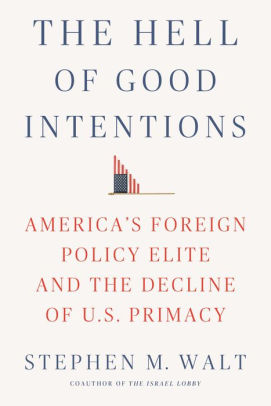
‘The Hell of Good Intentions’, A Review

hell of good intentions

Stephen Walt was one of the most influential contemporary international relations theorists to me when I first entered the field of IR as a Master’s student over a decade ago. Of the currently active crop of IR thinkers he remains my favorite, so it should be no surprise that the coming of his newest book, ‘The Hell of Good Intentions: America’s Foreign Policy Elite and the Decline of U.S. Primacy’ was an instant acquisition for my massive nonfiction library. Though Walt and I have diverged on some issues in the past few years, our overall diagnoses of both what ails the US foreign policy mainstream as well as what to do about it remains extremely similar.

I am not going to go over the details of the book as many of its themes have been covered on this blog multiple times already. From the incestuous navel gazing of the Court Eunuchs of the Beltway ghoul class to the virtues of America’s fortuitous geography in its rise and options towards grand strategy, to the virtues of offshore balancing to those lucky enough to be able to practice it, all can be found here in various posts. If you know many of my bugbears you can guess what are Walt’s, and vice-versa.

What I will do, however, is review how good a case Walt makes for covering this topic as a single book meant for a large audience. Unsurprisingly, this book is meant for a similar audience as the very one it rightly criticizes. This means Walt takes a very different tactic than I do. Whereas I tend to go after people outside-of-the Beltway and show how the fables of liberal hegemony are directly counter to someone’s interests, Walt wants to convince those who are a bit more integrated into these elite circles. This is not a criticism of mine, as its important to be firing on all cylinders here. I am merely acknowledging that if he is the Martin Luther King Jr of foreign policy realism than I am more the Huey Newton-to use a somewhat tortured and tongue in cheek analogy. I try to convince people who are non-centrist independents, the few sane paleocons, and leftists and he goes more for the liberals and centrists.

Keeping this in mind, Walt does an excellent job. Not only does he wage a thorough and quite multi-topical demolition of both the record of our very own Late Ming court eunuch equivalents whose lanyards are the modern version of the old quill said eunuchs once used to hold in their piss (analogy once again mine), but also the long term effects of these luxury wars we have found ourselves in. For someone who is sometimes (unjustly) criticized in academic circles for ignoring domestic factors and how they shape foreign policy, it is worth pointing out that, so far, this book seems to have little in the way of big newspaper reviews. Quite possibly because it also criticizes the general neoconservative/liberal bias of major legacy papers such as the Washington Post and the New York Times’ op-ed section. Had this book come out in the twilight of the cursed Bush II presidency I have no doubt it would have been given more media attention, but in a world where both parties now identify openly with unthinking hawkishness-from Trump embracing Pompeo and Bolton to the Democrats rallying around the flag of the national security state and even bizarrely ex-Bush Junior officials-there is little mainstream attention paid to this work so far despite the fact that Walt is a distinguished and well known scholar in the field.

Fascinating that. I’m sure its just a coincidence.

Needless to say, this is *the* work to get your foreign policy orthodoxy questioning people to engage with series realist critiques of both the present system and what to do about it. The book even helpfully closes out a useful list of talking points and arguments that could be deployed to make the case for a more restrained offshore balancing strategy. Worth keeping around to push the needle especially as a reckoning with the establishment must be only one or two more of their failures away.

My only real critiques of the text as follows:

While Walt does mention how the Lanyard Ghoul (once again, my phraseology) class has an intrinsic reason to back mindlessly hawkish policies due to them making money and status off of such policies, he only barely mentions the privatization and for profit militarization of much of the DoD in the past few decades. This is not something that could be easily reversed without major structural reform not only of The Pentagon, but also our entire political-economic system as it presently stands. This, along with environmental issues, are some of the reasons being a realist actually made me evolve more structurally left wing positions over time. Also, when living in DC, as I currently do, one sees how this recession-proof city really functions as more and more ‘Beltway Bandits’ move in with the attached monstrous apartment complexes clearly designed for pod people in tow. In DC the policy is made, and DC itself is increasingly economically reliant on what Eisenhower once called ‘the military-industrial complex’….except that now said complex has a profit motive above all, and thus far less reasons to uphold the national interest first. This entails not only many jobs that rely directly on the perpetuation of bad policies to exist, but also an army of lobbyists to see that their voices are disproportionately heard in government.

My second criticism is just a minor oversight but one worth mentioning. Walt rightly bemoans the lack of foreign policy focused elected leadership in office currently. While I agree with the argument overall, and also with his complaint that the cause suffers when certain people from a family with the last name of ‘Paul’ do much of the public speaking on its behalf, he is missing one very persistent and vocal figure in congress: Congresswoman Tulsi Gabbard of Hawaii. The entire reason she has managed to restore realist and restraint positions to the discourse is because she is charismatic and is a rare figure focused on foreign affairs. Personally, I would love to see Walt support her mission in congress as congruent to his own.


Will Taiwan Fight?

taiwan_strait_98

It is the nightmare scenario of policy planners in Beijing and Washington alike. It is the hypothetical that keeps many an IR scholar pondering the many ramifications and dangers. It is a war over Taiwan.

To the fellow traveler interested in world history, Taiwan’s ambiguous status on the world stage is hardly a new thing. The island was one of main progenitor points of Polynesian culture and eventually would attract a Dutch trading fort due to its simultaneous remoteness to dense population but also close proximity to China proper. The Dutch would in turn be evicted by Ming Dynasty loyalists fleeing the collapse of their government and the birth of the new Manchurian Qing Dynasty. Once the pirate base for Ming loyalists was subdued the Qing recognized the need to incorporate this nearby landmass firmly into their state.

After the First Sino-Japanese War of 1894-5 the island’s ownership was transferred to Japan and Taiwan soon became the new Japanese Empire’s first major overseas possession (that wasn’t under the assumption of one day becoming a home island). The Japanese met significant resistance from the native population (though not the Chinese already there) and would eventually go on to incorporate indigenous scouts into their Pacific forces once this initial colonial conflict was over. There is even a metal song about these units.

Taiwan was restored to China-then the Republic of China-after Japan’s total defeat in World War II. Shortly afterwards, the civil war in China would drive the Republic’s government and forces (with the state treasury in tow) to the island as their position rapidly collapsed in China Proper. Late Ming history repeating itself. Here the Kuomintang forces under Chiang Kai-shek would survive, unlike their Ming forebears, due to the protection of the American navy and the weak post-war status of naval forces now held by the People’s Republic on the mainland.

Not giving up its official title to be the legitimate government of China, the Republican forces on Taiwan would in fact hold China’s seat in the UN until the United States and Beijing came together during the Nixon administration to work out defensive arrangements against a perceived common Soviet threat. Much like democratic peace theory today or the US-France ‘Quasi War’ during the aftermath of both countries revolutions, international communist solidarity turned out to be hollow words easily undone by the brute realities of great power competition. The price for the US to gain this new inroad with Beijing was, of course, to put the PRC in the drivers seat as the internationally recognized government of China. Washington also had to agree that Taiwan was a part of China-but it retained its influence over the island and reiterated that it would defend the island from a reunion with the mainland that would be conducted with force.

So it remains up through today. In the meanwhile, there have been significant if minority calls in Taiwan to cease being the Republic of China and simply become Taiwan, a fully independent nation. Its historical experience has certainly put it on a more divergent path than the simple warlord renegade provinces of modern Chinese history before World War II. Of course, everyone knows that a blatant declaration of independence might well trigger a full blown military response from the mainland.

This all sounds quite convoluted, and as history and political baggage it certainly is. Will Taiwan come back into the fold through force? Diplomacy? Will even the PRC one day unexpectedly collapse leading to Chiang’s long delayed dream of reunification from Tapei a strange new reality? Will Taiwan become a fully sovereign and recognized state?

But one way it is not complicated is in what will happen to Taiwan’s future if that nightmare scenario of a military invasion to forcibly reunify the island breaks out. Despite what you may assume about such a complex issue, the entire fate of the island and of great power conflict will rest solely on one factor: Do the people of Taiwan resist the PRC or do they not?

It seems simple and perhaps reductive to break down the fate of this issue in a confrontation to this one factor, but I will list reasons why I believe this to be true:

-Neither China nor the United States wants to fight each other directly, especially as neither country knows the effectiveness of its naval strategy against the other. China has bet a lot on diesel submarines and shore based anti-ship missiles, the US on carrier battle groups, nuclear submarines, and air power. The Taiwan Straits could be the death zone of an invading fleet coming across American technological power projection, or it could be a perfect shooting gallery for mainland missiles restoring coastal defenses to their pre-gunpowder days of sabotaging troublesome fleets. Either power, or both of them, could be fatally weakened with global consequences in such a confrontation.

-The morale of the Chinese forces would be higher than that of the American forces, considering the historical ties to the island that one shares and the other do not. For Americans to be willing to take the casualties necessary to either defend or (more likely) re-take Taiwan the country would have to be united in the cause. The country could *only* be united in such a cause if the people of Taiwan were seen to be oppressed and victims of an unwanted annexation like that of Iraq invading Kuwait in 1990.

-Therefore the decision falls into Taipei’s ball court rather than Washington or Beijing. Taipei and the common people of Taiwan in general. The island is riddled with underground defenses and weapons caches to fight and delay any invasion until a bailout from America can occur. Much of its terrain is extremely mountainous. It also has a large amount of jungle. Taiwan could indeed put up quite the fight-if it were willing to. Conventionally it might be plastered (unless the PRC really screws up the initial operations) but a popular war waged by the army and militia and common civilian resistance could flounder an invasion. More importantly, such resistance is the single factor that could bring in open ended American commitment for a fight until the issue is settled with a fully independent Taiwan. (Or, if American was being extra clever, a unified China that had to legalize the KMT throughout the entirety of the mainland and open the system up to competitive elections).

And this is the question, is Taiwan willing to do this? Literally everything in a conflict over the island boils down to this single factor. Honestly, I have no idea. I don’t think most people in Taiwan even really know with certainty. But I do know that this is the factor on which US-China rivalry will hinge on in any confrontation. Without something that at least looks like a genuine people’s war, America might roll over and acquiesce as easily as a compliant Taiwan would. After all, it barely effects the core of American Pacific strength and provides a rallying cry to get more nations on Washington’s bandwagon. But if the Taiwanese are clearly fighting as allies expecting a delivery then this flies out the window. If Taiwan were to fight all sides would have to see it through for the sake of their preexisting commitments and the very legitimacy of their governments.

So to get the heart of the mater, will Taiwan fight or not?


O’Bagy and Boots: Spirit Totems of the Beltway Ghoul Class

You may not remember (or have ever heard of) Elizabeth O’Bagy. Basically, she was a fraudulent expert hired by the (neoconservative) Institute for the Study of War to serve as a Syria expert. Her expertise was largely in advocating for the ‘moderate rebels’, whose work she did on their behalf she failed to disclose, and in lying to people that she had a doctorate. See below:

In a denouement that will surprise exactly no one, she had the right opinions of cheerleading endless regime change policies to qualify for a failing upwards promotion to join the staff of Senator John McCain (of course) as a legislative assistant.

What this small potatoes lanyard has in microcosm is in fact emblematic of a greater problem with the Beltway. I have mentioned before how ideologues get signal boosted and actual scholars get sidelined, but its worth mentioning exactly why this is and what purpose such a system serves.

Amber A’Lee Frost, who as far as I know has no foreign policy experience, accurately diagnosed the problem with so many regional ‘experts’ in mainstream foreign policy commentary. To paraphrase from memory, ‘the point of regional experts is-90% of the time-to advocate for more U.S. intervention in their region of focus.’ As someone who has lived and worked in DC for a few years now, I can confirm the truth of this statement. Objective reporting and actual regional expertise for cost/benefit calculation is sidelined for new ways to make a case for various forms of intervention and increased defense spending and to dupe the middle class rubes who seek such high minded sounding justification. This is the name of the game.

While these types are common beyond belief, a certain few always rise to what passes for media influence from time to time. William Kristol, the hilariously named Power and Slaughter Axis (Samantha Power and Anne Marie Slaughter), and on the list goes. But none has quite taken the O’Bagy status of our times quite like Max Boot.

Boot’s career is far more ‘impressive’ than any of these, if we take impressive to mean consistently and often hilariously wrong. He is one of the rare military historians who has achieved fame, and the method of acquiring that fame is the one which is most detrimental to history: parroting the popular political mythologies of the ruling class of his time. Despite the fact that a thorough study of global history, and yes, military history, reveals a total lack of teleology in human affairs save for the triumph of power and cleverness over weakness and rote-thinking, Boot has churned out one book after another turning advocating for an understanding of American history that supports the largely disastrous post-Cold War trends of foreign policy-as well as increasing those failed policies in both scope and intensity. I suppose at this rate he should be loved by accelerationists who wish to see a collapse of American world power, since the acceptance of everything he wants would fatally cripple the long term sustainability of American power.

But rather than go on about his career I really wish to lament that these are the people called in for ‘expert analysis’ on much of the media. All that gives the public is self-affirmation of the policy wonk bubble-a bubble that has been clearly failing since 2003 if not before. See for yourself Max Boot in action:

And also here:

What I find fascinating about both of these clips is that Boot is up against opposition that is hardly unsurpassable. Tucker Carlson is often laughable rube on many issues that are not related to his welcome recent turn on foreign policy. Stephen Cohen is a real scholar but is certainly the most uniformly pro-Russian voice you could possibly find on American television anywhere. Yet despite being able to take any number of ins, Boot always gets flustered that other people simply don’t believe in an ‘American Exceptionalism’ where great power politics is cloaked in the language of morality and norms. On the very format of cable news where his audience is most likely going to be sympathetic he cannot even hold his own.

When the propaganda machine promotes the unworthy every time they make a terrible policy prediction that just so happens to flatter the already existing biases of a class of people it will inevitably lead to their own PR not being able to hold its own in the public arena.

Perhaps, in this way, O’Bagy and Boot are indeed performing a public service of sorts.

Academics vs Lanyards

Ive walked the path in both worlds and I have a disturbing revelation: Academics often have smarter and more informed conceptions of foreign policy than the lanyards who work ‘in the field’ directly.
 
This is *not* to say that academics are not often utterly deluded themselves. They are often too in love with theory and models that do not apply to the chaos and moral neutrality of reality. But in a direct comparison with an average academic in the field and an average foreign policy lanyard I have to say 9/10 the academic will come out on top. Why?
 
Because even though being an academic *often* results in being utterly consumed by an ideology or cause, its not always. Also it means constantly being challenged by colleagues who do not share the same intellectual background (unless of course one is a postmodernist who thinks everyone can magically be right ‘in their own way’). In the case of the lanyard ghoul, however, it almost always means being surrounded by utterly like minded individuals and never being challenged professionally on anything that isn’t simply topical to preexisting assumptions. Indeed, there may be social pressure not the rock the boat. It also means being ensconced inside a hive that believes itself to be post-ideological when in fact it is anything but and that therefore all criticism must be ‘extremist’ even if it is extremely factually grounded.
 
I think a good and calculating instinct with a background of being historically and geographically well informed is key, but if I couldn’t have that I would still take an absent minded professor over a self described professional ‘wonk’ who uncritically totes the main line they were basically indoctrinated with since childhood any day. Such people will be the death of us all.

The Spectacle Presidency and the Spectacle of Opposition

trumpswan

I was a History undergrad (thank the gods) and not a ‘political scientist’ until grad school. And even then, I stuck my political science more towards the real than the ideal. Geography and geology and anthropology were as much my focus as political science and philosophy. Because, at the end of the day, it is all about what really exists, not what we hope. Hope, as apparently Eisenhower and one of my co-workers mothers once said, is not an achievable policy. But the one political science class I took in undergrad was ‘The Presidency’. In it, our professor talked about how Reagan, then (and somehow still now) was lauded as this great president when in fact he was nothing but a milquetoast capable of great shows of spectacle. He used the media to build up issues which he could ‘solve’ in a media friendly way, from invading Grenada to smashing up the traffic control strikers. Everyone loved this. The people cheered, much as they would cheer as the charismatic but empty shell of the Clintons cut away any remainders of meritocracy in this country with a smile and a wave.

We have, unsurprisingly, an erratic administration in the White House. In light of the recent strikes in Syria, conducted without an investigation into an attack which occurred in a war where we know all sides possess chemical weapons, most likely based on the president having an emotional reaction to television, much like his core constituency does. Words, spoken or written, cannot adequately express how utterly horrifying a prospect that is. Grand strategy is now in the hands of serial molester and loofah/falafel shipping fanfic audiobook narrator Bill O’Reilly’s prime time rants.

The conservative movement, which often had pretenses of intellectualism but could find no intellectual with which to cling to aside from William F. Buckley (himself basically the Bill O’Reilly of the 1950s), Ayn Rand, and the clueless ideologue bro-‘wonk’ that is Paul Ryan-a man who opposed Obamacare so much for 8 years he never even came up with an alternative until one week before his epic failure in the House passing something far worse-is basically bereft of brains. In America this has always been so. Vague attempts to cling to the coattails of Edmund Burke usually come up short when faced with the sheer ranting racism and religious fanaticism that makes up the vast majority of American conservatives (and once again, always has). In many ways this makes Trump unremarkable except in one way, he is totally honest. A purely instinct-driven creature, he shuffles from outrage to outrage and poll boosting issue to poll boosting issue as only the most delicate of right wing shrinking violets can. The mask has not only slipped, but fallen into a boiling cauldron of lava and is never to be retrieved again. Trump is barely into his presidency. Sure, he has the potential to be beyond the scope of horror, but in the small time he has yet to even come close to Dubya’s track record of sheer globe spanning incompetence and murder. He also has yet (although his policies promise to do so soon) to come close to Bill Clinton’s record of waging ruthless and brutal warfare against America’s working class. In other words, the spectacle has never been more honest. Its all style and no substance, exactly what an enormous percentage of voters have been content with for a very long time.

But to find such a mercurial and unqualified character making an erratic President is hardly a perspective you need me to elucidate. You can find that anywhere. 90% of online content now exists to do exactly this. What I find even more craven, even more bothersome moving forward, is The Loyal Opposition, or what they call themselves with no self-awareness whatsoever, ‘The Resistance.’ They are just as much a fraudulent spectacle as the president they condemn….Condemned that is, until he shot some missiles and CNN got the footage.

Much like how the Democratic Party has been ‘anyone to the left of John McCain’ in definition since at least Carter, so too is The Resistancebasically defined as anyone who hates Trump. That is actually quite a lot of people of various divergent backgrounds. Most don’t have large financial backing and mainstream support anymore, but the ones that do….oh the ones that do. They certainly earned their this week didn’t they?

Nothing like a good act of war to bring out the sheer levels of contortions required for the sad sacks who pass for an opposition. Fareed Zakaria, one of the few neoliberals which I had any respect for, declared the act of President Baby’s hissy fit to be ‘Presidential’, Admiral Stavritis and other wannabees in an alternate universe Clinton cabinet could not stop themselves from using the kinds of words op ed columnists use when reviewing the latest self serving autobiography of a public figure. ‘Bold.’ ‘Decisive.’ ‘Insert Generic Descriptor Here.’

My original thought if Trump took us into the field of basically becoming Jihadist Offshore Support Group 1 was that the mainline democrats and Sensible Serious Center of which I have spoken before would suddenly pull the same move they did when their rosy Iraq predictions turned out to be wrong-suddenly flopping back into Dove mode. The good news is, they defied that low partisan bar. The bad news is they went even lower…by just coming around, at least on this one very important issue, to the very force they claim to oppose.

The day after former Secretary Clinton called for a wholesale attack on the airbases of Syria, something equivalent to if the Pearl Harbor assault had hit the entire West Coast in addition to Hawaii, Trump struck only one (so far) in a demonstration of spectacle which immediately was followed by bipartisan praise. In other words, The Resistance™ came around to Trump. Because he bombed someone. That is just as horrifying as the idea that he ordered the attacks based on his emotional response to the news. It also shows that it is Trump who is becoming much like the DC establishment he ran against, rather than bending it to his will. This blog is focused on foreign policy issues, but there is ample reason to see the same effect on domestic policy as well if one is willing to look for it.

The only thing The Resistance™ is doing is building themselves up as the people who could do the same failed policies, but more politely. With less….acrimony. In the case specifically of Syria most Democrats demand something more hawkish than Trumps irresponsible flirtations with World War III on behalf of sectarian Wahhabi fundamentalists. And what the Thomas Freidmans’ and David Brooks’ of the world want is precisely that, because its safe and polite. It is what they know. America has an excess of military power so it must ‘do something’, and damn the consequences. I mean, otherwise those bombs just might sit around. Why have that when you can use them to provide collective therapy for the neoliberal/neoconservative on the world stage? These people have no actual critique of systemic forces, but only brands. Coke and Pepsi, Marvel and DC, Lockheed Martin and B.A.E. Systems, the Democrats and the Republicans.

Spectacle Presidency, meet Spectacle Opposition.


Fortunately, occasional lone voices cry out in the wilderness against this double sided madness. One of them has been one heartily endorsed by this blog since before the party primaries. That continues to be a damn good call.

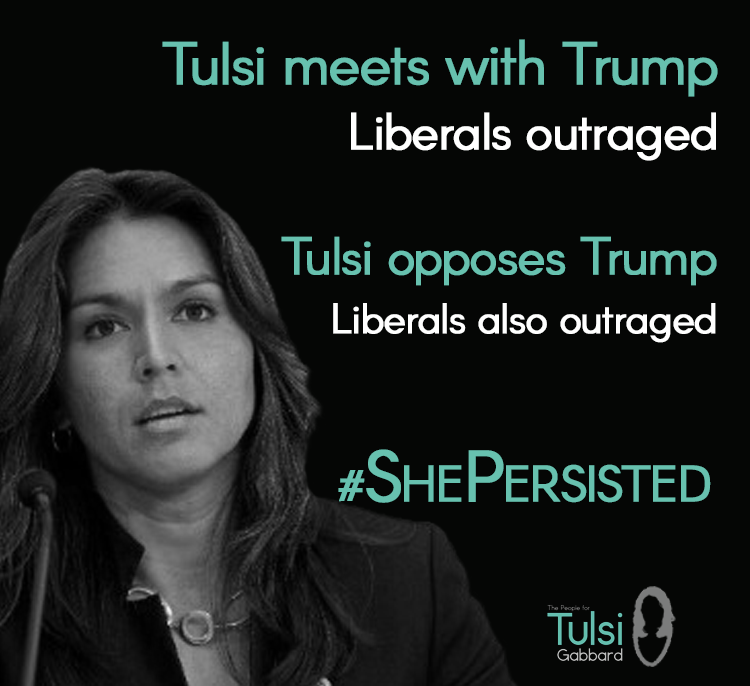
Tulsi triggers liberals