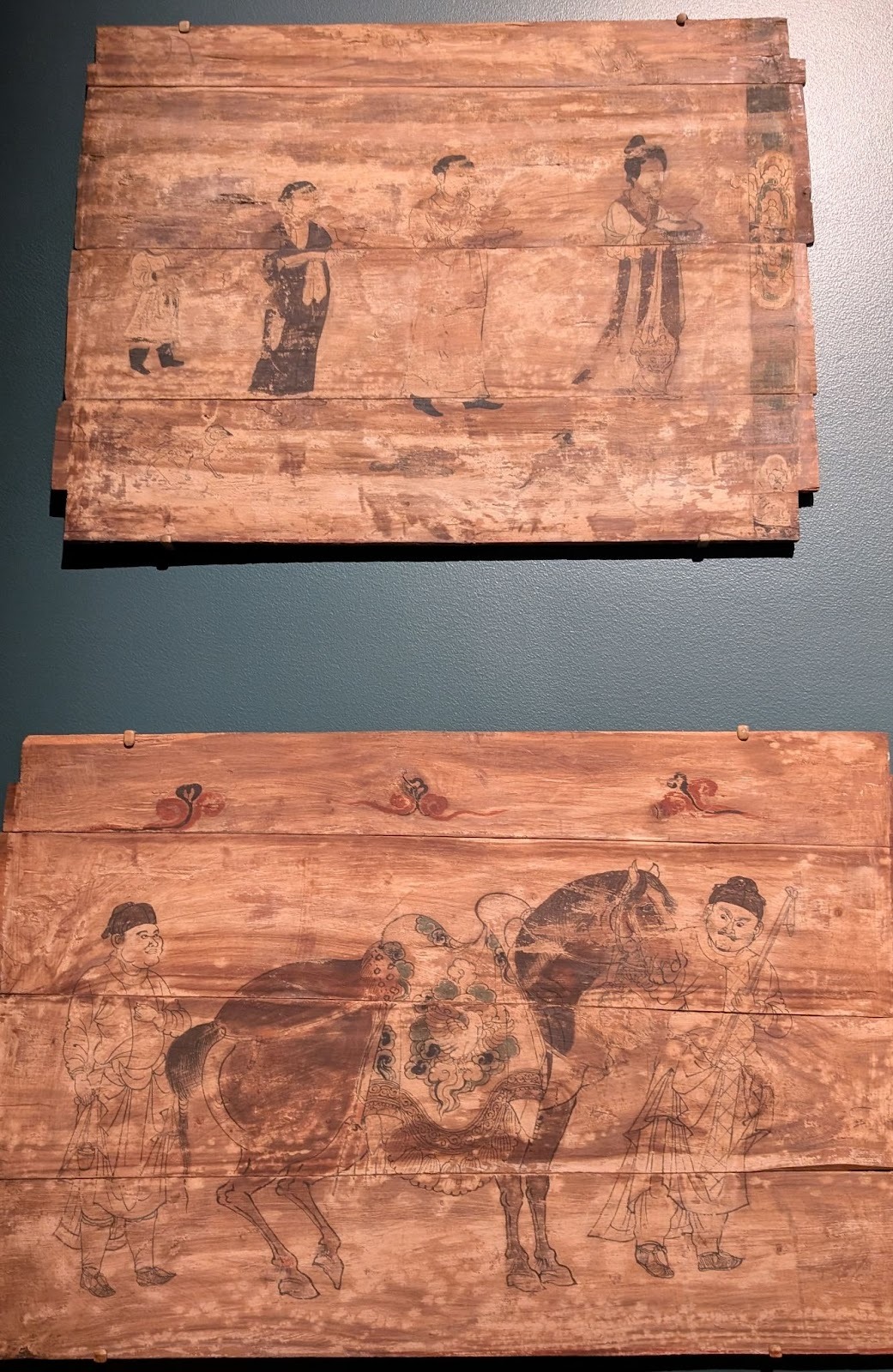
Photograph of Khitan Liao coffin lid paintings I took in the Princeton University Art Museum
If you don’t know me personally or have never read my book you probably would never guess that my favorite state(s) in history are the two successive Khitan empires. The Liao Dynasty and its differently located sequel the Kara-Khitai Khanate are to me the most fascinating combination of nomadic frontier and settled agrarian statehood. Their practical and flexible government system even survived full state collapse, being taken on horseback west after an unexpected fall caused by a Jurchen rebellion, and set up all over again in majority Turkic and Tajik Central Asia where it would survive for another century until annexed by the rising Mongol Empire.
Founded by a tribe of perpetual peripherals, the Khitans were a nomadic proto-Mongolian people who spent centuries hanging around the northeastern frontiers of the Tang Dynasty as sometime vassals and sometime foes of said government. Nothing was particularly noteworthy about them even as they began confederating into proto-statehood save that they generally got the worst of many of their contests with other powers.
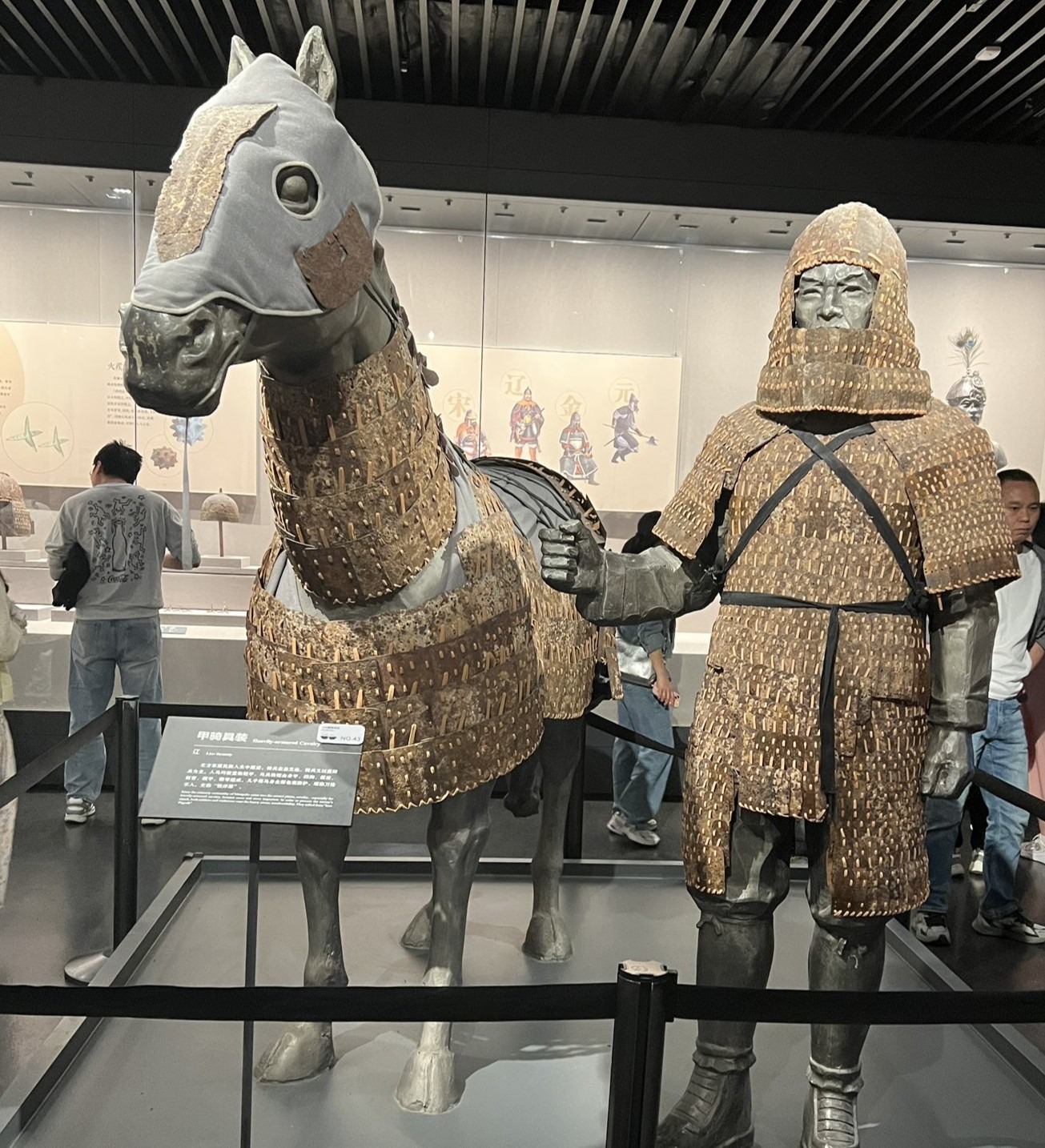
That was until the Tang collapsed. The Khitans, having much experience with great powers, stepped into the role well. Yelu Abaoji unified the tribes and drove south, conquering new territories to provide tax revenue and manufactured goods from areas primarily settled by Chinese farmers. While China was divided, the Khitans built the Liao Dynasty. A unique government that sought the best of both worlds by governing settled and nomad differently. Nomads were ruled by a Khan, settled farmers an Emperor. They were, of course, both the same person. There was a courtly bureaucracy and a migrating capital, the elite grew up in the saddle but learned poetry and the arts too. Powerful dowager Empress’ served as guardians of tradition against the temptations of Sinicization.
And, in a rarity for large imperial nomadic states, it was an empire of restraint, with a comparatively minimal appetite for foreign interventionism once it was established. There was no sustained drive to fully dominate China, only to balance factions in that country so that none could conquer the Liao. The Khitan elite understood that too many Chinese subjects would bring about assimilation, just as they understood that alienating or losing what Han subjects they had risked a large hit to their tax and administrative base.
Khitan “Inshore Balancing” (see my book) tactics only worked so long however, for the Song Dynasty would eventually come to reunify the country south of their borders in time. That left only the Tangut Xi Xia Kingdom to the west and the Liao to the north. The Liao and Song entered into decades of an again off again warfare over a contested border zone. During a climactic-in-scale campaign in 1004-5, the two powers realized neither could achieve decisive victory over the other.
The build up to this peace treaty and its aftermath can be found in many books on Chinese history, my personal favorite being FW Mote’s Imperial China 900-1800. What came after is harder to find in English. There are a few books on this subject, and I own almost all of them, but one that I only just came into possession of after a long time of coveting is “From War to Diplomatic Parity in Eleventh Century China” by David Curtis Wright. This is a book intended for the longtime fan of this place and time, as it doesn’t even have much of a prelude about pre-Liao origins of the Khitans. What it does have, however, is all the gritty details about why the two parties agreed to settle in a century long peace, how this was justified to the Song, and what the nature of their rivalry was once it had become one of diplomatic, rather than military, games.
The Song were a ‘unified’ dynasty, and back then the fiction that China’s natural state was one of perpetual unity was almost as strong as it is today. The Song, having to forgo reconquering the parts of northern China ruled by the Liao, had to excuse being part of a bipolar system of legal equals where a “Northern Court” and a “Southern Court” managed affairs as peers.
Reliant as it is on Song sources more than Liao (understandible given subsequent historical events and the different nature of the Khitan script) the book gives us endless examples of SinoCope. Elaborate excuses as to how the Khitans won their place as a civilized peer while still trying to get away with sending junior level diplomats in a passive-aggressive way to not quite admit it. Song annual tribute payments to the Liao were written off as investments in a secure border. Song diplomats moaned about the climate and reacted in horror when diplomatic meals with the nomads degenerated into drinking contests or when the primary course was just a pile of grilled meats from various unspecified animals. Oftentimes, the Song envoys would write emo-ish poetry about the hardships of the journey but it was mixed with pride in the necessity of keeping the peace, for example the diplomat Wang An-shih wrote:
His majesty issues a royal appointment;
The Son of Heaven indulges the Xiongnu.
Though you reply that the ways of the barbarian are vile,
You understand the distinction of being an envoy for the Han.
At night the border signal towers have long been unused;
In autumn the watchmen are still and free of worry.
What need is there to be cruel like swallows
And smear the livers and brains of living beings on the battlefield?
The primary source detail in the book is great, and being about the neglected side of this relationship- the one of a long standing peace- becomes all the more interesting. Also of interest is the chapter on the ‘Mid-Century Crisis’, when there was a war scare between the two powers 40 years after the treaty. This was due to the rising power of the Tangut state. Far from as powerful as the other two, the Xi Xia kingdom nevertheless had a potent military capable of inflicting massive defeats on Song frontier forces. The Liao used this to threaten intervention on the side of the Tanguts unless they received an increase in the annual tribute payments. After much wrangling, the proposal was accepted.
The Song would have their revenge over a half century later when the Jurchens rose in revolt. Collaborating with them, the Song thought the Jurchens would be easier to deal with than an integrated peer power. Instead, the Jurchens attacked them much more relentlessly than the Khitan ever had, causing the loss of yet further territory and a perpetually simmering state of war for the next century (and beyond when counting the Mongol conquest of the Jurchen Jin Dynasty). Oops! Probably would have been better off keeping the balance.
Sure, this is a topic I appreciate solely on its own terms. But it is hard not to think of other examples of a domineering major power really struggling to adapt to the return of natural multipolarity. The U.S. replicates Song passive-aggressiveness by referring to modern day China as a “Near-peer” rather than peer. The British after World War I badly underestimated how much relative power they had lost to the U.S. and Japan on the world stage, and of course the Qing Dynasty’s inheritance of Middle Kingdom syndrome made it woefully unprepared for the arrival of the European expansion on their own shores.
Perhaps more importantly, sometimes it’s just better to leave a good enough situation as is, even if you have to eat from the randomly assorted meat pile from time to time. I always like a culinary adventure, myself. It usually beats a geopolitical one.
This is not meant to be a comprehensive review of Star Trek: The Next Generation, nor is it a deep dive take connecting it to political theory like I once did for Deep Space 9. This is simply an overview of what it was like to rewatch one of the defining shows of my childhood from start to finish (albeit with some skips) for the first time since it was being broadcast in real time back when I was in elementary school.
This was the first non-cartoon television show I ever got into (not counting Rescue 911, which was ironically hosted by William Shatner), being introduced to it by a babysitter in what I imagine was the fifth season at the time. The show would have one new episode per week with the rest of its slot time in the week being dedicated to re-runs. This made it easy to catch up on most of the older episodes within a year or so of starting.
Despite the fact that I demanded action in my sci fi entertainment, and always preferred the more violent episodes at that time, the Enterprise-D quickly became a kind of fictional idealized home, a place that one could imagine “Maybe when I am older I can do something like that.” Because of this, I pretty much ended up liking all the episodes. It also inspired me getting into Micro Machines because there were so many Star Trek ones out there.
I had all of these and even more. These days I only have one left in my possession. But if I told you which I would be letting slip what my third and probably final Star Trek post on here eventually will be.
When the show ended, the final episode went a bit over my 9 year old brain and I mostly focused on how cool the alternate future Enterprise with the third warp nacelle was. I wasn’t too broken up about the end as I had found a local public access channel (remember those?) that played The Original Series and soon pivoted to that, which at that time I liked just as much. I was still too young and DS9 was too serialized and too adult to grab me aside from the occasional episode and the later Voyager just did NOT work after I gave it a couple seasons, so I ended up moving away from the franchise for over a decade. Only returning to it in my senior year of college when, sick with the flu, I ended up finding TNG and DS9 both on some of the channels the university network had access to. At the time they were playing seasons 1-2. The next year I moved to the UK where, interestingly enough, the novelty rerun station Dave (yes, that was its name) was re-running TNG’s seasons 6 and 7. In this time my primary return-focus was DS9 and the TOS movies so this spotty partial rewatch was hardly comprehensive and missed most of the middle run of the show. Ten years ago I gave DS9 a full rewatch, and last year I gave TOS the same treatment. These past 3 months I finally came back to my first show and did the long overdue same for TNG. I also decided to rewatch the first two of the TNG movies but not the later two, as I rewatched all of these under lockdown and so had recent experience.
Let us break the following down into sections.
My streamlined rewatch guide:
Want to do a beginning to end watch but not see every single episode? I have some easy but loose guidelines for you. It is easy to skip episodes because the show has relatively little serialization (though more, bizarrely given the other show’s premise, than Voyager ever did).
I strongly recommend skipping the majority of Season 1. To say the show had yet to find its footing would be understatement. It comes across as a bad parody of TOS. “Encounter at Farpoint” is necessary but more for how it bookends with the final episode and introducing the character Q then for any reason of quality. “The Battle” and “The Neutral Zone” are key establishing episodes for important themes. You can watch Tasha Yar die to a stupid slime monster just to see the end of that character arc and Worf’s promotion to security chief. Otherwise, it’s best to zip through this one. Season 2 improves upon it and has more episodes worth catching, but is still very much not the TNG you remember qualitatively. There are stand outs though, especially including “Q Who?” which is the introduction to the Borg and is one of the top 10 episodes of the entire show. Be sure to skip the montage episode season finale though, it’s the worst episode of the entire show if not the entire 20th Century era franchise.
For the remainder of the show’s run I recommend watching the majority of the episodes. Yes, including in the more uneven Season 7. The show is firing on all cylinders from Season 3 through 6 with bad or even lackluster episodes being the outliers. Season 5 was the high point for me, and it contains the best single episode, “Darmok” (the meme language one that encapsulates all that is best with Trek as a franchise). My general guide to what is skippable is all Lt. Barclay episodes except for “The Nth Degree”, all Lwaxana Troi episodes save maybe Menage a Troi (for the ending Picard monologue), and all Alexander and Holodeck episodes save perhaps the funny “Fistful of Datas”, which paradoxically is both an Alexander and a Holodeck episode.
Season 7 is an extra-special season and so I have extra-special thoughts on it. I was most curious going into this what I would make of it on rewatch. I found that, for the most part, I liked it. The writers clearly knew (and later in interviews they would admit this) that they were running out of ideas and just throwing things at the wall to see what would stick. This creates some truly awful episodes, chief among them “Sub Rosa” and “Force of Nature”, but also possibly the highest concentration of really stand out episodes such as “Phantasms”, “The Pegasus”, the so-bad-its-good “Masks” (you may hate but I KNOW you remember it), “Preemptive Strike”, and of course “All Good Things…” which is not just a series highlight perhaps the best show-ender of all time. Considering that most shows linger on well past their expiry date, I think it was great we saw just enough to want the show to end but not enough that it dragged. And what a finale! Upon rewatch I enjoy the ending so much more than I did as a kid. If only shows since had followed this path of ending on a high note.
And since I wanted to end the films too on a high note and not a mediocrity (Insurrection) or something outright vile (Nemesis- not even pre-fame Romulan twink Tom Hardy could save it)…so when it came to movies Generations and First Contact was the perfect endpoint for this rewatch. Generations is pretty mediocre in a lot of ways, but ends up just over the positive side for me on rewatch specifically due to its most criticized aspect: the offscreen and seemingly random death of Picard’s extended family in a house fire. This not only reminds us that in the relatively utopic future of the 24th Century life is still filled with unpredictable and random tragedy and how this can inspire both bad and good coping mechanisms for people. It also gives an emotional resonance to the main plot point of the film of people trying to recover an idealized past. Additionally, it is the end of the Enterprise-D and the Duras Sisters. Data getting his emotion chip completes his arc in a way, though whether you find it funny or annoying will vary with the observer. Plus, Malcolm McDowell. First Contact, meanwhile, is a great series send off because it is the best TNG film, introduces the beautiful Enterprise E, and completes the Picard Borg Arc by having a drawn out fight on a single ship, deck by deck and point blank range. Speaking of Arcs…
General Theme and Character Impressions
The Borg Arc is an example of how a not-very-serialized show can have a running theme. Hinted at only vaguely near the end of Season 1, encountered in a freak one-off in Season 2, properly confronted in the climactic “Best of Both Worlds” (and its PTSD follow up third part “Family”), then with occasional reference to a looming threat without overusing it. The drone Hugh is returned to the collective to sabotage it with individuality, which causes a single group to go rogue but otherwise does not remove the threat. Picard’s experiences with assimilation are clearly (but not directly) akin to a rape. They were aiming for a concluding confrontation in film form which is why I view First Contact as a necessary conclusion despite not agreeing with the introduction of the Borg Queen as an element in the lore. Also, we know now that this more restrained use of the galaxy’s ultimate threat was far more effective, with Borg episodes/movie being horror-lite forays into the dangers of techno-optimism which are needed to balance the general euphoria of the setting. Voyager would, of course, go on to totally ruin this by making the Borg almost a monster of the week, easily fooled and outwitted by a single ship. But Voyager was, of course, the beginning of the decline of the franchise as a whole.*
Something I found more interesting than before on rewatch were Prime Directive episodes. Starfleet’s first and foremost rule is to not interfere in the development of prewarp civilizations. I have seen a lot of hot takes, especially during our recently concluded Woke Era, by midwits online that this policy is somehow racist and bad. Implying that one cannot trust single-planet species with advanced technology. I think watching the show clearly should give the opposite impression- it is to protect weak powers from exploitation at the hands of great powers and safeguard the cultural diversity of cultures in or near Federation space. It is cool and good, the revisionists are wrong, and in the unlikely event we ever go into space outside of our own system ourselves and (even more unlikely) encounter sentient life, we should adopt a similar rule.
Prime Directive episodes, where inevitably the rule is broken, usually by accident in some way, thus became more interesting to me during this rewatch. “Who Watches the Watchers” is justly famous on this premise where contact must be initiated after an anthropological investigation is exposed to the natives. But even better is “First Contact” (the episode not the movie) where a race is deemed ready for contact by the Enterprise but the political situation quickly shows that it is not and the whole attempt has to be aborted and covered up, showing how contested these issues can be.
The astropolitical situation of the Alpha Quadrant is obviously something I was much more tuned into this time around. I know the actual explanation of things is that the writers were trying different races as regular arc-villians, starting with the Ferengi, mostly settling on the Romulans, and diving into Cardassians later as a hand off to DS9. But what this really shows in-lore is that the Federation is bloated, over-expanded, and needs to consolidate. It has too many cold wars ongoing, hence the need for an unfavorable peace settlement with a weaker power (Cardassia), perpetual fear of the peer-competitor of the Romulan Empire, and the need to hold the peace after the destruction of much of the Federation fleet in the first Borg invasion. Interestingly, this invasion did spark a revolution in military power, as seen by the ships we get in First Contact (the movie not the episode) and in DS9. And once again showing a realistic take on the unpredictability of power politics, most of these vessels would end up used to fight the previously totally unseen threat of the Gamma Quadrant’s Dominion, which would be the ultimate arc of DS9 if not the franchise itself. One cannot help retroactively fan-theorying that Q’s actual role was not to indirectly prepare the Federation for the Borg by forcing contact between the two- who were too distant from each other to immediately square up at full force- but rather to prepare them for the Dominion by way of a Borg-induced military upgrade. You thought the Alpha Quadrant was bad, you should see the other neighborhoods.
One theme I especially appreciated was to be found in “The Chase”, which might be the episode I have most upgraded from prior view to present estimation. An episode clearly designed to provide an in-universe explanation as to why most of the races of the galaxy live on the same type of worlds and all look the same save for different forehead ridges, “The Chase” does a great job providing a founding species myth to actually explain this otherwise improbable series of events. Sure the universal translator shows why everyone can talk to each other (even apparently when one party has it only) but the actual shared genetic heritage of the species shown via an archeologically themed thriller episode is great fun and ends on a poignant note with the Cardassians and Klingons rejecting the findings out of racism while the Romulans and Humans quietly nod respectively at each other and wonder when the galaxy will be ready to accept this knowledge of a common origin. At least now we know why different species can breed with each other, though billions of years of divergence still makes this…improbable to say the least.
Another great episode that lacks the fame of the typical “best of” lists (the rightfully famous episodes everyone talks about like “Yesterday’s Enterprise” “Darmok” “The Inner Light” “Best of Both Worlds” “Chain of Command” etc) is “Phantasms”. My personal favorite (after Darmok) episode and the one I always like more every time I see it. Data learning to dream and finding the dreams are utterly bizarre and an indirect portal to the subconscious is interesting enough, but as a person with intense and often utterly unhinged dreams myself it really speaks to me. It also has the best scene in the show. You know the one I mean.
My character impressions are as follows. Wesley is still annoying, but probably not as bad as you remember. The character was an expy for Gene Rodenberry’s self-insert instincts, whose death freed it to become less annoying. Ensign Ro was a way better helmswoman though. She was my favorite character as a kid despite appearing in only 6 or so episodes but that is mostly because she was my first crush. (Such is the power of Michelle Forbes that she convinced me from elementary until halfway through high school, no mean feat- It was only another science fiction film, Pitch Black, that would awaken reversal of the trend years later). Interestingly, the most impressive pilot and person who seems to appear most in the role is a character with maybe one speaking line in the entire show’s run, and who is only referred to by name about twice- Ensign Gates. Talk about the true unsung hero of TNG.
Geordi…uh…comes off way worse on later rewatches. He is just such an incel. One of my favorite characters from childhood is now, in my minds eye, the Ship’s Creep. Your spine will not survive watching “Galaxy’s Child”, I can tell you that much. Ah well, at least he’s an engineering genius!
My least favorite character as a kid was Counselor Troi, called by my entire family at the time “Counselor Cleavage” due to her amazingly unprofessional early show attire. It is interesting how the writers made her better once Captain Jellicoe made her put on a real uniform. We went from “Captain, I sense anger” in response to some enemy ship threatening to fire on the Enterprise to actually being one of the funnier (intentionally) characters in later seasons. Even so, true 90s kids know Marina Sirtis’ best role was actually as Demona. Plus, her office perfectly encapsulates the nostalgic vaporwave interior of the Enterprise-D.
The D was never my favorite Enterprise on the outside, being beaten by the A-refit of the TOS movies and the E, but its interior is like a warm dreamy cruise ship ready to bathe you in slowed down reverb elevator music. Perhaps it is nostalgia from childhood, but I swear there is something to the D-interior that just makes it the kind of place you could happily live in even while facing mortal peril once on average of every week for seven years.
W E L C O M E T O B Σ T ∆ Z Σ D P L A Z A
Another character who grew in my esteem was Dr. Crusher. Not just because it’s funny when Picard pronounces her given name as “BEBALY”, but because she has a habit of flying any ship she is in charge of into the nearest star. This happens more than once. She deserves to be captain one day just because it is hilarious.
Though if one wants to mark a real scene-stealing character who is not part of the main cast it has to be Gowron. This is a bit of a cheat because he has an even larger role in DS9, but TNG was his start as High Chancellor of the Klingon Empire and what can I say, the eyes have it. I would have also liked to have seen more of Commander Tomalak from the Romulan Empire as well, as he was a great foil for Picard. Denise Crosby coming back to play the half-Romulan Sela was not a full replacement for his presence, though I do maintain that Sela should have been used in DS9 as the primary Romulan character. That was also a wasted opportunity.
Conclusion
My concluding thoughts are that the show is not as euphoric as I remember. Its vision of the future is optimistic unabashedly but Trek is best when grappling with difficult ethical questions. Despite being an “End of History” era show on broadcast, it actually gave far more nuance than even the politicians and media entities of its time could towards exploring the future. Thomas Friedman and Francis Fukuyama were singing the praises of a society that had beat all challengers and could happily auction off the roots of its success to international finance capital, laying the seeds of terminal decline at the height of triumph. As the Chinese strategist Su Shi once said “It is at the point of victory that the greatest danger lurks”. Despite being a product of this era, Star Trek: The Next Generation did not do this. Its post-scarcity future was still one of messy compromise. Living standards could expand and knowledge could grow, but the wrestling with what it means to make difficult calls in the face of the unknown remained. Even if the future is nicer, it would be any better at providing simple absolute answers.
Sure it is a fun nostalgic show from a more hopeful time. Perhaps it would seem to modern audiences as quaint even. But it still makes for interesting and entertaining viewing today. And for me in particular as someone who finds television by far the worst form of entertainment media, being both passive for the audience and lacking the singular vision of film, it takes a lot to get me to watch, even re-watch, a long running series. TNG has that appeal.
Star Trek, despite the protestations of its fans, is definitely NOT hard science fiction. Its technobabble is a contrivance to engage in high space fantasy. Its exploration episodes are fun from a visual perspective but usually empty or only half-explored. Its strength, and Picard’s strength as captain in TNG, is in how it covers diplomacy. How the inevitably flawed compromise that decides the fates of millions is almost always for the better. How it is usually more desirable to show restraint than to dive headfirst into a crisis. And how, even with all of this, one will still fail and will need to take risks. But the inevitable failures to come do not diminish the effort it takes to keep the peace, to meet new people, and find new constructive ways to work with them.
—
* My personal theory is that the reason the massive Borg Collective only sends two one-ship attacks on Earth is that the Collective experiences lag between ship communications. The cube that attacked in Best of Both Worlds was a reconnaissance vessel responsible for the earlier destruction in the Neutral Zone (meaning it was already there before the first encounter of the Enterprise elsewhere) that gradually became sucked into an armed recon in force towards the heart of the Federation. Meanwhile, I think the lone cube with experimental time weapons we see in the First Contact movie was the originally encountered cube from “Q Who?” that had been effectively chasing the Enterprise’s direction of retreat for years and years, finally arriving perhaps with little detailed knowledge of what happened to the previous Alpha Quadrant assigned cube.
It should be obvious right now that something is wrong with how we in the Anglosphere train and educate professionals who enter into the fields of diplomacy. Due to elite overproduction, short term topical issues are used to show regime loyalty and compete for ever scarcer positions, creating a class of people who believe the normal basics of geopolitics are abnormal and the abnormal period we are emerging from is the definition of the typical ideal. The ideology of democratism, not the wordly realities of statecraft, hold an inordinate sway over the world view of multiple generations in the North Atlantic policy making class.
While not the entirety of the diagnosis, it cannot be denied that how International Relations is taught is a major factor in this problem. And one thing I have quite a lot of experience with (even if it rapidly recedes in the rear view mirror from the present), is academia. Even when I was still in it eight years ago, I had many thoughts on how I did not like how international relations was taught, especially at the graduate level. As it was, I was a history major in undergraduate, which if anything gave me an advantage over the more conventional political science/IR undergrad people due to having a vast library of case studies to draw upon rather than the typical few. The only people having interesting or original thoughts in my program were also outsiders to the major, having just joined at the Master’s level if not later.
So, what would the ideal IR academic program look like? For simplicity’s sake and economic efficiency, let us make it a 4 year all comprehensive undergraduate program. The kind that requires no graduate schooling in order to immediately enter the diplomatic/statecraft field.
This four year program would be split into two two-year sections. In the first two years the knowledge of the student will be a kind of ‘Pre-IR’, with each student being able to choose the proportions of their courses from the following list: -Geography -History -Anthropology -Economics -A foreign language
So long as the baseline requirements of having at least two courses in each of those topics are met, the student can choose however many additional ones from the list (as well as from psychology and philosophy) they want to meet their credit quota. Once this requirement is met, there is a mid-point review where the student is accepted into the next 2 year phase of the program, international relations proper or can opt out to pursue one of those other concentrations on the list instead with no penalty.
This concluding half of the experience begins with Introduction to International Relations Theory and Introduction to Diplomatic History as two required seminar courses. At this point, the amount of courses is reduced for higher credit modules and longer modules. Once those two courses are complete the student is then given free reign to choose any courses they wish so long as they are topic relevant. (Example of topics would be things like State Collapse, Alliances, International Political Economy, History of wars that had many participants, Courses on specific kinds of theorists, etc). Additionally, they now must select a mandatory study abroad year, either to begin second semester of junior year or first semester senior year.
This study abroad year will be covered in the tuition/financial aide of the baseline university costs and should come at no additional expense to the student. It would consist of either two separate stints in different countries (one developing, one developed) or a single year in one location of any level of development but which must NOT be an allied country to the host student’s host university. In other words, should this program be based in the North Atlantic, the full year study abroad options could not be in a country in the “liberal international order.” If it was based in China or Russia, the year abroad must not be in an S.C.O. country, etc. The point is that the students experience a diplomatic world outside of the normal bubble they would be subjected to. There will be coursework completed at an educational institution in the host country and an internship/job (part time) also done in that country, be it one’s home country’s embassy, an NGO, or at the temporary host university.
During this study abroad experience, the student would be encouraged to come up with and submit for approval a thesis project, to take one or two semesters, which they would create as a solo project upon their return to the home institution. If they end up taking extra semesters to do this they would not have to pay tuition for this time, and their accommodation would be taken care of by the university. But they must complete the project no more than two semesters after the return. The thesis project would use the knowledge they have gained both in coursework and in study abroad/internships in order to argue a unique and original point
Upon completing this, the student graduates and is now eligible for government service in a diplomatic capacity, and more than eligible in for work in the nonprofit sector. No further education should be needed unless specific subject matter expertise on a niche topic is desired. In such cases, this streamlined IR program should serve as a leg up in getting into any such programs.
A program like this would correct for many of the deficiencies in IR education and make the major one of the more impressive and prestigious in the humanities. It would reinvigorate the humanities themselves as something practical and worth investing in. And, perhaps most importantly, it would give a graduate-level quality of education without having to take on any expense or time commitments beyond a basic Bachelor’s degree.
Ryn comes to the real problem of both rejecting missionary assimilationism and absolute universalism as well as postmodern/clashing relativism by creating a synthesis point where universal self-betterment is assisted rather than sabotaged by cultural and intellectual diversity. Different groups of people can not only learn about their own blind spots by studying and interacting with others, but in so doing learn to interact with each other more proficiently. Though he does not use this analogy, its a bit like viewing politics and culture like the Olympics at their collaborative best. These themes also dovetail well into previous topics I have talked about such as ‘Cosmopolitan Chauvanism.’
Ryn is writing as a universalist (albeit a rare non-messianic one) and I am reading it as a relativist (albeit very much NOT a postmodern/idealist one but rather as a materialist-anthropology influenced one a la The Human Swarm) and its remarkable how much we come together despite our different origin points. Perhaps proving the thesis of the book, we couldn’t be more different in how we approach the issues of societal cultivation, but come to many of the same conclusions based on the utility of the deep historical perspective and our mutual scorn for Leo Strauss and his ahistorical and idealist acolytes.
Which is not to say that I endorse all of his views. In fact, since I reject abstract concepts of ‘the good’ or the desirability of ethical convergence on many things, I would say we still have some fairly significant differences. One instance would be my objection to conservative historiography’s rejection of accepting big dramatic political breaks as part of the holistic story of how societies evolve-I happen to think they are almost as important as the continuities in creating the whole.
However, while Ryn talks about a true cosmopolitanism being the acceptance of difference and the ability to learn from it, our purposes are the same. I see this book being vital for diplomats in particular in underlining how their profession relies on both the acceptance of divergence but for mutually constructive benefit. After all, even if I think societies learn from others not just for self-betterment but also to heighten difference and compete, all societies have a certain set of shared interests. Keeping local wars from becoming global, management of climate change, and maintaining a diplomatic standard everyone can negotiate from.
While there was more than one section I wanted to quote, there was one section in particular that stood out to me I will directly cite here:
It hardly needs saying that all traditional societies have notable weaknesses and that some are much less admirable or humane than others. Much time has already been spent in this book explaining that a properly traditional society is always trying to select and extend the best in its own traditions and to discard whatever blocks the development of its higher potentialities…
As we have seen, today many want to replace the diversity of historically evolved peoples and civilizations with a ‘universal’ global culture. They do not grieve any lost historical opportunities of the kind just mentioned, for their view of humanity is flat and prosaic. To these globalists, a good society or world is one in which all live in the same way, the way that the globalists themselves deem to be superior. They do not recognize the conceit of the presumption that the world should be transformed according to their own ideas, for they have little awareness of the depth, complexity, and richness of humanity, formed as it is by histories extending in complex ways back to the beginning of time. These globalists cannot see any need for human beings to cultivate their distinctive origins. After all, the model of society that they advocate is recognized by all enlightened persons as the one for which mankind has always been seeking. What is cultural distinctiveness but an obstacle to achieving the desirable social arrangements and ideological homogeneity? The efforts of the globalists to substitute a new world order of their own for historically rooted societies will efface not only what they may think of as the quaint and superficial ‘charm’ of various traditions, but will gut mankind’s deeper, shared, though highly diverse, humanity. These efforts will rob mankind of a rich source of value and self-understanding. They could benefit only people who have something to gain from each others losing their creativity, strength, and self-confidence.
It was because of this that I overlooked the author’s old man comments on contemporary vs classical genres of music when listing aspects of civilizational self-improvement.
When looking at the potential for future multi-polarity in world affairs it becomes important to consider what kind of multi-polarity is preferable and what is not. Surely, no one but the most diseased wiki-youtube edgelords of the alt right and neoreactionary movements pine for the days before World War II, where the entire planet was either exploited by rapacious colonial powers or had to live in fear from the periodic eruptions of late-comer powers with a world war or two in tow. But between the endless devastation of the first half of the Twentieth Century and the increasingly schizoid overreach of the dying post-9/11 neoliberal consensus, and the foul upswing in religious and ethnic identitarian non state actors it has unintentionally spawned, lies a far more instructive period of history to what our near future could learn from.
The Cold War, like any era, was a time filled with horrors of its own. It should never be the point of the serious historian or strategist to grow sentimental, idealistic, or above all become afflicted with that disease of critical thinking…nostalgia. But some time periods are simply more constructive for examples of this issue than others. Then, as now, the world lived under the threat of nuclear weapon armed powers. Now, perhaps as then, such enforced great power stability could give smaller and more independent countries the room to grow both diplomatically and developmentally. If they are up to the task anyway.
There were epic disasters in that time period, of course. The Khmer Rouge, the multiple attempts by outside powers to subjugate and divide Vietnam, the rule of Idi Amin in Uganda, Apartheid South Africa, Pakistan’s attempt to retain Bangladesh, the Soviet intervention in Afghanistan, and many more. But none of that outshines the vast achievements in human economic development made across the planet in this time-achievements that would slow or even reverse with the end of the Cold War and the triumph of neoliberalism. This is because the end of the Cold War also led to a diminishing in the power of small states diplomacy for the omnipresent dictatorship of a globalized market. We see the results of this now.
In countries like America and Britain we sigh at the decadent boomers who think with hard work and gumption you can get a college degree for the price of a used car and view hoarded wealth as a sacred entitlement. We rightly condemn that generation’s war on the postwar consensus of their actually hard working forefathers for the sake of tax breaks while gutting civil society and the planet itself with no regard for future generations This effect, however, is still restricted to the victory addled Anglosphere more than the rest of the world. While North America and the North Atlantic lived off the accumulated fat of times past, and even made some gains with it, other places actually did have to build from nothing. Many succeeded.
In much of the rest of the world the destruction of the final colonial powers (Japan, Britain, France) as well as the large scale stability of the situation between the United States and the USSR and the removal of the perennial German threat saw a massive wave of development guided by various modernist visions of a future for newly independent states. Perhaps more importantly, the ability to extract aid, technical advisers, and good deals from the major powers was increased by the fact that they were in a constant state of rivalry. Egypt under Nasser was particularly adept at using diplomacy to aid development and to grow living standards, but others would soon follow suit.
When the paranoia of the immediate post-Stalin Soviet Union and post-McCarthy United States started to peter away, more and more of the astute started to realize that this too was simply more of a great power competition than any ideological battle. In addition to the loosely affiliated nations of the so-called Non-Aligned League, it became more and more possible with time to seek a more fluid status in the international realm by rejecting the thinking of binaries. France, despite its pro-western tilt, made concerted efforts to reach out and develop connections with Eastern Bloc nations, while communist Yugoslavia maintained both NATO and the Warsaw Pact at equal distance-which in turn helped it extract better aid and trade deals from both as well as boost its international position with other independent states. Technological developments too were spread not just from the defense budgets of the competing powers (a la space exploration) but also in a desire to show off what they could do and how they could be of use to the Third World. Nowhere was this more apparent than the Green Revolution in agriculture whose spread was assisted by experts being encouraged to come to other nations. While both Washington and Moscow often tried to compete with technologies and aid in a way framed as a competition between capitalism and communism, the truth was they were using their technological advantages to buy influence and allies. And this was often a net boon for many newly independent countries. This was not a company hiring a few locals as it extracts raw materials for profit. This was genuine developmental assistance.
With the end of the Cold War, this favorable conjunction for national development would also end. While new opportunities would open up to a select few who had reached a level of development strong enough to take advantage of the changes that came in the late 80s and through the 90s (mostly, and perhaps tellingly, in already partially developed post Soviet countries such as Kazakhstan and Estonia), the majority of the Third World effectively lost its bargaining power. Even leaving aside that the collapse of living standards in much of the former USSR was the largest peacetime loss of human development in recorded history, the consequences for the Third World would often be quite dire as well.
Much aid dried up almost immediately. The US lacked a need to compete with anyone. Meanwhile, the type of economic exchange between the North Atlantic plus Japan and the rest of the world moved towards a more unchecked and predatory phase. Many developmental and technological advisers were replaced by voluntourists and vulture capitalists. While trade increased, development often slowed or stopped at the same time more and more resources were extracted. While the most extreme forms of poverty has continued to reduce since 1991, the majority of the people who experience that boon are in China, a country far less tied to neoliberalism than most others. Many other successes come from nations who had already set up a path to success before ’91. Meanwhile, the countries targeted for regime change such as Libya and Syria have seen an utter collapse of living standards in systems that once two were somewhat independent and working towards developmental success. To further this, the very pioneers of the present economic order are now facing rising poverty rates, especially in rural and post-industrial areas.
In a world were all gains are temporary but can at least be made somewhat long term in the right circumstances, it behooves us to think about what opportunities could be returning to developing countries as the Chinese economy reaches out to challenge America’s. For all the various dangerous multi-polarity can bring, there could be a bounty of opportunities for the independent nations of the world…ready to open a bidding war of experts and assistance between the great powers.
Its either that or give in to nostalgia as the only refuge.
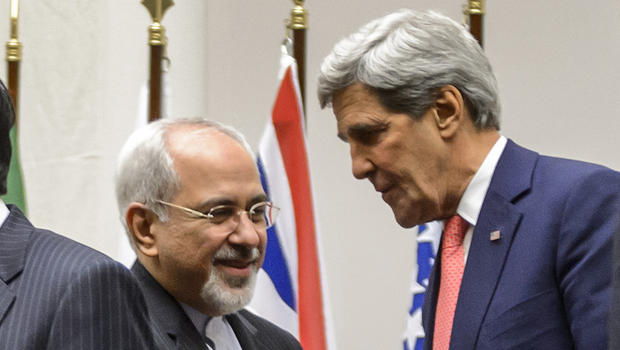
You can hear the discussions and the debates already: ‘A Major Middle-Eastern Re-Alignment’, ‘The Dawn of a New Era’, ‘From Foes to Friends?’ and on the litany of predictable headlines goes. And it is true, no matter what the future holds this was a big moment in the relations between two countries who have oscillated from low-intensity Cold War to outright hostility and back and back again numerous times since 1979. But now both sides realize the commonalities of interest outweigh the still substantial disagreements and there will at least be an attempt to deal with it. Whether or not it will be successful only time will tell. But hopefully it will be. Both nations share an enemy in combating Sunni extremism, which has much more global appeal and violent credit to its name than any corresponding Shi’a movement. In fact, last month U.S. airstrikes supported Iranian backed Shi’a militia offensives against Daesh (ISIS) in Iraq. Nothing like an even scarier foe to bring to former enemies together.
The question will be if this rapprochement is temporary or long term. Iran also wants more diplomatic options, an end to sanctions, and greater levels of flexibility than to be forced into becoming a junior partner with Russia. The U.S. on the other hand no longer has the will to bluster about constant large scale conventional intervention and also needs more options in the region-particularly if it is going to downplay its presence in order to focus on the far more important (to Washington) Asia-Pacific and possibly even European spheres of interest. It may also be desirable to remind the Saudis and Israelis who is boss in the relationship with Washington, but good luck getting anyone to acknowledge that in any official capacity. Both sides have a lot to gain and even more to lose. Nothing is settled yet but the gamble just might be worth it. After all, look at Yemen. A Saudi led coalition as well as (allegedly by some but unproven so far) an uninvited Israeli guest are stepping up bombing runs on Iranian-aligned Houthi rebels who are making gains at the expense of the government. Now this is a wild card for both parties as it introduces independent action from their allies separate of their own negotiations. It is so convoluted that it actually has captured a fair amount of media attention relating to the talks-as it should.
But one thing I am so far not seeing mentioned, except in passing, concerns less about new-found chumminess in Iraq against a common foe or even the dangers of the situation in Yemen, but rather the still ongoing and far more deadly than either of those examples Syrian Civil War.
When the war began there was no question as to whose side Iran would stand on. Syria under the Assad family was a die-hard Iranian ally, all the more important for really being the only one. Naturally, this meant that the United States and its allies jumped on the rebels bandwagon (this was of course those dark and far off days of 2011). Syria also of course had close ties to Russia (The Tartus Naval Base in Syria being Russia’s only external military installation not in a part of the former U.S.S.R.) and a quite obvious minefield of ethnic and sectarian divides. All of this made direct intervention a la Libya not an option. But short of invasion or no-fly zone, the U.S. and Iran went to work on a proxy conflict as the once sealed Syrian state splintered apart.
The problem of course was that so did Saudi Arabia. In fact, nations like Saudi Arabia and Qatar were much more gung-ho about such an intervention than even the U.S. seemed to be (neoconservative fantasies of then Secretary of State Hillary Clinton aside). The extreme form of Islam often championed by elements within these states, coupled with the fact that the Assad regime had long since made alliances against the majority Sunni population of their nation with many of the various other minorities basically guaranteed a particularly nasty division of society. Something that the Iraq War should have given the U.S. foreign policy establishment much more pause when contemplating entering the fray.
Once it became apparent that the Syrian government would not fall quickly-or perhaps at all-radicalization within the rebel movement was pretty much a guarantee. Gradually, the Islamist elements became a larger and larger part of the Syrian opposition, to the point where any hopes of a moderate-only victory became about as likely as a Green Party candidate winning the American presidency.
I remember watching the early stages of the Syria conflict unfold as a doctoral student familiar with Syria’s general demographic makeup. My first thought was ‘if the government doesn’t crumble in a month or two this is going to be nasty on all fronts-how I hope the U.S. doesn’t interfere!’ But so it happened. How much of an effect this had on the war is debatable, but once the war was guaranteed to be long it very much served U.S. interests to hope the regime-yes the Assad one-would be the faction which emerged triumphant. Rebel victory increasingly looked like a scenario where the price of getting rid of one family and their nepotistic gang would demand a terrible price for ethnic and sectarian minorities alike, not to mention the empowerment of religious fanatics who respected no borders. And yet, the American foreign policy establishment still hedged its bets with the rebels who at best could deliver only the most questionable gains in the form of Iran having to spend money and arms on aid to Damascus.
Perhaps the United States realizes its errors on this issue. Perhaps not. But this brings us back to the recent Iran-US talks. Iran and Russia are the only state level external actors that pull weight with the Syrian regime. It would be wise-if the U.S. wishes to take back its Syrian mistakes-to be using those secret talks in order to negotiate something on Syria, namely to agree to stop any indirect support for the rebels in order for something else.
Considering the way things can go in such negotiations, it would hardly surprise me if that ‘something else’ was acknowledging Iranian influence in Syria and maybe even assisting them against Daesh there (where they are even more entrenched in than in Iraq) in exchange for Iran agreeing to make its Shi’a militias in Iraq loyal to the Iraqi government at least once the current conflict is over. Or it could be for Iran to have its proxies hold off from hostility with the Kurds. This is of course speculation, but its the kind of deal I would strike. If it is not that, one suspects Syria still comes up, and that the U.S. could very well be looking for a face-saving way to distance itself from that country or for further collaboration between all parties opposed to Daesh-something Iran could very likely provide.
Simply because this is the one issue being sidelined by the media covering the US-Iran talks makes it by far the most interesting one to me. If indeed this is being actively discussed the ramifications of it could be as big as any nuclear program or shift in alliance networks.
Anyway, have a pretty jumpin’ propaganda song.
Edit: 4/13 to clarify that the claims of Israeli involvement in Yemen are so far unsubstantiated.





 The Trickster's Guide to Geopolitics