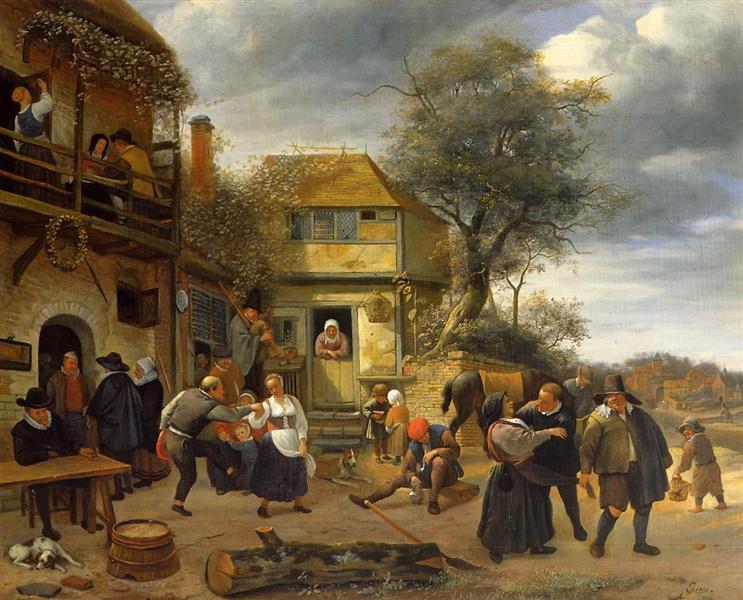
I have recently completed a ton of research on the structure of the Tokugawa Shogunate in preparation for an upcoming (still far away) publication. It is a subject I have written about before here less formally so I will spare the details, but one thing that has always struck me is how the reclusive state intentionally worked to keep the general people ignorant and removed from government while also allowing a large amount of social mobility within the literati, enabling a government culture with remarkably frank and honest discussions that put most modern states to shame. This was happening at a time when growing stability led to increased prosperity in much of the country and massive increases in living standards from before.
Preceding the above is also my long-standing view that economic populism is good and necessary but that other forms of populism are usually terrible, reactive, and uncreative, and often a net negative on society. I have come to the conclusion that this is not a contradiction at all- it is merely noting the correct way to combine different aspects of society for the best overall outcome.
Economic populism is meritocracy. It is understanding that the circumstances of one’s birth are not what should determine their ultimate fate and that large wealth gaps are destructive to social cohesion and communal interest. It is also the acknowledgement that those who suffer most from economic policies are more likely to know about the actual results of said policies than the ivory tower midwits who craft elaborate theories about what *should* happen. The demos is actually quite well informed of economic policy, even if the terminology of the profession is still alien to most of them.
This is not true for many other issues. Foreign policy especially, which requires a knowledge of the world and a resistance to media-driven propagandized narratives, is naturally closed to most of the provincialized demos. Even in our present dire circumstances of being ruled by an out of touch foreign policy elite which makes every hubristic error imaginable as it commits arson around the world, the point should be to replace this class of ruinous court eunuchs with a new and better elite, not remove the existence of an elite entirely. And I have ideas on how to start doing that.
But I think it is worth considering where one is most likely to come across low-information rhetoric, be it populist or not: social issues. Or, perhaps more contemporary in labeling, culture war. This is the field that most infects everything else under our present rule by the cultural demos, turning Steve Bannon’s assertion that politics is downstream of culture into a self-fulfilling prophecy on behalf of the worst people in society. It does not matter which particular tribe one is speaking of, woke or reactionary, feminist or manosphere, postmodern of religious, this is the feverish dream-cosmos of the lumpenprole, the addictive and destructive delusion of moral battle on behalf of principle rather than an analysis of power. Civil society seen as a playground for those too stupid or too lazy to study actual networks and the real physical logistics behind them.
And it is here we see why economic populism should be divorced from cultural populism. There are fools with a peasant mentality who were born into wealth and power who should be demoted to the peasantry, and there are people capable of cultivation of lowly birth who should be promoted. This is very real. But it should not come at the cost of having to promote those who have a naturally peasant mentality. It is not just bad for the rest of society to have to tailor cultural output around the easily manipulated and stridently ignorant, it is bad for them too. They were mentally happier illiterate and in the fields before, and others were happier in turn to leave them there. The natural inclination of the mental peasant is rage and horror when confronted with anything from outside of their narrow comfort zone- so why remove them from said zone?
I suspect this is a major reason why social media drives so many people insane. Most were not ready to be exposed to other ways of being and the psychic damage it seems to do to their pre-Copernican protagonist syndrome where their limited ability to parse events was then confidently projected onto places and times far different from their own with no understanding of circumstance.
The peasants of old stayed toiling in a relatively small areas separated from discussions of the learned. Parochial as it was, it spared the simple from psychological breakdown while also sparing the more intellectually inclined from the unthinking mob. Its worst feature was its suppression of merit and talent, but it also suppressed fanaticism and memetic stupidity. Here was localized culture that could integrate the salt of the Earth without forming a Great Salt Lake. Art could be made without it becoming enslaved to a for-profit market that values only buckets of slop with no distinguishable flavor to be enjoyed by everyone without a palette. The key element in determining who has or does not have a peasant mentality is who is comfortable with there being many ways of being, even those wildly divergent from their own, against those who cannot.
So I think the question for economic populists who want to live in a rational society not prone to massive meltdowns every few months should be how to go forward in a way that uplifts all who contribute but does not uplift *everyone*. In fact it should actively seek to keep the intellectually incurious and the fanatical down, as well as eject them from the upper cultural crust via demotions to peasant status. Peasant and cultured status will have no economic and blood lineage markers as it would be a merit based designation only. But it would determine who can govern and who can serve in the media as analyst. While I would not trust the state to determine who gets this and who does not, I do believe a parallel institution could exist which would exert behind the scenes pressure to keep the bloviators and the ignorant out through a sort of subtle social pressure targeted around potential for output. Kind of like an artisan guild. The reintroduction of peasant status is thus no longer an economic tier of society, but rather a social one.
Naturally this Designated Peasant class, so resentful of having their simple world robbed from them, will need something to do. This is easy. Farmhands are needed and mass immigration too destabilizing to still be popular. Another option would be a new Works Progress Administration, where teams of people can assist rebuilding crumbling infrastructure. Good economic populist that I am, they get paid as much (or more, critical nature of the work depending) as the intelligentsia. Its a cost well worth paying to keep a certain kind of person’s head empty and hands busy.
It should be obvious, however, that such a fair yet tiered system would struggle to exist under capitalism. It is well past time that conservatives give a second thought as to their political priorities on economics anyway. Communism, ironically for a system that began as globalist in its goals, did a better job protecting local communities from globalization. And leftists need to learn to divorce negative forms of hierarchy, like family entitlement, from good types of hierarchy like proven contribution to society, erudition, and ability to see beyond current ephemeral fads and panics. There always has and always will be an elite. The question is simply how it is chosen.
The peasants unwittingly yearn to return to the fields, and I say let’s help them do it.

