
OPEN CALL: Crypts of Corporate Memphis Anthology

We here at Human Resources Press have an exciting announcement! We are soliciting an open call for the CRYPTS OF CORPORATE MEMPHIS anthology to be released next summer.

Human Resources Press is committed to advancing small press weird fiction into the 21st Century. Horror for its own sake is increasingly stale and backwards looking, and we wish to do something no other Weird Fiction small press has ever attempted by releasing a thematic collection looking forward. The future seeks to move beyond editorial tampering and old tropes. Horror for its own sake is played out, what we need is something new- something contemporary to really chill us to our bones. Make us quiver, make us question our sanity in the cosmic void.

What We Want

-Fully original stories you will not find anywhere else. Cosmic Horror, deep boundary-pushing fiction that breaks all the rules.

-Seeking the home for that piece that has never been accepted? Its Here! Be adventurous, be terrifying, challenge our perceptions.

-Authors of diverse backgrounds.

-Show us something that has never seen before in print!

Your Original Submission Will

-Be Between 50-5,000 words, preferably between 450-600 words. Ideally, exactly 500. The further from this golden mean the word count is, the less likely your submission is to be accepted.

-Communicate a novella’s worth of concepts and events with the brevity of flash fiction.

-Be stunning, avant-garde, and boundary pushing without making any of our editors psychologically uncomfortable.

-Have 1.75 inch margins, custom pi-divisible spacing, double spaced except for dialogue which is single spaced, and use Arial font except for the first and last sentences of each section, which will be delineated by the use of Times New Roman.

-A cover letter of no more than 50 words which includes your name, resume, life goals, prior submissions, social security number, and signed third party proof that your employers both past and present have never once declared you problematic.

-If you are writing in a subgenre that was popular before the 21st Century, you must include a second cover letter (minimum 1,000 words) explaining why you are breaking with all the most societally damaging tropes of those times.

-Content warnings. The last thing anyone wants to feel while reading horror is the ick.

What we do NOT want:

-Anything that will disturb our editors. The cosmic void is one thing, causing psychological distress to a divorced English Major is another.

-Subtext without first clearing bullet-pointing the themes. Ideally in the voices of the characters (but naturally), we don’t want readers to get lost!

-Violence against vulnerable groups. This includes children, animals, women, the disabled, the obese, long COVID sufferers, and editors.

-Present tense, future, tense, dialogue written in an accent, indented paragraphs, words that require a thesaurus, compound sentences, slang, and conjugations.

-Characters of diverse backgrounds. Only write what you personally know from childhood and nothing else. All characters from outside of the submitters’ ethnic or religious background will be seen as cultural appropriation and your manuscript will be rejected.

Sound good?

Send your manuscript to @Mcskaileighlough.HRP. All accepted authors will be paid $5 per story and given a free copy (PDF only) of the collection to be mailed to your address (at your expense).

Let your imagination soar!
Theory: There is No Specifically ‘Male Reading Crisis’

My growing but so far unsubstantiated theory is that there is no ‘male reading crisis’ at all. At least, not in a way separate from the growing proportionate trends towards societal illiteracy at large that one sees in both the very old and very young. I have done no empirical research on this topic, nor is it important enough for me to do so. However, simply wallowing within the osmosis of multiple communities who read constantly, as well as generally averaging over 50 books read a year myself, I have a tentative theory I would like to put forward.

What you are seeing is the hostile takeover of mainstream bookstores by Corporate Memphis People, the majority of whom are progressive women. This drives all other reading traffic either fully to niche e-reader subjects or to old used bookstores. Since journalists and other members of the low information commentariat never enter these places (they might see something not from Current Year and thus PrObLeMaTiC after all) they have no idea such places are thriving. They just walk into the nearest Bookslop, marvel at the pastel colors, see the endless shelves of Antiracist Baby, White Fragility, Ravished By Sasquatch, What Happened, and The Anne Applebaum Coloring Book, and thus assume that these are the only books anyone is reading. A quick surface level search in sales figures seems to confirm this.

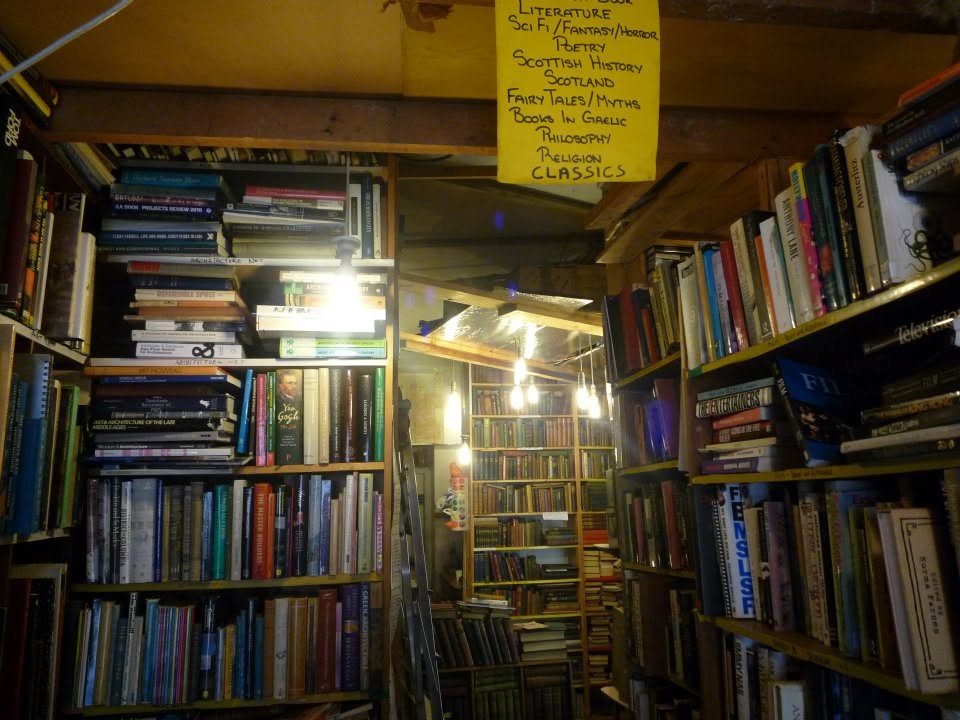
But this ignores the less exact and often cash dominated used book market. Those dark and moody stores with art collections, old volumes, lots of nonfiction, and DAW paperbacks. These stores on average are doing better now than they did when Barnes and Noble were trying to take over the market. Oh how times have changed.

My old haunt, Armchair Books, in Edinburgh’s Grassmarket.

If you frequent these places you will see that the clientele is as male dominated as the Social Justice-Gentrified mainstream bookstore is female dominated. They often even have their own smut sections which replace prose about being held captive by the cast of Monster Mash with vintage highbrow erotica. The amount of physical media moved is less overall but of such a wide and diverse nature across genre and interest that one can’t help but suspect the shadow cash economy is far larger than assumed.

Some element of this probably extends to ebooks. The overall sales are not counted as drastically relevant because they are far less concentrated and far less connected to large trends. Books about naval battles or popular physics or biographies of Richard Feynman or whatever don’t cluster like the new big thing that is doomed to be forgotten like a has been era marker (James Frey, The Alchemist, The Da Vinci Code, 50 Shades of Gray, etc). 

This is anecdotal, of course, but even in fiction the explosion of the New Weird that has revitalized horror for the last 15 years is very real, but also extremely decentralized and, with one or two possible exceptions, rarely elevated a singular author to the charts noticed by the commentariat.

While the Corporate Memphis Bookstore has gentrified far too many shops to the point that many think this ugly, samey, rigidly tone policed bubble is the primary culture of readers today, the mythical modern audience chased by clueless consultants in other fields, it has a role in the ecosystem. Namely, it serves as a holding tank for the kind of people whose prim sense of delicacy and perpetual taking of offense can be safely quarantined away from actual culture within a realm of teapots, doilies, and wall hangings with fakespirational text on them. What any of these things have to do with reading I have no idea, but rather than seek the destruction of all such places, they merely need to be culled into more manageable numbers. That way they can allow the monoculture of the shrinking violets to hold its precious and brittle cargo far away from the real places that might actually contain unique and unexpected finds. 

The vulture’s eye of the priggish scans the horizon constantly for heresy, but can be easily distracted by shiny baubles. As such, there is still a vast ecosystem of people, men included, reading but not seen by the best sellers list following crowd. They just aren’t reading the stuff that appears with the godawful samey book covers that has taken over the front-facing side of the hobby. The undercurrent of bookselling is now large enough that is fundamentally distorts the narratives that rely on official figures.

Or so goes my theory. I would be interested in evidence or anecdotes, pro or con about this phenomenon. 

I do wonder if there is a proportional Zoomer reading crisis across the board. However, even this is most likely panicked and overblown. The majority of people have been opting out to be couch potatoes since Boomers were raised with/by television. Millennials might be the only partial exception to this trend and even that is very compromised by the dominance of YA in an increasingly ageing yet ever-twee demographic.