Theory: There is No Specifically ‘Male Reading Crisis’

My growing but so far unsubstantiated theory is that there is no ‘male reading crisis’ at all. At least, not in a way separate from the growing proportionate trends towards societal illiteracy at large that one sees in both the very old and very young. I have done no empirical research on this topic, nor is it important enough for me to do so. However, simply wallowing within the osmosis of multiple communities who read constantly, as well as generally averaging over 50 books read a year myself, I have a tentative theory I would like to put forward.

What you are seeing is the hostile takeover of mainstream bookstores by Corporate Memphis People, the majority of whom are progressive women. This drives all other reading traffic either fully to niche e-reader subjects or to old used bookstores. Since journalists and other members of the low information commentariat never enter these places (they might see something not from Current Year and thus PrObLeMaTiC after all) they have no idea such places are thriving. They just walk into the nearest Bookslop, marvel at the pastel colors, see the endless shelves of Antiracist Baby, White Fragility, Ravished By Sasquatch, What Happened, and The Anne Applebaum Coloring Book, and thus assume that these are the only books anyone is reading. A quick surface level search in sales figures seems to confirm this.

But this ignores the less exact and often cash dominated used book market. Those dark and moody stores with art collections, old volumes, lots of nonfiction, and DAW paperbacks. These stores on average are doing better now than they did when Barnes and Noble were trying to take over the market. Oh how times have changed.
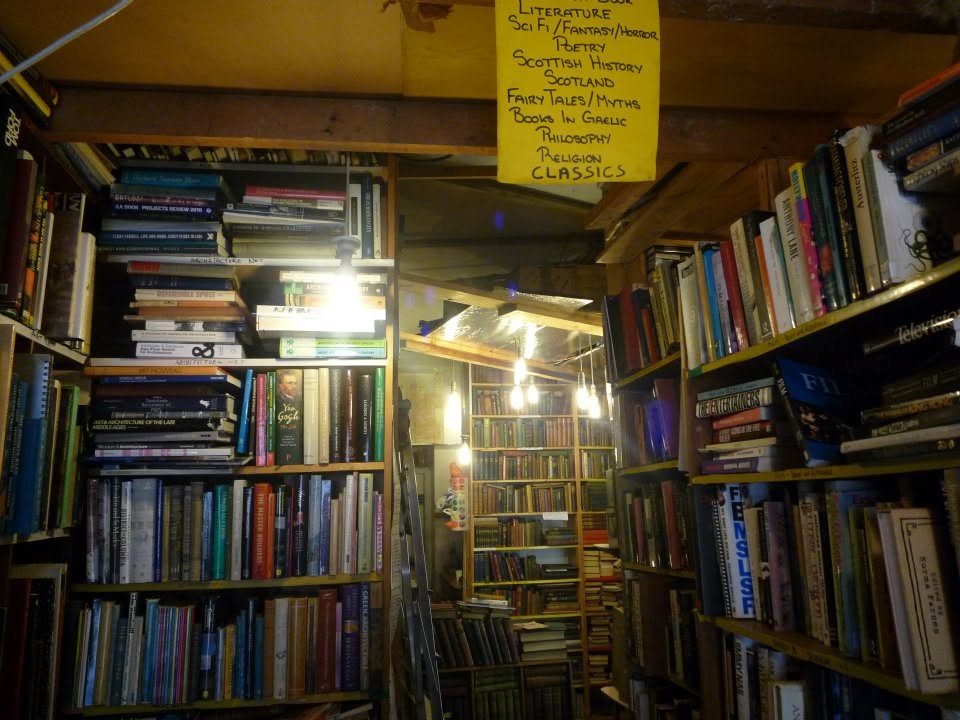
My old haunt, Armchair Books, in Edinburgh’s Grassmarket.

If you frequent these places you will see that the clientele is as male dominated as the Social Justice-Gentrified mainstream bookstore is female dominated. They often even have their own smut sections which replace prose about being held captive by the cast of Monster Mash with vintage highbrow erotica. The amount of physical media moved is less overall but of such a wide and diverse nature across genre and interest that one can’t help but suspect the shadow cash economy is far larger than assumed.

Some element of this probably extends to ebooks. The overall sales are not counted as drastically relevant because they are far less concentrated and far less connected to large trends. Books about naval battles or popular physics or biographies of Richard Feynman or whatever don’t cluster like the new big thing that is doomed to be forgotten like a has been era marker (James Frey, The Alchemist, The Da Vinci Code, 50 Shades of Gray, etc). 

This is anecdotal, of course, but even in fiction the explosion of the New Weird that has revitalized horror for the last 15 years is very real, but also extremely decentralized and, with one or two possible exceptions, rarely elevated a singular author to the charts noticed by the commentariat.

While the Corporate Memphis Bookstore has gentrified far too many shops to the point that many think this ugly, samey, rigidly tone policed bubble is the primary culture of readers today, the mythical modern audience chased by clueless consultants in other fields, it has a role in the ecosystem. Namely, it serves as a holding tank for the kind of people whose prim sense of delicacy and perpetual taking of offense can be safely quarantined away from actual culture within a realm of teapots, doilies, and wall hangings with fakespirational text on them. What any of these things have to do with reading I have no idea, but rather than seek the destruction of all such places, they merely need to be culled into more manageable numbers. That way they can allow the monoculture of the shrinking violets to hold its precious and brittle cargo far away from the real places that might actually contain unique and unexpected finds. 

The vulture’s eye of the priggish scans the horizon constantly for heresy, but can be easily distracted by shiny baubles. As such, there is still a vast ecosystem of people, men included, reading but not seen by the best sellers list following crowd. They just aren’t reading the stuff that appears with the godawful samey book covers that has taken over the front-facing side of the hobby. The undercurrent of bookselling is now large enough that is fundamentally distorts the narratives that rely on official figures.

Or so goes my theory. I would be interested in evidence or anecdotes, pro or con about this phenomenon. 

I do wonder if there is a proportional Zoomer reading crisis across the board. However, even this is most likely panicked and overblown. The majority of people have been opting out to be couch potatoes since Boomers were raised with/by television. Millennials might be the only partial exception to this trend and even that is very compromised by the dominance of YA in an increasingly ageing yet ever-twee demographic.

Laird Barron’s Carnivorous Cosmicism

Hunter by Justin Sweet

“”To know itself the universe must drink the blood of its children.” Her voice cracked like an ice shelf collapsing; it roared across an improbable expanse of inches. The talon pressed against my pupil. It went in and in.” ~Laird Barron, ‘Swift to Chase.’

“The foxes run. The foxes die. I mourn them, but I understand that there is a danger in mourning for those who would not mourn you in return. Empathy is for those who can afford it. Empathy is for the privileged. Empathy is not for nature.” ~Tanya Tagaq, ‘Split Tooth.’

Happy October. The best month is upon us so it is time to be thematic.

As of the time of this writing, I am one story away from closing out Not a Speck of Light, Laird Barron’s latest collection of short stories. I imagine that reviews of this specific work will be rapidly proliferating, so I am more interested in examining the overall themes of his oeuvre. All I will say about the latest publication is that it is excellent- as much so as his last collection Swift to Chase. As is normal, there are three or so stories on average from each work that really stick with me, a whole lot I enjoy thoroughly, and one or two that I am simply (but not negatively) baffled by.

Barron’s publicly available biography is well known because it is so interesting. Born and raised in Alaska, he worked in fishing and dog sledding, and spent some time in Washington State before moving to upstate New York. These three locations are extremely present in his works. Interestingly, he seems to be working backwards, with more recent stories being more likely to be set in Alaska. His earlier work was Washington-focused. There is also a novel series set in New York State, which retains the weirdness of his shorter fiction if more indirectly but is more focused on two fisted mystery and action.

Most of Barron’s stories are readable as self-contained and stand alone entries. Yet there is a clear overlap and greater cosmos going on here. Characters reappear, as do cults and monsters. Old Leech, an eldritch being who loves humanity “in his own way”, enjoys feasting on our suffering to sustain either his power or perhaps merely to slake his boredom. The world is animalistic and very much alive. But it is not a Live, Laugh, Love world- although you can do all of those things in it if you like.

Something that brings all of Barron’s work together, at least from my own perspective, is the same thing that has attracted me to for eleven years now: Its ruthless paganism. Barron’s protagonists are like Robert E Howard’s in the sense that they are tough and fight back no matter the odds. Unlike Howard, however, who was very much on Team Humanity, human supremacy never exists in Barron’s world. No one wins out over entropy. The food chain, like in Lovecraft of Clark Ashton Smith, is not stacked in favor of man. People fight back, but they often go down fighting. Specific underlings and odious toadies can get their comeuppance, but the protagonists don’t really win either in the long run. I have long maintained that Barron is really a modern Sword and Sorcery author more than even a horror author. That older and better form of fantasy was rooted in an earthy defiance of established order combined with naturalistic sensibilities. Horror was everywhere, but so was adventure. The world was predatory and so were its heroes.

A film example of sword and sorcery in the modern day which also goes unrecognized is the film Mandy, a movie I suspect Barron has seen, especially considering the direction some of his newer stories have taken in the past few years. In this way it takes one to know one as that film also influenced my own writing.

What you get with Barron is a kind of beautifully sparse and atmospheric writing style. Cormac McCarthy doing the pulps. But to say this is pulp is not to deny its literary value. In a culture where we are expected to be awash in Platonic idealism and a mandatory public moralism, it is of cultural value to take the human glasses off from time to time and see the surging tide of instinct and feeding that undergirds our experience. Life is visceral, and above such notions as good and evil. Suffering is everywhere, but so is the joy of combatting it. The pulps understood this drive, to see the awe in horror. Mysterium Tremendum made manifest. To choose life is to choose confronting, perhaps embracing, horror. Personally, I think these kinds of outlooks are extremely useful to meet many present challenges.

Barron shows us a world where everything eats everything else. An endless cycle of predation and consumption. It is perfectly in line with the view of the surviving shamanistic traditions or the old gods. This is the shamanic journey, where one is devoured by monstrous animals before being reborn with the devouring beast as a personal guide. One lives, laughs, and loves with a bloodstained mouth. As the musician and author Tanya Tagaq once put it while complaining about PETA’s demonization of traditional indigenous communities continuing to hunt: “We’re animals! We’re meat! We’re so stupid to think we are not.”

I am not one to become personally invested in people I do not know directly. When famous people I respect become ill or die it does not impact me like it does others. One very big exception to this, I found out, was when it was announced not too long ago that Laird Barron had a sudden and major medical emergency. A jolt passed through me fearing the worst. It was the fear that we would lose one of our best living authors. Someone who spoke to a reality lost in the endless publications of mainstream literary fiction with its endless focus on human subjectivity. Someone who had been one of the main reasons I had gotten back into writing fiction after years of inactivity on that hobby. Thankfully, he pulled through. Old Leech isn’t done digesting us yet. Here is to many more- both years and publications.

I can’t help but wonder if he listens to atmospheric black metal.