I am aware of the tired No True Scotsman trope. But if you extract it down to its core Platonic essence you really do have something worth talking about.
We have all heard it before when a low-knowledge person with extremely strong ideological attachments feels backed into a corner: the exhortation that actual historical examples that show that their attachments are not so simple in practical outcome are not representative of what they believe but aberrations. The militarized expansions of various supposedly peaceful ideologies? Clearly this must be the misunderstandings or willful interpretations of doctrine! The collapse in living standards caused by various economic experiments? Corruption! The takeover of causes by sociopathic personalities? It must be infiltration!
Plato was the philosopher of the ideal. Of reaching for the most perfect form of what something could be. Of always striving for perfection. This is contrary to observable reality and philosophical materialism and pragmatism implies that this ideal is a chimera. A false promise. What matters is circumstantial, situational, and results oriented. Therefore, the calls of ‘not true Islam’ and ‘not true capitalism’ and ‘not true communism’ can all be dismissed out of hand by those who do not claim to be idealists.
Let me take it a step further. Whatever belief or result is the majority viewpoint in any given camp *is* that camp, because what they have done and are likely to do matters far more than than what they intend. Organizations are made up of people, and groups of people have trends. This is likely to vary with time and place, of course, because in the end all things are local and temporal. Yet further reasons to distrust claims of the eternal and transcendent. If social justice, for instance, is dominated by an alliance of corporate HR and younger clones of Tipper Gore, than that is what social justice is right now. If MAGA is dominated by Q Anon and Stop the Steal, than MAGA is a front for those groups first and foremost. The true essence of a thing is the power of who commands it, not some ethereal and idealized promise of something to come. It reminds me of how the Book of Revelation was clearly written in the expectation that the End Times would come within decades of its compilation, and that the thousands-year-ongoing Christian meltdown we are still living through is a failure to come terms with the failure of this promise time and time again. ‘But surely this time..!’ they say each time assumptions are overturned, only to be proven wrong again. It is easy to believe oneself the protagonist of the culminating act of the story and harder to accept most individuals are merely background characters in a story that began far before they were born and either will never end or will only end long after they die. More importantly, it is easy to imagine oneself as just on the cusp of some breakthrough that will justify prior belief no matter how many times it has failed before.
Of course, one does not have to do this. One could simply acknowledge that the chaos of events do not move in any particular direction and so picking a tribe is just that: a tribal preference rather than a quest for universal truth. This, of course, requires giving up belief in some true eternal form of good ideology. It takes a certain amount of courage to admit that one supports a real-world messy compromise of a policy platform, contingent as it is on fate and historical circumstance. But I think if everyone was honest about merely trying to push greater forces in generalist directions rather than achieving some totalizing and ideal program it would be easier to talk with people who are from different backgrounds and forge new coalitions. Good diplomats are situationalists and opportunists. Ineffective diplomats take their cues from Woodrow Wilson.
If you declare yourself to be in support of any particular movement, you have to accept who dominates it. This means you can say ‘I really don’t like current trends in my faction, but I think the cost is worth it for the following reasons…’ This is fine. Cost/benefit calculations are really the only rational way to think about principles and they are far superior to Platonic idealism. Even better, though rarer for the thinking person, is when you are totally ambivalent and/or supportive of what others might consider a group’s flaws. In this case you don’t downplay them or apologize, you own them. This serves as a reminder than morality is not and can never be universal. So, when critics of political realism accuse me of belonging to a group known for seeing people as pawns being moved about on a great amoral game of Go who behave more along the lines of instinct than freedom of will, I answer with ‘Yes! Yes!’
I had plans to lighten the load of relentlessly depressing Ukraineposting from every quarter with my second music related post of all time. This was the first. I was going to make a post about soundtracks in gaming, actually. But I realize now I haven’t actually narrowed down my favorite to a short enough list yet. So instead, and based on a conversation I recently had with a friend, I am going to give each generation raised in the context of mass media a theme song. This is postwar stuff only here (for now-you should see the musical knowledge of the interwar period I have picked up as someone GMing Call of Cthulhu for two decades).
This theme song does not have to be current with them coming of-though its usually not too far off-but it does have to encapsulate the general culture and zeitgeist of that generation. This does not mean it is a famous song well known to most people, though it can be. It means it is lyrically and instrumentally a good summary of their general essence. I will state why and post the song.
SILENT: ‘The Water Was Red’
Johnny Cymbal, if he’s remembered at all today, is remembered as a one hit wonder for ‘Mr. Bass Man.’ But he really captured the essence of Silent Generation corniness running concurrently with their ‘still water run deep’ affect with this song about a teenage couple making out on the beach when a shark attacks and kills the girl and the boyfriend enters the ocean with a knife in hand to kill the shark in revenge. Song never stops sounding corny though.
BOOMER: ‘We Didn’t Start the Fire’
Billy Joel’s grocery list of context-free events is probably the most obvious thing to be on a list like this. But rather than include it because Boomers unironically get wistful when listening to it, I decided to include it because it speaks about them so well: nostalgic, self-indulgent, a superficial understanding of events in the world around them provided entirely by television media headlines, narcissistic, suffering from protagonist syndrome…and YET…catchy and playable with a good music video because one thing you can say about Affluent Decadent Generations throughout history is that they tend to have good artists.
X: ‘Head Like A Hole’
The only unambiguously good song on this list. Despite being too young to be X, I think this is the demographic where my soul resides nevertheless. I have very Generation X cultural sensibilities. I picked this Nine Inch Nails song because it perfectly matches Gen X apathy, edginess, and-frankly-incoherence. Plus, gotta have that rejection of everything Boomer Flower Power/corporate. Its ironic X raised Z because Z came out just like the the 1968 hippy type this X culture was rejecting. So, parenting is not among their cultural skill sets.
MILLENIAL: ‘Young Folks’
My least favorite song on this list is the song I assign my own generation. So, you can throw your accusations of chauvinism right out the window. Bad Y2K era-looking flash animation for an insufferable hipster delving into something that sounds so boring and generic but is just ‘odd’ enough for indy cred? A sound of sad ennui with ‘quirky’ twee Wes Andersonesque aesthetics? Yup, sounds fucking Millennial to me. Hell, that describes at least half of the music I came of age too. You can almost hear it playing in the background of some open plan office where ageing redditor consoomers and downwardly mobile NGO middle management types compare real world events to Harry Potter and share sassy AOC react gifs. And people wonder why I like strange bands that never got radio time.
ZOOMERS: ‘Anime Pu$$y’
Schitzophrenic, terminally online, annoying, divorced from real life and physical reality, TMI about ones personal life in a public forum, but pretty funny with an on point meme game. This plays in the background whenever an anime avatar slathered in 5 contradictory pride flags and political affiliation labels in social media sneaks up in the wild to cancel you for inflicting literal violence on bodies and spaces with a ‘Yikes Sweaty’.
(you’ll have to click because its age restricted and doesnt like external hosting for that reason)
I had to eat some shit last night for blowing my first big foreign prediction. I thought that Russian troop build ups were all for leverage at the negotiation table. I thought it would be too risky to launch a full assault when one could, theoretically, get a neutral Ukraine over the bargaining table. We don’t yet know if this was a realistic possibility or not. If Blinken and co sabotaged such a deal or if Putin did. I hate that Putin resorted to this in response either way. Fuck Vlad.
So yesterday I was getting ready to go to bed when suddenly some cursed impulse made me check my phone one last time. Only to be immediately jolted awake by The Great Gopnik War and cries of ‘Anuuuuuuuu cheeki breeki iv damke.’ I really wish I hadn’t looked. I wish I had a full night’s sleep and only got rudely awakened the next morning.
For now its too early to make super serious comments. But I will say this: If Putin’s goals are limited, he will likely scoop out either a diplomatic neutrality concession by Kiev or, more grossly, a new territorial swathe from the Donbass to Crimea, connecting them in a kind of Slavic Northern Ireland facsimile. He could get away with this and, in time, things might settle down. But if his ambitions are as stated and he wishes to go full American-style regime change…well, get ready for full insurgency, poisoned relations with neighbors in Europe, and a simmering guerilla war that will indirectly suck in other countries and hold the potential to directly involve more as it goes on. Russia’s inferiority complex to America, it seems, has caused it to flirt with repeating its mistakes too. I distinctly remember being a teenager in the Iraq invasion and having those first months seem a euphoric victory ride for most of the population. We know now how that turned out. Moscow has a choice, and choosing wisely involves recognizing your limits.
But I am not done eating shit, though I do wish to put it in context that makes it less bad. I never said Russia would ‘never’ attack Ukraine. I always quantified the prediction with ‘probably not’ and then went on to say ‘and here’s how they would do it if they did,’ which-so far-is still somewhat accurate from what I can tell. I do feel in taking this path Russia has burned a lot of diplomatic bridges it once could have crossed. This is precisely why I didn’t think they would go ahead.
For what its worth, Biden so far seems to be handling this better than any other President of my conscious lifetime would have. Ukraine is not a NATO nation, and we are under no obligation to defend them. Additionally, its location, political situation, and other factors mean it never was a likely inductee to NATO (another reason I thought Putin would refrain from attacking). It is truly baffling to me that no one in NATO could have admitted this publicly, and I wonder if they had if the current situation would be different now. Knowing this, Biden seems to be owning, much like he owned the issue on Afghanistan, the reality that war in Ukraine directly does not suit U.S. interest. Obama said the exact same thing in 2014, but now, due to Russiagate, his partisans seem to forget this. For now anyway. It is too close to Russia and all advantages go to team Moscow. Even in the event of a decisive U.S. victory that would mean permanent stationing of U.S. troops near Russia’s core area for decades. In a country with no core shared interest with the North Atlantic? Ridiculous. The cost would not be justifiable, especially considering how far east that would be. If Ice Cream Joe keeps it up, I might just vote for his reelection. And I haven’t voted for a major party candidate at the national level since 2012…including Joe himself. Granted, I suspect many of the others who yelled at me for not doing so in 2020 might jump ship by that point. Well, there’s little point to life without some contrarianism.
As I said already, its too early to go too much into detail on the war itself. If Kiev was wise they must have prepared interior defenses in depth to compensate for their numerical and firepower disadvantages and won’t contest every inch of ground but rather fight like hell in a core defensible area. If they didn’t prepare at all than their actor-president (who once played an actor-president on tv, peak clown world) is even more cavalier than I feared. Let us leave it at that for now.
What I can do, and what I will do right now, is examine why I got this one wrong by comparing it with my other bogus prediction: the 2016 Presidential election. Both are outliers in an largely on point predictive career, so maybe if smashed together they can be elucidating.
First, lets establish that I am actually on the whole good with predictions in politics. I am not going to go through everything I ever wrote for hyperlinks, but you can search this site and my external publications are largely linked to on the publications tab. Feel free to see for yourself. But I made many big calls successfully before. Nation building in Iraq would be a disaster (2002-still in high school!), proved true in 2004 onwards. NATO expansion being a mistake that could lead to further conflict in Europe (2005), proven true from 2014-present. That the U.S. and company should avoid the Syrian Civil War like the plague (2012), proven true 2013-present. Most on point, I predicted a Karabakh re-match (2016) where advantage would be strongly in Azerbaijan’s camp…this of course came true in 2020. Additionally, and more domestically, I predicted with a one state margin of error, every U.S. presidential election from 2000-2020 with the sole exception of 2016. 2004 and 2012 I got with not a single state in error. I also had one big but very mixed prediction made in 2020, that Afghanistan’s government would collapse post-U.S. pullout (yes) but not until at least 6 or so months had passed (no).
I am not listing this to brag or fellate my ego to compensate for messing the two I fumbled up. It is important to establish the overall record to investigate the flops. Furthermore, it is important when rating a geopolitical analyst to see the overall picture. Someone like Thomas ‘lets ally with ISIS’ Friedman is remarkable for his near total failure rate, while someone like George Kennan, who predicted both the overall course of the Cold War in the 40s, and, in the 90s, the current post Cold War mess, had a proper record that showed he was paying attention. Few if any get everything right, and some room for failure must be allotted, but proportionality remains a key attribute. And should I ever tip the balance near 50/50 or…even worse, under that, I promise to do something terrible and humiliating. Like drawing Uncle Klunk erotica, signing it, and sending it to whoever asks to adorn their wall of shame (as it will not be going on the blog).
So, what do my two big failures have in common? A domestic political call that thought the election would be close (correct) but totally misread several key states vs a tale of brinksmanship vs hard power deployment in a foreign country that came out on the wrong side of that equation?
I think, placed in binary, a common theme emerges. I am…and this pains me to say…far too trusting in the long term planning abilities of powerful people. Yes, me who dunks on lanyards all the time. But I thought ‘Hillary has the money and the connections, she’ll leverage them correctly.’ And I thought ‘Putin won’t burn most of his European bridges/NATO surely wouldn’t dangle out membership to Ukraine as an actual possibility.’
So clearly, I, who gets criticized for being too cynical, need to becomes more cynical. Because I am not yet cynical enough. Challenge accepted.
P.S.:
U.S. intelligence, possibly for the first time in my adult life, got something right out the gate and told us the truth of what was going to happen. This is a good thing actually (though last week it furthered my doubts as to Russian action given the general record of those-who-glow). I would like to see more of this. HOWEVER…so far this is one big public call for U.S. intelligence out of…what, dozens of failed or intentionally doctored calls? WMDs? Gadhafi’s Viagra rape army? Moderate rebels? Russiagate? Havana Syndrome? Kuwaiti baby incubators? Tonkin Gulf? The rise of ISIS? You get my point. They are going to use this one case as a ‘trust us’ pass in the future. Do not. The odds still do not bear out their claims on most issues. It is up to them, not to us, to earn the public’s trust again.
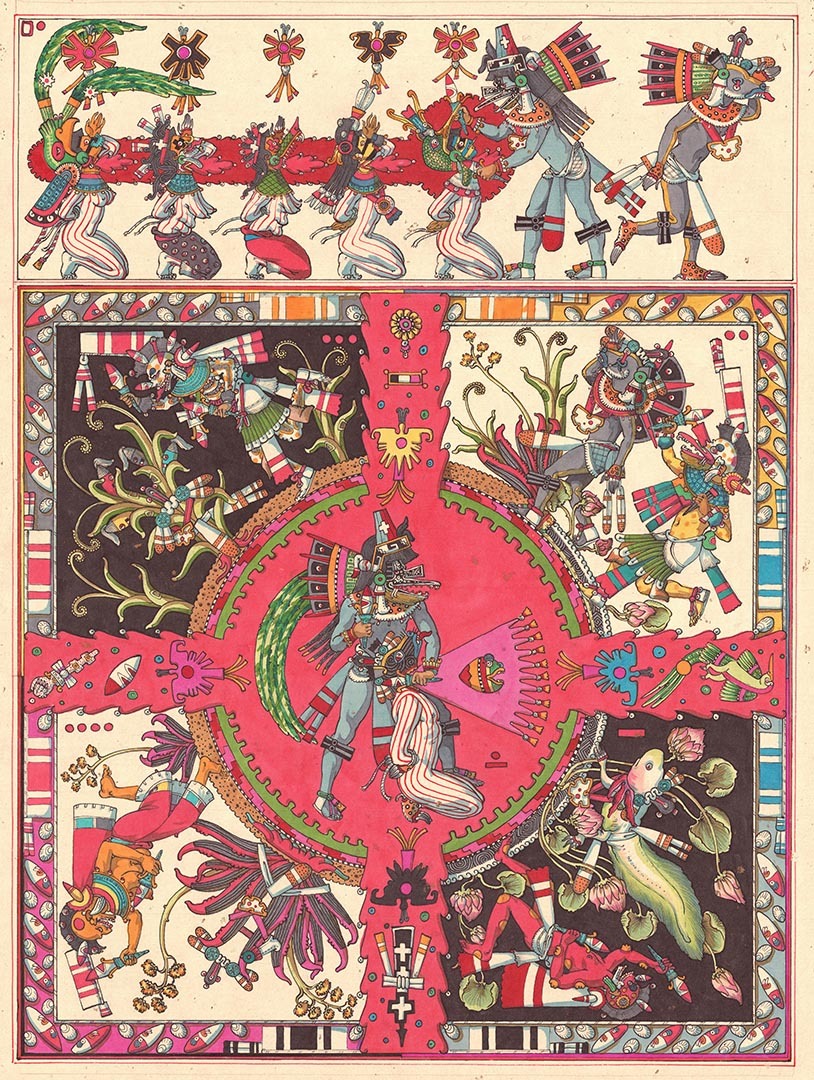
The Birth of the Fifth Sun. Artwork from Chicome Itzquintli and the Mexica Heart site.
‘Aztec Thought and Culture: A Study of the Ancient Nahuatl Mind’ by Miguel Leon-Portilla is a circa 1990 attempt to extrapolate the metaphysics of Nahuatl-dominated Mesoamerica based off of what surviving sources are available. Much was lost, destroyed, and hidden in the Spanish conquest, not so much due to the war itself as much as the subsequent invasions of priests and missionaries who insisted on demolishing, ISIS-style, as much of previously existing culture as they could. This has left us with imperfect records to work with, yet the Mesoamericans were an incredibly literate people and some had the foresight to safeguard many things until later and less fanatical eras.
Leon-Portilla has an interesting way of approaching this anthropology-meets-philosophy overview. He likes to let primary sources speak for themselves. Only after listing the excerpt he wishes to reference does he then move on to repeating it but while deconstructing each line or paragraph in turn with modern interpretation. This is an atypical way of conducting this kind of analysis, and it takes some getting used to. However, it works extremely well and made me wonder why this method is not used more often.
The author is interested in figuring out the rise of philosophy independent of mythology and religion as much as he can (in many cultures there is not a clear line of division between the two and such is the case here as well). Nevertheless, we must begin with the cultural context of Mexica myth. We get a breakdown of religious beliefs and cosmology but also see that many scholars doubted these accounts going back to the start of what in today is known as the Aztec Empire (actually a triple alliance of three city-states in the Nahuatl culture complex dominated by the Mexica people). Most importantly, there is a summary of how the Mexica people saw their right to rule in the origin of the present Fifth Sun Era. All previous suns had been specific to past eras that had all ended in cataclysm. This current era would be no different, however, its ending could be delayed by honoring the covenant of sacrifice that had made it possible in the first place. For, after the initial creator duality-god/god couple created the other gods, those gods had in turn brought about this new era through the self-sacrifice of two of their own members, Tecuciztecatl and Nanahuatzin. The first showed hesitation thus could only become the moon. The second who jumped right into ‘the God Oven’ became the sun. In order to keep this new and most beneficent sun going, Nanahuatzin/the sun must be periodically recharged with human blood, which holds power when shed due to it having a link with the gods as well. As gods sacrificed themselves to make the world livable for men, so too should men return the favor if they wish these conditions to continue.
Naturally, this also gave the expansionistic Aztecs a great ideological foil to pursue an empire. As the prestige of taking captives for sacrifice fueled war, so too could war fuel growth. Growth, in turn, was tied to a special pact of their empire with the maintenance of divine order. It upheld the cosmos for the Aztecs to expand. If they stopped expanding their world would end.
It becomes apparent that skepticism of religious literalism was quite common in that society for a long time. This put many ‘wise men’ on a different path than that of the religious establishment. Fittingly, since the Mexica saw the most important creator god as one of duality, a core dualism emerges in Aztec thought. There was the priests and the warriors going out and growing the empire through war and sacrifice, but there were also highly respected wise men who taught of empathy in a world of constant entropy, and the utility to practical Epicurean-like pleasures through harm reduction at home. This led to a philosophical emphasis on what we might now call universal primary schooling, with an enormous percentage of children literate and learned for a pre-modern society.
This example also, along with that of, say, the British, pretty firmly puts to bed the idea that educated societies become more peaceful.
The purpose of this new Mesoamerican society was to cultivate a ‘face and heart’, a personality in our terms, that understood the temporary nature of things and the necessary fatalism to cope with it while also building themselves up as distinctly useful for society as a whole. The author emphasizes that while Aztec political culture was collective (hence both public education and public sacrifice spectacle) its concept of personal life was in fact more individualist. Only in a well running collective could things work to allow the arts and philosophy, and only through the arts and philosophy could individuals differentiate themselves from each other in order to better contribute to society by meeting their true potential. While societies with similar civic bargains to this have existed elsewhere, few I know of were so specific in making this their intention. There quite literally is no self/society divide because the self is in service to society and vice-versa.
Mexica intellectual pursuits were dominated by an understanding that all things pass in time. They were also enormous weebs for the previous Toltec culture, using the term ‘Toltec’ to describe things that were well made in a material sense. Much like the Japanese concept of mono no aware, it was the fact that the Toltecs has passed into history but still left moving monuments that inspired the Aztecs to make art. The temporary nature of things was inevitable but beautiful. It was part of nature and life. And it was a reason to build a society with a highly cultivated aesthetic sense. What these thinkers thought when it came to the necessity of blood sacrifice to prolong the apotheosis of the now, it is unknown. I suspect many were skeptical.
Yet, strip the symbolism aside and you really see a society far more honest with itself than that of the moderns. Expansionist orders are founded and maintained by blood. The Aztecs tied a frank openness about this to their very being and even promised a higher destination in the afterlife for those sacrificed than those who died naturally. Compared to our high culture, which lives in total disavowal and denial that our empires are much the same in effect towards other people, and which rigorously seeks to hide our bloodletting far away from view, the honesty of the Aztec tableau is a bracing comparison. For many in the contemporary world, our ritualistic bloodletting goes towards no less a mythical edifice than theirs, as the constant laments from our priestly class for ‘upholding the values of the liberal world order’ imply. At least the Aztecs got a great show for their efforts. We just get to be on ‘the right side of history.’
It also shows us the limits of absolute duality. For it is not that high culture exists despite its gruesome elements, but often in total tandem with them. The lake city of Tenochtitlan was larger than any in Europe at the time of its height. It was remarked upon by the very people who conquered it and enslaved its inhabitants that it was a place of remarkable cleanliness, order, and urbanity. Another water-based city, Venice, exists as an admired tourist attraction to this day not in spite but because it experienced its first golden age as a result of rampant piracy and the looting of Constantinople.
The Aztecs were very fatalistic towards the forces of nature, and the caprice of their gods reflected this. While you would be judged in life by how you lived, you were still going to the afterlife designated for you based off of the method of your death regardless of conscious action. Yet their obsession with self improvement shows that fatalism is not mere passivity. Fatalism can be the call to self-improvement. Being unable to remold the world, one can remold one’s reactions to it. And if enough people do this together- albeit in their own particular ways-this changed response creates its own impetus to not just live life for what its worth, but to contribute to it through the arts. To quote directly from the book’s conclusion:
‘Nahuatl philosophic thought thus resolved about an aesthetic conception of the universe and life, for art, ‘made things divine’ and only the divine was true. To know the truth was to understand the hidden meanings of things through ‘flower and song’, a power emanating from the deified heart.’
Anyway, on the subject of art, have some OC content:
Priest of Xipe Totec, the flayed god of agriculture, warfare, and renewal, also called ‘The Night Drinker’. At certain sacrificial events these guys would cut the hearts out of victims, flay the flesh, and create a skin suit out of it to then dance around for a few days. At the end of the ceremony they would strip off the rotting human pelt and bury them under the main temple in jars. This represented Xipe Totec’s shedding of his own skin of foliage with the seasons and bringing about the renewal of the next corn crop. Some sources I’ve seen say they painted themselves pink or red under the pelt to really get that raw muscle look peeking out from under the hide, hence the skin coloration here.
We interrupt this MetaVerse NewsBeam for a direct broadcast from President Lemur:
Greetings citizens of the United BrEntered AngloStates.
Today, our military forces, supported by the 5th Juggalo Militia and the STALKER scouts, finally achieved the ultimate goal of the past twenty-two years of war…the final defeat of Belarussian Eurasia.
What began as a dispute over the Donetsk region in Ukraine long ago spiraled into something much greater. Millions, if not billions, have perished. A situation made worse by the merger of the Covid virus with AIDS and the Bubonic Plague. Prior Administrations stumbled from defeat to defeat, culminating in near total global collapse under former President Incel_Sniper1488. But I am glad to say that today, under the capable leadership of General Foxbussy420, the tide has decisively shifted. TsarKhan Nikolai Lukashenko has abandoned his capitol and is now on the run. His chief advisor, the Warlock RasputiDugin, is dead, along with most of the snorks, bloodsuckers, and burers he summoned to the battlefield. As of last night, the PawPride Maple Stars and Jack flag flies proudly over the enemy capitol of Neo-Chernobyl. Soon, Secretary of State Chillhop_Raccoon and Vice President Cub_Destroyer will arrive in the city to begin the final surrender negotiations.
This event will be called SlavCon, and there will be an extra hour in the ball pit for all paying attendees.
Reports of destabilizing attacks by the Krokodil Insurgency have been greatly exaggerated by misinformation sites such as The Gayzone and the New Zealand Agricultural Landbird Herald, who will subsequently be acquired by Verrit Verified Public Streaming as a matter of national security. The world is now safe for everyfur, though talk of equal rights for scalies is pushing too far, too fast. Right now we must take stock and rebuild.
I now head to the UN headquarters in Harajuku to meet with Secretary General Kyary Pamyu Pamyu and Chinese President Warcraft_OrcStud_Appreciator1368 to begin planning a new and most glorious world order. The one Meta CEO Chuck Todd assures me will bring about the End of History.
Thank you, and may God Bless the United BrEntered Anglostates.
No matter how tenuous the justification for putting it here is, having written about the importance of table top role playing games in understanding macro-scale events exactly one year ago, I feel it is perfectly fine in light of the announcement of a new or upgraded edition coming in 2024 to have a post ranking Dungeons and Dragons editions. I promise, given the order I plan on ranking them in, that nobody but myself and a few others I personally know will be happy with it.
Before starting, I want to point out that DnD is not my first, second, or even necessarily third favorite game. This is specifically a ranking only of official DnD editions lest we get bogged down in Old School Renaissance discussions (my preferred way of playing the game). We will start with the best and decline to the worst as if heading from the safety of town into perpetually gloomier bowels of peril much like that of a dungeon. Now, with that out of the way…
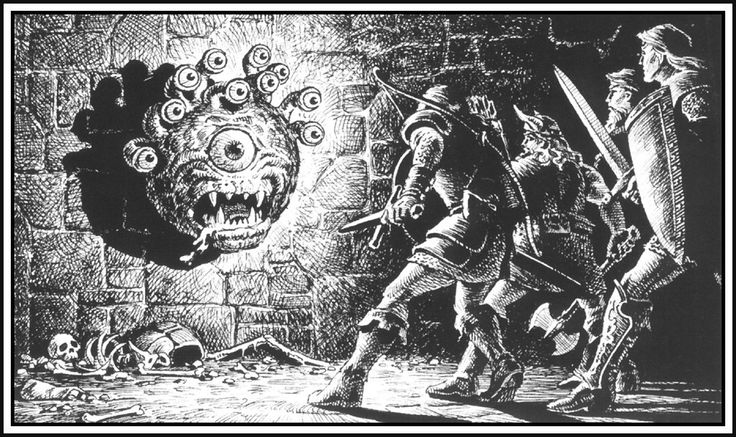
1. First Edition
This is no grognard nostalgia at work here on my part. The one edition that predates my very birth into the real world is actually the last edition I ever got to start playing. I am recent convert to its simplicity, deadly peril, and extremely evocative amateur art, having only begun to experience it about three years ago. (Something worth noting is how much of the art has a party quaking in fear, dying or running away rather than looking like confident superheroes like they would in the art of all subsequent editions, more on this later). Coming in both advanced and basic versions, and easy to house rules (a necessity for anything DnD), it is the first official rendition of the game that gives the best play experience all these years later. Characters do not start out as superheroes. A lot of them will die embarrassing and miserable deaths. Loot gets you experience points, not monsters slain. This coupled with the greater emphasis on player (rather than character sheet) agency and cleverness really brings forth what a tabletop game should be-and shows how much more fun it is when not structured around the limitations of what computer game-influenced expectations have imposed on the genre. Creative and unconventional problem solving rule when rules are tough but not omnipresent. What you get is a game whose rules play like how Sun Tzu conceptualized warfare; something to be avoided whenever possible but, if unavoidable, need to be gamed with clever and unexpected thinking. This worked well considering the game’s culture was all about constructing the strangest most mind-bending adventures possible.
This is real tabletop gaming from a time of non-Euclidean interior décor, hideous jellied party food, and ‘fancy’ overcooked dinners at the Steak and Ale®. Jimmy Carter might have made it famous as the ‘Malaise Era’, but there was nothing but the bounce of a vibrant disco subculture in those deadly dungeons. It is a style of play that, outside the old school modern spin off scene in TTRPGs, is best encapsulated by PC games like Darkest Dungeon-or it would if that example had zany roleplaying and psychedelic funhouse settings.
The Basic versions are to be preferred over Advanced, for what it is worth.
2. Fifth Edition
Having 1rst and 5th both at the top end is enough by itself to make this list controversial. The oldest and the newest editions fans tend to view each as the polar opposite. How fast things change. When 5th first dropped it was often hailed as a welcome return to old school sensibilities for its simplicity and cutting away of the endless amounts of math fat that had grown in the intermediary editions. And rightly so. The game is popular for a reason. In fact, its only real mechanical flaw compared to the first is both a greater amount of mechanical bloat (gotta sell those splat books!) and the lack of danger. Without house-rulesing its almost impossible to kill a player character without breaking the game’s balance, ruining the dramatic tension of encounters. This ties into a questionable design philosophy of starting out the PCs as de facto superheroes that began back in 3rd and was never stopped up through the present day.
The real drawback of 5e is really in its generic nature. Trying to be everything for everyone means it is kind of for no one whose tastes expect more than the generic. Though no fault of the game itself, this does mean it has the (second) worst fan base of any edition. Being a Zoomer-hugbox-friendly game, it tends to attract a fandumb very much integrated into the present Postmodern-Protestant monoculture and its ever-shifting labyrinth of zeitgiesty-yet-sterile human resources department derived ideologies. Most annoyingly, this tends to manifest as people caring more for lame podcasts about playing the game than, you know, actually playing the game themselves.
A Carelord Paladin character about to advance from level one intern to level 3 lanyard at daddy’s NGO.
That and the game system being built for cornball high fantasy over the sword and sorcery weirdness of 1rst Edition is what keeps this perfectly fine game at second place. But is still perfectly playable and has brought many people into the hobby so credit goes where credit is due.
3. Second Edition
The middle position usually delineates ‘average’, but there’s nothing really average about 2. It’s a grab bag of terrible and awesome. Mostly, the actual system is an overly complicated hot mess version of 1 but at least maintains its sense of perilous play and player agency. However, you need more types of dice than there are kinds of legos for it to work at all. Unrelated to the system but worth mentioning, this was the system that had the best PC game adaptations (Planescape: Torment, Icewind Dale, etc) and the best pre-made settings in general like Dark Sun and (regular) Planescape. But since I always make my own campaign settings myself this doesn’t really affect me. Sadly, it was also the first to come after the 1980s Satanic Panic that had really attached itself to 1, and thus came with this weird squeaky-clean veneer that robbed the game of much of its edge. A loss it has yet to really fully recover from even today. NEXT!
4. Fourth Edition
How many times could Deep Blue, being a hostile dungeon master and running DnD 4E, defeat a party of Gary Kasparovs?
This is a weird one. A noble experiment in some ways but just an utter failure in execution. They wanted a very tactical and well balanced game…and they got that! Its just…it came in 2008. Long after PC games could deliver exactly that far better than a tabletop game could. So…you could effectively play a computer game on the table and have to do all the math yourself. Really just misreading what makes tabletops still so good even in the era of advanced electronic gaming. This is most people’s least favorite edition and for good reason…but the fact that it was so combat focused ironically meant the non-combat portions of the game could be played old school style since they weren’t rules’d out to death. Its just a shame it took half an hour for a party to fight one small band of goblins. To add an ultimate level of irony, this system, that would have worked great in PC adaptations, never got a major PC game adaptation! But hey, it was still better than…
5. Third Edition
Do you like mass market monoculture superhero movies? Do you like character creation that feels like doing your taxes? Do you love rules-layering and meta-gaming? How about reading novels worth of ‘feats’ that ‘give you so many options’ but in so doing show how little player agency exists off of the confines of the character sheet? Than OH BOY DO I HAVE THE EDITION FOR YOU!
An average third edition player showing off simplified 3e character creation.
3E, and its different company pseudosequel Pathfinder, [more like Mathfinder, amirite?] have got to be not just my least favorite edition of DnD, but among my least favorite mechanical systems in all of TTRPG-dom. Feats? Ugh. In an action oriented game with stats and classes rather than skills as focus you should never have to read paragraphs to tweak numbers off your core stats. Do you want to be skills based 3? Then get a better system for it! Do you want to be class based? Then keep it simple! The bloat becomes offensively bad the longer you play, with both friends and foes spiraling up like a bad shonen anime power up sequence that never stops but without the entertainment value of them screaming each other’s names (though I suppose you could roleplay this if you wanted). High level characters don’t even have much in the way of random elements from the dice as modifiers make the tossing of the D20 a mere formality of turn taking. Spellcasters (that class of nerds) are even more ridiculously overpowered than usual, turning all late game encounters into WWI artillery duels between them with everyone else getting to be the obsolete and sidelined horse cavalry.
Couple that with the fact that the people who still like this system like to loudly proclaim its nonexistent virtues with a healthy side of ‘you’re just not smart enough to play my High Fantashire Turbotax Simulator’ and its just beyond me how anyone could ever enjoy this game. This game I once had to run an entire campaign in for a bunch of players despite my objections to using such a terrible system.
But I suppose it will get its second wind when future President Incel_Sniper1488 sets up a game of it in the Oval Office in order to DM for the First Waifu Pillow and the hapless members of the Secret Service who haven’t resigned yet.
The Crossroads
By both being very modern and somewhat old school, the future and whether 5.5 or 6 or what have you will be better or worse remains open to question. It won’t really matter to me, since I have already decided my ideal monster-bashing table top system is Shadow of the Demon Lord, but I do like to wonder. Will the exploding OSR scene cause the largest role playing property to take another hard look at learning from its avocado colored furniture on orange shag carpet disco original core? Or will the next iteration be in all pastel colors, replace deadly damage in entirely with ‘literal trauma’ and conduct character advancement via ‘lived experience points?’
Just a quick post for today to sum up something I haven’t been able to get out of my head since first brooding over the term ‘NPR-American.’
Is it worse for a person to be a little bit informed than to be not informed at all? I ask this because I keep seeing and having interactions with people who are extremely confident in quite questionable if not blatantly myopic views whose confidents stems from a certainty that they are well informed people. Anti-vaxxers are the most obvious form of this (a group whose danger I called back in 2010), but that is almost too obvious now. Other groups would be NPR listening zeitgeist-chasing people who criticize foreign countries for having state-run news services without any acknowledgement as to what most media they consume is. An intense irony considering that the entire self-conception of NPR people seems to be being a kind of critical thinking cultural elite who is objectively informed about the world. Point out examples of them being low information voters and they will rage like you attacked their mother. Cable news and mass entertainment consoomers often believe themselves to be informed on the truth or at least able to make inferences about it despite being monstrously ill-equipped to do so. The disaffected, who I am normally sympathetic to, proportionally tend to slide into bizarre extremes that range from unproductive to downright insane.
Is this worse than the honesty of sheer ignorance? There is something to be said for the incurious who say ‘not my problem’ or ‘nothing can be done about it anyway.’ But those who aggressively try to insert themselves into discussions without doing the requisite learning to contribute as anything but a Rush Limbaugh ‘dittohead’ circa 1998 are dragging everyone, ignorant and learned, down alike.
To my knowledge, the phrase ‘Low Information Voter’ first became popularized in the Bush Administration, when Karl ‘Turd Blossom‘ Rove (the only member of that crew who did his job successfully) said he was explicitly appealing to such people with emotional buzzwords and knee jerk social, religious, and jingoistic causes. Democrats immediately latched on to the admission as proving the GOP was for stupid people (correct) but quickly showed themselves to be just as happy to engage in the same behavior with the rise of their own inverted form of evangelism, Russiagate, and ‘muh norms and decorums’ during the late Obama years on through the present. Guess they were for stupid people too.
Needless to say, if you believe that culture war largely exists to whip up mobs against each other (and redirect them away from actual centers of powers) as I do, it becomes increasingly apparent that the Low Information Voter is probably the single most anti-intellectual, politically dangerous, and all around miasmic segment of the modern public. Utterly mindless products of the media they consume, they amplify the most odious and corrupt establishment interests and do so without even drawing a paycheck. Their confidence and aggressive insistence on inserting themselves in discussions they are not equipped to handle does almost much damage to civil society as neoliberal austerity or the unchecked growth of the mass surveillance state. And the solution cannot simply be just more education, as the continual ideologically imposed rot of higher education is likely to make more of these people. The more that go through a university system that has given up all pretenses at being anything but an establishment laundering mill the more of this phenomenon will occur.
So we are left with some questions moving forward:
How can engagement with public issues be taken out of a place where the Low Information Voter is the primary driver of the discourse?
How can we increase the prestige of dropping out of having opinions entirely so that more of the ignorant choose that option instead?
What are the most effective ways to discredit official and reliable seeming sources that are anything but (high prestige legacy press, etc)?
What is the most effective way to turn away from the ‘get more people engaged’ model which has been such a disaster and pivot instead towards one of getting the interesting, curious and nuanced people engaged without the posturing rubes outnumbering them?
Should we consider the possibility that complex events and ideas being distilled into extremely simplified soundbites (the Voxplainer, for example) is actually a net negative for discourse rather than a positive triumph of public accessibility?
A turn of quality over quantity is desperately needed.
Back in 2018, my friend Brandon Hensley reviewed a terrible book on this blog in my first guest post. Now, he returns to review what might be an even worse book. The following text are his words and not mine.
“I’m so hungry I could eat the balls off a low-flying goose.” –Joe Biden, according to Andrew Shaffer
Lord Dismiss Us is a 377 page novel by written in 1967 by openly-gay British Peer Michael Campbell. It is a tense, sexually-driven novel about young men coming to terms with their sexuality amidst an administration’s religiously-motivated witch hunt to purge deviants from the boarding school in which the story is set. It is fraught with desire, unrequited love, and the problem that every man wrestles with in Western society—is a quick pump and dump the closest thing gay men can have to experiencing love and fulfillment? If I were to write a review of it I would give it four stars out of five. It’s really good, I highly recommend it, and you should read it instead of Hope Never Dies, a 301 page novel written in 2018 by Andrew Shaffer.
If my choice of opening quote (pg. 112) is anything to go on, I promise you that my comparison to Lord Dismiss Us is not snarky or random. It is intentional, and I am sure by the end of this review you will fully appreciate why. Because for 301 pages, Andrew Shaffer desperately wants to write a slash-fiction of former President Barack Obama and former Vice President, current President, Joe Biden. He wants it very, very badly. The problem is that an explicitly pornographic fan fiction would probably have been better than what he actually turned in to his publisher. I have a lot of criticism of Shaffer’s ability to tell a story, as well—it’s not just the wannabe slash-fiction that makes this bad—but I really need to hammer home just how much Shaffer wants Obama and Biden to Pete and Chasten Buttigieg. To do this I will present to you a brief passage from Chapter 43:
When I woke up, I found myself in the middle of the cemetery. I was lying on my back, with the sun beating down on my face. A gentle breeze was rustling the unmowed grass. Far away, I heard a thump-thump, thump-thump, thump-thump. Like racing heartbeat. The louder it grew, the more distinct it became. It wasn’t a heartbeat at all. It was the trotting of hooves. Big, heavy horse hooves. I sat up just as a white horse emerged from over a hill. A faceless rider snapped the reins and flew down the slope of the hill, dodging broken tombstones and barren trees. The hooves pounded louder and louder, as if the sound was coming from inside my own head. Thump-thump, thump-thump, thump-thump… The closer the horse came, the more indistinct its shape. It was so white that it was glowing. Looking at it was like staring into the sun during an eclipse; I was forced to look away. Just when it sounded like the horse was about to run me down, the animal came to an abrupt stop. It was so close now, I could feel its warm breath on me. I was vaguely aware that I was dreaming, but every sensation was so vibrant. I desperately wanted it all to be real. “Need a hand?” I peeked at the figure on the horse’s back through cracks in my fingers. My eyes slowly adjusted to the light emanating from the horse, and the figure came into focus. It was Barack Obama, clad in a white toga.
Take all the time you need to revel in that afterglow. It’s honestly a surprise to me that this bodice-ripper wasn’t given some kind of GLAAD award or picked up as a multi-season crime drama on Logo or VH1, wherever RuPaul’s Drag Race is currently being hosted.
To be fair to Shaffer, this steamy Obama-as-Greek-god scene (turns out it’s a unicorn, not a horse—seriously) is meant to evoke a symbolic foreshadowing of the once bosom-buddies to their pre-2016 status quo. The overriding emotional theme of the story is that, since Trump’s inauguration in January, 2017, Obama has been out gallivanting around with celebrities while Biden eats ice cream at home, neither one has kept in contact with the other, and now Biden is insanely jealous that Obama is holding auditions for a new best friend. This tension defines their interactions throughout the book. Told in the first-person from Biden’s perspective, this tension is necessary because Biden just isn’t a tough cop act. He can’t just go swaggering in and solve a murder—oh yeah, sorry, I forgot to tell you this wanna-be porn show is actually a murder mystery. Let’s back this up a little bit. Face down ass up, right into daddy’s lap.
Biden is at home one night, feeling jealous, when his dog gets all feisty to go outside. Biden sees the orange glow of a cigarette in the dark trees outside and goes to investigate. Turns out Obama is hiding in the woods waiting for Biden to make an appearance, and he’s back on Marlboro Man’s good graces. Shaffer tips his hand very, very early in the text and gives us a sprawling four page description of Obama being the coolest dude in the locker room. The jock everyone looks up to, desperately wanting to be like him, the familiar feelings of latent homosexual longing that most young men experience at one point or another but only a select few will ever go on to actually experience. I’m not even kidding about this. The actual text of the story begins on page eleven, and every single thing that happens over the entire first chapter is either Biden scowling at how cool Obama is or Obama channeling serious James Dean energy:
“He rose to his feet, a slim figure in his black hand-tailored suit. His white dress shirt was unbuttoned at the neck. He took a long drag off his cigarette and exhaled smoke with leisure. Barack Obama was never in a hurry.”
You smoke after sex, Shaffer, not during foreplay. Jeez. Anyway, Obama lets Biden know that he heard about Biden’s friend’s Anna Karenina moment (read another book, Potterheads) and hand delivers a printed map to Biden’s house that was found in said dead friend’s apartment, setting off the mystery for Biden to investigate. In a normal murder mystery, we’d have Sherlock or Poirot or even fucking Bond running off to begin the investigation. Instead, because Obama and Biden aren’t your normal crime-fighting duo, we need to set the stage a little more elaborately to really dig into the how’s and why’s of a former POTUS and his VP actively investigating a death without any public or legal sanction to do so. This gives us more time to elaborate on just how salty Biden is that Obama has friends other than him. This goes on for several chapters.
After deciding that Finn (Biden’s stiff) didn’t Anna Karenina himself into that train and was actually put there Spaghetti Western style, he gets squirrely and decides he should Uber home with some flowers for Jill. When suddenly:
A black Cadillac Escalade pulled up to the curb in front of me. The truck-sized SUV sat there, idling. Was my ride early? If there was an Uber sign on the dash, I had no way of knowing—I couldn’t see anything through the heavily tinted windows. Suppose this wasn’t my ride. Suppose it was some enemy of the state, some deranged lunatic fixated on a former vice president. Suppose Finn wasn’t the one who’d left the printout of my address behind on the train… My heart rate began to ratchet up. I had no Secret Service protection anymore. No private security. I didn’t even have my pistol, because who brings a gun to a funeral? The vehicle just sat there, towering over me. There was nothing stopping a passenger from rolling down one of the windows and poking me full of holes. I was a sitting duck, with no wings to carry me away. I inhaled sharply and squeezed the bouquet tight. Water dripped out the bottom and onto the cement. The tinted back window lowered. “Need a lift?” Barack Obama asked.
Again. Afterglow. Also, Shaffer’s version of Biden has one single romantic fantasy, and that’s to be plucked away and carried off by the in-shape, bronze Adonis of his dreams. Now, I’ve read a LOT of Russian literature. It formed the backbone of the college degree that I, like most millennials, am not actively using to pay my bills. (Shaffer’s acknowledgements page literally just says “Thanks, Obama,” a sentiment that I, for no reason related to the 2008 bailout and its aftermath, would like to echo now.)
I understand the intended symbolism of Biden’s tension feeling like he’s about to get capped by Cornpop being relieved by Obama just rolling up all cool-like being mirrored later in the story when Biden is finally getting back to where he feels the most fulfilled. I get it. But, this is not a dense symbolist tome from 1880’s Russia. We do not have a Myshkin and Rogozhin from Dostoevsky’s The Prince debating the ethics of murder on a train as the set up for the payoff later of actually killing someone who is otherwise suicidal at the end of the novel. The only actual investment anybody involved has with the dead Finn is just that Biden happened to ride the train that Finn happened to be the conductor of. And Obama doesn’t know how to express his feelings because men apparently don’t have friends. The set up and pay off for these highly symbolic parallels at the beginning and end of the book does absolutely fuck all for anybody. And this, more than the porn, is what makes this a terrible fucking book.
Andrew Shaffer does not know how to actually tell a story. This book only exists to be pornography for blue-tick twitter nerds who think the term “policy wonk” is a compliment instead of a warning. Spoiler alert: Finn was not put in front of the train. He did, actually, Anna Karenina himself. Like Anna Karenina, he got himself too deep in something that he couldn’t handle and didn’t see a way out. Biden, always the plucky boy from Scranton, Pennsylvania, who lived most of his life in Wilmington, Delaware, just can’t wrap his head around the evidence that his friend—who, again, was not his friend, but just the conductor of a train he happened to ride—could have been somebody that he didn’t know very well, gosh darnit! Biden inserts himself into an active criminal investigation, is told off by law enforcement and Obama’s Secret Service agent, almost dies in the process, and gets a DEA agent murdered. All so that he and Obama can be friends again. Awwwww!
I actually stopped taking notes after a while because, once Shaffer gives the whole “Will they, won’t they” shtick a rest and gets into the groove of actually telling a murder mystery, there isn’t much to report on. His mystery proceeds as one would expect. Obama and Biden go poking around and find out that Finn was living in a motel. They go to check it out and gasp! A lady is there who gives them the slip! A clue that leads them to a Waffle House—sorry, Waffle Depot; also Shaffer calls a pawn shop a “pawn store”? Who the hell calls them that?—where they learn that Finn had a duffel bag sometimes. Finn’s family doesn’t know anything about a duffel bag. So who is the mystery lady and where is the duffel bag? The head of the investigation steps in and tells them it’s a suicide and they need to go home and stop playing cops and robbers. There’s tension between Obama and Biden! What are they going to do? Biden’s cop friend feeds them leads here and there. Turns out the mystery lady was a private investigator for the insurance company. She fills in Biden that she’s going to say it was a suicide. Biden and Obama finally have it out and Biden tells Obama they aren’t friends anymore! Oh no! Maybe Finn was a dirty drug pusher after all! But wait! A letter from Finn admitting that he’s a drug mule! Biden is off to tie up loose ends. The duffel bag! What’s this? Cop friend? Oh noes! Cop friend stole the dope! He was Dirty Harry the whole time! Oh no! A big bad biker dude is helping Dirty Harry! Biden literally has fisticuffs on a moving train, gets thrown from it, hangs on for dear life, and gets pulled back in by the biker dude! Lucky break! Biker dude was actually an undercover DEA agent! What a time to blow your cover right before you’re thrown off the train at-speed and die. Dirty Harry isn’t unconscious at all! The train has come to a stop! Quick! What do? Let Dirty Harry off the train, apparently! And then…whack! Dirty Harry is hit by a train going in the opposite direction. But wait! Shit! Somehow being hit by a 120 mph Amtrak Acela at-speed does not kill him. Because he gets back up, shoots Biden, gets shot by the Secret Service agent (oh yeah, Obama came back and showed up right at the nick of time—such belabored imagery, Shaffer), and Biden’s life is spared by his Presidential Medal of Freedom that he just so happens to carry in his pocket because reasons.
So. To summarize. Biden’s friend Finn dies by train. Biden refuses to believe it wasn’t murder. Biden inserts himself into an active investigation and it turns out that everything the police were saying about Finn was absolutely true. The only thing Biden did was uncover a dirty cop. The experience brings Obama and Biden closer together and now they’re besties again and can emote to one another like mature adults.
This isn’t a murder mystery. It’s not even a buddy cop story. It’s literally a romantic fictionalization of the twee DC liberal ideal of the Obama-Biden white house that is framed as a murder mystery, not the other way around. If you subbed in any other mystery solving duo for these two and expunged the obvious slash-fiction tropes, this would be a halfway decent first draft in need of some serious workshopping. It reads like fanfiction because that is precisely what it is.
A December, 2021 article by Vox points out the serious problem with Obama-era pop culture and how almost all of it is a projection of the world according to Hillary Clinton. As cringey as Vox itself is, they get the cringe of Harry Potter, Hamilton, Parks and Rec, et al to a T. After reading Hope Never Dies it is astonishing to me that this did not make it into their analysis. Because, at the end of the day, their analysis applies to this book, as well (and not just because of the many belabored references to Hillary in Biden’s narration of his worldview). The Obama years were never about Obama in the ontological worldview of these people. The Obama years were always about setting up Hillary to win in 2016. The people that hitched their wagons earnestly to Obama so that they could serve as the vanguard for Hillary eight years later see the world as being solely there to service Hillary. And Andrew Shaffer is no exception. “An Obama Biden Mystery” this ain’t. It’s pure Freudian, psycho-sexual projection. The twenty-four hour news cycle may have murdered the part of the American brain that is still capable of healthy sexual relationships, but it hasn’t murdered the part of the brain that still wants to fuck. And it’s the policy-wonk mentality that is used as a substitute for smashing genitals into various orifices for fun. So while my understanding of the English language leads me to define pornography in a particular way, I also know that society takes all kinds, and for a specifically loud and influential segment of our nation’s elite, Hope Never Dies should be sold at gas stations with a black bag hiding the cover art.
In my entire life I have only ever thrown two books across the room once I was done reading them. Hope Never Dies is one of them. Twilight was the first.
(Perhaps audience voting should begin to see if we make him read the sequel?)
I have a personal history with George Romero entirely separate from the fact that I met him once at the 2008 Sundance Film Festival. It was back in the last few years of the 1990s, when I was a tween, that I got really into low budget 70s and 80s horror movies. Introduced me to what Perfidious Albion once called ‘video nasties‘ through the last years of the video rental store. The favorite of mine adjacent to this genre was the original Dead Trilogy, my favorite film trilogy of all time to this day. Night of the Living Dead, both its original and 1990 remake (both were made by Romero hence the lack of usual decline in quality of remakes) got me hooked, and the totally apocalyptical conclusion of Day of the Dead was an apt and surprisingly Epicurean conclusion to the series. But the real stand out was the middle entry, Dawn of the Dead. My favorite movie of all time to this day. I still remember the night I first watched it. It was the week of Halloween, 1997 and I was home alone. Despite the movie already being twenty years old, I had never seen gore like that, nor such a perfect blend of bleakness and comedy. I was a kid and coming into an awareness that shopping malls were the nexus of social interaction still for the time (though this would be the last decade that would be the case), and did not like that, and so thoroughly enjoyed the thorough pisstake of consumer culture the movie represented. Not to mention that soundtrack with what has to be the most iconic (to me) main theme of any movie. I had yet to be acquainted with Italian synth-prog-rock band Goblin, now, thanks to the Giallo film subgenre, a general staple of my life- but unknown to me then. More importantly, I liked that human society still exists at the start of the movie, despite being a sequel to Night, but gradually fades in the background before utterly unraveling by the end, leaving only disparate groups of people to fight over resources while they still hold off the zombies.
And if you thought this was cynical, in 2006 Land of the Dead rolled around and we got to see civilization’s reboot quite literally eat itself once again due to an inability to deal with class inequality.
But while the Dead Trilogy may be Romero’s best faire, it is one of his other movies, The Crazies, that we should turn to foremost in the era of Bungled Pandemic. While definitely not one of his best movies as an artistic production, and mildly irksome to my inner military history nerd due to the ubiquity of M1 Carbines shown in the 1970s army, it remains an exceptional take on government, bureaucratic, and small town bungling and miscommunication and is tied only with It Comes At Night for my favorite pandemic movie.
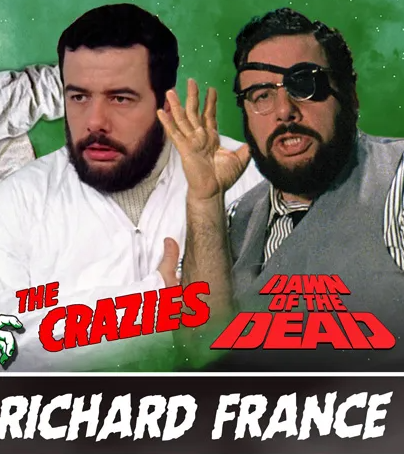
“Oh Gentlemen, we are not dealing with the flu virus here.” The most sympathetic character in The Crazies is played by the same actor who did the best background character in Dawn of the Dead.
In The Crazies, a bioengineered virus by the Department of Defense is accidentally released due to a plane crash over a town north of Pittsburgh. The virus, codenamed Trixie, drives people into violent and irrational fits of behavior making them murderous and/or suicidal. The town is already half descended into chaos by the time the army arrives and begins setting up a quarantine. The initial response was badly bungled due to the need for secrecy, and just when the state forces are beginning to start fixing the situation the people begin revolting. As scientists are given the correct amount of leeway to do real work, the bungled edifice around them crumbles at the moment when it can do some good. The damage is done, a heavy handed government response is too deadly and the people no longer believe nor seek to obey state decrees as too many have been killed or detained.
And here is where the most interesting part of the film comes to play. Unlike the Dead Trilogy, there is no way to tell who is infected with Trixie and who is merely reacting due to stress and mass panic from societal breakdown. The movie shows us multiple massacres and gunfights between the army and the citizens where it is entirely unclear if anyone is even infected with the virus at all. The main band of townies we follow is entirely sympathetic when we see them storm an army occupied house and massacre the soldiers there. But when it becomes obvious part of their party is infected we also see that the main military figures we are following are also sympathetic as the existence of the virus is in fact quite real.
Meanwhile, the monotonous military drum roll music that provides most of the film’s soundtrack goes from annoying but perhaps reassuring and authoritative to increasingly farcical as the entire setting and containment operation collapse under multiple factors of bureaucratic clashes and incompetence. Additionally, the use of amateur actors and locally recruited extras (a common in Romero films) is actually a boon as real life people in a crisis behave like amateurs and not actors with prescribed roles. The heroic Dr. Watts, played by the memorable Richard France, is too rushed to tell his aide the details of the vaccine he is developing and then, right as he completes his task successfully, is caught up in a stampede of detained townies and killed in the resulting mob rush, his work lost. The last surviving rebel local that we followed is finally captured after everyone he sought to escape with has been (rightly or wrongly) killed. It is clear he has natural immunity and even knows it, but he elects to stay silent out of spite once under government custody. Whether this situation is handled well considering the its chaotic and unprecedented nature becomes irrelevant as a new outbreak is reported in Louisville.
This leaves us with some important questions: Did the virus only effect a few people and the rest was all resulting panic? Who was really infected and who wasn’t then? These questions are never answered. It is worth noting that the 2010 Crazies remake, while not a meatheaded disaster like the 2004 Dawn of the Dead remake was, makes it obvious who is infected and who is not, which fundamentally undermines the core ambiguity of the original film.
Once again, like in Dawn of the Dead, Romero’s filmmaking is an intense and personal-to-small group view into societal breakdown while, like in real life, feeding incomplete information from rumor, hearsay, and a dysfunctional media. Romero was no fan of unrestrained capitalism or the carceral state, and I can’t help but think he, along with other later-tier Silent Generation directors and writers, saw something in the coming Boomer zeitgeist that would lead to only the most farcical of societal breakdowns. A plague of mullets and hideously colored clothing and interior decor that would usher in a chaotic new dark age of misinformation, confusion, and mass panic.
This is going to be a brief and unstructured post as I have a vaccine-breakthrough case of Covid-19 and thus am not at the height of my mental faculties.
But while I linger here in inglorious self-isolation, I have been reading the collected philosophy of Baruch Spinoza. I am not finished yet and I do not mean to give a comprehensive take, but it is worth mentioning that I came to this task via a book I recently read for work that compared and contrasted various historical definitions of the concept of sovereignty. I knew Spinoza by some philosophical concepts but had no idea that he was a thinker on such relevant (to my interest) political concepts. The ideas that I read about in that book made me want to know more.
Spinoza is most famous today for his metaphysics and his radically materialist concept of a pantheistic god, rather than a spiritualist and religious one. This interests me much less than his politics here, but serves as a fascinating example of materialist thinking in a deeply spiritual age. He comes across as similar to an early Tantric thinker with elements of Vedanta philosophy but in a 17th Century Dutch context. His god, such as it can be called such, is really a combination of the will of energy serving as the connective force for all of matter. To Spinoza, this matter is the same everywhere and thus the creative energy may as well be ‘god’ because this is the only way things may happen by forcing change and interaction. Of course, we know now through the hard sciences that matter can indeed change its nature in many circumstances and that it can be converted into energy. This punctures his need for the god language, but was information that was unavailable to him in the time of his life. Therefore, we get an interesting example of a fully materialist god with the characteristics of the theology of the Dharmic religions. Good and evil are pointless, as is faith. The majesty of being leaves no use for the simple moralism of man. And it is the simple moralism of man that the Abrahamic faiths, of course, hold as supreme.
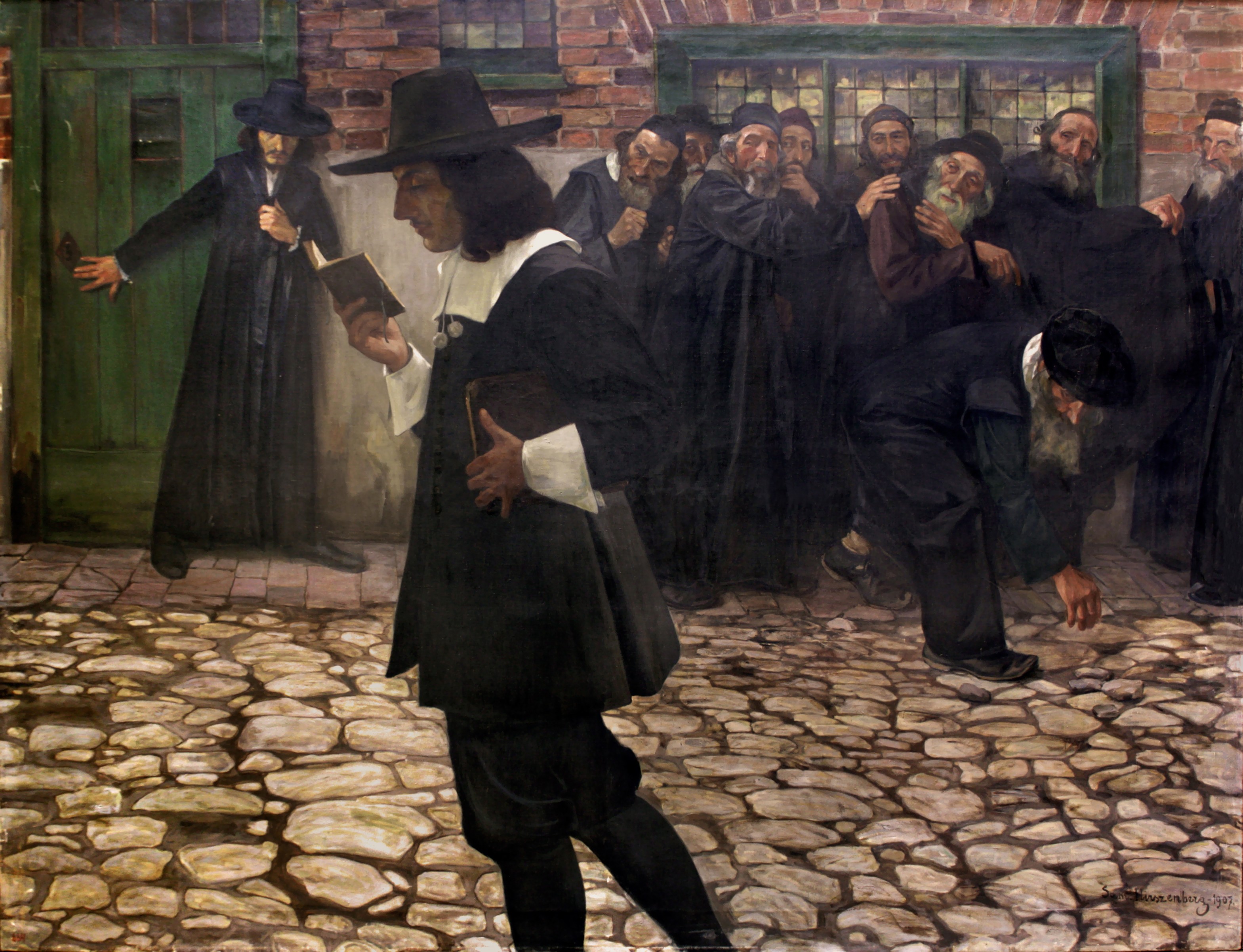
No wonder Spinoza’s Jewish community in Amsterdam excommunicated him. Then so did the Protestant Dutch municipals of that city. After death, his writings would be banned by the Catholic Church. Cancelled by three different religions, now that’s a guy I can respect! He would never end up joining any faith community again and lived the rest of his life as a private tutor and lens grinder, apparently content and with his own circle of friends from many outlier communities. Honestly, he sounds like a cool dude.
While his attack on the specifics of the Abrahamic God, (a being much more like Miura’s Idea of Evil than Spinoza’s omni-nature) and his creation of a deterministic world view of moderation and autonomy in service of living with nature while also exploring it would be his most famous contribution, what I really find interesting in his political philosophy.
Spinoza is an extremely interesting contemporary and counter-point to Thomas Hobbes. Both believed in the ultimate sovereignty of the state as the enabler of human thriving, particularly in societies that had grown large enough to have dense populations. Both sought state control over religion to quash sectarianism and outside societies interfering in domestic affairs. Both looked down on violent rebellion but left themselves each specific escape clauses when the situation became dire. Both, most interesting to me, upheld the right of different countries to have different political systems based in their own culture and untampered with by the designs of others…even if their personal preferences were for different kinds of systems. Both were aware of one another and Spinoza at least read Hobbes’ work.
The differences are more interesting, however. Whereas both Spinoza and Hobbes saw a strong state as the most effective way for maximizing human flourishing, Spinoza emphasized the state’s capacity to uphold freedom of thought, religion, and the press whereas Hobbes viewed such things as potential dangers to the state. Hobbes also sought a centralized state whereas Spinoza sought a more decentralized one, where the dynamic tension of regions and their differences sparked an engaged citizen-culture that would, over all, actually strengthen the state against outsiders. Hobbes’ personal preference for monarchy also contrasts with Spinoza’s personal preference for republics. But both, I will re-iterate, did not believe there was one universal best form of government for all places and peoples. In fact, Spinoza was insistent that a political system will always be regionally and situationally unique. He was also even more of a realist than Hobbes when it came to social contracts, finding that power, not safety, was the true ultimate determinator in who got what. And that power came not from ideas, but by living within nature and understanding it enough to get the most out of it.
Here we have a thinker who denies progress, teleology, and idealism for a fully deterministic and materialist world view, yet comes to support freedom of the press and secularism in service of a republican civic virtue. Is Spinoza a liberal with all the stupid bits cut out? Or a realist with a modern sense of nuance lacking in Hobbes? Or both? Nevertheless, you can see why I am interested in him.
To create an artificial binary here, I am probably more personally close to Spinoza’s world view than that of Hobbes. However, I will maintain that so long as certain caveats such as adding economic security to the Hobbesian bargain are done, that Hobbes might still be the more relevant thinker on sovereignty for much of the world. Why? Because the dynamic tension of Spinoza is often preferable but too dangerous to work in fragile or besieged societies. A very strong and secure society can afford a level of decentralized experimentation, but a weak one cannot. Hobbes wrote in the aftermath of an apocalyptic war and its resulting fanaticisms in his home country. Spinoza wrote exposed to fanaticism as all in 17th Century Europe would have been, hence his desire to relocate from region to region to avoid antagonists, but also in a society at its financial and military peak. The Dutch Republic was in a far stronger place than England in that period. It could afford to be experimental. The British would only shift to a more mixed political system once they pulled ahead of the European pack.
We see this today in the world’s conflict zones. Embattled states either fail or become more Hobbesian to avoid failure. And so, as I am want to do, let us bring in Ibn Khaldun to add a third corollary here: the passage of time matters. Personal bonds create a new ruling elite, the ruling elite, if successful, creates a Hobbesian (or Chinese Legalist or whatever) state focused on survival and establishing itself as the dominant force in a territorial unit. Then, the Hobbesian state can (and possibly should) morph into a Spinozan state, strengthening itself by more fully integrating its citizens into its body and allowing dynamism to survive the loss of the original solidarity provided by security needs. The cycle will eventually repeat itself again, of course, but the transition to a Spinozan state could delay the inevitable decline in the final phase, meaning while upheaval is still inevitable, it is less common. This is not to ignore, of course, that a state could go from a Spinozan position to a Hobbesian one as a matter of necessity due to security concerns and internal division. Indeed, this is to be expected as well. But if the state survived the crisis by doing this, it could always pivot back to the Spinozan position once things clamed down.
And now, because that is the most effort I have been able to put into anything for the last couple days, let me leave you with a Spinoza quote that I think sums up both his metaphysical and his political views quite well:
‘Whenever then anything in nature seems to us ridiculous, absurd or evil, it is because we have only a partial knowledge of things, and are in the main ignorant of the order and coherence of the whole, and because we want everything to be arranged according to the dictates of our own reason; Although in fact what our reason pronounces is bad is not bad in regards to the order of laws of universal nature, but only in regards to the laws of our own nature taken separately.’